Qualified Trust Form Caps Contract With The Government
Description

Get your form ready online
Our built-in tools help you complete, sign, share, and store your documents in one place.
Make edits, fill in missing information, and update formatting in US Legal Forms—just like you would in MS Word.
Download a copy, print it, send it by email, or mail it via USPS—whatever works best for your next step.
Sign and collect signatures with our SignNow integration. Send to multiple recipients, set reminders, and more. Go Premium to unlock E-Sign.
If this form requires notarization, complete it online through a secure video call—no need to meet a notary in person or wait for an appointment.
We protect your documents and personal data by following strict security and privacy standards.

Make edits, fill in missing information, and update formatting in US Legal Forms—just like you would in MS Word.

Download a copy, print it, send it by email, or mail it via USPS—whatever works best for your next step.

Sign and collect signatures with our SignNow integration. Send to multiple recipients, set reminders, and more. Go Premium to unlock E-Sign.

If this form requires notarization, complete it online through a secure video call—no need to meet a notary in person or wait for an appointment.

We protect your documents and personal data by following strict security and privacy standards.
Looking for another form?

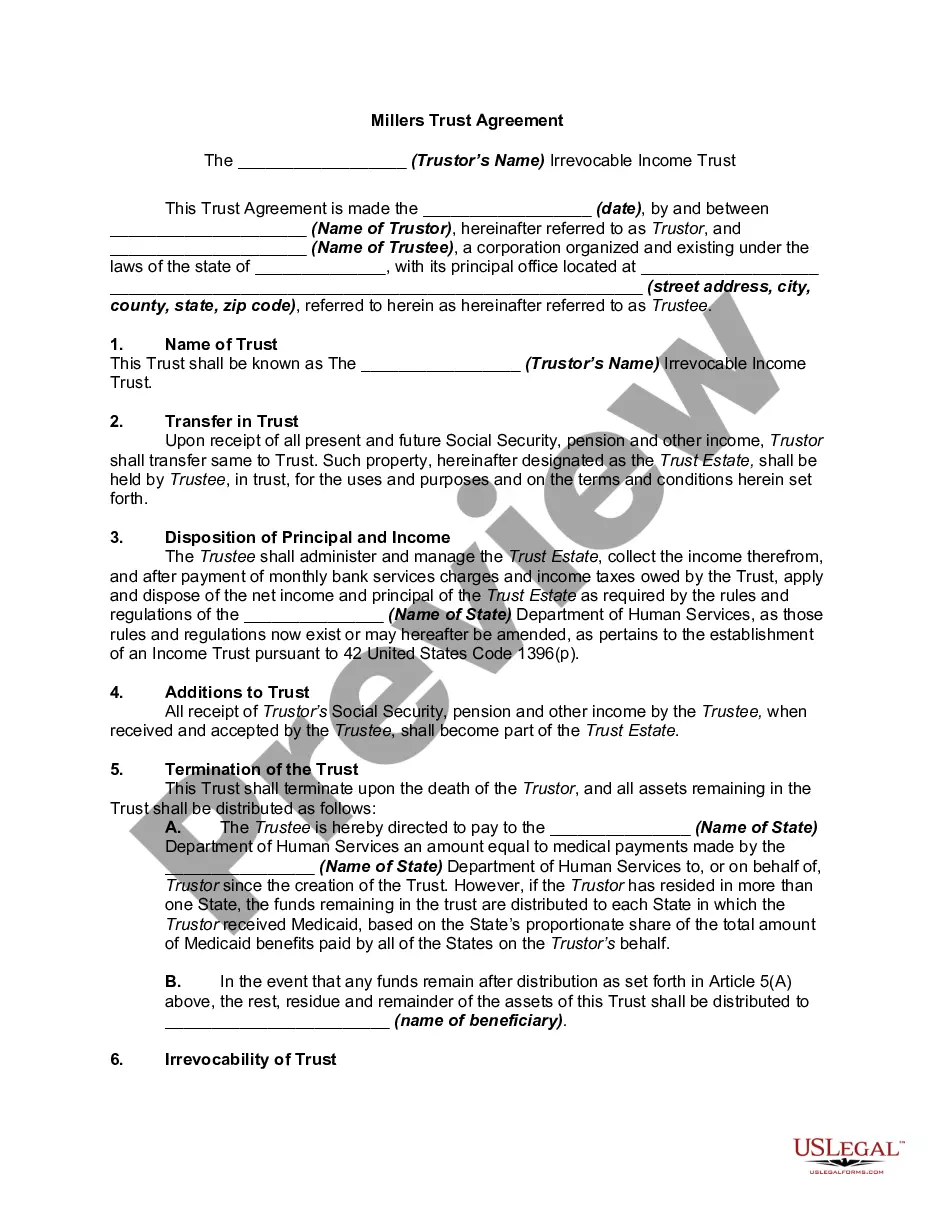
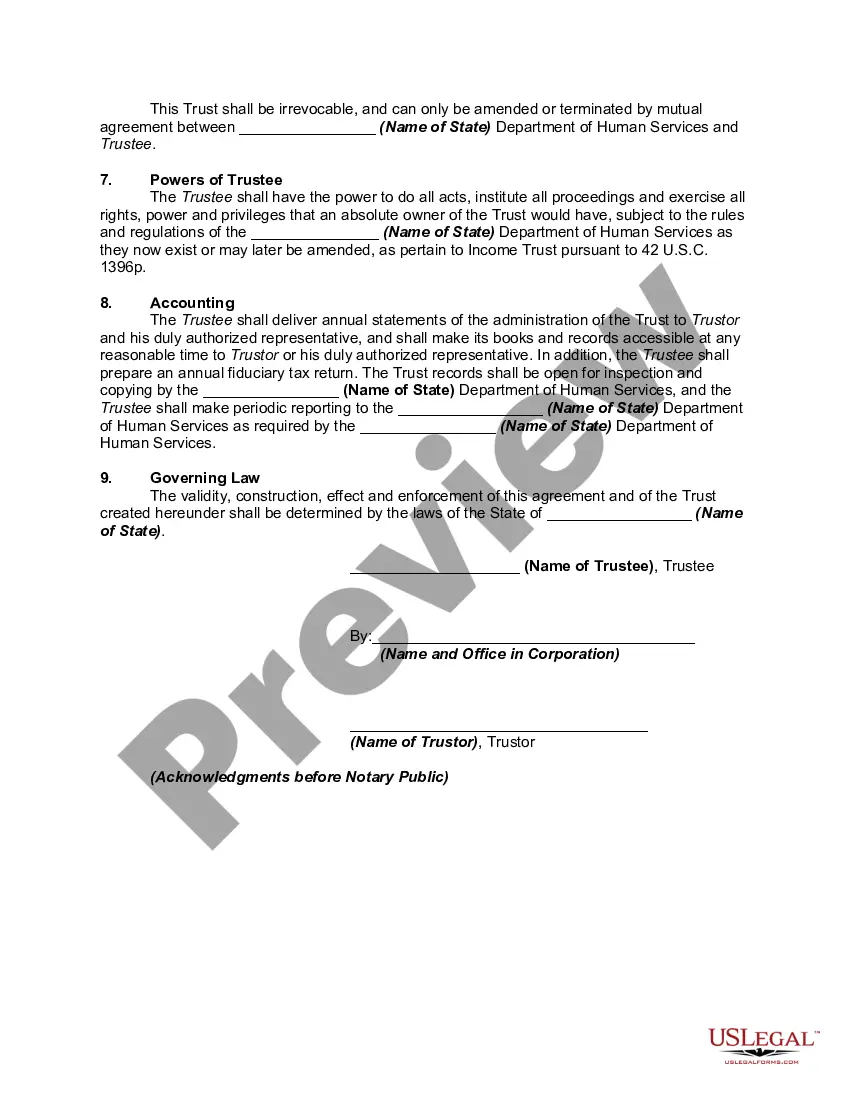
How to fill out Qualified Income Miller Trust?
- If you're a returning user, log in to your account and select the appropriate form template to download directly to your device. Ensure that your subscription is currently active; if not, renew it as needed.
- For first-time users, begin by reviewing the available document in Preview mode. Verify that it aligns with your requirements and complies with your local jurisdiction.
- If necessary, utilize the Search tab to locate an alternative template that suits your needs better.
- Once you find the correct document, click on the Buy Now button and select your preferred subscription plan. You will need to create an account to gain full access to the form library.
- Complete your purchase by entering your credit card information or opting for PayPal payment.
- After your transaction, download the form to your device. You can also access it anytime from the My Forms section of your profile.
US Legal Forms empowers individuals and attorneys to speedily prepare legal documents with a user-friendly library, ensuring that you can find and complete your forms accurately.
Start your legal journey today by accessing US Legal Forms and gain confidence in handling your legal documents. Don't wait; get started now!
Form popularity
FAQ
A Qualified Income Trust (QIT) allows individuals to meet specific income limits set by the government to qualify for benefits. By establishing a QIT, you can deposit excess income into this trust, which then makes you eligible for necessary assistance programs. This mechanism effectively shelters income, ensuring you can access crucial services. Consequently, a properly structured Qualified trust form caps contract with the government helps in maximizing financial support.
The main purpose of a QIT is to allow individuals to qualify for Medicaid while managing their income. It helps maintain financial stability by sheltering excess income from Medicaid calculations. Utilizing a Qualified trust form caps contract with the government can significantly enhance your financial strategy and support your long-term healthcare needs.
A QIT document is a legal instrument that outlines the structure and purpose of a Qualified Income Trust. This document includes details like the income limits, beneficiaries, and terms of the trust. By having a solid QIT document, you can ensure compliance with Medicaid rules and improve your financial standing through the Qualified trust form caps contract with the government.
Setting up a QIT involves identifying a financial institution that allows for such accounts. Complete the Qualified trust form caps contract with the government by outlining how the trust will be administered and what funds it will hold. You may also consider consulting with a legal expert to ensure that the setup meets all required regulations.
To open a QIT account for Medicaid, you first need to gather pertinent financial documents, including proof of income. Next, complete the necessary application forms, which should include the Qualified trust form caps contract with the government. Once approved, the trust will help you meet your income requirements while retaining your assets.
QIT stands for Qualified Income Trust. This trust is a financial arrangement that allows individuals to manage their income while meeting Medicaid eligibility requirements. By using a Qualified trust form caps contract with the government, you can effectively protect your assets and benefit from essential healthcare services.
In New Jersey, a Qualified Income Trust works by allowing individuals to qualify for Medicaid while receiving income. The qualified trust form caps contract with the government ensures that excess income is directed into the trust, making the individual eligible for assistance. Funds within the trust can only be used for specific expenses, and maintaining accurate records is crucial for compliance with state requirements.
Setting up a QIT account involves a few straightforward steps. First, you must choose a financial institution that offers trust management services tailored to your needs. Then, complete the trust forms, ensuring they align with the qualified trust form caps contract with the government. Once the account is established, manage contributions carefully to maintain compliance with applicable regulations.
To set up a Qualified Income Trust (QIT), also known as a qualified trust form caps contract with the government, you need to follow a structured approach. Start by gathering all required documentation, including proof of income and identity. Next, complete the necessary forms to establish the trust, ensuring they meet state-specific requirements. Finally, fund the trust to enable eligibility for state assistance programs.
Taxpayers with significant net investment income, who exceed income thresholds, are required to file Form 8960. This obligation is crucial for those who want to ensure compliance with tax laws. If you hold a Qualified trust form caps contract with the government, be aware of how Form 8960 might affect your overall tax strategy.