Property Auction In London
Description

Get your form ready online
Our built-in tools help you complete, sign, share, and store your documents in one place.
Make edits, fill in missing information, and update formatting in US Legal Forms—just like you would in MS Word.
Download a copy, print it, send it by email, or mail it via USPS—whatever works best for your next step.
Sign and collect signatures with our SignNow integration. Send to multiple recipients, set reminders, and more. Go Premium to unlock E-Sign.
If this form requires notarization, complete it online through a secure video call—no need to meet a notary in person or wait for an appointment.
We protect your documents and personal data by following strict security and privacy standards.

Make edits, fill in missing information, and update formatting in US Legal Forms—just like you would in MS Word.

Download a copy, print it, send it by email, or mail it via USPS—whatever works best for your next step.

Sign and collect signatures with our SignNow integration. Send to multiple recipients, set reminders, and more. Go Premium to unlock E-Sign.

If this form requires notarization, complete it online through a secure video call—no need to meet a notary in person or wait for an appointment.

We protect your documents and personal data by following strict security and privacy standards.
Looking for another form?









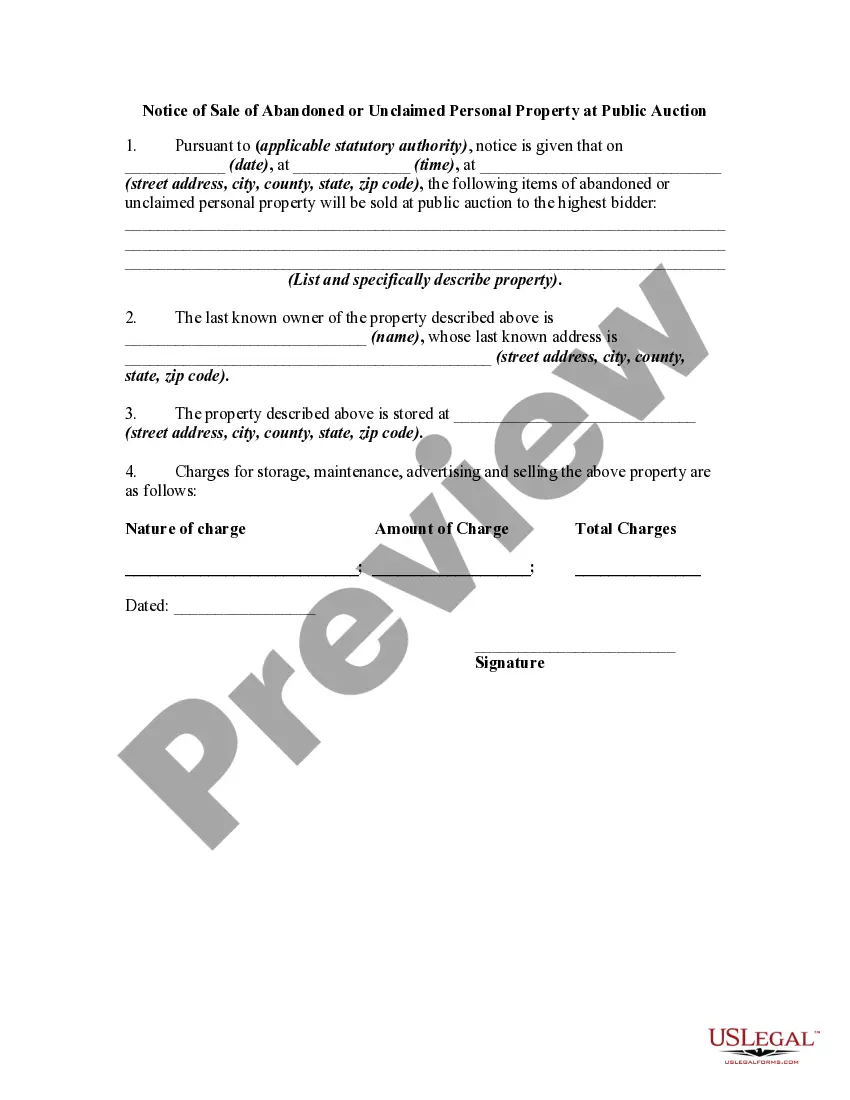
How to fill out Notice Of Sale Of Abandoned Or Unclaimed Personal Property At Public Auction - Abandonment?
Obtaining legal templates that adhere to federal and state regulations is essential, and the internet provides numerous choices.
However, why spend time searching for the appropriate Property Auction In London template online when the US Legal Forms digital library already consolidates such documents in one location.
US Legal Forms stands as the largest online legal repository housing over 85,000 customizable templates created by attorneys for various professional and personal scenarios.
Review the template using the Preview feature or through the text description to confirm it meets your requirements.
- They are straightforward to navigate with all forms categorized by state and intended use.
- Our experts stay informed about legislative changes, ensuring that your document is current and compliant when obtaining a Property Auction In London from our platform.
- Acquiring a Property Auction In London is quick and uncomplicated for both existing and new users.
- If you already have an account with an active subscription, Log In and retrieve the document template you need in the appropriate format.
- If you are new to our site, follow the steps outlined below.
Form popularity
FAQ
Property auctions in the UK typically involve listing properties for sale through an auction house, where buyers can place bids. Each auction has a set date and time, and buyers must register beforehand. The highest bidder at the close of the auction wins the property, often requiring a deposit immediately. Understanding this process can empower you as you navigate the property auction in London.
The 3 minute rule in auction refers to a guideline ensuring that bidding remains open for at least three minutes after the last bid. This rule helps to give potential buyers a fair chance to place their bids without feeling rushed. When participating in a property auction in London, understanding this rule can enhance your bidding strategy and improve your chances of securing a property.
To buy auction property in London, start by researching upcoming auctions and the properties listed. Register with the auction house and review the terms and conditions. It’s wise to arrange financing in advance and conduct thorough inspections of properties. When you find a property you like, be prepared to bid confidently during the auction.
The 10 minute rule at a property auction in London refers to a time limit set on bidding for a specific lot. If no new bids are placed within ten minutes, the auctioneer typically closes bidding for that property. This rule helps maintain a brisk pace during auctions, ensuring that buyers remain engaged and that properties are sold efficiently. Understanding this rule can help you strategize your bidding approach.
To buy a property at auction in London, start by researching upcoming auctions and reviewing the auction catalog. It’s crucial to visit the properties you are interested in and conduct thorough due diligence. Once you find a property, register for the auction and ensure you have finances in place. During the auction, place your bid confidently and remember to act quickly, as the bidding can escalate rapidly.
Property auctions in London allow buyers and sellers to come together in a competitive environment. Typically, properties are advertised prior to the auction, and buyers can inspect them before bidding. On auction day, interested buyers place bids, and the highest bid secures the property, often requiring a deposit on the spot. This process can be fast-paced and exciting, making it essential for buyers to be well-prepared.
Traditional auctions are usually held at an auction house. All interested buyers will be there and they'll place bids in front of each other. If you're the highest bidder, you exchange contracts and pay your deposit on the day of the auction.
Buying a property at auction is really simple If you would like to bid on a property you will need to register to bid prior to the date of the auction. The approval process may take a few days so please ensure that you give yourself enough time to register if you are interested in bidding on a property.
How does a property auction work? To purchase the property the bidder has to put a 10% deposit down to secure the sale. The sale will then be completed within a month, when the remaining 90% of the funds are transferred. At an auction, interested buyers will bid for your property and the highest bid wins the auction.
With an auction, there are set rules when it comes to buying a property. You usually need to pay 10% of the purchase price on the day and then complete the mortgage transaction within 28 days. If you fail to do this then your deposit is at risk.