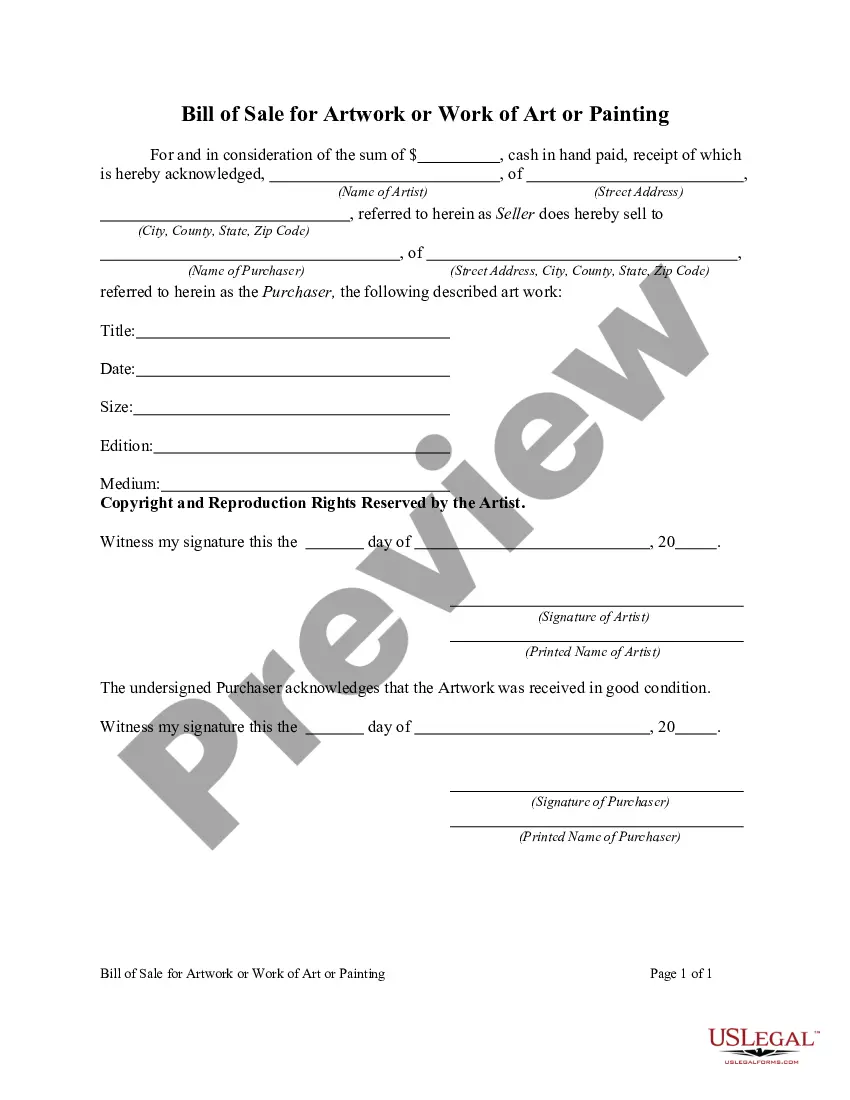
Bill Sale Art Sample For Job Application In Queens
Description
Get your form ready online
Our built-in tools help you complete, sign, share, and store your documents in one place.
Make edits, fill in missing information, and update formatting in US Legal Forms—just like you would in MS Word.
Download a copy, print it, send it by email, or mail it via USPS—whatever works best for your next step.
Sign and collect signatures with our SignNow integration. Send to multiple recipients, set reminders, and more. Go Premium to unlock E-Sign.
If this form requires notarization, complete it online through a secure video call—no need to meet a notary in person or wait for an appointment.
We protect your documents and personal data by following strict security and privacy standards.

Make edits, fill in missing information, and update formatting in US Legal Forms—just like you would in MS Word.

Download a copy, print it, send it by email, or mail it via USPS—whatever works best for your next step.

Sign and collect signatures with our SignNow integration. Send to multiple recipients, set reminders, and more. Go Premium to unlock E-Sign.

If this form requires notarization, complete it online through a secure video call—no need to meet a notary in person or wait for an appointment.

We protect your documents and personal data by following strict security and privacy standards.
Looking for another form?







Form popularity
FAQ
If you decide that making contact is a good idea, addressing them by name is a great way to start. If you don't know their name, find out. Begin by talking about them, not you. If you think they might like your art, briefly explain why you think so and how you reached that conclusion.
The best way to sell art online is by building your own branded ecommerce site with a platform like Shopify. You can also sell your work on a crafts and art marketplace like Etsy or on social media platforms like Instagram and Facebook Shops.
The rule of thirds is a guideline commonly used in painting, photography, and design. The rule of thirds means that the subject isn't centered; rather, the main focal point can be to one side or at the top or bottom of the image.
Art consultants can be excellent sources for connecting to decision makers in the corporate market (and they will typically take 50% of the sale as their commission) but artists can reach out to potential buyers directly, too. Bacca suggests Call for Entry as a good source of leads for this type of sale.
So, how do you sell your art locally? The answer lies in leveraging local networks, participating in community events, and embracing the power of word of mouth. Artists can explore setting up booths at local art fairs, markets, and exhibitions, or partner with local businesses and galleries to display their work.
Finding Corporate Prospects Contact companies that already own your work to find out if they are expanding in size or building new offices. Contact architects and interior designers who have new corporate clients. Ask your artist friends who have sold their art to corporations how they did it.
Public art is everywhere and has been around for centuries. Greek cities were early advocates of religious and social art (predominantly sculpture), that was viewed and appreciated by the community at large. A supreme example of public art in Ancient Greece is the Parthenon (c. 447-422 BCE) on the Acropolis at Athens.
Ready to Exhibit Your Art? Here Are Steps You Can Take Try a home show and invite your friends. Connect with a local business and see if they might be interested in hanging your work in their establishment. Get together with a few other artists and rent a space for your exhibition. Enter juried exhibitions.