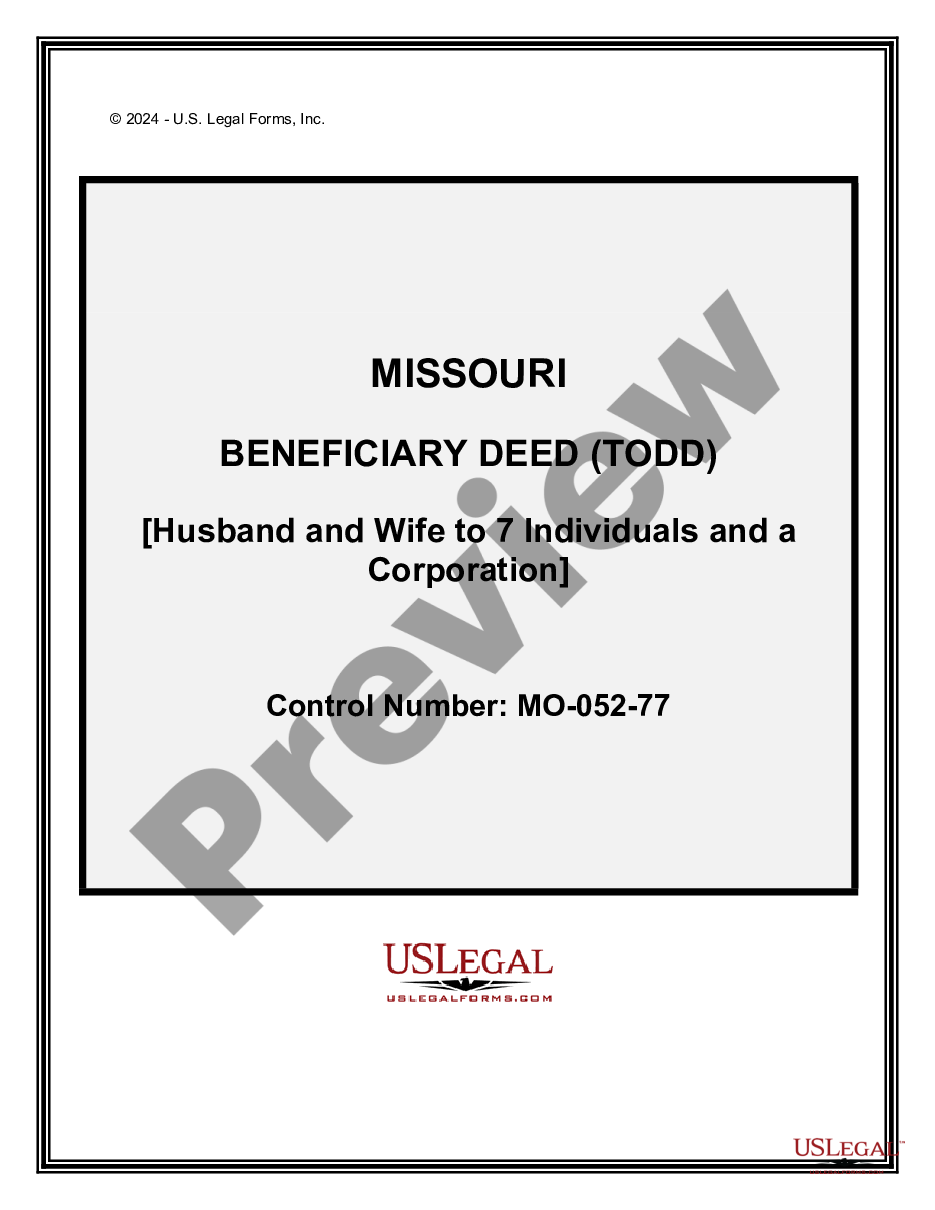
Missouri Transfer on Death Deed or TOD - Beneficiary Deed for Husband and Wife to Seven Individual Beneficiaries and a Corporate Beneficiary
What is this form?
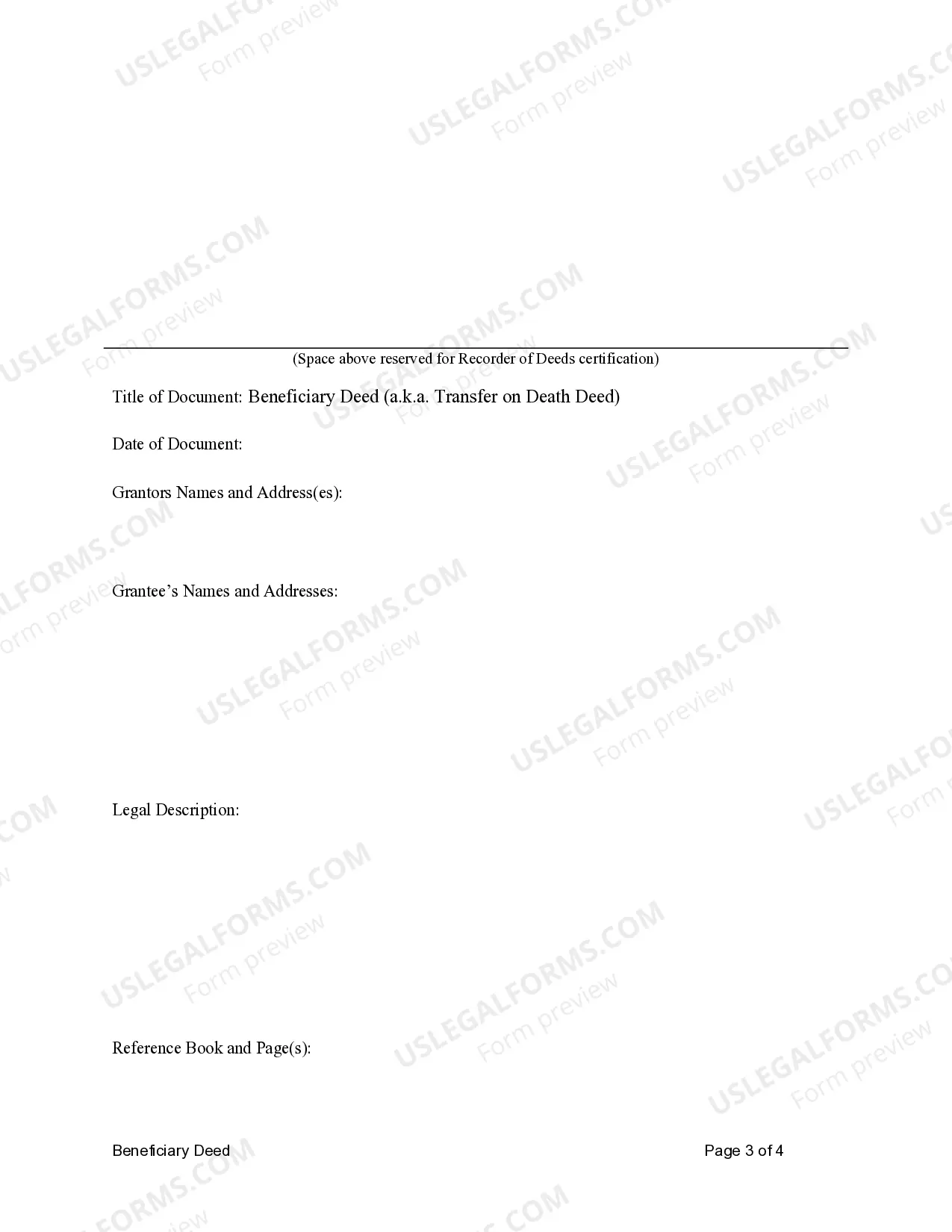
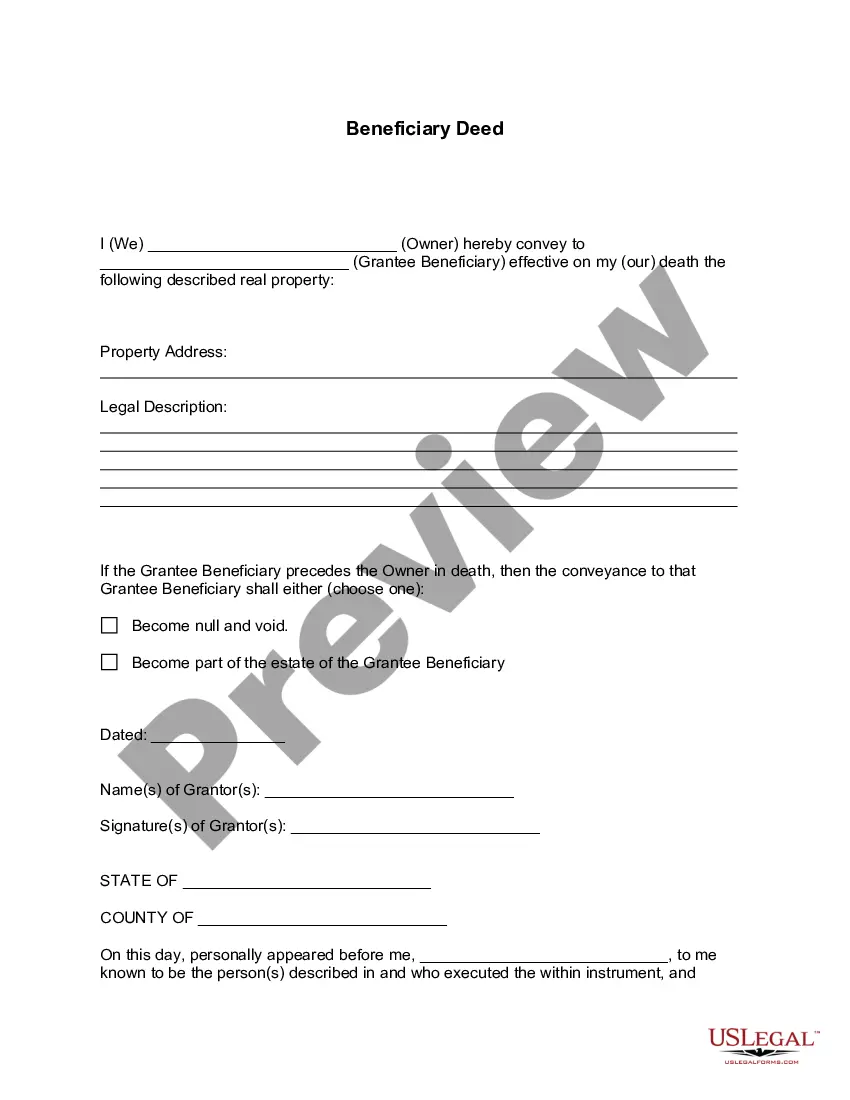
The Transfer on Death Deed, or TOD Beneficiary Deed for Husband and Wife, is a legal document that allows property owners, specifically a husband and wife, to designate beneficiaries who will receive their property upon their death. This deed is revocable during the lifetime of the owners and activates only after the death of the last surviving owner. It differs from a traditional will as it allows for immediate transfer of property without the need for probate, providing a straightforward way for property owners to manage their estate planning.
Key components of this form
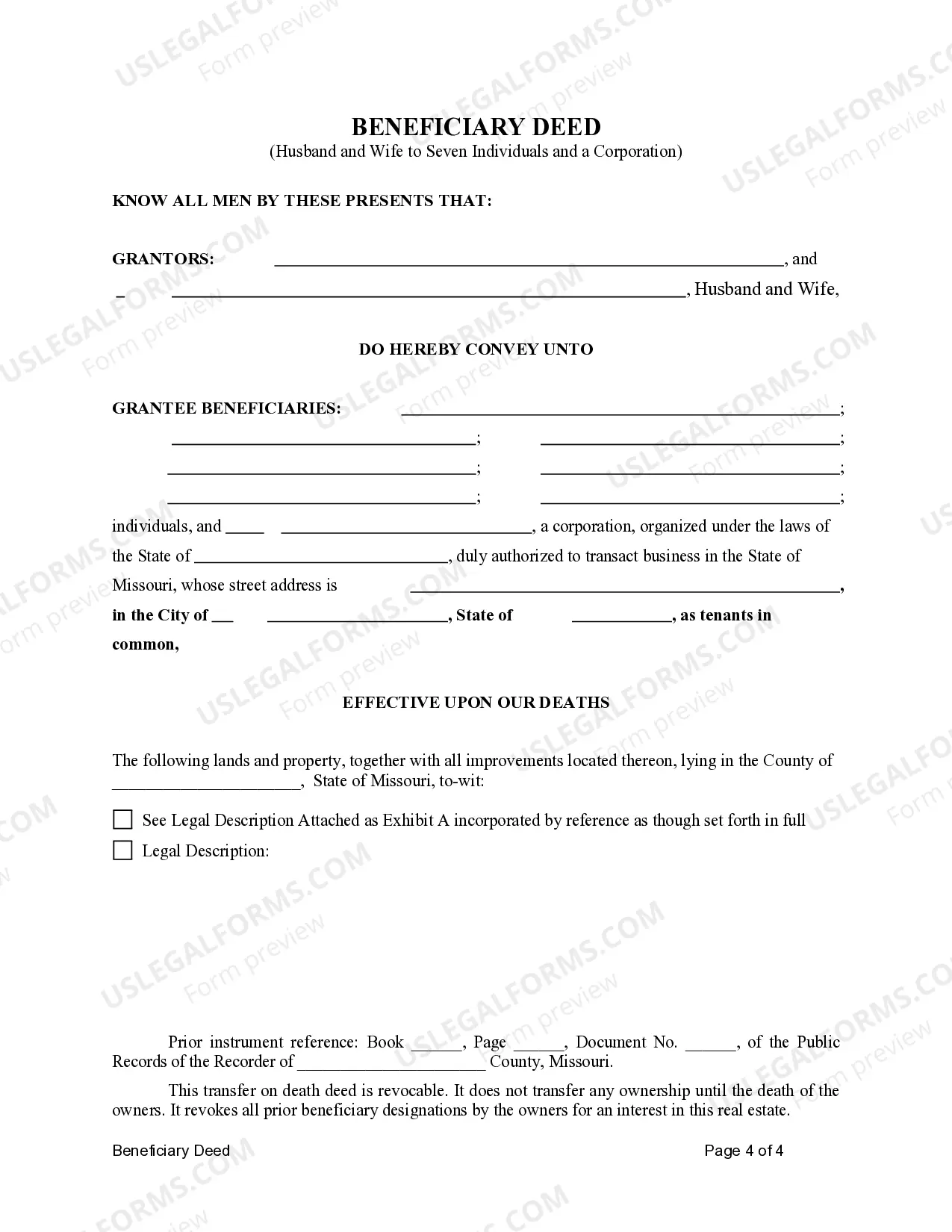
- Identification of the Grantors (husband and wife).
- Designated beneficiaries, including seven individuals and one corporate entity.
- Revocation clause allowing either Grantor to change the deed during their lifetime.
- Tax implications and rights of survivorship details.
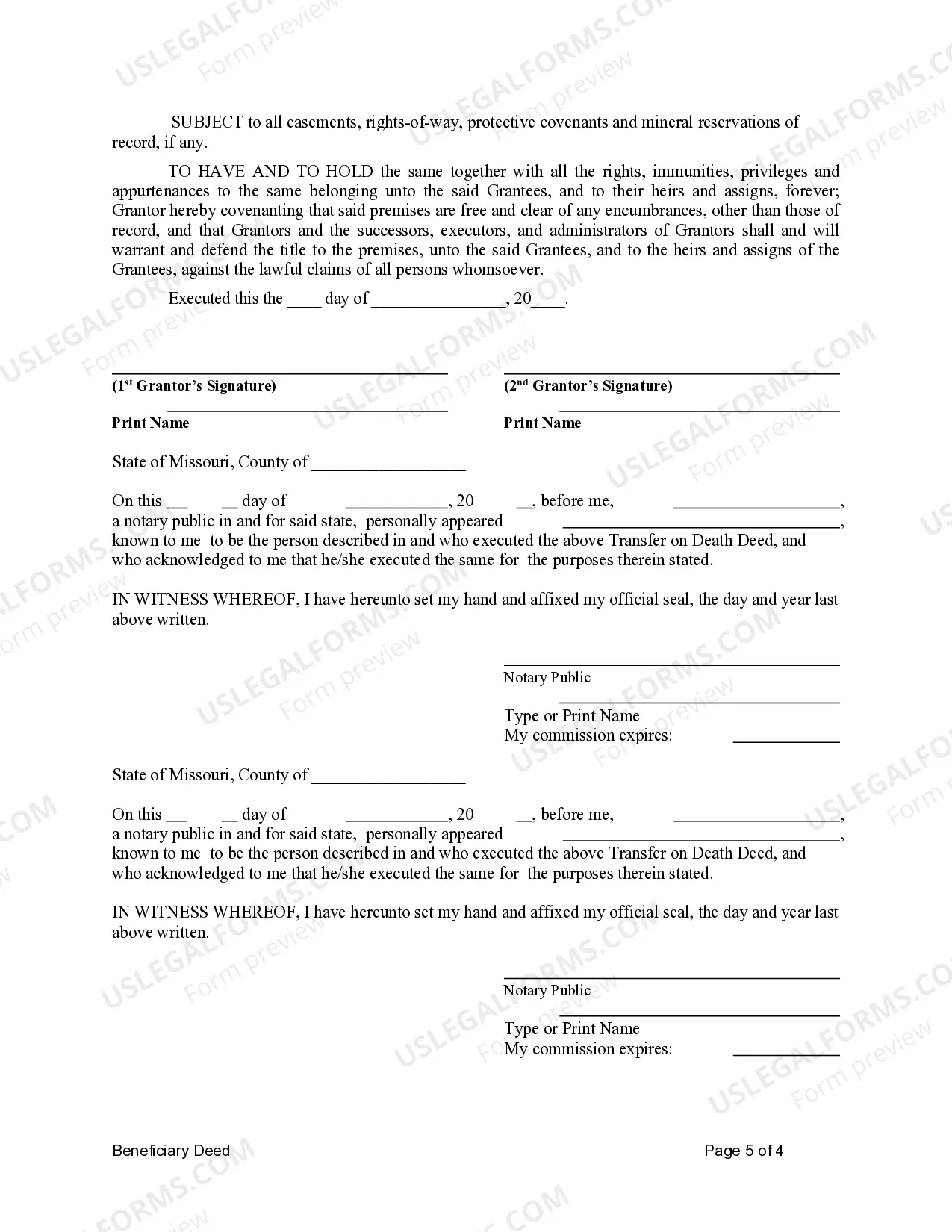
- Notarization requirement for legal validity.


When this form is needed
This form should be used when a couple wants to leave their property to specific individuals or a corporation upon their death without the hassles of probate. It is especially beneficial for estate planning when multiple beneficiaries are involved. Use this deed if you want to ensure a smooth transition of property ownership while retaining control over the property during your lifetime.
Intended users of this form
- Couples (husband and wife) wishing to transfer their property to designated beneficiaries after death.
- Property owners who want a revocable and simple estate plan.
- Individuals with a preference for handling inheritance outside the probate process.
Steps to complete this form
- Identify the Grantors by entering the full names of the husband and wife.
- List the names of the seven individual beneficiaries and the corporate beneficiary.
- Specify the property address and legal description of the real estate being transferred.
- Include dates and signatures of the Grantors where indicated.
- Have the document notarized to ensure its legal validity.
Is notarization required?
To make this form legally binding, it must be notarized. Our online notarization service, powered by Notarize, lets you verify and sign documents remotely through an encrypted video session.
Get your form ready online
Our built-in tools help you complete, sign, share, and store your documents in one place.
Make edits, fill in missing information, and update formatting in US Legal Forms—just like you would in MS Word.
Download a copy, print it, send it by email, or mail it via USPS—whatever works best for your next step.
Sign and collect signatures with our SignNow integration. Send to multiple recipients, set reminders, and more. Go Premium to unlock E-Sign.
If this form requires notarization, complete it online through a secure video call—no need to meet a notary in person or wait for an appointment.
We protect your documents and personal data by following strict security and privacy standards.

Make edits, fill in missing information, and update formatting in US Legal Forms—just like you would in MS Word.

Download a copy, print it, send it by email, or mail it via USPS—whatever works best for your next step.

Sign and collect signatures with our SignNow integration. Send to multiple recipients, set reminders, and more. Go Premium to unlock E-Sign.

If this form requires notarization, complete it online through a secure video call—no need to meet a notary in person or wait for an appointment.

We protect your documents and personal data by following strict security and privacy standards.
Common mistakes to avoid
- Failing to include all required signatures and notarial acknowledgment.
- Listing incorrect or incomplete beneficiary names.
- Assuming the deed takes effect during the Grantors' lifetime.
- Neglecting to review and possibly revoke prior beneficiary designations.
Advantages of online completion
- Immediate access to a legally drafted form provided by licensed attorneys.
- Convenience of completing the form digitally from home.
- Editability allows for easy adjustments before finalizing.
- Secure download ensures safe storage of important documents.
Main things to remember
- This form allows for a smooth transition of property ownership upon death for married couples.
- It is revocable and remains in effect only after the death of the last surviving Grantor.
- Complete the form accurately and ensure notarization for legal validity.
Looking for another form?

Form popularity
FAQ
The TOD rule in Missouri allows property owners to transfer their property to designated beneficiaries upon their death without going through probate. This rule is particularly beneficial as it simplifies the transfer process and can help avoid delays. With a Missouri Transfer on Death Deed or TOD - Beneficiary Deed for Husband and Wife to Seven Individual Beneficiaries and a Corporate Beneficiary, you can designate multiple beneficiaries easily. Understanding this rule can help you make informed decisions about your estate planning.
To fill out a transfer on death deed form, you will need to include your personal details, the legal description of the property, and the designated beneficiaries. It’s important to state that the deed is a transfer on death deed clearly. After completing the form, don't forget to sign it in front of a notary. Utilizing resources from platforms like uslegalforms can simplify this process and ensure all necessary steps are followed correctly.
Filling out a Missouri beneficiary deed form requires clear identification of the property and the beneficiaries. Start by providing your name, the property's legal description, and the names of the beneficiaries. Ensure that the form is signed and notarized to make it valid. You can find user-friendly resources on platforms like uslegalforms to guide you through the process smoothly.
Using a Missouri Transfer on Death Deed or TOD - Beneficiary Deed for Husband and Wife to Seven Individual Beneficiaries and a Corporate Beneficiary can have some disadvantages. For instance, the transfer only occurs upon death, meaning property management during your lifetime remains unchanged. Additionally, if you have debts, creditors may still seek claims against the property. Therefore, it’s essential to consider your entire estate plan before making this choice.
Yes, you can designate multiple beneficiaries on a Missouri Transfer on Death Deed or TOD - Beneficiary Deed for Husband and Wife to Seven Individual Beneficiaries and a Corporate Beneficiary. This flexibility allows you to distribute your property among different individuals and entities according to your wishes. By naming multiple beneficiaries, you ensure that your assets are divided in a way that reflects your intentions. If you need assistance with this process, uslegalforms can provide the necessary resources and templates to create your TOD deed effectively.
Perhaps the simplest way to avoid Probate is to utilize Missouri's Non-Probate Transfer Law. Simply put, Missouri (and many other states) allow you to designate beneficiaries to receive property or assets upon your death.
Get a Deed Form or Prepare Your Own. You can buy a state-specific TOD deed form for your state or type up your own document. Name the Beneficiary. Describe the Property. Sign the Deed. Record the Deed.
Get a Deed Form or Prepare Your Own. You can buy a state-specific TOD deed form for your state or type up your own document. Name the Beneficiary. Describe the Property. Sign the Deed. Record the Deed.
A beneficiary deed is generally used for avoidance of probate, although it may be used to remove a particular property from a probate estate.
The Beneficiary Deed transfers an owner's interest in real estate to named beneficiaries upon the owner's death without need for the probate process. This saves the family both the time and money associated with the Probate Process.