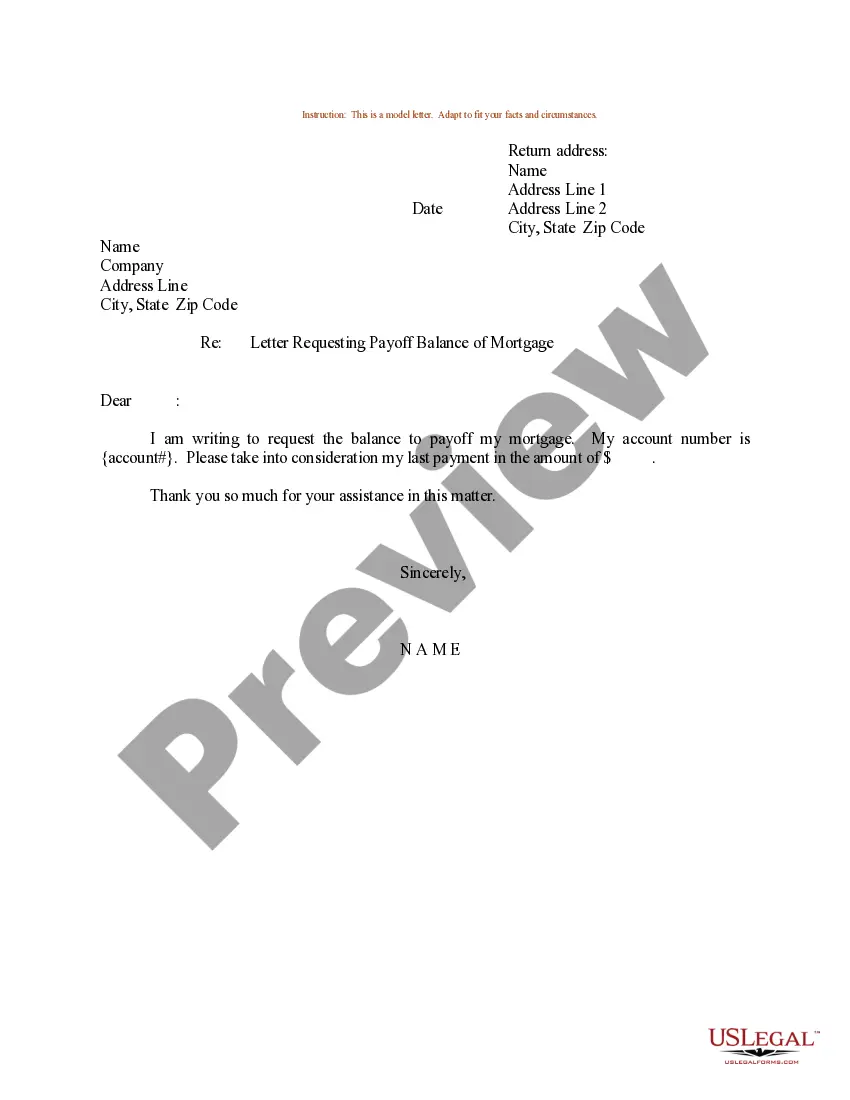
Loan Payoff Letter Sample With Payment In Hennepin
Description
Get your form ready online
Our built-in tools help you complete, sign, share, and store your documents in one place.
Make edits, fill in missing information, and update formatting in US Legal Forms—just like you would in MS Word.
Download a copy, print it, send it by email, or mail it via USPS—whatever works best for your next step.
Sign and collect signatures with our SignNow integration. Send to multiple recipients, set reminders, and more. Go Premium to unlock E-Sign.
If this form requires notarization, complete it online through a secure video call—no need to meet a notary in person or wait for an appointment.
We protect your documents and personal data by following strict security and privacy standards.

Make edits, fill in missing information, and update formatting in US Legal Forms—just like you would in MS Word.

Download a copy, print it, send it by email, or mail it via USPS—whatever works best for your next step.

Sign and collect signatures with our SignNow integration. Send to multiple recipients, set reminders, and more. Go Premium to unlock E-Sign.

If this form requires notarization, complete it online through a secure video call—no need to meet a notary in person or wait for an appointment.

We protect your documents and personal data by following strict security and privacy standards.
Looking for another form?






Form popularity
FAQ
How to File a Quitclaim Deed in Minnesota Step 1: Locate the Current Property Deed. Step 2: Find the Property's Legal Description. Step 3: Complete the Quitclaim Form. Step 4: Complete Disclosures. Step 5: Sign Before a Notary. Step 6: File the Deed With the County Recorder's Office.
How to File a Quitclaim Deed in Minnesota Step 1: Locate the Current Property Deed. Step 2: Find the Property's Legal Description. Step 3: Complete the Quitclaim Form. Step 4: Complete Disclosures. Step 5: Sign Before a Notary. Step 6: File the Deed With the County Recorder's Office.
A Minnesota Quitclaim Deed does not provide any of the statutory covenants of title which are provided by a Minnesota Warranty Deed. In addition, the interest conveyed by the grantor in a Minnesota Quitclaim Deed: is limited to that which the grantor held at the time of execution of the deed, and.
Per Minn. Stat. § 507.24. 2, a quitclaim deed must include the original signature of the grantor and an acknowledgment from a notary or other approved officer under Minn.
A: Yes, a quitclaim deed can protect you by getting the deed in your own name exclusively. This is possible through a divorce proceeding or your spouse can sign a quitclaim to relinquish his rights to the property. If the mortgage is in your spouse's name, it doesn't mean he has an ownership interest.
You may come into the Recorder's Office and look at the official plat, order a copy online by entering the name of the plat instead of the document number, search for the property on LandShark GIS, search/download the plat using LandShark online searching, or contact the Public Works Department at 651-213-8700.
If you default on your mortgage payments in Minnesota, the lender may foreclose using a judicial or nonjudicial method.
The sale is followed by a redemption period, which is usually six months. ingly, assuming there is no bankruptcy filing, a typical foreclosure by advertisement (including the typical six month redemption period) generally takes around eight to nine months.
