360 Feedback Examples For Leadership In Florida
Description

Get your form ready online
Our built-in tools help you complete, sign, share, and store your documents in one place.
Make edits, fill in missing information, and update formatting in US Legal Forms—just like you would in MS Word.
Download a copy, print it, send it by email, or mail it via USPS—whatever works best for your next step.
Sign and collect signatures with our SignNow integration. Send to multiple recipients, set reminders, and more. Go Premium to unlock E-Sign.
If this form requires notarization, complete it online through a secure video call—no need to meet a notary in person or wait for an appointment.
We protect your documents and personal data by following strict security and privacy standards.

Make edits, fill in missing information, and update formatting in US Legal Forms—just like you would in MS Word.

Download a copy, print it, send it by email, or mail it via USPS—whatever works best for your next step.

Sign and collect signatures with our SignNow integration. Send to multiple recipients, set reminders, and more. Go Premium to unlock E-Sign.

If this form requires notarization, complete it online through a secure video call—no need to meet a notary in person or wait for an appointment.

We protect your documents and personal data by following strict security and privacy standards.
Looking for another form?







Form popularity
FAQ
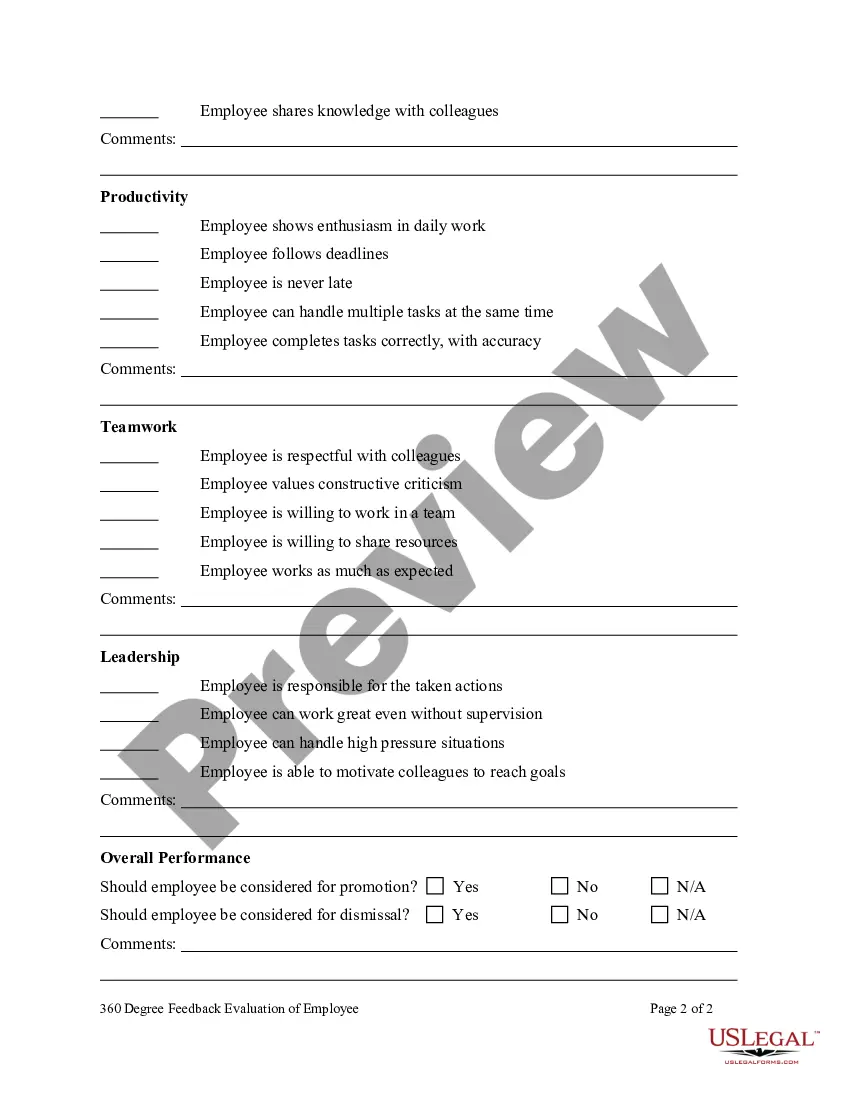
A 360 leadership assessment is a feedback tool for measuring a leader's skills, behaviours, and competencies. A 360 degree leadership review collects anonymous feedback about a leader from the people working most closely with them. These people may include direct reports, peers, customers, suppliers and managers.
“You consistently provide constructive, actionable feedback to your team.” “Your willingness to share your knowledge and expertise helps everyone grow.” “You have a unique ability to boost confidence and inspire others to improve.” “Your openness to learning from others, even while coaching them, is commendable.”
What should be included in 360-degree feedback? Communication skills. Interpersonal/soft skills. Collaboration and teamwork. Leadership and management capabilities. Innovation and creative abilities. Business goals/desired culture being lived out.
"You demonstrate strong leadership qualities by consistently guiding your team members towards achieving their goals." "Your ability to inspire and motivate your team contributes significantly to our team's overall success." "You've shown excellent leadership in managing projects, driving both process and results."
Start Positive: ``I really appreciate how you handled the recent project; your leadership was inspiring.'' Provide Constructive Feedback: ``I've noticed that during team meetings, some voices are not being heard as much. Perhaps we could encourage more participation from everyone.''
“I appreciate how you always listen to our ideas and encourage open communication within the team. It makes us feel valued and respected.” Highlighting this behaviour reinforces its positive impact on team morale.
Here are examples of positive leadership feedback: “I've been really impressed with the way you've fostered collaboration within the team. Your open communication style and active listening have created a work environment where everyone feels valued and heard.
However, one of the main challenges of implementing 360-degree feedback is ensuring confidentiality. Confidentiality is essential for creating trust, honesty, and openness among the feedback providers and receivers.
One of the key steps to report 360-degree feedback results is to communicate the purpose and benefits of the process to your clients and their employees. You should explain why they received 360-degree feedback, how it aligns with their goals and values, and how it can help them grow and succeed.
