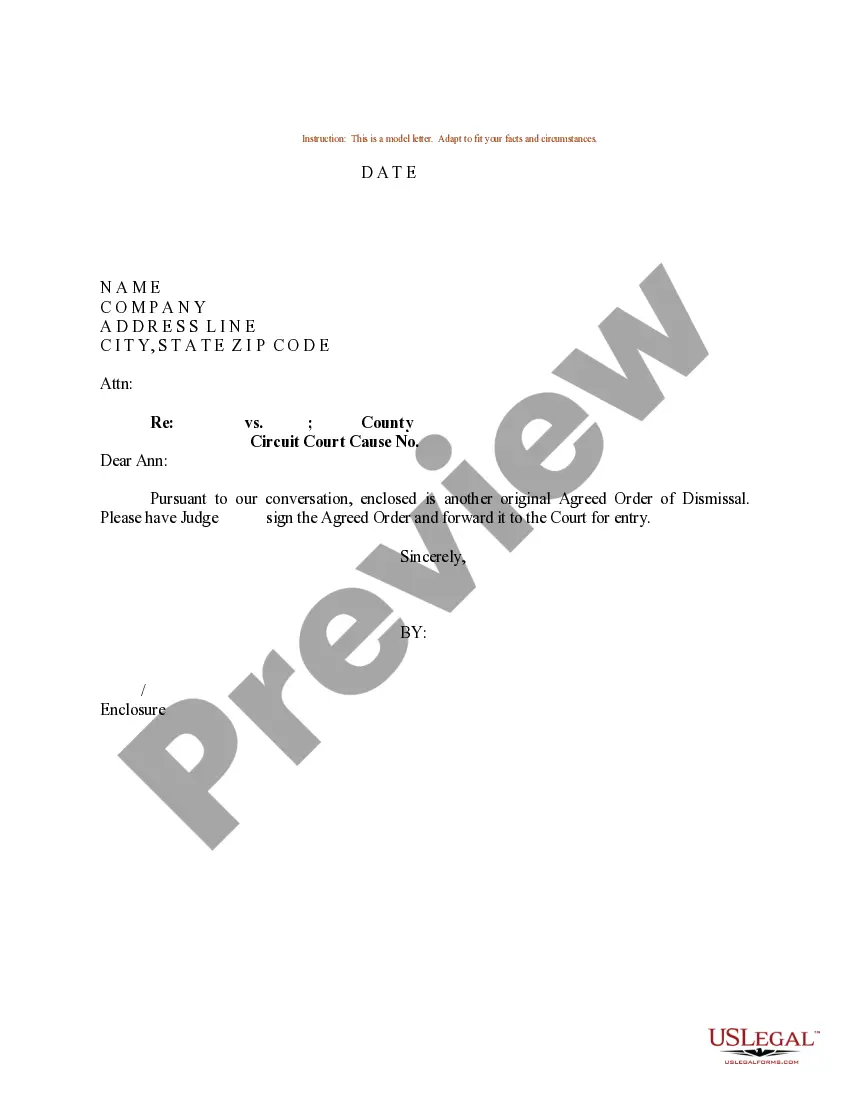
Letter Format For Court In Virginia
Description


Get your form ready online
Our built-in tools help you complete, sign, share, and store your documents in one place.
Make edits, fill in missing information, and update formatting in US Legal Forms—just like you would in MS Word.
Download a copy, print it, send it by email, or mail it via USPS—whatever works best for your next step.
Sign and collect signatures with our SignNow integration. Send to multiple recipients, set reminders, and more. Go Premium to unlock E-Sign.
If this form requires notarization, complete it online through a secure video call—no need to meet a notary in person or wait for an appointment.
We protect your documents and personal data by following strict security and privacy standards.

Make edits, fill in missing information, and update formatting in US Legal Forms—just like you would in MS Word.

Download a copy, print it, send it by email, or mail it via USPS—whatever works best for your next step.

Sign and collect signatures with our SignNow integration. Send to multiple recipients, set reminders, and more. Go Premium to unlock E-Sign.

If this form requires notarization, complete it online through a secure video call—no need to meet a notary in person or wait for an appointment.

We protect your documents and personal data by following strict security and privacy standards.
Looking for another form?








Form popularity
FAQ
Format full mailing address of the sender. date on which letter is written. address of person to whom letter is addressed. subject line. salutation. body (the main message) complimentary closing. signature line (be sure to sign your letter)
Introduce yourself in the opening paragraph. Outline your relationship with the person who is the subject of the legal proceedings. Acknowledge the charges that have been brought against the person. State your opinion of the person's general character.
Follow the order of this format, leaving a space in between each section: Your Information (first thing that goes on the inside of the letter) Name. The Date. The Judge's Information. Honorable Judge First Name Last Name. What the Letter Is Going to Address. Salutation. Body. Signature.
In many cases, temporary guardianship can be obtained without going to court. This is usually done through a power of attorney agreement between the parents and the guardian. A power of attorney legally authorizes the temporary guardian to make healthcare and legal decisions on behalf of the minor.
If sufficiently well-written, even one letter could make an impression on a judge. If more than one, or many more than one, this will always make a favorable impression. It is not a guarantee of more favorable treatment at sentencing, but it sure won't hurt.
The Virginia Rules of Evidence recognize a broad definition of writings, including “letters, words, numbers, or their equivalent, set down by handwriting, typewriting, printing, photographing, magnetic impulse, mechanical or electrical recording, or other form of data compilation or preservation.” The best evidence ...
If you have a court case, you must keep your address up-to-date. Please use this form and file it with the court handling your case. Last updated on March 31, 2022 .
Curing statute A party, whether an individual or a corporation, who is not properly served may move to "quash" service of process, which will result in the court treating the case as though service had not been effected.
The document is a legal form titled 'Bill of Particulars' used in the Commonwealth of Virginia, requiring the plaintiff to outline specific reasons for their claim against the defendant.
Virginia's unified district court system consists of the general district and the juvenile and domestic relations district courts. Within the 32 districts of the state, there are general district courts and juvenile and domestic relations district courts in every city and county.

