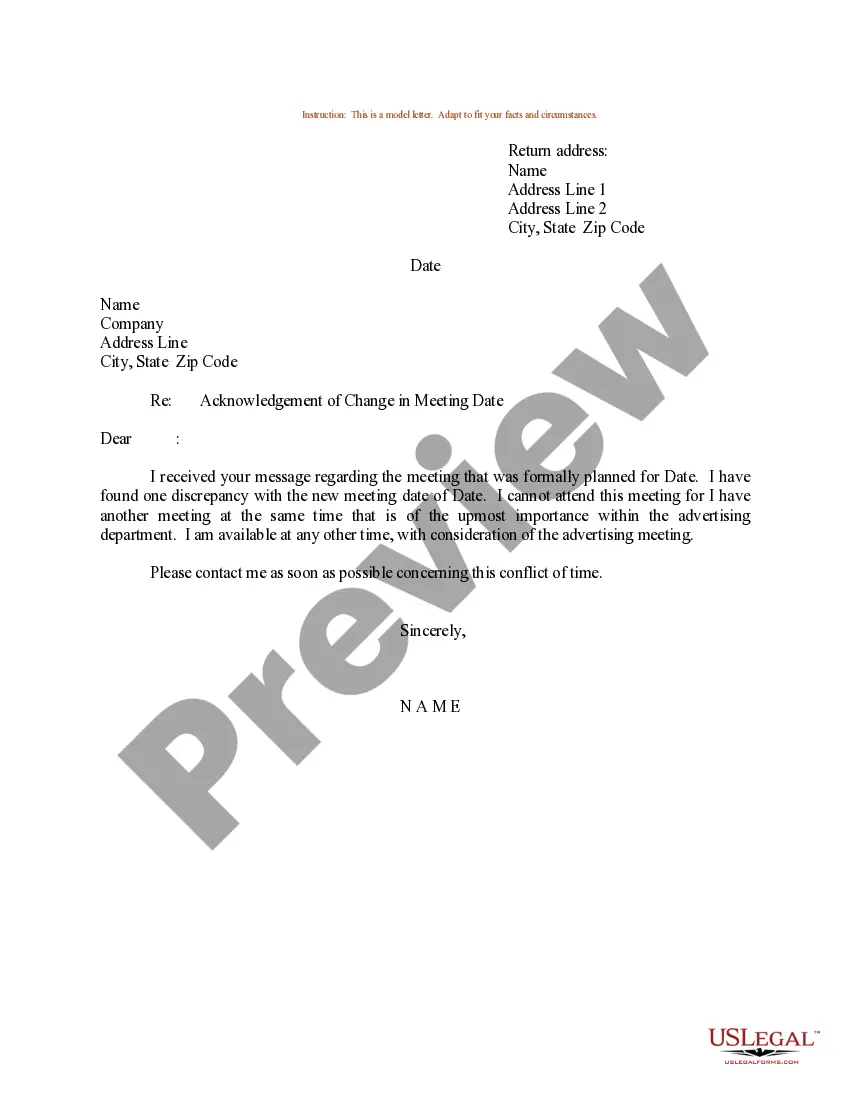
Sample Letter For Date Change In Maryland
Description

Get your form ready online
Our built-in tools help you complete, sign, share, and store your documents in one place.
Make edits, fill in missing information, and update formatting in US Legal Forms—just like you would in MS Word.
Download a copy, print it, send it by email, or mail it via USPS—whatever works best for your next step.
Sign and collect signatures with our SignNow integration. Send to multiple recipients, set reminders, and more. Go Premium to unlock E-Sign.
If this form requires notarization, complete it online through a secure video call—no need to meet a notary in person or wait for an appointment.
We protect your documents and personal data by following strict security and privacy standards.

Make edits, fill in missing information, and update formatting in US Legal Forms—just like you would in MS Word.

Download a copy, print it, send it by email, or mail it via USPS—whatever works best for your next step.

Sign and collect signatures with our SignNow integration. Send to multiple recipients, set reminders, and more. Go Premium to unlock E-Sign.

If this form requires notarization, complete it online through a secure video call—no need to meet a notary in person or wait for an appointment.

We protect your documents and personal data by following strict security and privacy standards.
Looking for another form?
Form popularity
FAQ
Crafting an Effective Leniency Letter to a Judge: Five Essential... Start with a Clear Introduction. Introduce Yourself and Establish Credibility. Provide Reasons for Leniency. Tell a Story or Give Specific Examples. Provide Your Contact Information. Not the Same as a Motion to Modify a Sentence.
The Statement of Probable Cause (form DC/CR 4) is a document used by the arresting officer to write a concise statement that articulates the probable cause related to the arrest of the defendant, including articulating the elements of each crime charged on forms DC/CR002 and DC/CR002A.
In legal terms, a change in a hearing date to a date in the future is called a “continuance” of the hearing.
Begin with a formal salutation, such as "Dear Judge Last Name," and introduce yourself and your case. Clearly state your reasons for requesting a continuance and provide supporting evidence. Conclude your letter by expressing your gratitude and willingness to cooperate with the court's decision.
Begin with a formal salutation, such as "Dear Judge Last Name," and introduce yourself and your case. Clearly state your reasons for requesting a continuance and provide supporting evidence. Conclude your letter by expressing your gratitude and willingness to cooperate with the court's decision.
The judge's continuance in office is subject to approval or rejection by the registered voters of the appellate judicial circuit or geographical area from which the judge was appointed at the next general election following the expiration of 1 year from the date of the occurrence of the vacancy and at the general ...
The Statement of Probable Cause is the written section of a statement of charges and typically contains the allegations outlined by the charging officer that form the legal basis for the criminal charges.
All requests for postponement must be electronically filed in ance with the MD Rules. All requests must be in motion form. If you are self-represented and wish you file a postponement, you may use the Motion for Postponement form.
When will I get a court date? In circuit court, the parties receive a scheduling order or hearing notice no later than 30 days after the defendant files an answer or response to the complaint. In a complex case, the Court may require a scheduling conference be held first.
When you miss a court date, the judge typically issues a bench warrant for your arrest. A bench warrant authorizes law enforcement to take you into custody and bring you before the court. This can happen immediately or at a later time, depending on when and where you are located. Contempt of court.