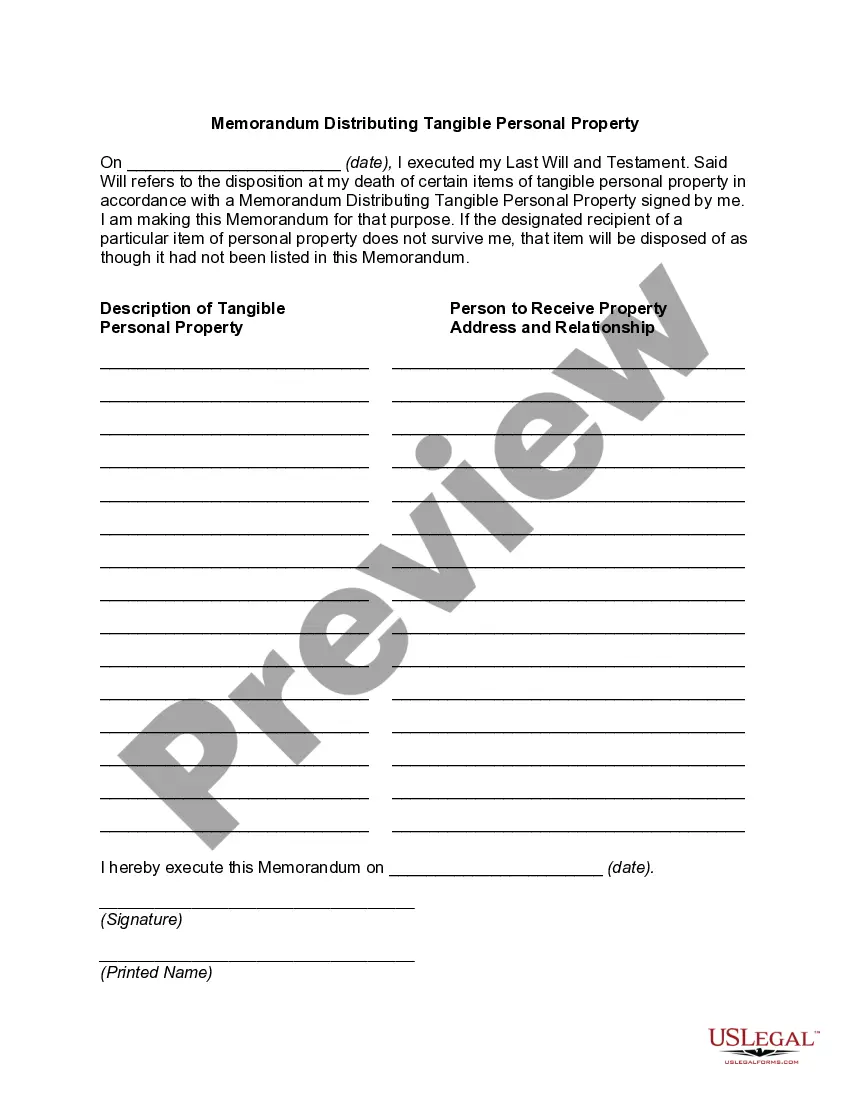
Memorandum Distributing Tangible Personal Property
What is this form?
A Memorandum Distributing Tangible Personal Property is a legal document that complements your will. It specifies which items of tangible personal property you wish to leave to particular individuals. Unlike a will, this memorandum can be updated easily and serves to clarify your intentions regarding personal belongings, ensuring a smooth transition of assets after your passing.
What’s included in this form
- Date of the last will execution
- Description of tangible personal property
- Name of the designated recipient
- Recipient's relationship to you
- Signature and printed name of the individual executing the memorandum

When this form is needed
This form should be used when you want to specifically designate personal property items, such as jewelry, artwork, or furniture, to individuals after your death. It is particularly useful if you wish to provide clarity and ease of distribution without revising your entire will each time there is a change in your intended beneficiaries or items.
Who needs this form
- Individuals drafting a last will and testament who have tangible personal property to distribute.
- Those wishing to make updates to beneficiaries without changing their will.
- People wanting to ensure specific items go to specific heirs, reducing potential disputes.
Instructions for completing this form
- First, write the date you executed your last will and testament.
- Next, list each item of tangible personal property you wish to distribute.
- For each item, include the name of the person to whom it is being given.
- Indicate the relationship of the recipient to you for clarity.
- Finally, date and sign the memorandum to finalize it.
Is notarization required?
This form does not typically require notarization unless specified by local law. However, having it notarized can strengthen its validity and help prevent disputes among heirs.
Get your form ready online
Our built-in tools help you complete, sign, share, and store your documents in one place.
Make edits, fill in missing information, and update formatting in US Legal Forms—just like you would in MS Word.
Download a copy, print it, send it by email, or mail it via USPS—whatever works best for your next step.
Sign and collect signatures with our SignNow integration. Send to multiple recipients, set reminders, and more. Go Premium to unlock E-Sign.
If this form requires notarization, complete it online through a secure video call—no need to meet a notary in person or wait for an appointment.
We protect your documents and personal data by following strict security and privacy standards.

Make edits, fill in missing information, and update formatting in US Legal Forms—just like you would in MS Word.

Download a copy, print it, send it by email, or mail it via USPS—whatever works best for your next step.

Sign and collect signatures with our SignNow integration. Send to multiple recipients, set reminders, and more. Go Premium to unlock E-Sign.

If this form requires notarization, complete it online through a secure video call—no need to meet a notary in person or wait for an appointment.

We protect your documents and personal data by following strict security and privacy standards.
Mistakes to watch out for
- Failing to update the memorandum when personal property changes.
- Omitting the relationship of recipients, which can lead to confusion.
- Not signing or dating the document, making it invalid.
Why complete this form online
- Conveniently complete the form at your own pace.
- Modify templates easily to reflect changes in your property or beneficiaries.
- Access reliable legal templates created by licensed attorneys, ensuring enforceability.
Looking for another form?
Form popularity
FAQ
Provides a written record documenting how tangible personal property is to be distributed among named recipients, typically used in estate planning or probate. The form helps reduce disputes by clearly listing items and their assignees, and it can be used across multiple states. It does not substitute for state law or a last will in all cases.
To write this memorandum, describe each item of tangible property, identify the intended recipient for every item, and include any conditions or notes about transfer. Add the date, your signature, and the signatures of witnesses if required in your state. Keep a copy with other estate documents and provide copies to executors or heirs.
Failing to itemize all tangible assets and assign clear recipients is the most common error. Ambiguity can lead to disputes or unintended transfers. Ensure items have precise descriptions, update the memorandum after life events, and avoid conflicting instructions with any will, trust, or court orders. Keep the document dated and signed to improve enforceability.
Common probate pitfalls include distributing items without proper authorization, creating conflicts with a will or court orders, and failing to document dates and recipients. This memorandum provides a written record to help confirm who receives which items, but it does not replace official probate procedures or legal advice. Consult an attorney for state-specific guidance.
Individuals who want a clear, written plan for distributing specific tangible items to named people often use this memorandum. It is commonly used by principals planning ahead, executors, or trustees to document allocations and reduce disputes among heirs. This form is intended for multi-state use and should be coordinated with any wills, trusts, or estate plans.
This memorandum is a standard contract-template designed specifically for documenting the distribution of tangible personal property among named recipients, reflecting its Contracts - Personal Property category and multi-state scope. A general property memorandum may address broader asset types or lack the formal structure and record of distribution provided by this form.