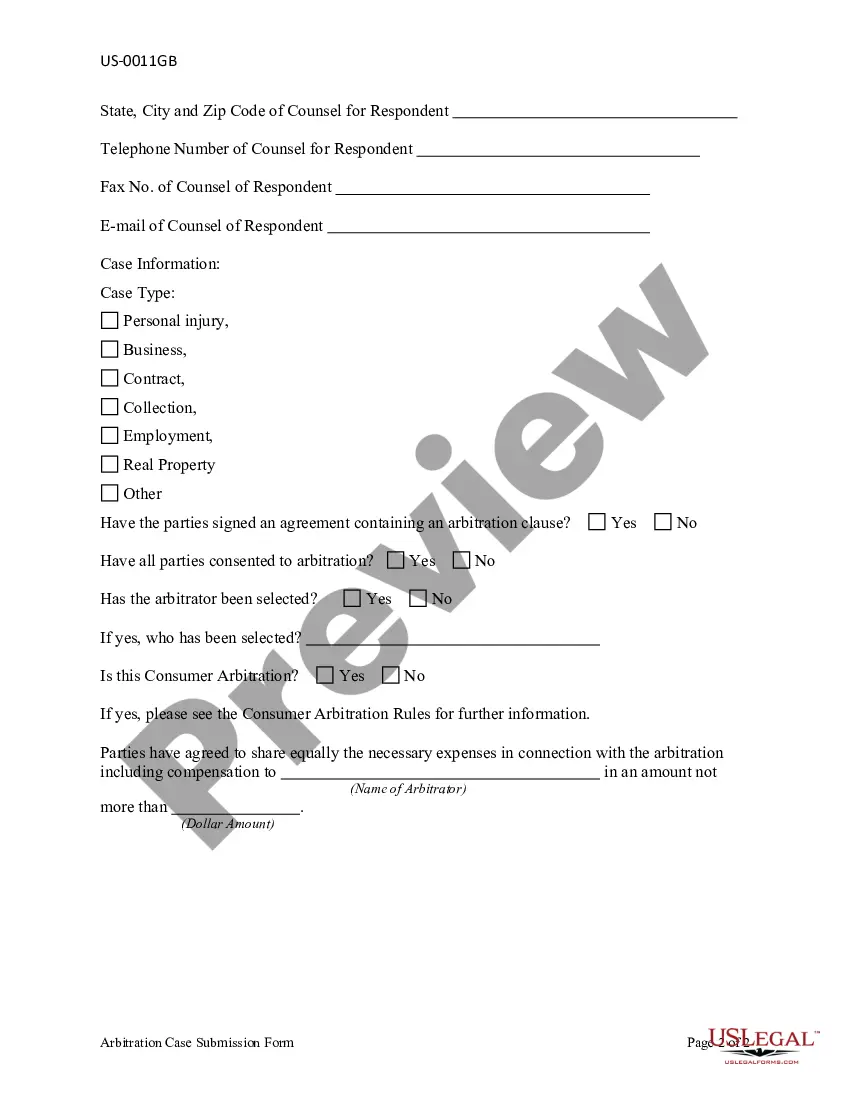
Arbitration Case Statement For Multiple Columns In Alameda
Description




Get your form ready online
Our built-in tools help you complete, sign, share, and store your documents in one place.
Make edits, fill in missing information, and update formatting in US Legal Forms—just like you would in MS Word.
Download a copy, print it, send it by email, or mail it via USPS—whatever works best for your next step.
Sign and collect signatures with our SignNow integration. Send to multiple recipients, set reminders, and more. Go Premium to unlock E-Sign.
If this form requires notarization, complete it online through a secure video call—no need to meet a notary in person or wait for an appointment.
We protect your documents and personal data by following strict security and privacy standards.

Make edits, fill in missing information, and update formatting in US Legal Forms—just like you would in MS Word.

Download a copy, print it, send it by email, or mail it via USPS—whatever works best for your next step.

Sign and collect signatures with our SignNow integration. Send to multiple recipients, set reminders, and more. Go Premium to unlock E-Sign.

If this form requires notarization, complete it online through a secure video call—no need to meet a notary in person or wait for an appointment.

We protect your documents and personal data by following strict security and privacy standards.
Looking for another form?





Form popularity
FAQ
Certified copies of divorce records can be requested through the superior court, either in-person or by mail. The George E. McDonald Hall of Justice is the courthouse in Alameda County that houses all divorce papers. For either option, start by filling out the county's civil records request form.
Requests for divorce and marriage records in Alameda County may be found at .
CDPH-VR is only able to provide you with a Certificate of Record, which includes the names of the parties, filing date, county, and case number of the divorce. Copies of the actual divorce decree can only be obtained from the Superior Court in the county where the divorce took place.
Records may be requested in the following ways: By submitting a request online via NextRequest. By telephone or visiting a department. By submitting a request in writing via email or US Mail.
A divorce decree is a court order ending a marriage. A divorce certificate is a vital document proving a divorce occurred.
George E. McDonald Courthouse, Alameda: (510) 891-6005.
"A dispute having arisen between the parties concerning , the parties hereby agree that the dispute shall be referred to and finally resolved by arbitration under the LCIA Rules. The number of arbitrators shall be one/three. The seat, or legal place, of arbitration shall be City and/or Country.
In conclusion, an effective opening statement will tell the arbitrator in a concise, courteous fashion exactly what the factual situation in the case is, what the issues are, how the advocate wants the arbitrator to rule on the issues, and exactly what relief is being requested.
After the opening statement, the claimants present evidence, that is, the details of their case. For example, they present witnesses and introduce any relevant documents. If the arbitrators did not swear a witness in at the beginning of a hearing, they will administer the oath before that person testifies.
Rule 3.31. Unless otherwise authorized by the court, discovery meet and confer obligations require an in-person, telephonic, or video conference between parties.