Stockholder Meeting For The First Time In Wayne
Description



Get your form ready online
Our built-in tools help you complete, sign, share, and store your documents in one place.
Make edits, fill in missing information, and update formatting in US Legal Forms—just like you would in MS Word.
Download a copy, print it, send it by email, or mail it via USPS—whatever works best for your next step.
Sign and collect signatures with our SignNow integration. Send to multiple recipients, set reminders, and more. Go Premium to unlock E-Sign.
If this form requires notarization, complete it online through a secure video call—no need to meet a notary in person or wait for an appointment.
We protect your documents and personal data by following strict security and privacy standards.

Make edits, fill in missing information, and update formatting in US Legal Forms—just like you would in MS Word.

Download a copy, print it, send it by email, or mail it via USPS—whatever works best for your next step.

Sign and collect signatures with our SignNow integration. Send to multiple recipients, set reminders, and more. Go Premium to unlock E-Sign.

If this form requires notarization, complete it online through a secure video call—no need to meet a notary in person or wait for an appointment.

We protect your documents and personal data by following strict security and privacy standards.
Looking for another form?
Form popularity
FAQ
While corporate board members are present at shareholder meetings, the main voice in these settings is that of the investors. Owning company stock provides holders with equity and, depending on the type of stock they own, the right to vote during shareholder meetings.
While the shareholder is the owner of the company, the directors control the company's internal affairs and management, including the completion of various tax, regulatory and legal compliances. The same person can assume both the roles unless articles of association of the company explicitly prohibits it.
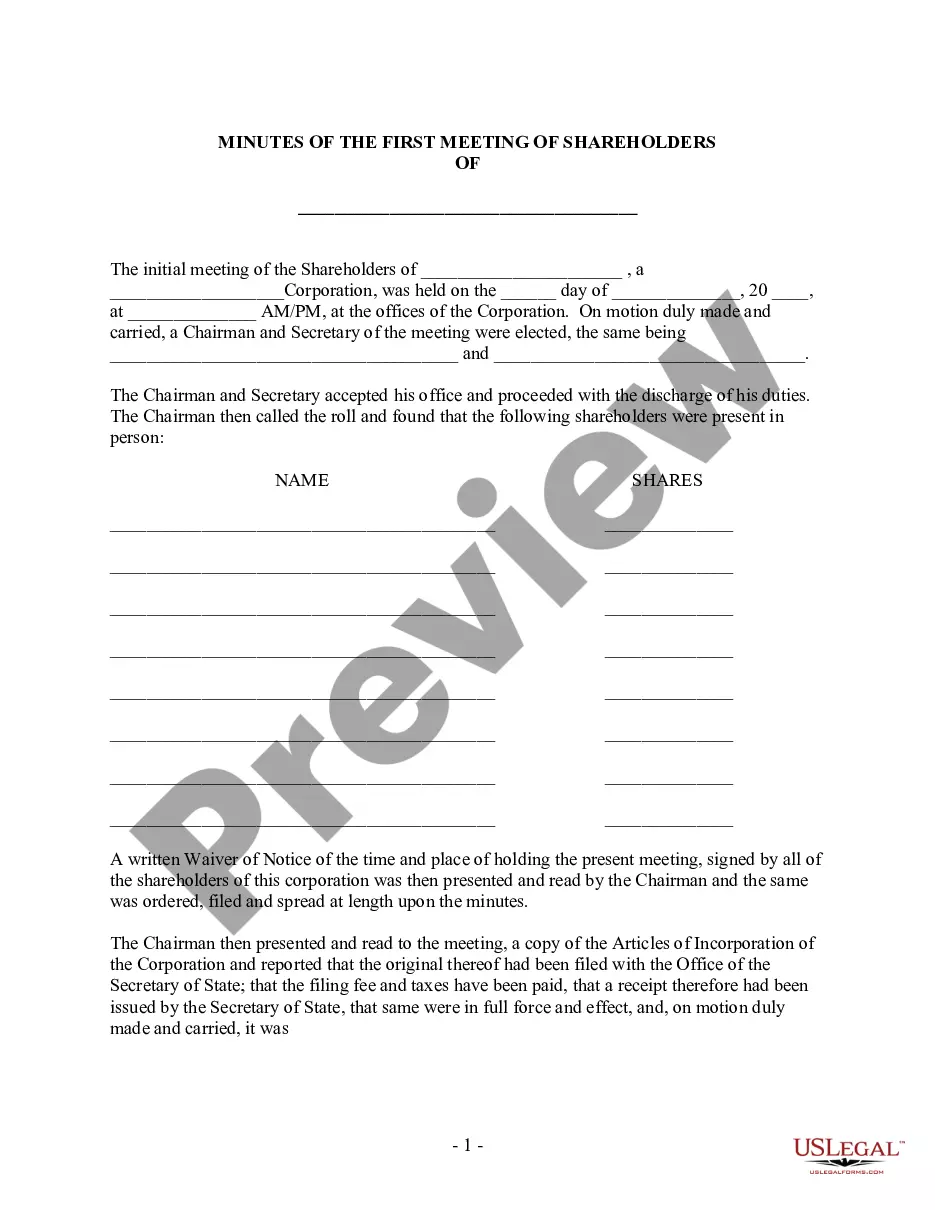
The first shareholder meeting is an organizational meeting where shareholders ratify and approve the actions of the incorporators. Shareholders also approve shares values, appoint directors and officers if needed, and wrap up other initial tasks.
A General Meeting is simply a meeting of shareholders and 21 days' notice must be given to shareholders, but this can be reduced to 14 days, or increased to 28 days, in certain situations.
For management, the annual meeting presents an opportunity to obtain shareholder approval of matters required under state or federal law, including, most significantly, the election of directors. The primary purpose of the annual meeting is to have shareholders act on the matters presented to them for a vote.
While shareholders' meetings represent ownership, board meetings embody the company's leadership. The board of directors, acting as a bridge between management and shareholders, is responsible for making strategic decisions, overseeing management, and safeguarding the company's long-term interests.
All shareholders must be notified of the format, date, time, and place of the meeting. How far in advance notices should be distributed may depend on your state, but generally, they should be sent out more than 10 days prior to the meeting, but less than 60 days.
In order to have a legal meeting you must have a quorum of shareholders present. Typically, a quorum is defined as a representative of more than half of all shares outstanding. There are many other items that can be included on the agenda for an annual shareholder meeting.
If your business is set up and registered as a Corporation, you're required by law to hold an annual shareholder meeting and to document the meeting with minutes.
