Annual Board Directors Sample Format In Texas
Description



Get your form ready online
Our built-in tools help you complete, sign, share, and store your documents in one place.
Make edits, fill in missing information, and update formatting in US Legal Forms—just like you would in MS Word.
Download a copy, print it, send it by email, or mail it via USPS—whatever works best for your next step.
Sign and collect signatures with our SignNow integration. Send to multiple recipients, set reminders, and more. Go Premium to unlock E-Sign.
If this form requires notarization, complete it online through a secure video call—no need to meet a notary in person or wait for an appointment.
We protect your documents and personal data by following strict security and privacy standards.

Make edits, fill in missing information, and update formatting in US Legal Forms—just like you would in MS Word.

Download a copy, print it, send it by email, or mail it via USPS—whatever works best for your next step.

Sign and collect signatures with our SignNow integration. Send to multiple recipients, set reminders, and more. Go Premium to unlock E-Sign.

If this form requires notarization, complete it online through a secure video call—no need to meet a notary in person or wait for an appointment.

We protect your documents and personal data by following strict security and privacy standards.
Looking for another form?







Form popularity
FAQ
The terms “Annual General Meeting” and “annual meeting” are frequently used interchangeably, though they can have distinct meanings. An AGM specifically refers to a formal meeting held by organizations, such as corporations or nonprofits, where key issues are discussed.
An annual general meeting (AGM) is a yearly gathering between the shareholders of a company and its board of directors. Generally, this is the only time that the directors and shareholders will meet throughout the year, so it is a chance for the directors to present the company's annual report.
The annual board of directors meeting is held to go over the details of the past year and decide on actions and strategies for the corporation for the next year. Keeping meeting minutes helps to ensure all these actions are documented in the corporate record.
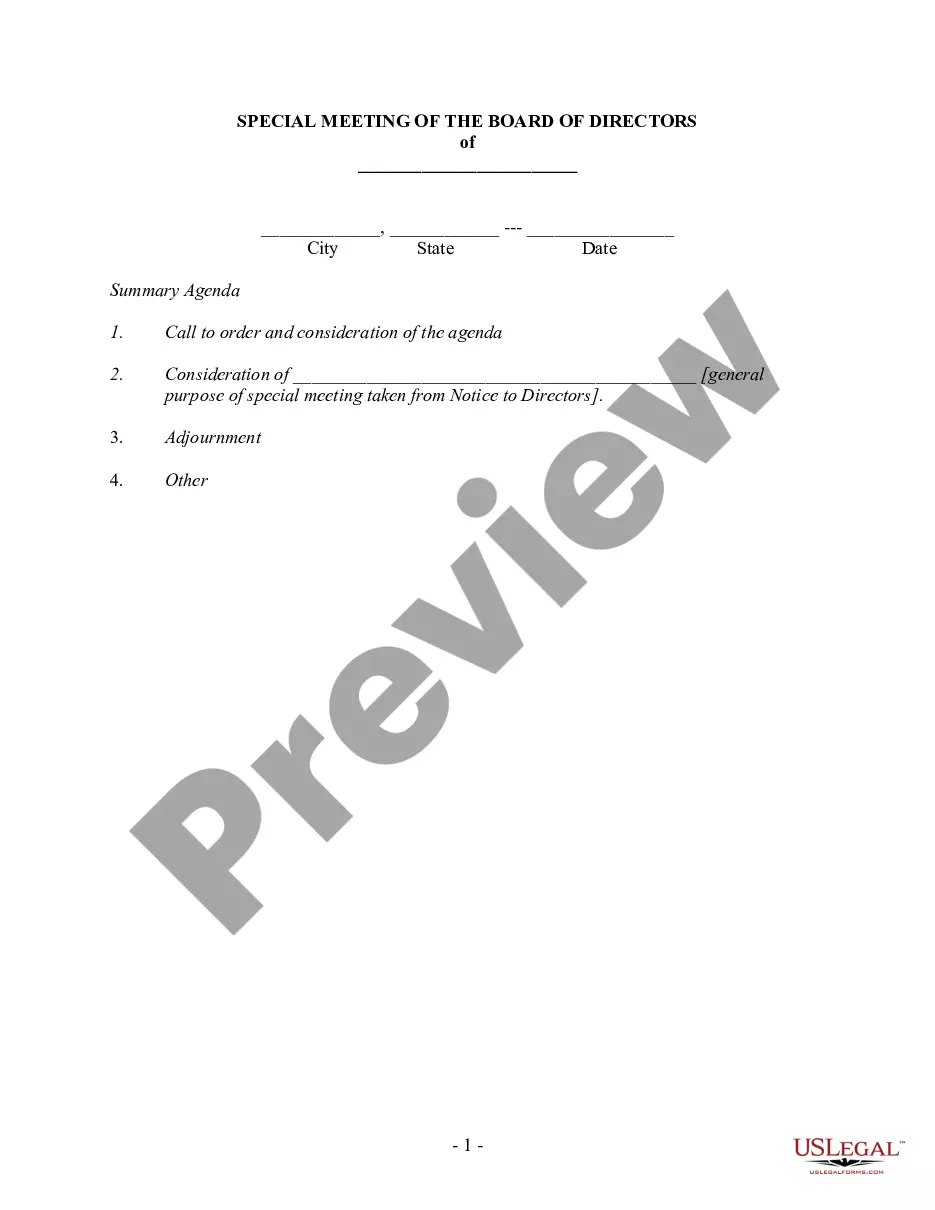
Board meeting agenda format example Call to order & roll call: A brief welcome and confirmation of quorum. Approval of previous meeting minutes: Review and approve the minutes from the last meeting. Reports: Financial reports, committee updates, and presentations from the executive director.
A general meeting is a meeting of a company's shareholders. This is different to a board meeting, which is a meeting of the company's directors. General meetings are used to consider company matters and to make decisions (ie to vote on company resolutions) on these matters.
The following are Texas's requirements for directors of corporations: Minimum number. Corporations must have one or more directors.
Most board meeting agendas follow a classic meeting structure: Calling meeting to order – ensure you have quorum. Approve the agenda and prior board meeting minutes. Executive and committee reports – allow 25% of time here for key topic discussion. Old/new/other business. Close the meeting and adjourn.
The discussion helps to inform board members and shareholders of the company's latest developments. AGMs also allow shareholders to express their concerns and have their questions answered by the board. Shareholders can also vote for or against measures such as director remuneration.
Information Reports: Corporations, LLCs, Limited Partnerships, Professional Associations and financial institutions must file the Public Information Report (PIR). All other entity types must file the Ownership Information Report (OIR).

