Declaratory Judgment Act With Essay In Cuyahoga
Description




Get your form ready online
Our built-in tools help you complete, sign, share, and store your documents in one place.
Make edits, fill in missing information, and update formatting in US Legal Forms—just like you would in MS Word.
Download a copy, print it, send it by email, or mail it via USPS—whatever works best for your next step.
Sign and collect signatures with our SignNow integration. Send to multiple recipients, set reminders, and more. Go Premium to unlock E-Sign.
If this form requires notarization, complete it online through a secure video call—no need to meet a notary in person or wait for an appointment.
We protect your documents and personal data by following strict security and privacy standards.

Make edits, fill in missing information, and update formatting in US Legal Forms—just like you would in MS Word.

Download a copy, print it, send it by email, or mail it via USPS—whatever works best for your next step.

Sign and collect signatures with our SignNow integration. Send to multiple recipients, set reminders, and more. Go Premium to unlock E-Sign.

If this form requires notarization, complete it online through a secure video call—no need to meet a notary in person or wait for an appointment.

We protect your documents and personal data by following strict security and privacy standards.
Looking for another form?



Form popularity
FAQ
(B) A declaratory judgment or decree that a court of record enters in an action or proceeding under this chapter between an insurer and a holder of a policy of liability insurance issued by the insurer and that resolves an issue as to whether the policy's coverage provisions extend to an injury, death, or loss to ...
Rule 57 - Filings and Judgment Entries (A) All filings, except wills, shall be on eight and one-half by eleven inch paper, without backings, of stock that can be microfilmed.
Instead, declaratory judgments state whether the parties may seek or are entitled to relief. Declaratory judgments are conclusive and legally binding, but do not have preclusive effect if: A later lawsuit involves issues other than those specifically litigated and ruled on in the declaratory judgment action.
How Declaratory Judgment Works. Any party to a contract may petition the court to clarify its rights and obligations in the event of a legal controversy. A court-issued declaratory judgment outlines the rights and responsibilities of each involved party. This judgment does not require action or award damages.
Another reason for insurers to pursue a declaratory judgment is that it allows the insurance carrier to “set the table” for the litigation. The insurer gets to tell their side of the story first and introduce key aspects of the dispute to their advantage.
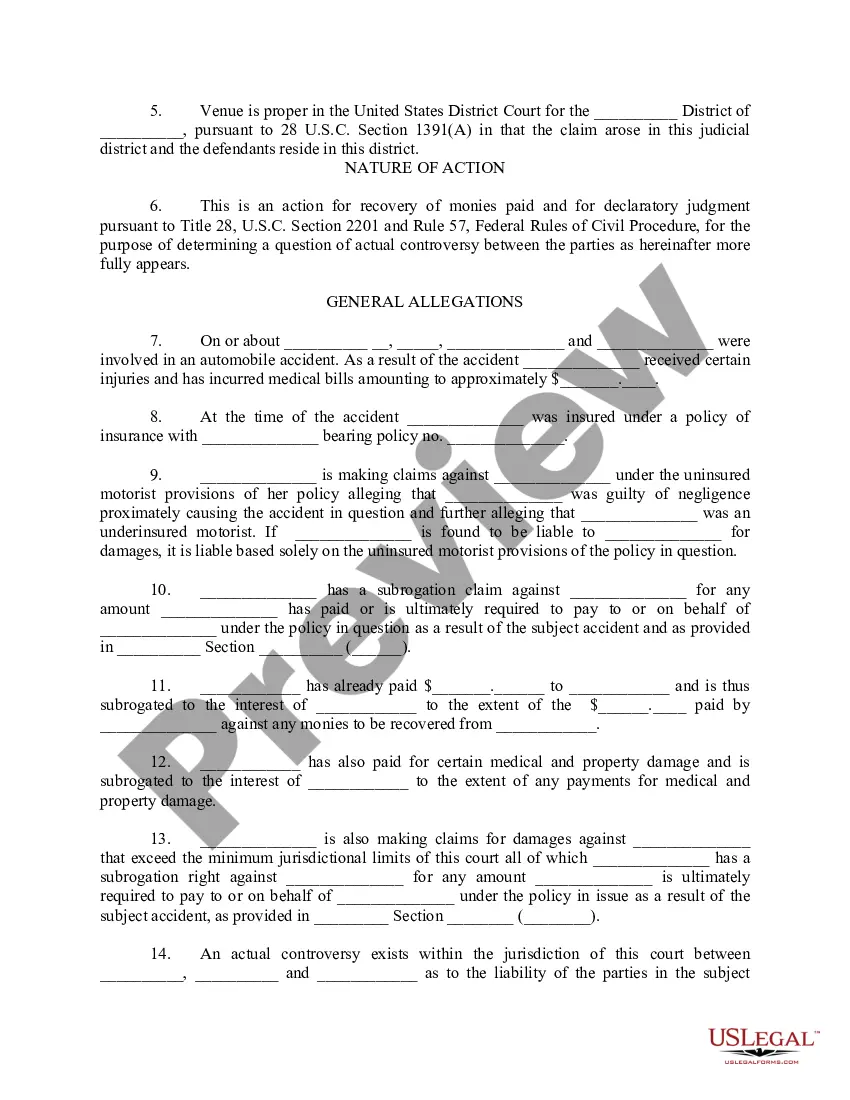
Similarly, the Declaratory Judgment Act, 28 U.S.C. § 2201, is not an independent source of federal jurisdiction. The purpose of that Act is merely to provide an additional remedy, once jurisdiction is found to exist on another ground.
To bring a claim for declaratory judgment in a situation where a patent dispute may exist or develop, the claimant must establish that an actual controversy exists. If there is a substantial controversy of sufficient immediacy and reality, the court will generally proceed with the declaratory-judgment action.