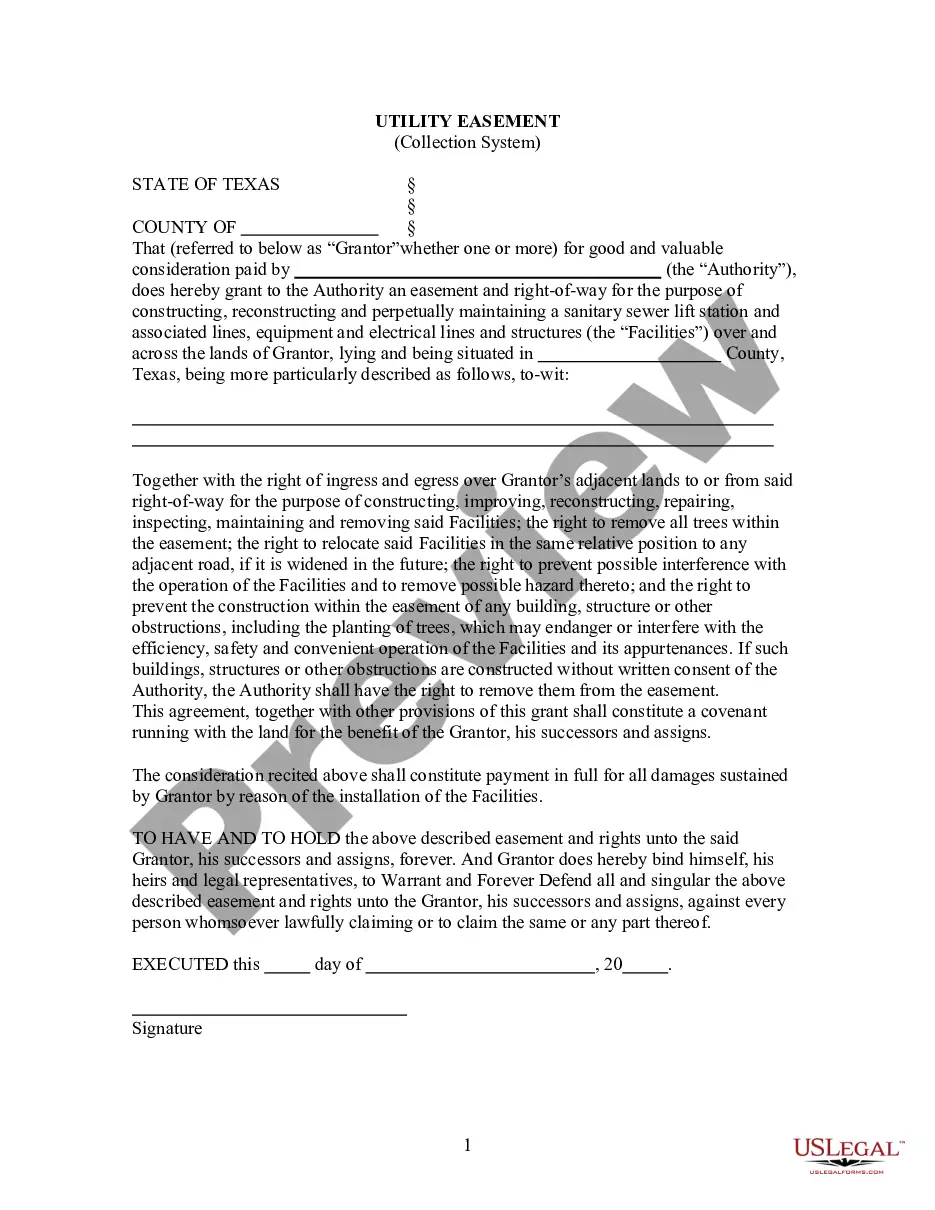
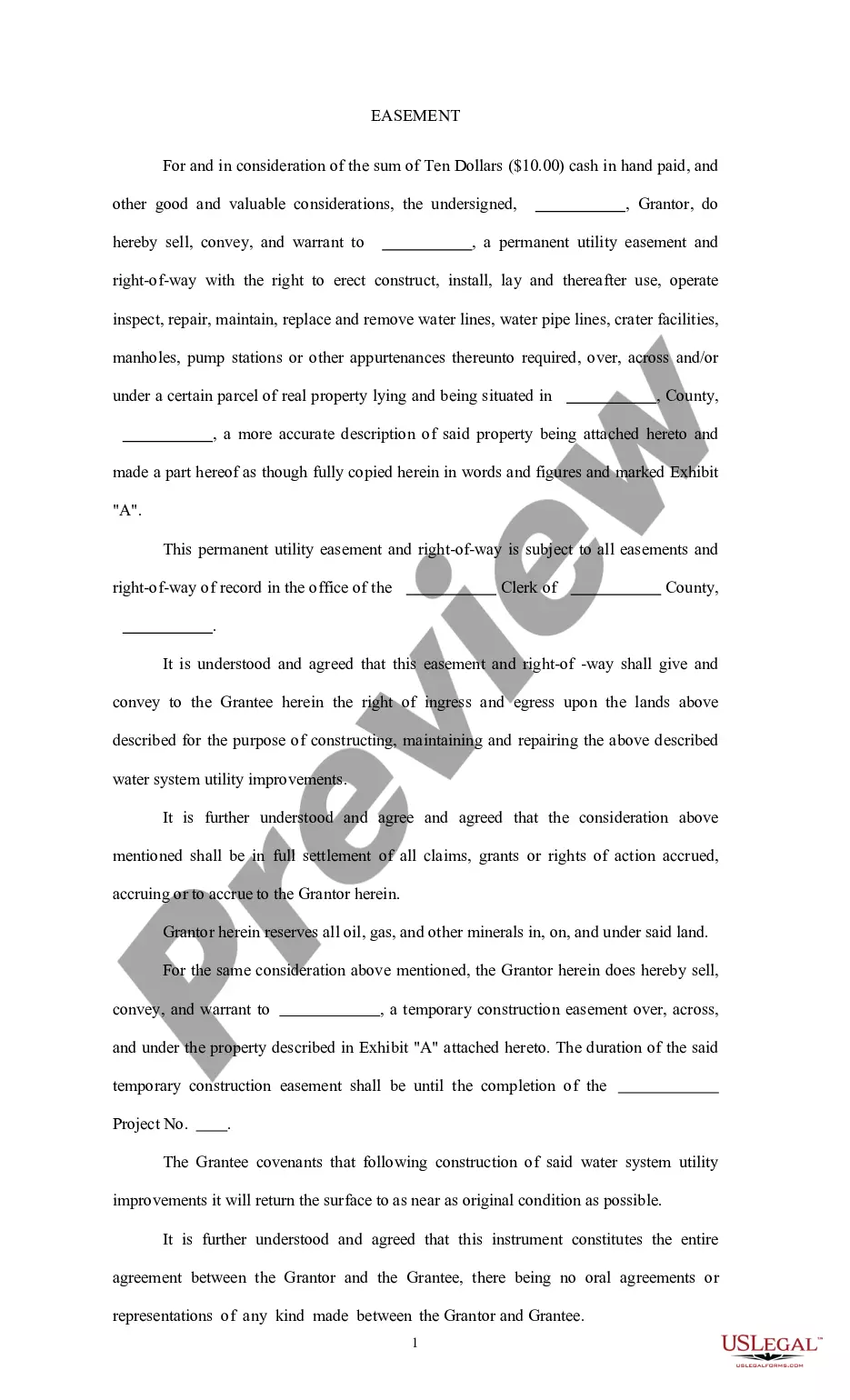
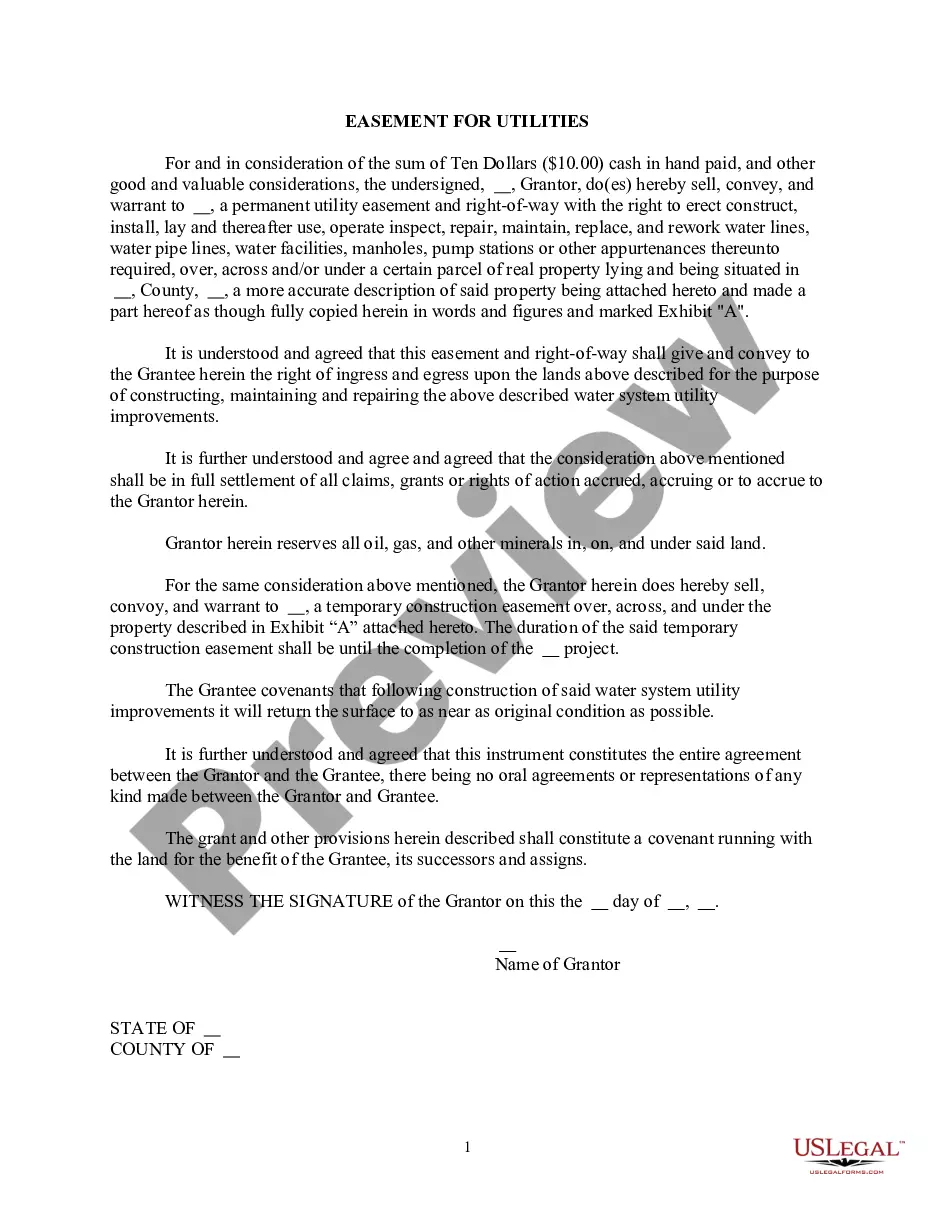
Easement Sewer Lines For Power
Description
Get your form ready online
Our built-in tools help you complete, sign, share, and store your documents in one place.
Make edits, fill in missing information, and update formatting in US Legal Forms—just like you would in MS Word.
Download a copy, print it, send it by email, or mail it via USPS—whatever works best for your next step.
Sign and collect signatures with our SignNow integration. Send to multiple recipients, set reminders, and more. Go Premium to unlock E-Sign.
If this form requires notarization, complete it online through a secure video call—no need to meet a notary in person or wait for an appointment.
We protect your documents and personal data by following strict security and privacy standards.

Make edits, fill in missing information, and update formatting in US Legal Forms—just like you would in MS Word.

Download a copy, print it, send it by email, or mail it via USPS—whatever works best for your next step.

Sign and collect signatures with our SignNow integration. Send to multiple recipients, set reminders, and more. Go Premium to unlock E-Sign.

If this form requires notarization, complete it online through a secure video call—no need to meet a notary in person or wait for an appointment.

We protect your documents and personal data by following strict security and privacy standards.
Looking for another form?









How to fill out Texas Utility Easement For Sanitary Sewer Station And Associated Lines?
Individuals typically connect legal documentation with something complex that only an expert can handle.
In some respects, that's accurate, as drafting Easement Sewer Lines For Power necessitates considerable knowledge of subject matter guidelines, encompassing state and municipal regulations.
Nevertheless, with US Legal Forms, everything has become easier: pre-prepared legal documents for any personal and business event tailored to state regulations are compiled in a unified online repository and are now accessible to everyone.
All templates in our collection are reusable: once obtained, they remain saved in your profile, allowing you to access them as needed through the My documents tab. Explore all the advantages of utilizing the US Legal Forms platform. Subscribe today!
- US Legal Forms provides over 85,000 current documents categorized by state and purpose, so locating Easement Sewer Lines For Power or any specific template only requires a few minutes.
- Previous users with an active subscription must Log In to their account and click Download to access the document.
- Users who are newcomers to the site will initially have to establish an account and subscribe before downloading any files.
- Here is the detailed guide on how to obtain the Easement Sewer Lines For Power.
- Review the content of the page carefully to ensure it meets your requirements.
- Examine the form description or confirm it via the Preview option.
- If the previous option doesn't fulfill your needs, search for another sample using the Search field above.
- When you identify the appropriate Easement Sewer Lines For Power, click Buy Now.
- Select the pricing plan that aligns with your needs and budget.
- Register for an account or sign in to continue to the payment page.
- Complete the payment for your subscription using PayPal or a credit card.
- Choose the format for your document and click Download.
- Print your document or upload it to an online editor for quicker completion.
Form popularity
FAQ
The benefited land is called the dominant tenementThe land that benefits from an easement., and the burdened landthat is, the land subject to the easementis called the servient tenement.
The most common type of easement, a utility easement allows a utility company to run its pipes, lines, etc., under or on other people's property in order to serve its customers. As opposed to buying all the land necessary, utility companies negotiate easement agreements with landowners.
An easement which passes (or runs) with land so as to benefit successors can only exist where a number of requirements are satisfied: The right must be one which is capable of being an easement (examples include rights of way, rights of light and a right to the passage of water).
In order to obtain an implied easement, the party seeking the easement is required to go to court, prove each of the required elements for the type of implied easement sought, obtain a court order granting the easement, and file the court order in the county deed records.
Having an easement on your property means that a third party (an individual or a utility company for example) has a right to use your property for a particular purpose. This could be passing by foot or with vehicles over your property, or a right to pass service media for utilities on, over or under your property.