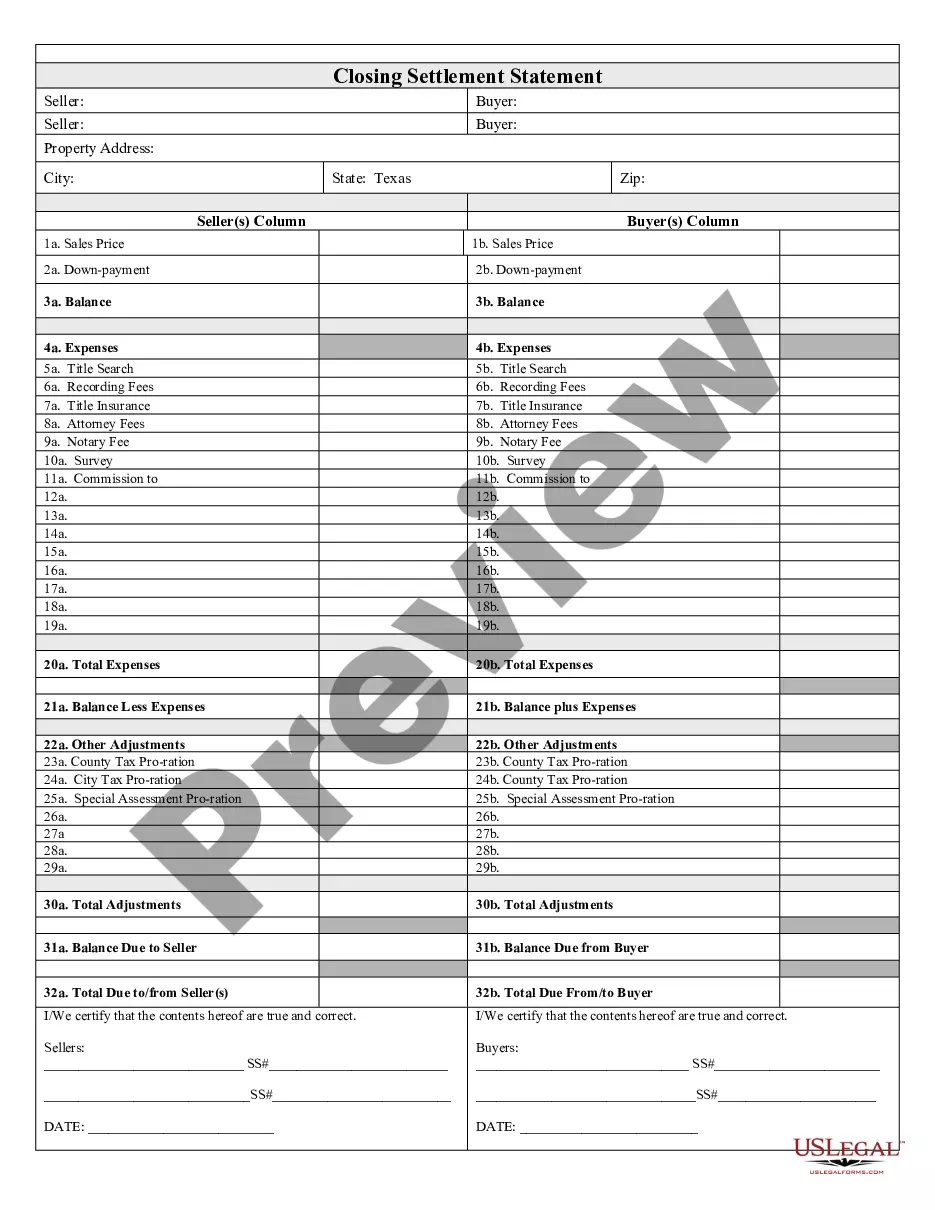
Closing Statement For House
Description

Get your form ready online
Our built-in tools help you complete, sign, share, and store your documents in one place.
Make edits, fill in missing information, and update formatting in US Legal Forms—just like you would in MS Word.
Download a copy, print it, send it by email, or mail it via USPS—whatever works best for your next step.
Sign and collect signatures with our SignNow integration. Send to multiple recipients, set reminders, and more. Go Premium to unlock E-Sign.
If this form requires notarization, complete it online through a secure video call—no need to meet a notary in person or wait for an appointment.
We protect your documents and personal data by following strict security and privacy standards.

Make edits, fill in missing information, and update formatting in US Legal Forms—just like you would in MS Word.

Download a copy, print it, send it by email, or mail it via USPS—whatever works best for your next step.

Sign and collect signatures with our SignNow integration. Send to multiple recipients, set reminders, and more. Go Premium to unlock E-Sign.

If this form requires notarization, complete it online through a secure video call—no need to meet a notary in person or wait for an appointment.

We protect your documents and personal data by following strict security and privacy standards.
Looking for another form?
How to fill out Texas Closing Statement?
Engaging with legal documents and processes can be a labor-intensive addition to your schedule.
Closing Statement For House and similar forms frequently necessitate you to search for them and manage how to fill them out efficiently.
As a result, if you are managing financial, legal, or personal issues, utilizing a comprehensive and accessible online library of forms when needed will be extremely beneficial.
US Legal Forms is the top online platform for legal documents, providing over 85,000 state-specific forms and various resources to aid you in swiftly completing your paperwork.
Simply Log Into your account, locate Closing Statement For House and download it directly from the My documents section. You can also access forms you have downloaded before.
- Explore the collection of relevant documents available to you with just a single click.
- US Legal Forms supplies you with state- and county-specific forms accessible at any time for download.
- Safeguard your document management processes with a premium service that enables you to prepare any form in moments without any hidden charges.
Form popularity
FAQ
A closing statement for a house is important because it acts as an official record of the financial exchange in the property sale. It protects both the buyer and seller by documenting what was agreed upon, including any fees or adjustments. This transparency is essential for a smooth transaction and reduces the chances of disputes after closing.
The closing statement typically lists fees in two columns, one detailing the buyer's expenses and one detailing the seller's expenses. The amount of cash the buyer must give the seller has its own entry at the bottom of the document.
The closing statement should include basic information about the property, such as the address where it's located, when it was built, and the type of structure it is (i.e., single-family home, multifamily home, manufactured home, etc.). Financial information.
Who prepares the settlement statement? Whoever is facilitating the closing ? whether it be a title company, escrow firm, or real estate attorney ? will be responsible for preparing the settlement statement.
The Seller's Closing Statement, or Settlement Statement, is an itemized list of fees and credits that shows your net profits as the seller, and sums up the finances of the entire transaction. This is one of many closing documents for seller.
A mortgage closing statement lists all of the costs and fees associated with the loan, as well as the total amount and payment schedule. A closing statement or credit agreement is provided with any type of loan, often with the application itself.