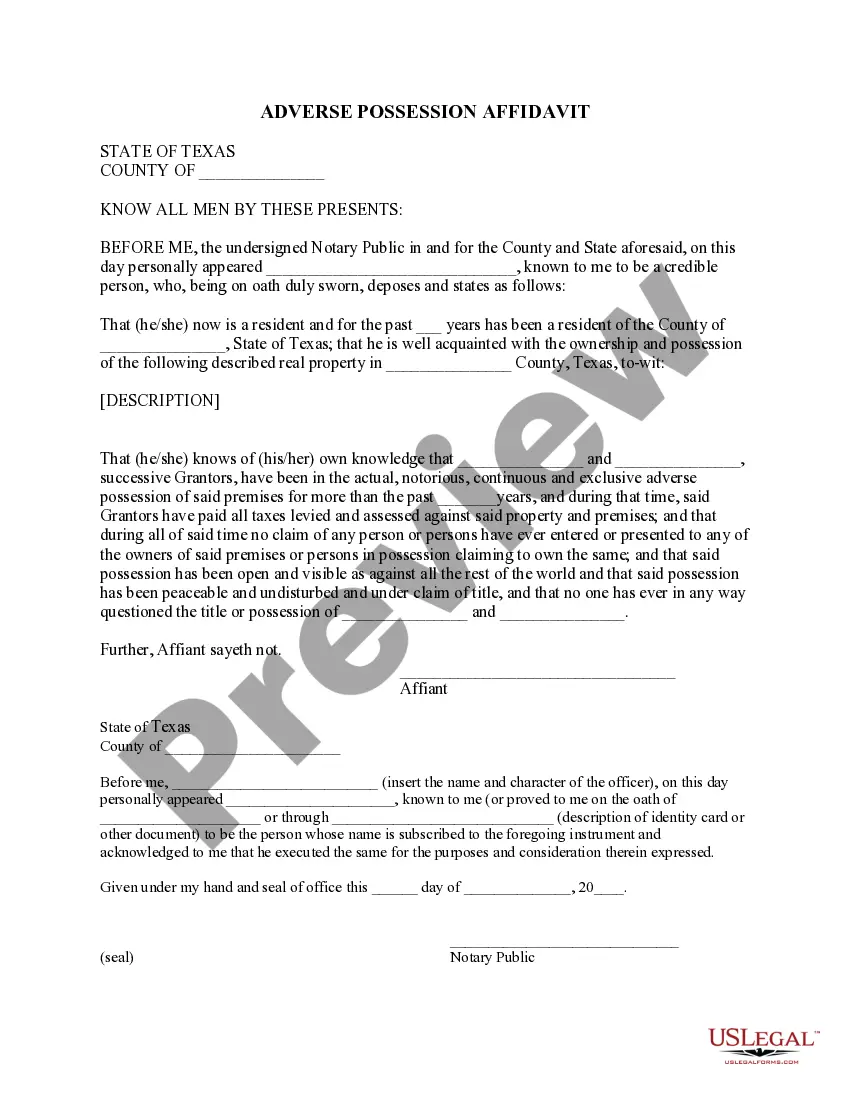
Texas Adverse Possession Form For Land
Description
Get your form ready online
Our built-in tools help you complete, sign, share, and store your documents in one place.
Make edits, fill in missing information, and update formatting in US Legal Forms—just like you would in MS Word.
Download a copy, print it, send it by email, or mail it via USPS—whatever works best for your next step.
Sign and collect signatures with our SignNow integration. Send to multiple recipients, set reminders, and more. Go Premium to unlock E-Sign.
If this form requires notarization, complete it online through a secure video call—no need to meet a notary in person or wait for an appointment.
We protect your documents and personal data by following strict security and privacy standards.

Make edits, fill in missing information, and update formatting in US Legal Forms—just like you would in MS Word.

Download a copy, print it, send it by email, or mail it via USPS—whatever works best for your next step.

Sign and collect signatures with our SignNow integration. Send to multiple recipients, set reminders, and more. Go Premium to unlock E-Sign.

If this form requires notarization, complete it online through a secure video call—no need to meet a notary in person or wait for an appointment.

We protect your documents and personal data by following strict security and privacy standards.
Looking for another form?


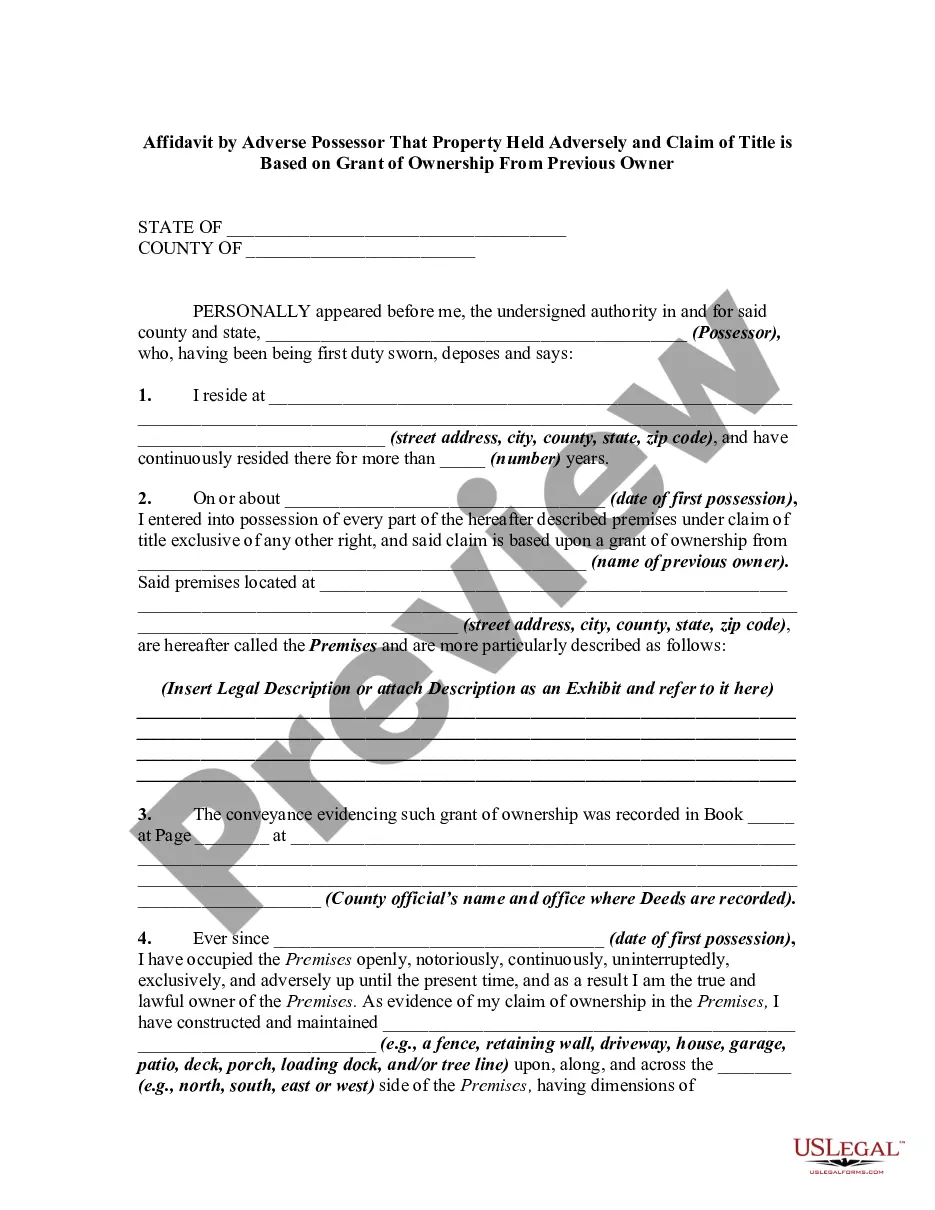
How to fill out Texas Adverse Possession Affidavit - Squatters Rights?
Finding a reliable location to obtain the latest and pertinent legal documents is a significant part of navigating bureaucracy.
Identifying the appropriate legal forms demands accuracy and meticulousness, which is why it's crucial to gather Texas Adverse Possession Form For Land exclusively from credible sources, such as US Legal Forms. An incorrect template will waste your time and prolong your circumstances.
Eliminate the hassle that comes with your legal documentation. Explore the extensive US Legal Forms library where you can discover legal templates, verify their applicability to your situation, and download them instantly.
- Utilize the library navigation or search option to locate your template.
- Examine the form’s details to ensure it aligns with the prerequisites of your state and county.
- If available, review the form preview to verify that the template is indeed what you require.
- If the Texas Adverse Possession Form For Land does not suit your needs, continue your search for the appropriate document.
- If you are confident in the form’s suitability, proceed to download it.
- If you are a registered user, click Log in to verify and access your chosen forms in My documents.
- If you have not created an account yet, click Buy now to acquire the form.
- Select the pricing option that best meets your needs.
- Continue to the registration to complete your order.
- Confirm your purchase by choosing a payment method (credit card or PayPal).
- Select the file format to download Texas Adverse Possession Form For Land.
- Once you have the form on your device, you can alter it with the editor or print it and fill it out by hand.
Form popularity
FAQ
Code § 16.024, the trespasser can bring a claim of adverse possession after a mere 3 years. To do so, however, they must establish "color of title," meaning that the trespasser has some sort of deed or conveyance, albeit perhaps a mistaken one, showing their name as record title owner.
Adverse possession is a process in which a person makes a legal claim to real property that did not belong to them originally. It is sometimes referred to as "squatters' rights." Certain circumstances and time limits must be met for an adverse possession claim.
What is the three-year rule? That is the general escheat rule for personal property. Unclaimed personal property is considered abandoned if, for longer than three years, the location of the owner is unknown and a claim to the property has not been asserted.
How to File Adverse Possession in Texas Five Requirements for Adverse Possession. Actual and Exclusive Possession. Open and Notorious Possession. Continuous Possession for a Specified Period. Hostile or Adverse Possession. Claim of Right or Color of Title. ?Tacking? in Adverse Possession Cases.
You can file for adverse possession in Texas by filing a lawsuit in county court. Successful adverse possession claims are rare, and the evidentiary requirements are substantial, because adverse possession involves a court taking someone's property and giving it to someone else.