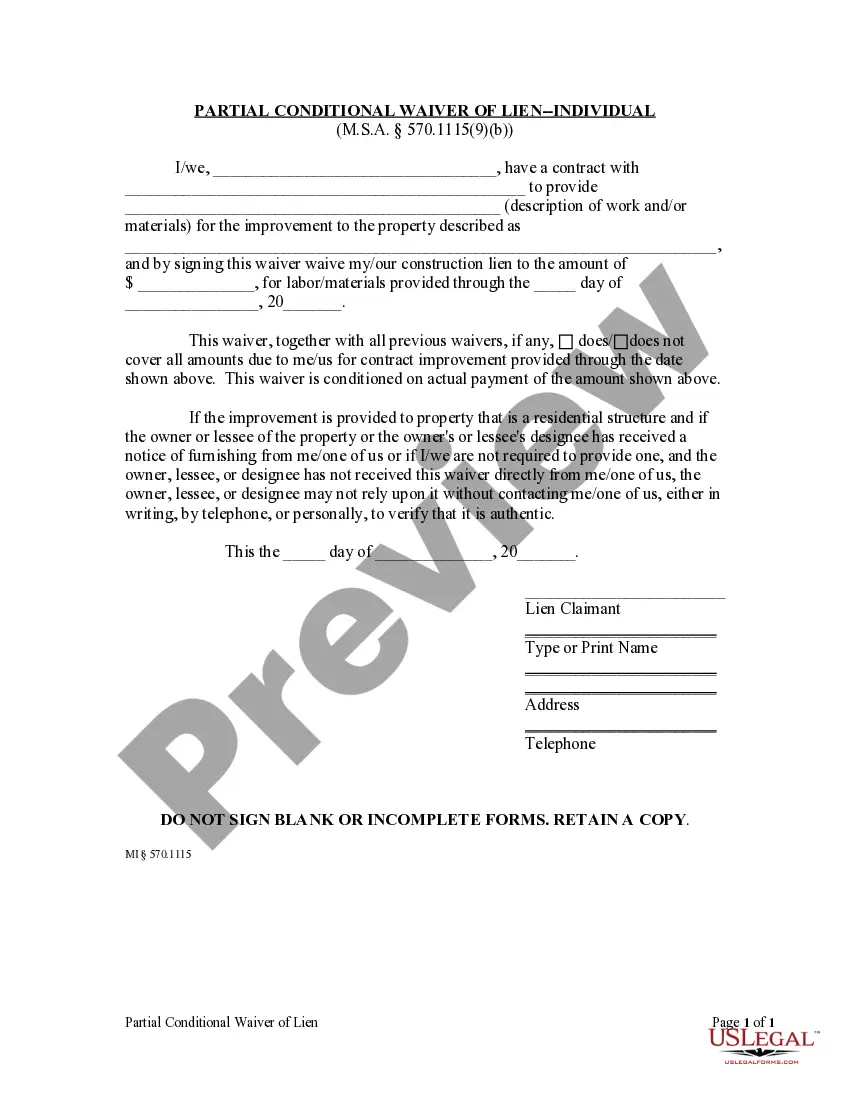
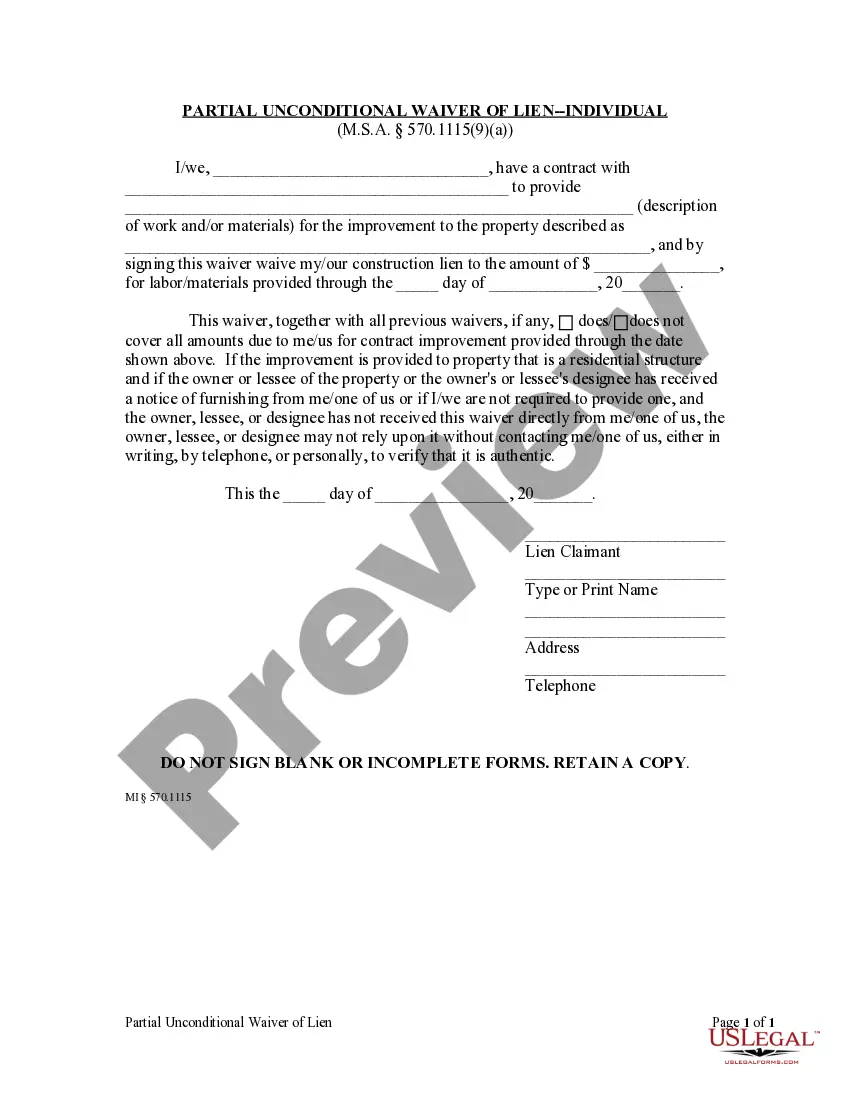
Michigan Partial Unconditional Waiver Form
Description
Get your form ready online
Our built-in tools help you complete, sign, share, and store your documents in one place.
Make edits, fill in missing information, and update formatting in US Legal Forms—just like you would in MS Word.
Download a copy, print it, send it by email, or mail it via USPS—whatever works best for your next step.
Sign and collect signatures with our SignNow integration. Send to multiple recipients, set reminders, and more. Go Premium to unlock E-Sign.
If this form requires notarization, complete it online through a secure video call—no need to meet a notary in person or wait for an appointment.
We protect your documents and personal data by following strict security and privacy standards.

Make edits, fill in missing information, and update formatting in US Legal Forms—just like you would in MS Word.

Download a copy, print it, send it by email, or mail it via USPS—whatever works best for your next step.

Sign and collect signatures with our SignNow integration. Send to multiple recipients, set reminders, and more. Go Premium to unlock E-Sign.

If this form requires notarization, complete it online through a secure video call—no need to meet a notary in person or wait for an appointment.

We protect your documents and personal data by following strict security and privacy standards.
Looking for another form?
Form popularity
FAQ
The key difference between unconditional and conditional waivers lies in the terms of release. An unconditional waiver is active immediately upon signing, while a conditional waiver becomes effective only when specified conditions are met. Opting for the Michigan partial unconditional waiver form gives you certainty and understanding about when your rights are released, making it a strategic choice for parties in any contractual arrangement.
A partial conditional lien waiver includes terms that are contingent on certain conditions being met. This means the waiver will only be effective if those conditions are satisfied, such as receiving payment. Utilizing a Michigan partial unconditional waiver form can simplify these conditions and clarify the obligations tied to the waiver, thereby enhancing transparency between parties.
A partial waiver of authorization limits the scope of consent usually provided in a legal or contractual agreement. Essentially, it restricts permission for specific actions while allowing for others to remain valid. This form of waiver can be crucial in ensuring that certain rights are still preserved, making the Michigan partial unconditional waiver form a useful tool for your legal requirements.
A partial waiver refers to the release of obligations or claims associated with a specific portion of payment or work completed. Unlike a full waiver, which relinquishes all rights, a partial waiver only applies to the agreed-upon part. In relation to the Michigan partial unconditional waiver form, it allows you to secure your payments while maintaining some rights for future claims or amounts.
An unconditional release waiver is a legal document that frees one party from any future claims related to a project. This means that once you sign this document, you cannot later demand payment or make claims tied to that project. In the context of the Michigan partial unconditional waiver form, it serves to ensure that payments have been made, and hence the signer relinquishes any future rights to those funds.
Filing a lien waiver involves several key steps. First, ensure you have the correct Michigan partial unconditional waiver form ready, as this is essential for the process. Next, fill out the form accurately, including details like project information and parties involved. Finally, submit the completed form to the appropriate entity, typically the property owner or lender, to complete the waiver and secure your rights.
To properly fill out a waiver form, focus on providing clear information that communicates who is involved and what is being waived. Utilize the format provided by the Michigan partial unconditional waiver form to ensure you include all necessary details. Once completed, review the form carefully, sign it, and submit it to maintain a reliable record of the agreement.
When filling out an unconditional waiver form, start by entering your business name, the date, and the amount involved. The Michigan partial unconditional waiver form will guide you to provide essential details, such as project information and specifics about your client. Lastly, don't forget to sign it and keep a copy for your records to support any future claims or concerns.
An unconditional waiver on a final payment in Texas is a legal document that relinquishes the right to claim payment once it is signed. However, it still requires you to ensure that all previous obligations have been settled before using the Michigan partial unconditional waiver form. This type of waiver is significant in providing assurance to property owners that they have satisfied their payment obligations.
Filling out an unconditional waiver involves providing thorough details about the transaction and the parties involved. Use the Michigan partial unconditional waiver form to clearly state the amount waived and any relevant project information. After entering all required data, double-check the information for completeness and accuracy before you sign and date the form to make it legally binding.