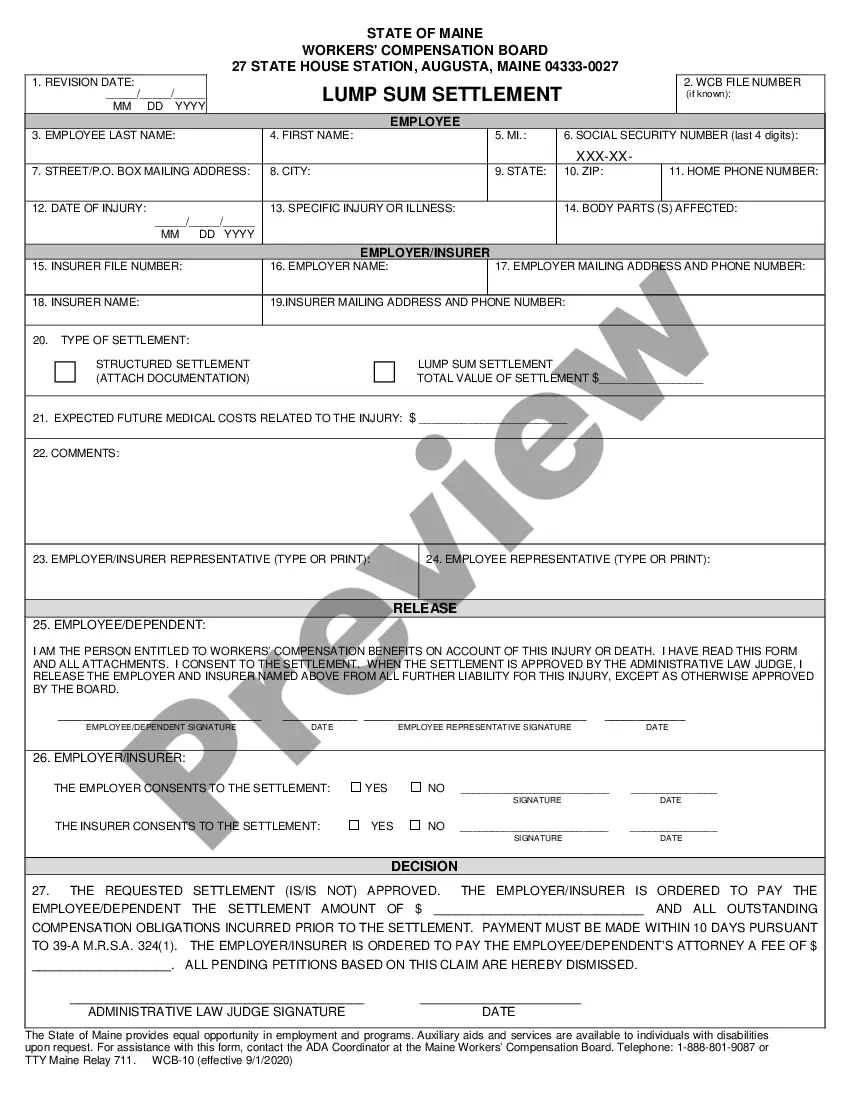
This is one of the official Workers' Compensation forms for the state of Maine.
Maine Workers Comp Settle With Me
State:
Maine
Control #:
ME-WCB-10-WC
Format:
PDF
Instant download
This website is not affiliated with any governmental entity
Public form
Description

Get your form ready online
Our built-in tools help you complete, sign, share, and store your documents in one place.
Built-in online Word editor
Make edits, fill in missing information, and update formatting in US Legal Forms—just like you would in MS Word.
Export easily
Download a copy, print it, send it by email, or mail it via USPS—whatever works best for your next step.
E-sign your document
Sign and collect signatures with our SignNow integration. Send to multiple recipients, set reminders, and more. Go Premium to unlock E-Sign.
Notarize online 24/7
If this form requires notarization, complete it online through a secure video call—no need to meet a notary in person or wait for an appointment.
Store your document securely
We protect your documents and personal data by following strict security and privacy standards.

Make edits, fill in missing information, and update formatting in US Legal Forms—just like you would in MS Word.

Download a copy, print it, send it by email, or mail it via USPS—whatever works best for your next step.

Sign and collect signatures with our SignNow integration. Send to multiple recipients, set reminders, and more. Go Premium to unlock E-Sign.

If this form requires notarization, complete it online through a secure video call—no need to meet a notary in person or wait for an appointment.

We protect your documents and personal data by following strict security and privacy standards.
Looking for another form?







How to fill out Maine Lump Sum Settlement For Workers' Compensation?
The Maine Workers Comp Settle With Me you observe on this page is a versatile legal template created by experienced attorneys in accordance with federal and state laws.
For over 25 years, US Legal Forms has supplied individuals, businesses, and lawyers with more than 85,000 validated, state-specific documents for any professional and personal situation. It’s the fastest, simplest, and most reliable method to acquire the forms you require, as the service promises the utmost level of data security and anti-malware safeguards.
Subscribe to US Legal Forms to have authenticated legal templates for all of life's situations readily available.
- Examine the document you require and assess it. Review the sample you searched for and preview it or check the form description to ensure it meets your requirements. If it doesn't, utilize the search feature to locate the appropriate one. Click Buy Now once you have identified the template you need.
- Register and Log In. Choose the pricing option that fits you and set up an account. Use PayPal or a credit card to make a swift payment. If you already have an account, Log In and verify your subscription to continue.
- Acquire the editable template. Select the format you prefer for your Maine Workers Comp Settle With Me (PDF, DOCX, RTF) and save the document on your device.
- Fill out and sign the forms. Print the template to complete it by hand. Alternatively, employ an online multifunctional PDF editor to quickly and accurately fill out and sign your document with a legally binding electronic signature.
- Download your documents once more. Use the same document again whenever needed. Access the My documents tab in your profile to redownload any previously obtained forms.
Form popularity
FAQ
Your employer will pay you 2/3 of your average weekly wage. This is called your compensation rate. There is a limit on how much you can receive, and the limit is different for different dates of injury.
Do you have to pay taxes on your workers' compensation payments? The answer is no. Whether you received wage loss benefits on a weekly basis or a lump sum settlement, workers' compensation is not taxable. IRS Publication 907 reads as follows: ?The following payments are not taxable ?
Typically, if your new job pays you less than you were making prior to your injury, you can still receive payment for the difference in wages. You can also continue to receive medical benefits for all healthcare costs related to your injury. If you're disabled, you can still receive disability benefits.
The maximum compensation rate for injuries on or after January 1, 2020 is 125% of the State Average Weekly Wage. Update for 2022: the state average weekly wage (SAWW) to $1,036.13. Provides that the maximum for injuries occurring July 1, 2022, through June 30, 2023, is $1295.16.