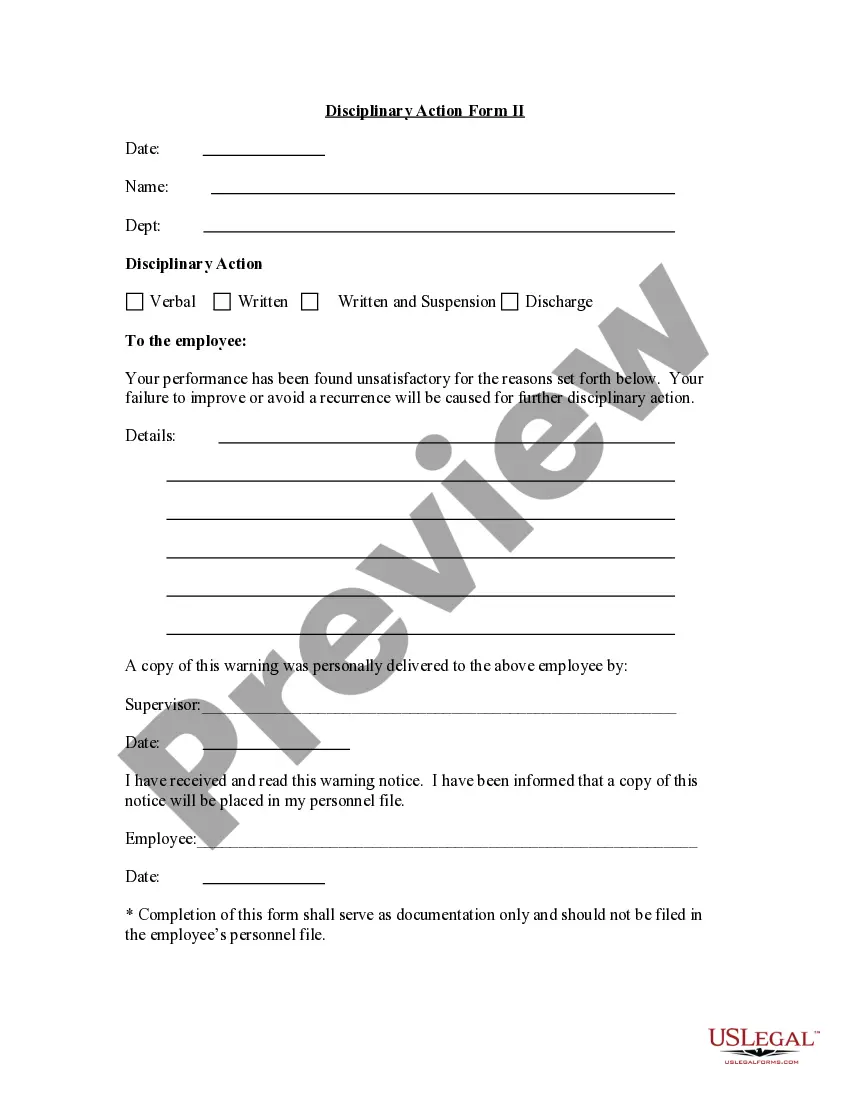
Disciplinary Action Form II
Overview of this form
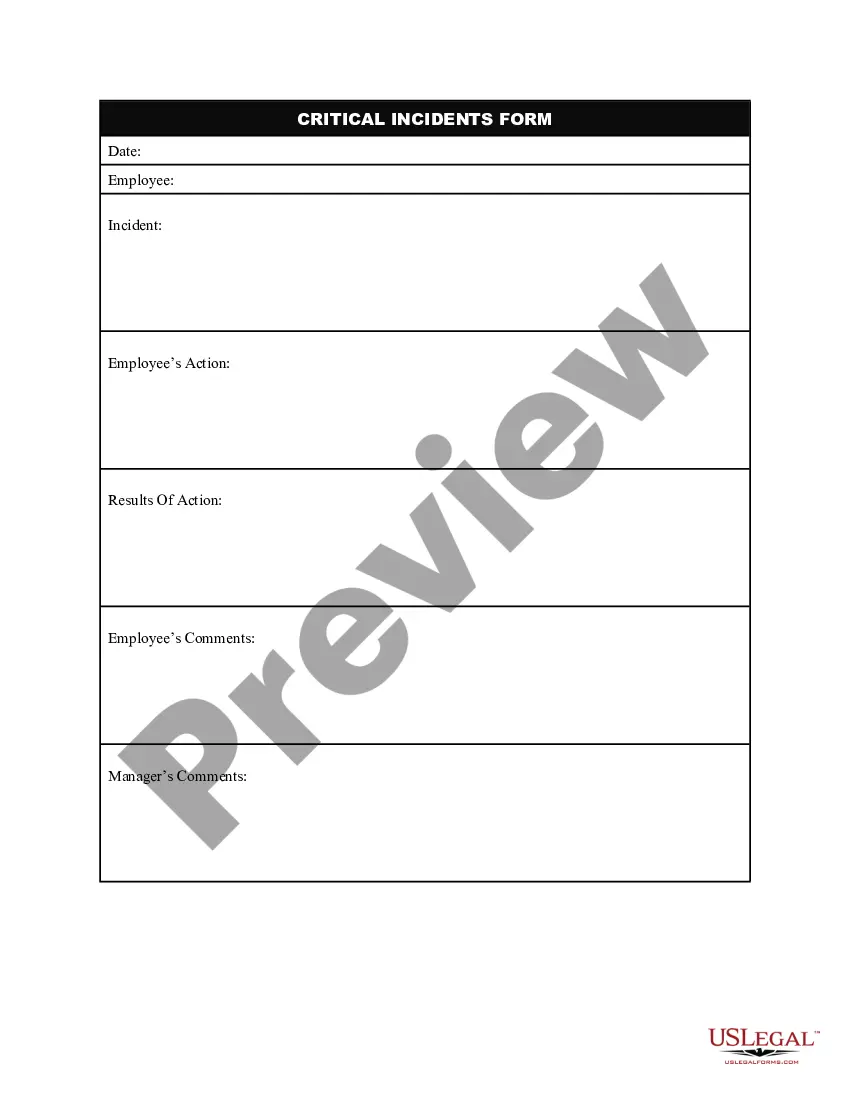
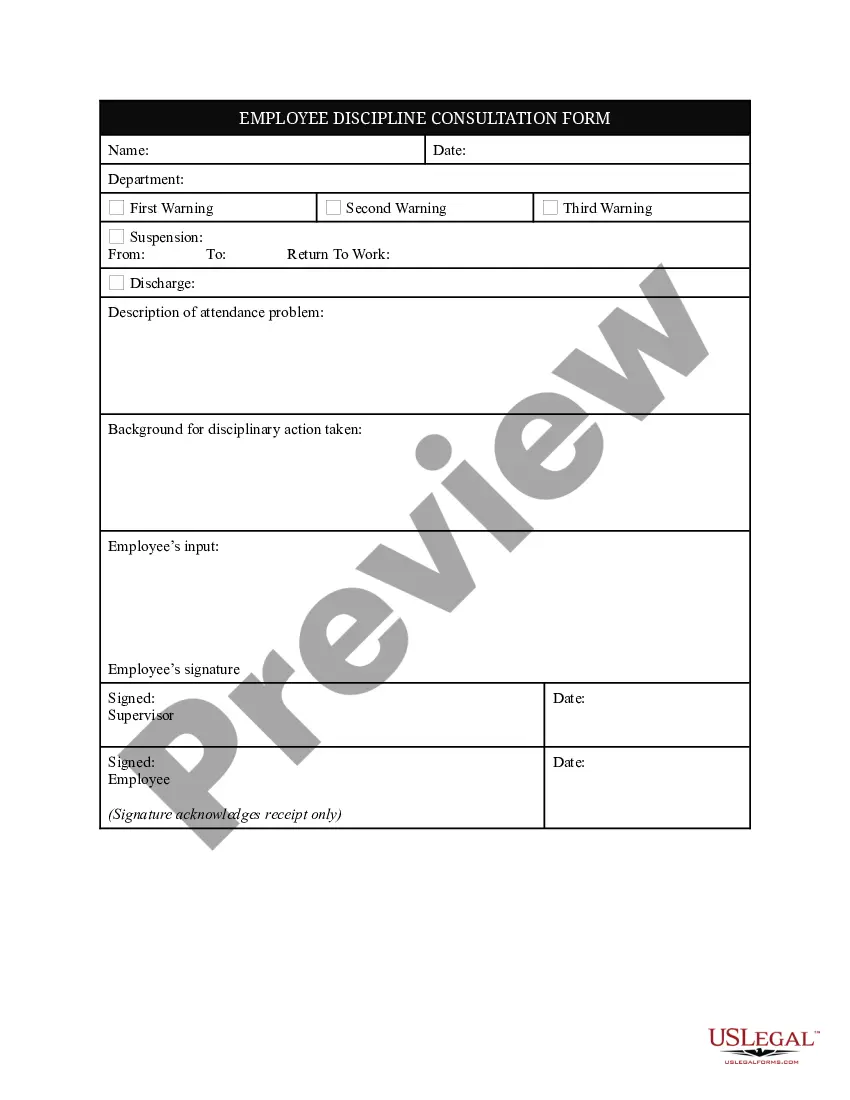
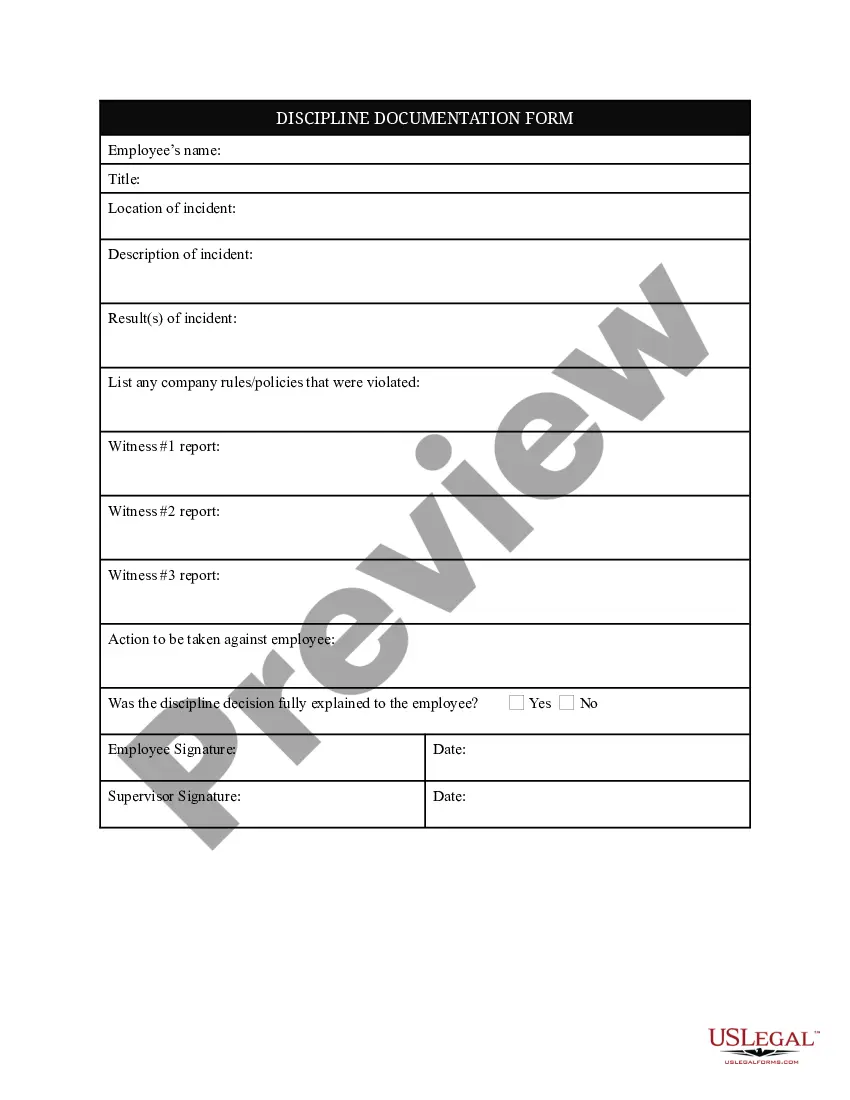
The Disciplinary Action Form II is a legal document designed for employers to formally document instances of employee misconduct or performance issues. This form helps employers maintain accurate records of disciplinary actions while ensuring compliance with labor laws. It serves as a crucial tool for fostering clear communication about workplace expectations and consequences, distinguishing it from general performance evaluation forms.
What’s included in this form
- Employee information: section for entering employee names, positions, and identification numbers.
- Date of incident: space to specify the date of the misconduct or performance issue.
- Description of the issue: detailed area to explain the nature of the misconduct.
- Action taken: section outlining the consequences or remedial actions taken by management.
- Employer's comments: space for additional notes or context from the employer.
- Employee acknowledgment: a field for the employee to sign, indicating they have received and understood the disciplinary action.
When to use this document
This form should be used when an employer needs to address specific disciplinary issues with an employee. Common scenarios include repeated tardiness, violation of company policies, or failure to meet performance standards. Utilizing this form helps ensure that all disciplinary actions are documented properly, which can be critical for future evaluations or legal matters.
Intended users of this form
- Employers in various industries looking to document employee misconduct.
- Human resources professionals managing employee relations.
- Managers who oversee teams and need to enforce company policies.
- Business owners who want to maintain a formal record of disciplinary procedures.
How to complete this form
- Identify the employee by filling in their name, position, and identification number.
- Enter the date of the incident that prompted the need for disciplinary action.
- Clearly describe the misconduct or performance issue, including any relevant details.
- Document the specific action taken by the employer in response to the issue.
- Include any additional comments that may provide context or clarification.
- Have the employee sign the form, acknowledging receipt and understanding of the disciplinary action.
Is notarization required?
This form does not typically require notarization unless specified by local law. However, having it notarized can add an extra layer of legal validity.
Get your form ready online
Our built-in tools help you complete, sign, share, and store your documents in one place.
Make edits, fill in missing information, and update formatting in US Legal Forms—just like you would in MS Word.
Download a copy, print it, send it by email, or mail it via USPS—whatever works best for your next step.
Sign and collect signatures with our SignNow integration. Send to multiple recipients, set reminders, and more. Go Premium to unlock E-Sign.
If this form requires notarization, complete it online through a secure video call—no need to meet a notary in person or wait for an appointment.
We protect your documents and personal data by following strict security and privacy standards.

Make edits, fill in missing information, and update formatting in US Legal Forms—just like you would in MS Word.

Download a copy, print it, send it by email, or mail it via USPS—whatever works best for your next step.

Sign and collect signatures with our SignNow integration. Send to multiple recipients, set reminders, and more. Go Premium to unlock E-Sign.

If this form requires notarization, complete it online through a secure video call—no need to meet a notary in person or wait for an appointment.

We protect your documents and personal data by following strict security and privacy standards.
Typical mistakes to avoid
- Failing to include all relevant details about the misconduct.
- Not obtaining the employeeâs signature, which weakens the validity of the document.
- Using vague language that does not clearly indicate the issue or consequences.
- Neglecting to keep a copy of the completed form for the employer's records.
Advantages of online completion
- Convenient access for employees and employers, allowing for quick documentation of issues.
- Editability ensures that employers can customize the form to reflect specific situations.
- Reliable templates drafted by licensed attorneys reduce errors in legal language and requirements.
Key takeaways
- The Disciplinary Action Form II is essential for documenting disciplinary actions in a workplace.
- It helps clarify the nature of incidents and the response from management.
- Use this form to ensure compliance with company policies and protect legal interests.
Looking for another form?

Form popularity
FAQ
It should include the date, time and location for the hearing. The disciplinary hearing letter should have details of the allegations against the employee, documentation supporting the incident and the possible outcomes of the procedure.
The employee's name and the date of the write-up. Clearly state why they are being written up. How many times this employee has been written up. Clearly state details about the problem. Give the employee a deadline to fix the problem. Always have them sign and date the write-up.
C) Preparing a comprehensive report that contains all the factual information, relevant documents, and interview records/statements. The report will contain an evaluation of the facts and make recommendations as appropriate, which will include whether or not the matter should proceed to a Disciplinary Hearing.
Have an employee discipline form. Conduct a full and fair investigation. Get the facts. Be objective. Be clear and specific. Complete the form while the facts are fresh. Get the employee's acknowledgement. Allow the employee to explain the conduct.
Review the employee's file and performance records. Prepare for the employee discussion. Hold a meeting with the employee. State objectives of the disciplinary action. Ask for the employee's input. Provide a copy of the disciplinary action to the employee. Schedule a follow-up.
Detail the Investigation of Misconduct. Explain the Specific Misconduct. Detail the Improvement Action Plan. Detail the Consequences of Future Misconduct. Detail the Employee's Right to Respond or Appeal.
Keep it private. Hold the discipline meeting in a private location, away from co-workers. Have a witness. Be straightforward. Remain calm. Be respectful. Explain impact to the company. Work with the employee to find a solution. State the consequences.