Iowa Amendment Trust With The Government
Description

Get your form ready online
Our built-in tools help you complete, sign, share, and store your documents in one place.
Make edits, fill in missing information, and update formatting in US Legal Forms—just like you would in MS Word.
Download a copy, print it, send it by email, or mail it via USPS—whatever works best for your next step.
Sign and collect signatures with our SignNow integration. Send to multiple recipients, set reminders, and more. Go Premium to unlock E-Sign.
If this form requires notarization, complete it online through a secure video call—no need to meet a notary in person or wait for an appointment.
We protect your documents and personal data by following strict security and privacy standards.

Make edits, fill in missing information, and update formatting in US Legal Forms—just like you would in MS Word.

Download a copy, print it, send it by email, or mail it via USPS—whatever works best for your next step.

Sign and collect signatures with our SignNow integration. Send to multiple recipients, set reminders, and more. Go Premium to unlock E-Sign.

If this form requires notarization, complete it online through a secure video call—no need to meet a notary in person or wait for an appointment.

We protect your documents and personal data by following strict security and privacy standards.
Looking for another form?







How to fill out Iowa Amendment To Living Trust?
- If you're a returning user, log in to your account. Check your subscription status to confirm it's active and click the Download button for your desired form.
- For first-time users, begin by exploring the vast library of forms on the US Legal Forms website. Use the Preview mode to read the description and ensure it aligns with your needs and local regulations.
- If you need a specific template that isn’t listed, utilize the Search tab to identify the necessary documents and verify their relevance before proceeding.
- Once you find the right document, click on the Buy Now button, select a suitable subscription plan, and register to create an account for access to the full library.
- Complete your purchase by entering your credit card details or using your PayPal account for secure payment.
- Finally, download your form and save it to your device. Access it anytime in the My Forms section of your profile.
Using US Legal Forms empowers you to efficiently manage your legal documentation needs with confidence.
Take advantage of our extensive library today to ensure your Iowa amendment trust with the government is accurately prepared. Don’t hesitate – start now!
Form popularity
FAQ
Any estate with gross income of $600 or more during the tax year must file Form 1041. If you are managing an Iowa amendment trust with the government, this requirement ensures that the estate meets necessary tax obligations. Failure to file can lead to penalties, so it's important to stay informed about these requirements.
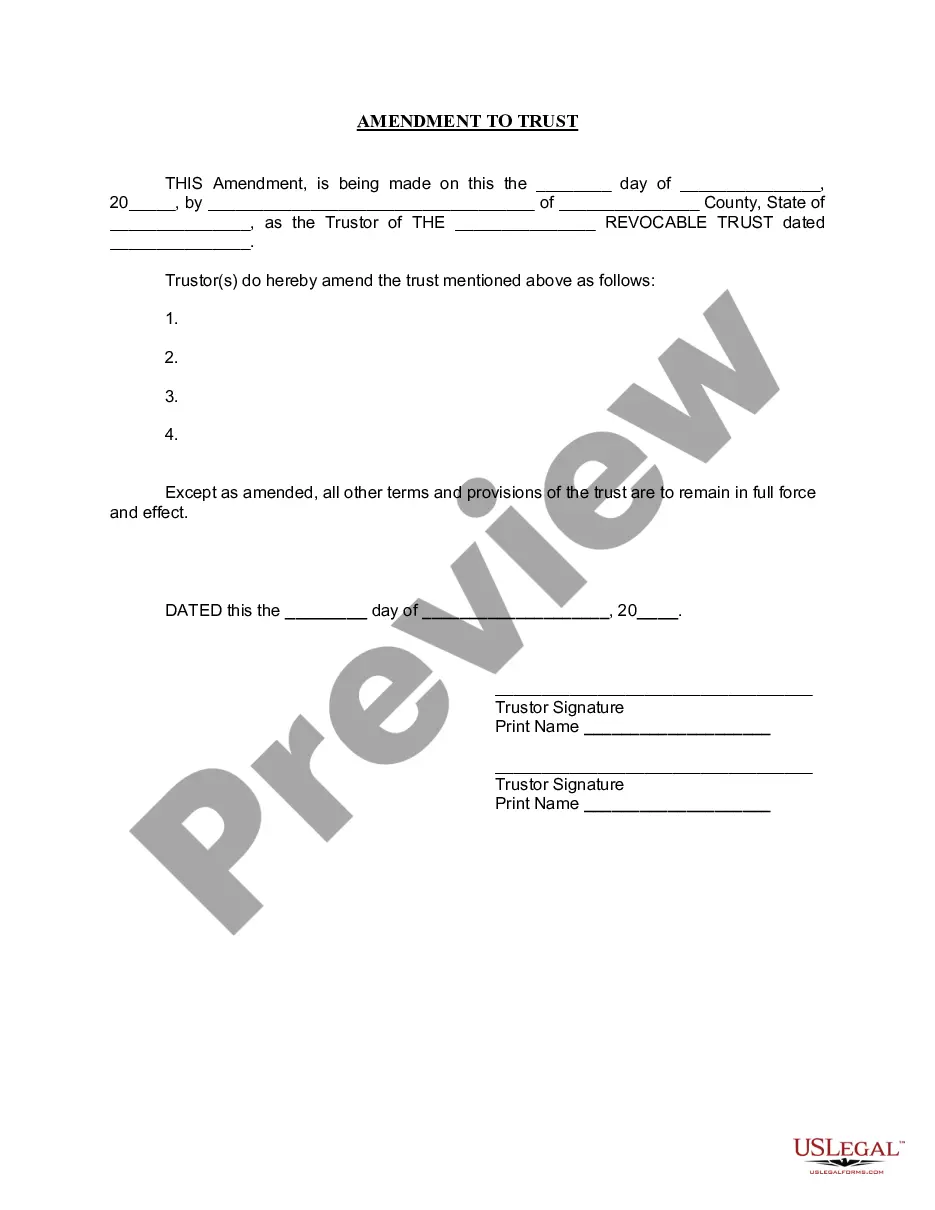
An amendment to a trust document is a legal change that updates the terms or provisions of an existing trust. If you have an Iowa amendment trust with the government, this process allows you to modify the trust to reflect current wishes or needs without creating an entirely new trust. It’s crucial to follow specific protocols for these amendments to ensure they are legally binding.
To set up a trust in Iowa, you'll need to decide on the type of trust you wish to establish. Working with an attorney can help clarify your options, such as creating an Iowa amendment trust with the government for your assets. You will typically require a written trust document, a named trustee, and an inventory of assets to fund the trust.
Amending a return can be straightforward if you have the correct documentation and information. If you made an error on a previous tax return for an Iowa amendment trust with the government, you can file Form 1040-X to correct it. While it acknowledges mistakes, reducing errors requires careful attention to details and understanding the IRS guidelines.
The purpose of IRS Form 1041 is to report the income, deductions, and credits of estates and trusts. When managing an Iowa amendment trust with the government, trustees must file this form annually if the trust has any taxable income. It helps ensure compliance with federal tax laws while providing a clear record of the trust’s financial activities.
In many cases, a trust offers advantages over a will, particularly in Iowa. Trusts can help you manage and distribute your assets without the lengthy probate process. Additionally, an Iowa amendment trust with the government provides privacy and control over your assets, which might not be available with a will. Consider your personal circumstances and consult an expert to determine the best option for you.
Amending a trust is generally straightforward, especially if you use resources like US Legal Forms. You will typically need to fill out a trust amendment form and follow the steps specified for your situation. Understanding the terms of your existing trust can simplify this process. With the right tools, you can successfully navigate your Iowa amendment trust with the government.
You can obtain a trust amendment form online through platforms like US Legal Forms. This resource provides a user-friendly process to access legally compliant forms. Simply search for 'Iowa amendment trust with the government' on their site, and you will find various options tailored to your needs. Using a trusted service ensures that your amendment meets all legal requirements.
Trust registration requirements vary by state, with some states not requiring registration at all. States like California and Delaware have specific rules about registration based on the trust's purpose. Understanding your state's laws is crucial for compliance. If you navigate these requirements alongside the Iowa amendment trust with the government, you will find the process less daunting.
A trust in Iowa works by allowing an individual to transfer assets to a trusted person or institution, known as a trustee. The trustee manages these assets according to the terms set forth in the trust agreement. This structure helps facilitate asset distribution efficiently and can provide tax benefits. Familiarizing yourself with the Iowa amendment trust with the government can further enhance your understanding of these processes.