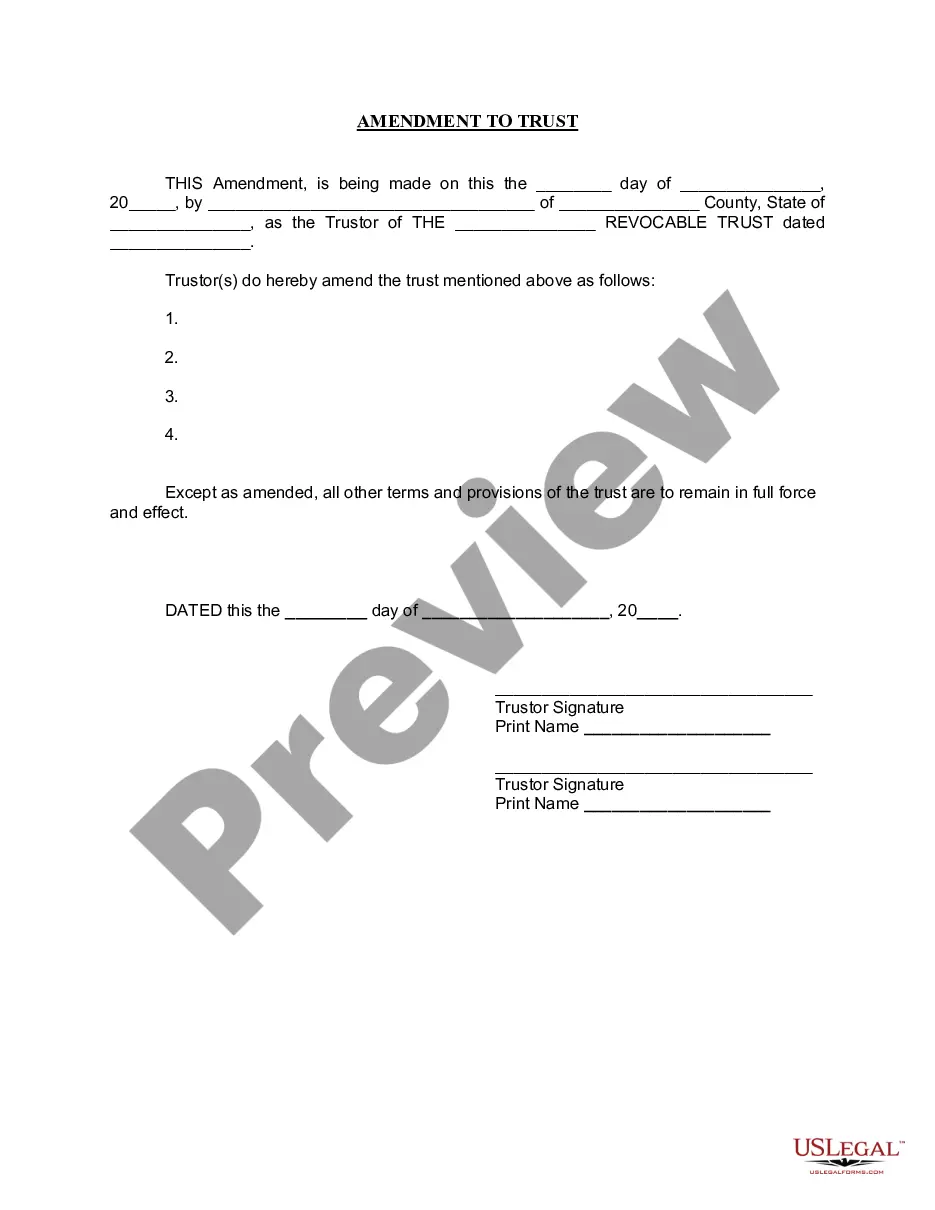
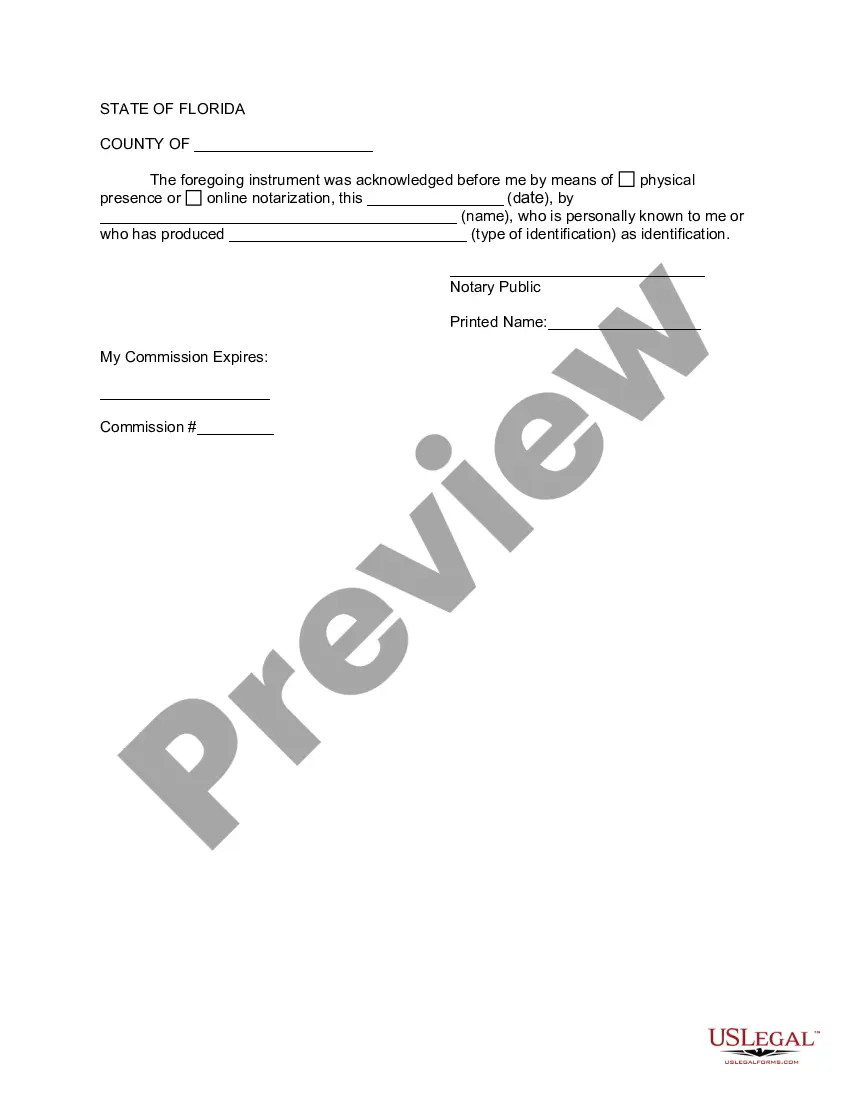
Sample Trust Amendment Form With 2 Points
Description


Get your form ready online
Our built-in tools help you complete, sign, share, and store your documents in one place.
Make edits, fill in missing information, and update formatting in US Legal Forms—just like you would in MS Word.
Download a copy, print it, send it by email, or mail it via USPS—whatever works best for your next step.
Sign and collect signatures with our SignNow integration. Send to multiple recipients, set reminders, and more. Go Premium to unlock E-Sign.
If this form requires notarization, complete it online through a secure video call—no need to meet a notary in person or wait for an appointment.
We protect your documents and personal data by following strict security and privacy standards.

Make edits, fill in missing information, and update formatting in US Legal Forms—just like you would in MS Word.

Download a copy, print it, send it by email, or mail it via USPS—whatever works best for your next step.

Sign and collect signatures with our SignNow integration. Send to multiple recipients, set reminders, and more. Go Premium to unlock E-Sign.

If this form requires notarization, complete it online through a secure video call—no need to meet a notary in person or wait for an appointment.

We protect your documents and personal data by following strict security and privacy standards.
Looking for another form?


How to fill out Florida Amendment To Living Trust?
Dealing with legal paperwork and processes can be a labor-intensive addition to your schedule. Sample Trust Amendment Form With 2 Points and similar forms typically necessitate that you locate them and understand how to fill them out correctly.
Consequently, whether you are managing financial, legal, or personal issues, utilizing a comprehensive and user-friendly online repository of forms readily available will be immensely beneficial.
US Legal Forms is the premier online platform for legal templates, featuring over 85,000 state-specific documents and a variety of tools to help you complete your paperwork with ease.
Explore the collection of suitable documents accessible to you with a single click.
Then, follow the steps below to complete your document: Ensure you have found the correct form using the Review feature and examining the form description. Select Buy Now when ready, and choose the monthly subscription plan that suits you best. Click Download then fill out, eSign, and print the form. US Legal Forms has twenty-five years of experience assisting clients with their legal paperwork. Acquire the form you need now and simplify any process without effort.
- US Legal Forms offers you state- and county-specific documents ready for download at any moment.
- Protect your document management processes by using a superior service that enables you to prepare any form in minutes without any additional or concealed fees.
- Simply Log In to your account, locate Sample Trust Amendment Form With 2 Points, and obtain it instantly in the My documents section.
- You can also access previously saved forms.
- Is it your first experience with US Legal Forms? Sign up and create an account in just a few minutes, and you will gain entry to the form library and Sample Trust Amendment Form With 2 Points.
Form popularity
FAQ
If there is no amendment clause in the Trust Deed, any amendment has to be done with the permission of a Civil Court. Once the Civil Court has allowed permission for amendment, it is not open on the part of the Income Tax Officer or any other person to challenge such amendment.
For example, you might use a trust amendment form to: Update your trustee or successor trustee: If your chosen trustee is no longer willing or able to manage the trust, or you'd like to designate someone else, you can use an amendment form to name another person or organization to manage your trust.
A restatement does not amend the trust but restates the entire trust and includes whatever changes the creator wishes to be included. It normally revokes the earlier trust entirely and replaces the old trust with the new version. The old trust becomes null and void, replaced entirely by the restated trust.
Revising the terms of a trust is known as ?amending? the trust. An amendment is generally appropriate when there are only a few minor changes to make, like rewording a certain paragraph, changing the successor trustee, or modifying beneficiaries.
So a Restatement would say ?I hereby take my entire trust named TRUST dated DATE and replace it with this whole new trust named TRUST dated TODAY'S DATE.? A restatement is generally cleaner, and a preferred way to amend trusts, as opposed to amendments.