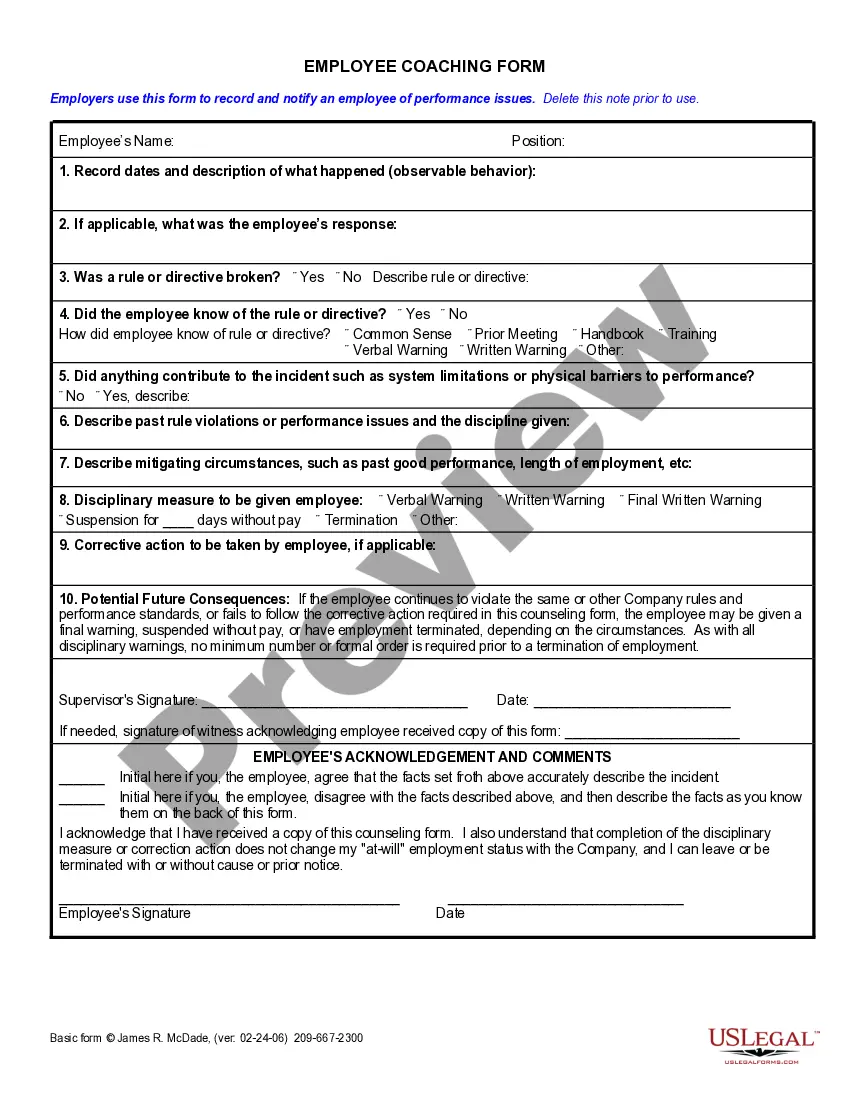
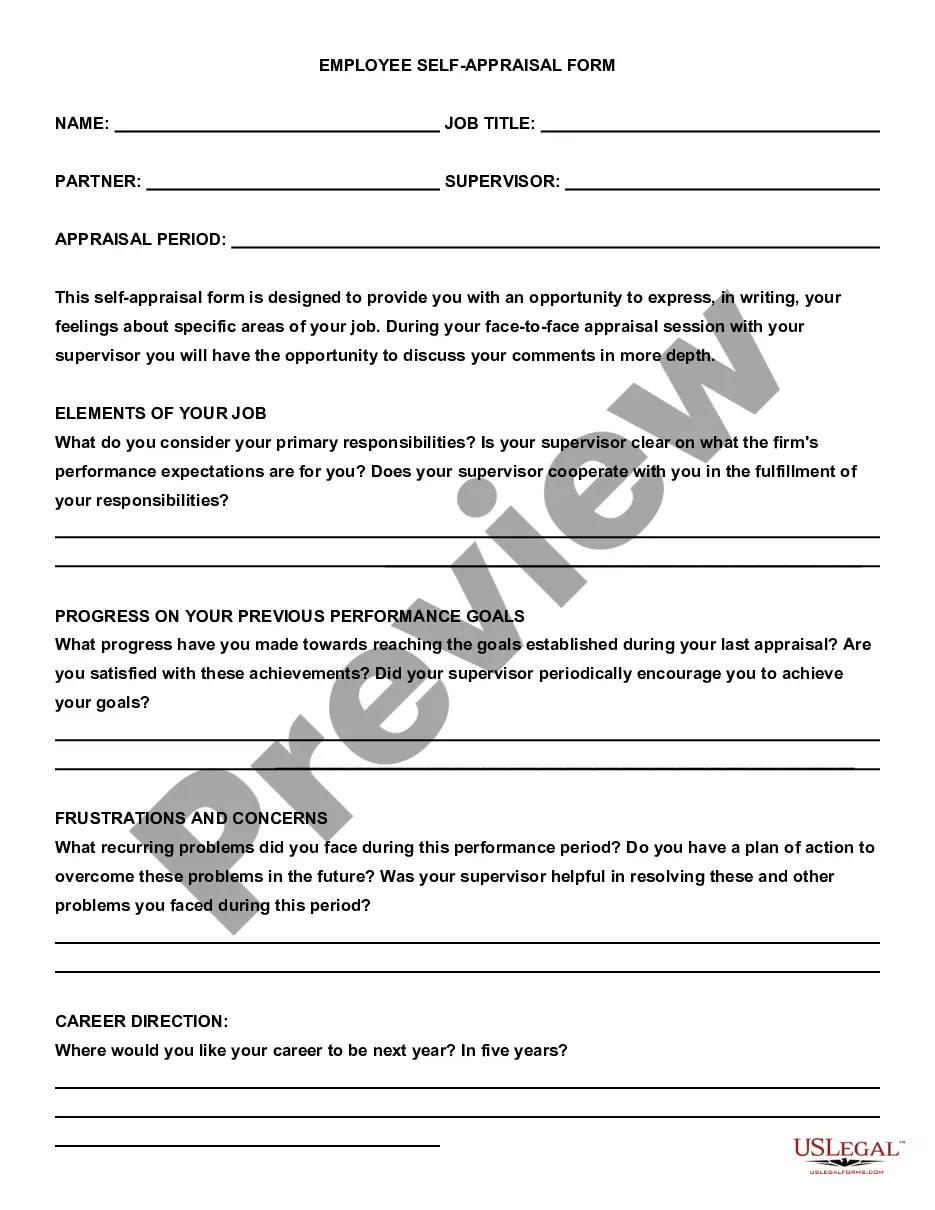
Employee Coaching Examples
Description
Get your form ready online
Our built-in tools help you complete, sign, share, and store your documents in one place.
Make edits, fill in missing information, and update formatting in US Legal Forms—just like you would in MS Word.
Download a copy, print it, send it by email, or mail it via USPS—whatever works best for your next step.
Sign and collect signatures with our SignNow integration. Send to multiple recipients, set reminders, and more. Go Premium to unlock E-Sign.
If this form requires notarization, complete it online through a secure video call—no need to meet a notary in person or wait for an appointment.
We protect your documents and personal data by following strict security and privacy standards.

Make edits, fill in missing information, and update formatting in US Legal Forms—just like you would in MS Word.

Download a copy, print it, send it by email, or mail it via USPS—whatever works best for your next step.

Sign and collect signatures with our SignNow integration. Send to multiple recipients, set reminders, and more. Go Premium to unlock E-Sign.

If this form requires notarization, complete it online through a secure video call—no need to meet a notary in person or wait for an appointment.

We protect your documents and personal data by following strict security and privacy standards.
Looking for another form?

How to fill out California Employee Coaching Form?
Utilizing legal documents that adhere to federal and state laws is essential, and the web provides numerous choices to select from.
However, why spend time searching for the accurately formulated Employee Coaching Examples template online when the US Legal Forms digital library already consolidates such documents in one location.
US Legal Forms is the largest online legal repository with over 85,000 fillable templates created by attorneys for all professional and personal situations.
Review the template using the Preview function or through the text description to confirm it fulfills your needs.
- They are simple to navigate with all documents sorted by state and intended use.
- Our experts stay updated with legal changes, ensuring your form is current and compliant when acquiring an Employee Coaching Examples from our site.
- Getting an Employee Coaching Examples is swift and straightforward for both existing and new users.
- If you have an account with a valid membership, Log In and store the document sample you require in the desired format.
- If you are a newcomer to our website, follow the steps below.
Form popularity
FAQ
An example of employee coaching could involve a manager helping a team member improve their presentation skills. The manager provides constructive feedback, suggests resources, and offers practice sessions, illustrating the practical application of employee coaching examples. This real-time guidance not only enhances the employee’s abilities but also strengthens the manager-employee relationship. Utilizing coaching techniques leads to more effective outcomes for both parties.
The 5 C's of coaching are clarity, connection, competence, confidence, and collaboration. These elements ensure effective employee coaching examples that lead to personal and professional growth. By focusing on clarity, you set clear objectives for your coaching sessions. Establishing connection fosters trust, competence builds skills, and confidence promotes self-assurance, while collaboration encourages teamwork.
The 70 30 rule in coaching suggests that, ideally, 70% of learning happens through experiential, on-the-job activities and 30% comes from formal education and training. This approach emphasizes the importance of applying what employees learn in real-world situations, which is crucial for effective development. By utilizing employee coaching examples, organizations can illustrate how practical experiences contribute to skill growth and overall performance. Understanding this balance helps leaders foster a more engaging and impactful coaching environment.
To effectively document employee coaching, start by keeping detailed notes during each coaching session. Use structured templates that highlight key points discussed, goals set, and progress made. For instance, when you present employee coaching examples, ensure you document both achievements and areas for improvement. This systematic approach not only tracks the employee's development but also serves as a valuable reference for future conversations.
Hear this out loud PauseAn example is an employee who turns in work late puts a project behind schedule, but a coach can help develop time management skills and improve the employee's productivity. Coaches may provide one-on-one training when company policy changes to help employees change their behavior and adapt to innovations.
How to coach employees effectively Praise achievements and growth. ... Explain why this change or development is important. ... Collaborate on solutions. ... Set SMART goals with them. ... Write out the action plan. ... Revise the goals and plan.
How to create a coaching plan Establish the employees' strengths. ... Locate any areas of improvement. ... Ask the employee to evaluate their performance. ... Determine any obstacles in the way of the employee's success. ... Provide potential solutions to help the employee overcome the obstacle. ... Develop short-term and long-term goals.
Hear this out loud PauseThe information required on a coaching form typically includes the date, the names of the participants, the goal of the coaching session, the topics discussed, the action items to be completed, and the date of the next coaching session.
An example is an employee who turns in work late puts a project behind schedule, but a coach can help develop time management skills and improve the employee's productivity. Coaches may provide one-on-one training when company policy changes to help employees change their behavior and adapt to innovations.