California Quitclaim Deed
Understanding this form
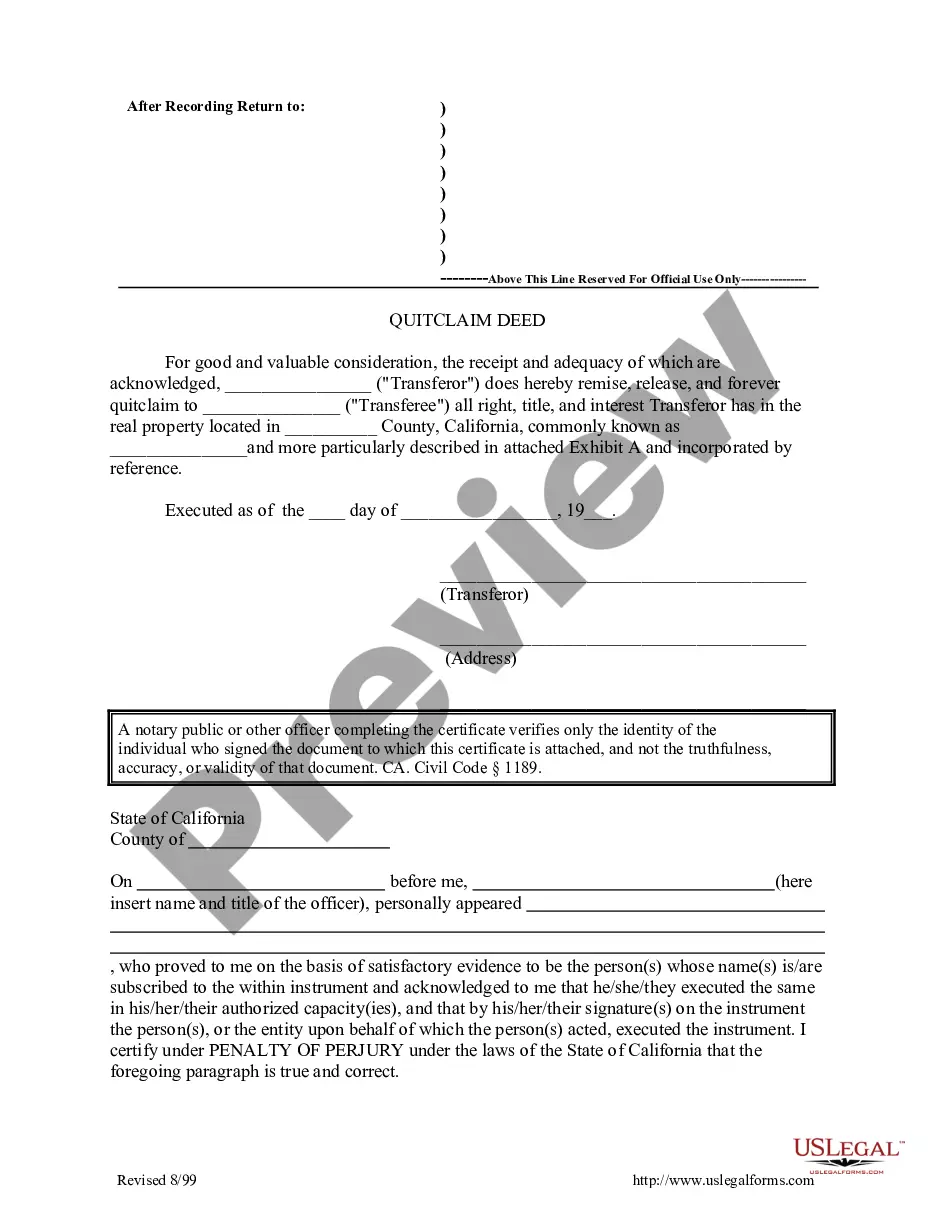
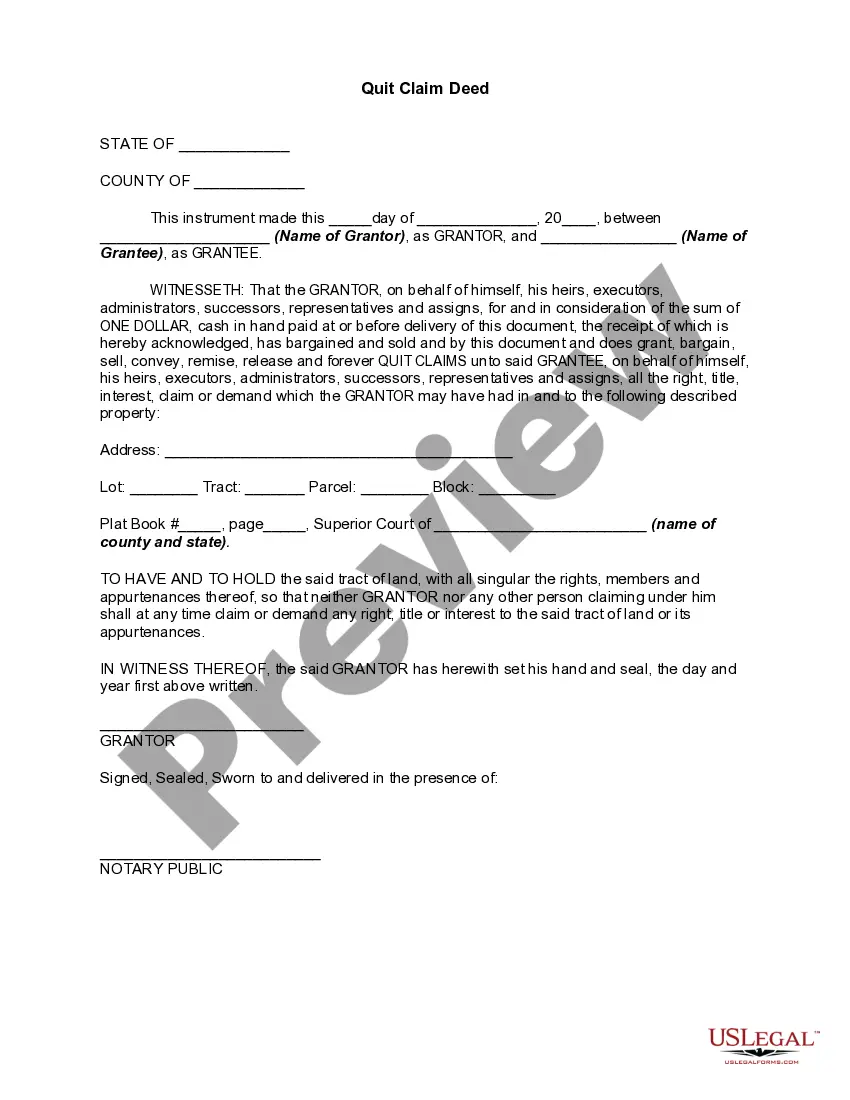
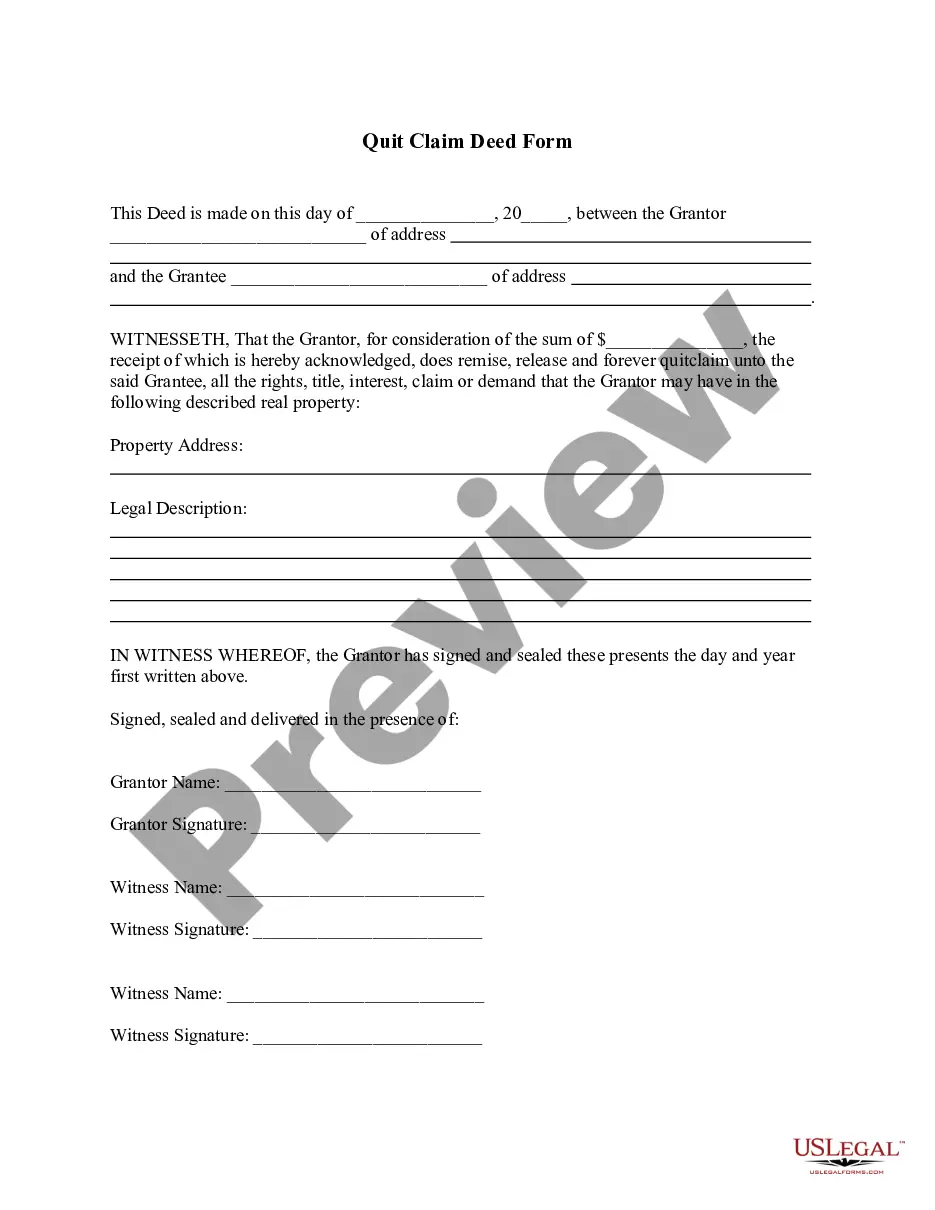
A Quitclaim Deed is a legal document used to transfer property rights from one party to another without making any warranties about the title. Unlike a warranty deed, which guarantees the grantor's right to transfer property, a quitclaim deed simply relinquishes any claim the grantor has to the property. This form is particularly useful in situations such as family transfers, divorce settlements, or when the exact ownership rights are uncertain.
Main sections of this form
- Transferor and Transferee: Identifies the person transferring the property and the person receiving it.
- Property Description: Provides the legal description of the property being transferred.
- Execution Date: Indicates when the deed is executed.
- Notary Acknowledgment: Confirms that the signatures were witnessed by a notary public.




Situations where this form applies
This form is typically used in circumstances where the property owner wishes to transfer ownership without providing any guarantee about the property title. Common scenarios include transferring property to a family member, resolving disputes in a divorce, or during estate planning to simplify property transfers.
Who this form is for
- Individuals transferring property to family members or friends.
- People involved in divorce proceedings needing to transfer property ownership.
- Estate executors or administrators handling property transfers as part of the estate settlement process.
How to prepare this document
- Identify the transferor (the person giving up ownership) and transferee (the person receiving the property).
- Complete the description of the property being transferred, including common name and legal description.
- Enter the execution date when the deed is signed.
- Have the transferor sign the deed in the presence of a notary public.
- Ensure the notary public completes the acknowledgment section, confirming the identity of the signer.
Is notarization required?
This form must be notarized to be legally valid. US Legal Forms provides secure online notarization powered by Notarize, allowing you to complete the process through a verified video call.
Get your form ready online
Our built-in tools help you complete, sign, share, and store your documents in one place.
Make edits, fill in missing information, and update formatting in US Legal Forms—just like you would in MS Word.
Download a copy, print it, send it by email, or mail it via USPS—whatever works best for your next step.
Sign and collect signatures with our SignNow integration. Send to multiple recipients, set reminders, and more. Go Premium to unlock E-Sign.
If this form requires notarization, complete it online through a secure video call—no need to meet a notary in person or wait for an appointment.
We protect your documents and personal data by following strict security and privacy standards.

Make edits, fill in missing information, and update formatting in US Legal Forms—just like you would in MS Word.

Download a copy, print it, send it by email, or mail it via USPS—whatever works best for your next step.

Sign and collect signatures with our SignNow integration. Send to multiple recipients, set reminders, and more. Go Premium to unlock E-Sign.

If this form requires notarization, complete it online through a secure video call—no need to meet a notary in person or wait for an appointment.

We protect your documents and personal data by following strict security and privacy standards.
Common mistakes
- Failing to properly describe the property, which can lead to ambiguity in the transfer.
- Not having the deed notarized, which may render it invalid in some cases.
- Forgetting to include all required signatures, particularly from the transferor.
Benefits of completing this form online
- Convenient access to legal forms from anywhere, eliminating the need for in-person visits.
- Editability allows users to customize the form easily to match their circumstances.
- Reliable templates created by licensed attorneys, ensuring compliance with legal standards.
Looking for another form?
Form popularity
FAQ
In California, a quit claim deed is signed by the person transferring interest in the property, known as the grantor. The grantee, or the person receiving the interest, does not need to sign the document. It is essential to include the signatures of all grantors to make the California quitclaim deed legally effective. If you need assistance with the process or require templates, consider using the US Legal Forms platform for comprehensive resources.
In California, a quitclaim deed can be prepared by anyone, but it is often advisable to have an attorney or a qualified professional assist you. Using a legal service like US Legal Forms can simplify the process by providing state-specific templates and guidance. This ensures that the deed meets all legal requirements and protects your interests. Always make sure to review the completed document before submitting it to ensure it is accurate.
To get a California quitclaim deed, start by downloading a template specific to California from a reliable source. Fill in the required details, including the names of the parties involved and a legal description of the property. After completing the form, you need to sign it in front of a notary public. Finally, file the quitclaim deed with the county recorder's office where the property is located to ensure it is legally recognized.
Yes, a California Quitclaim Deed must be notarized to be legally valid. The notary public confirms the identity of the person signing the deed, which adds a layer of security to the transaction. After notarization, the deed can be recorded with the local county recorder's office for proper documentation. Ensuring notarization is a vital step in transferring property ownership confidently.
In California, a quitclaim deed can be prepared by an individual, attorney, or a qualified real estate professional. It is advisable to seek assistance from legal experts or platforms like US Legal Forms to ensure that the deed complies with local regulations. Their resources can provide accuracy and help avoid common mistakes. Using a reliable service simplifies the preparation process and enhances your peace of mind.
To submit a California Quitclaim Deed, begin by completing the deed form accurately. Once completed, you need to sign it in the presence of a notary public. After notarization, file the deed with the local county recorder's office. This process ensures that the transfer is legally recognized and protected.
If a California Quitclaim Deed is not recorded, it may lead to complications regarding property ownership. Without recording, third parties remain unaware of the transfer, which can result in legal disputes. It is essential to record the deed with the county recorder’s office to protect your interest and establish clear title. Recording also serves as public notice, helping to confirm your ownership rights.
Quitclaim deeds are most commonly used to transfer property between family members, with limited legal formality. They also play a significant role in simplifying property transfers in cases of divorce or separation. In essence, they provide a straightforward way to manage shared ownership or resolve disputes without lengthy legal procedures.
Individuals transferring property within families often benefit the most from a California Quitclaim Deed. This includes situations like gifting property or resolving estate issues without the need for a sale. Additionally, this deed can serve as a practical solution for partners dissolving business relationships while maintaining clear terms.
A quitclaim deed does not override a will, as these are two distinct legal documents. While a quitclaim deed transfers ownership of property immediately, a will governs the distribution of an estate after someone passes away. It is important to coordinate the two to ensure there are no conflicts between your wishes and the deed's terms.