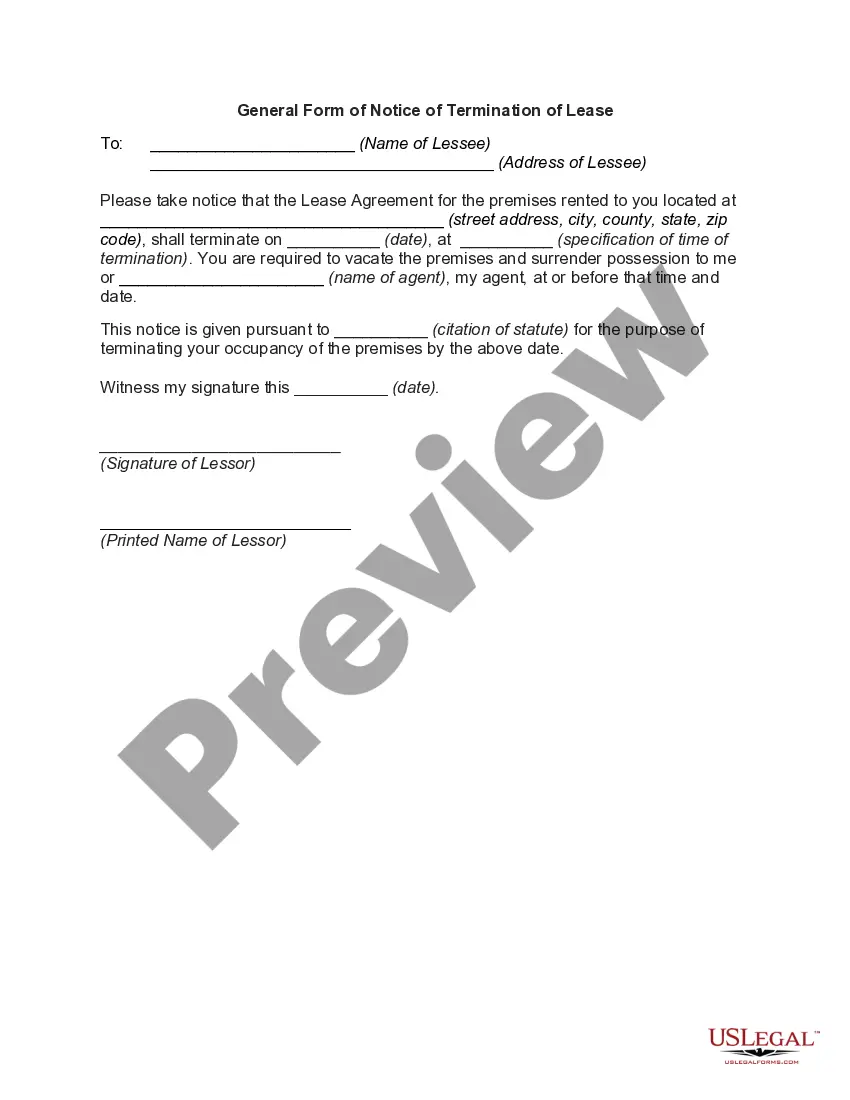
Canada Termination For Cause
Description

Get your form ready online
Our built-in tools help you complete, sign, share, and store your documents in one place.
Make edits, fill in missing information, and update formatting in US Legal Forms—just like you would in MS Word.
Download a copy, print it, send it by email, or mail it via USPS—whatever works best for your next step.
Sign and collect signatures with our SignNow integration. Send to multiple recipients, set reminders, and more. Go Premium to unlock E-Sign.
If this form requires notarization, complete it online through a secure video call—no need to meet a notary in person or wait for an appointment.
We protect your documents and personal data by following strict security and privacy standards.

Make edits, fill in missing information, and update formatting in US Legal Forms—just like you would in MS Word.

Download a copy, print it, send it by email, or mail it via USPS—whatever works best for your next step.

Sign and collect signatures with our SignNow integration. Send to multiple recipients, set reminders, and more. Go Premium to unlock E-Sign.

If this form requires notarization, complete it online through a secure video call—no need to meet a notary in person or wait for an appointment.

We protect your documents and personal data by following strict security and privacy standards.
Looking for another form?



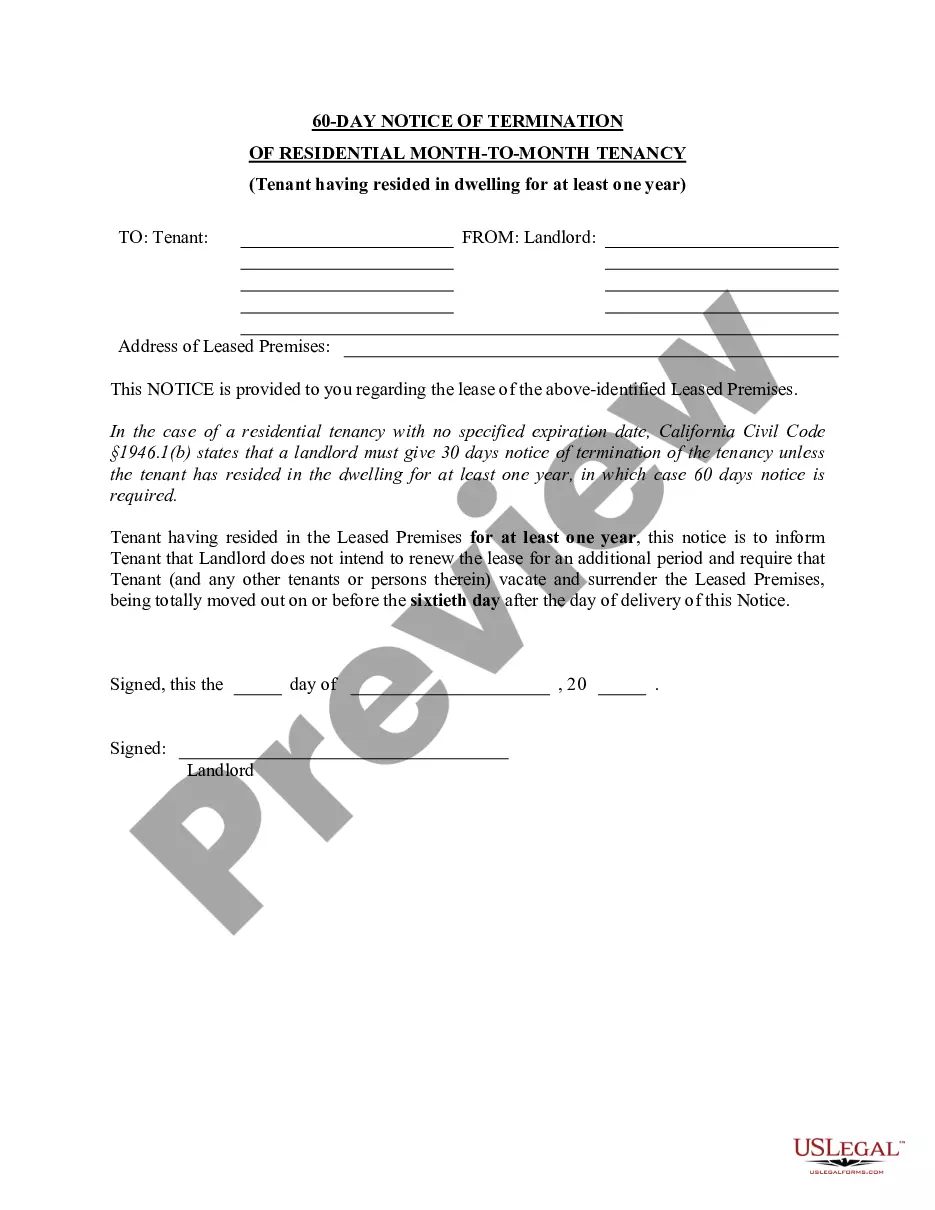
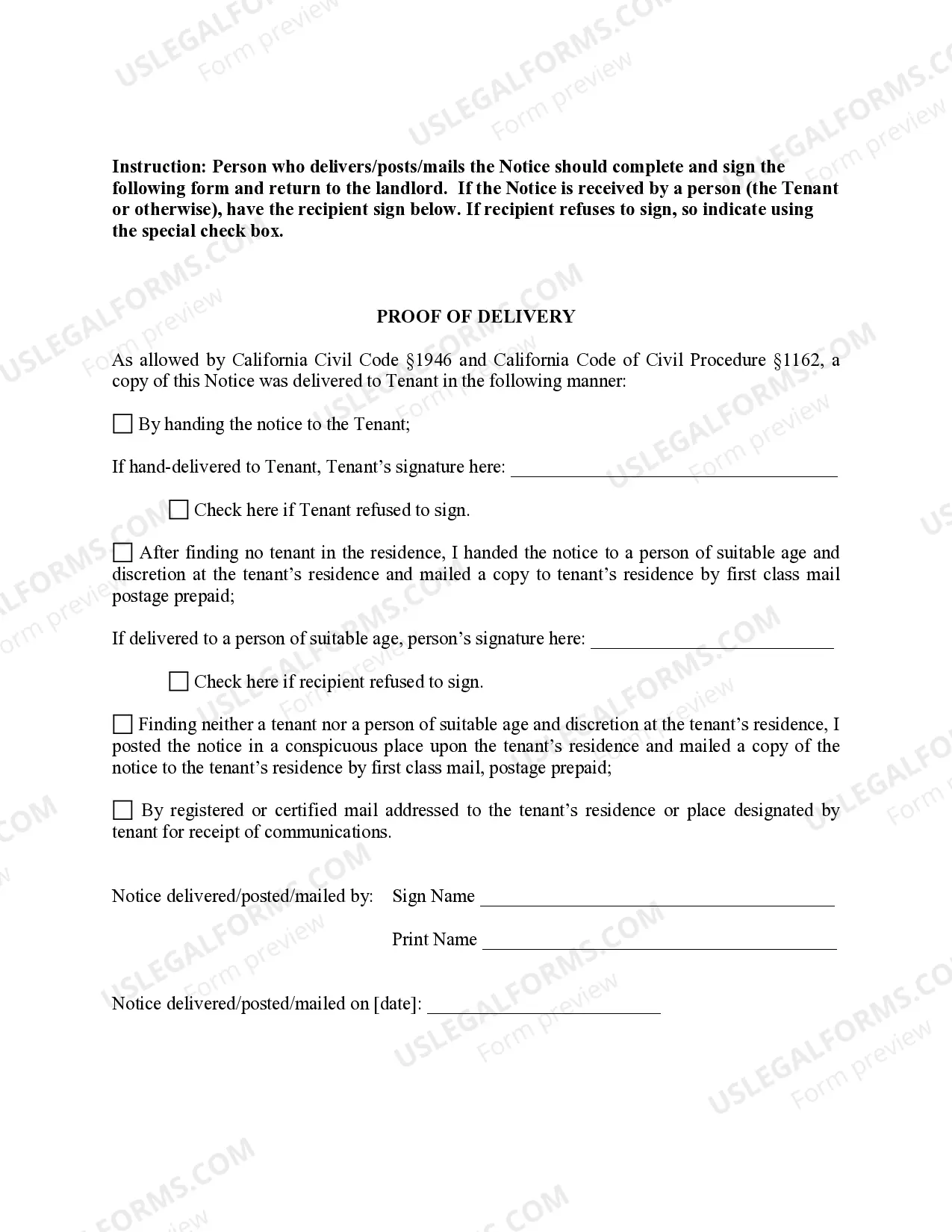
How to fill out California 60 Day Notice Of Termination - Residential Month-to-Month Tenancy?
Identifying a reliable location to obtain the latest and most pertinent legal templates is a significant portion of the challenge associated with bureaucracy. Locating the appropriate legal documents requires precision and careful consideration, which is why it's essential to source Canada Termination For Cause samples solely from trustworthy providers, such as US Legal Forms. An incorrect template will squander your time and prolong the matter at hand. With US Legal Forms, you have minimal concerns. You can access and review all information related to the document’s applicability and relevance for your situation and within your state or county.
Take the following actions to finalize your Canada Termination For Cause.
Eliminate the stress associated with your legal documentation. Dive into the extensive US Legal Forms catalog where you can discover legal samples, assess their relevance to your needs, and download them instantly.
- Utilize the catalog navigation or search bar to find your template.
- Examine the form’s details to verify if it meets your state and regional requirements.
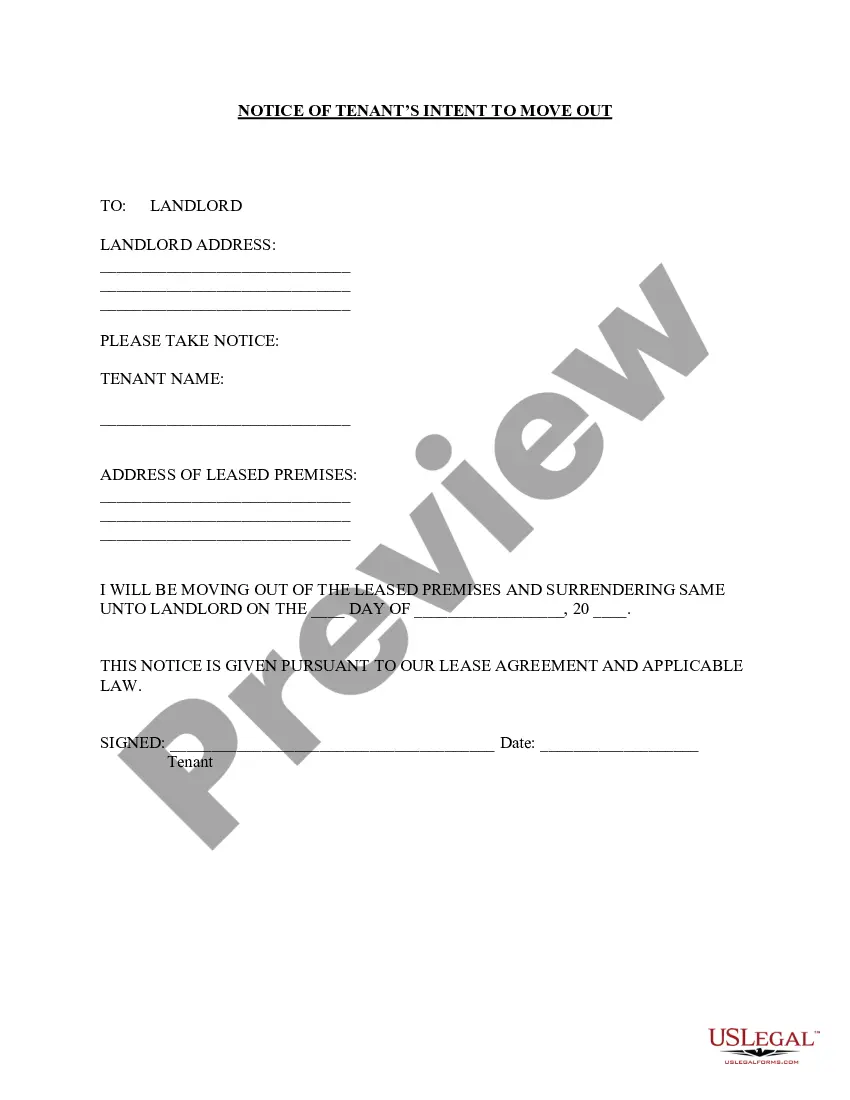
- Check the form preview, if available, to ensure that the form is indeed the one you are looking for.
- Continue your search and find the correct document if the Canada Termination For Cause does not align with your needs.
- If you are confident about the form’s pertinence, download it.
- As an authorized user, click Log in to verify and gain access to your chosen forms in My documents.
- If you do not possess an account yet, click Buy now to acquire the form.
- Select the pricing option that fits your requirements.
- Proceed with the registration to finalize your purchase.
- Complete your transaction by choosing a payment method (credit card or PayPal).
- Choose the document format for downloading Canada Termination For Cause.
- Once you have the form on your device, you can modify it using the editor or print it and fill it out manually.
Form popularity
FAQ
Yes, you can absolutely ask for a reason for your termination. Employers are generally expected to provide clear reasons to uphold fair practices, especially in Canada termination for cause scenarios. Understanding the reasoning behind your dismissal can be crucial for assessing your next steps and determining if any legal recourse is available. Engaging with a platform like uslegalforms can help you navigate this process efficiently.
Paragraph 1: Advise the employee that they are terminated and include an effective date. Paragraph 2: Include a statement reflecting that the reasons for termination have been outlined in the previous warning letters.
What to include in your employee termination letter Employee name. ... The date of termination. ... Reason(s) for the employee's termination. ... Documented disciplinary action prior to termination. ... Employee benefits. ... Employee acknowledgment of termination. ... Terminated employee's forwarding address. ... Instructions for their last paycheck.
Canadian employment law requires a very high standard to dismiss an employee for just cause. Generally, there must be serious misconduct by the employee (such as theft, violence, fraud, etc.) to warrant receiving no termination or severance pay.
Simply state the reasons and leave it at that. To do more is to risk hurting the employee's feelings unnecessarily or drawing the employee into an argument. There's no point trying to prove to the employee that firing was your only option.
Incompetence, including lack of productivity or poor quality of work. Insubordination and related issues such as dishonesty or breaking company rules. Attendance issues, such as frequent absences or chronic tardiness. Theft or other criminal behavior including revealing trade secrets.