Damage Release (For Fiber Optic Easement)
What this document covers
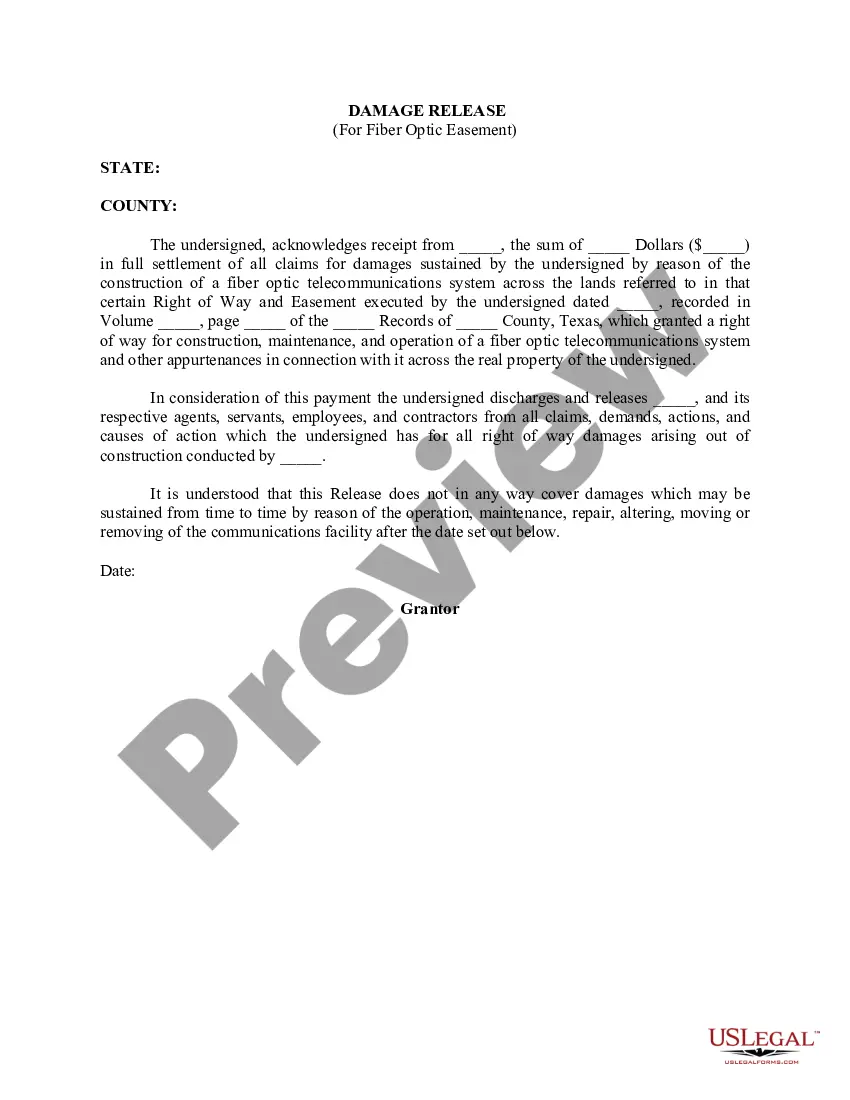
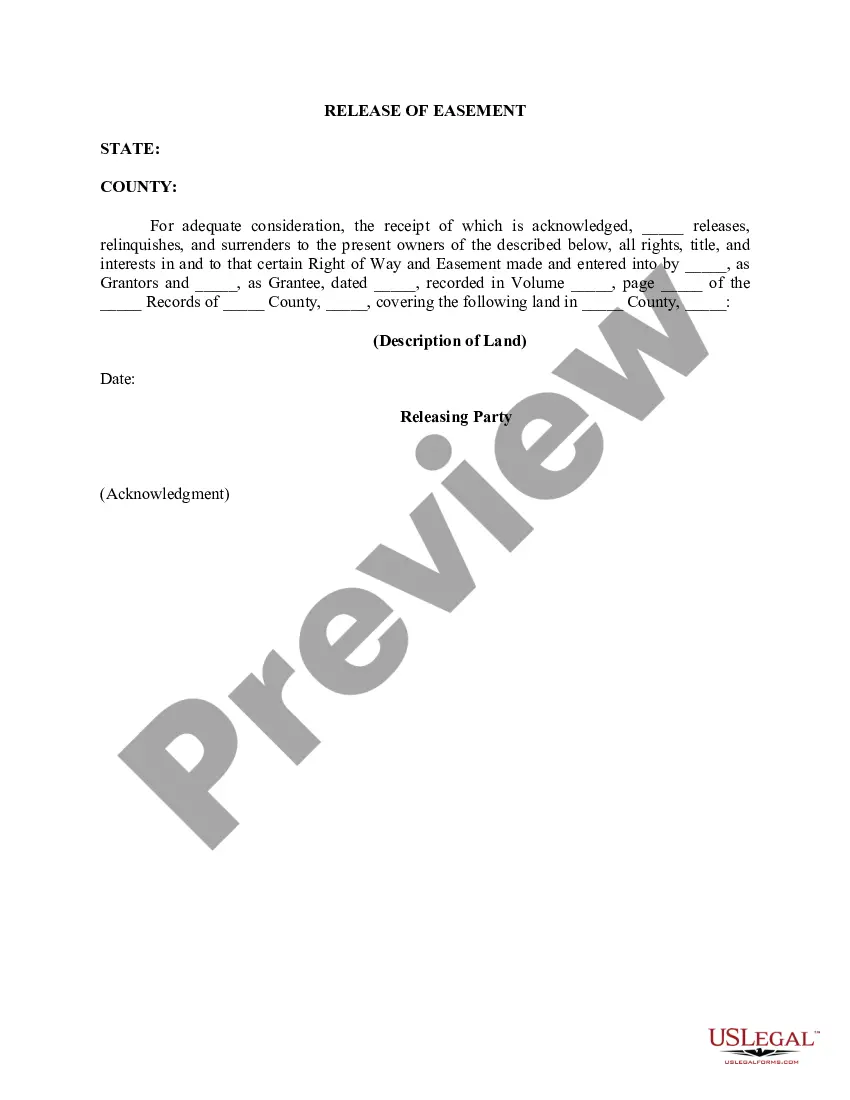
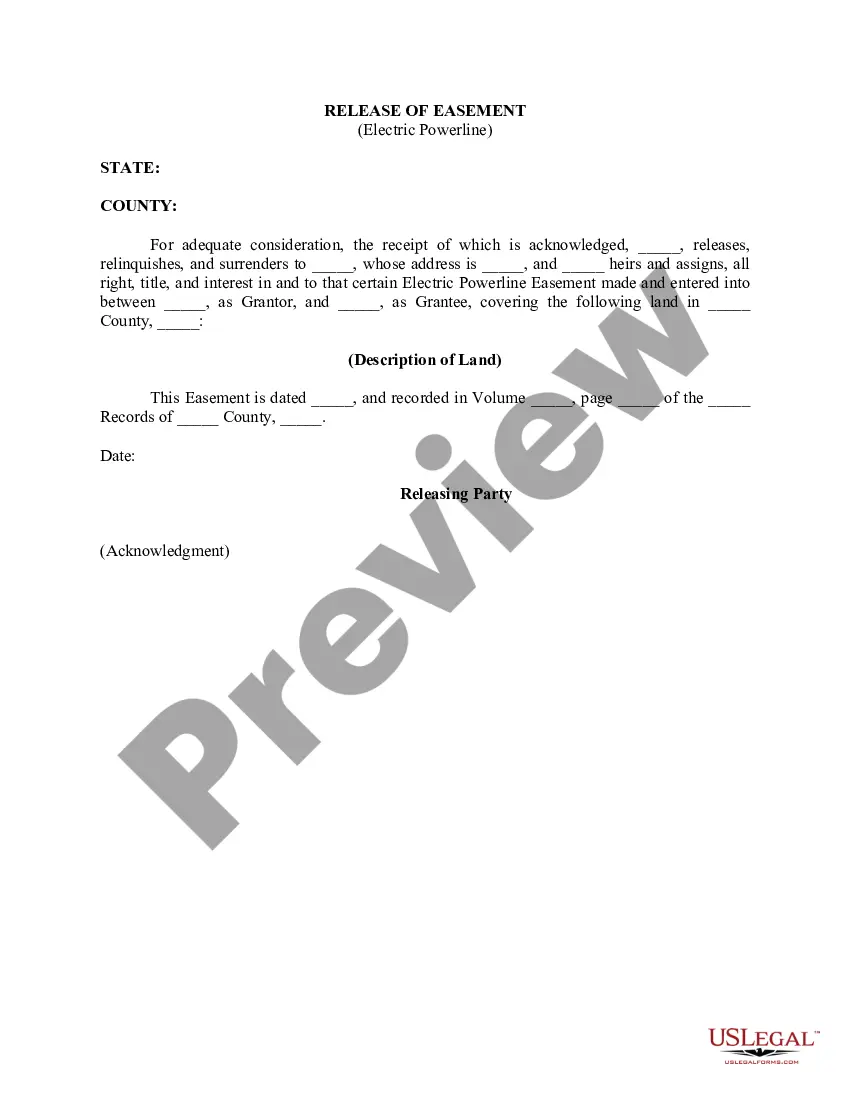
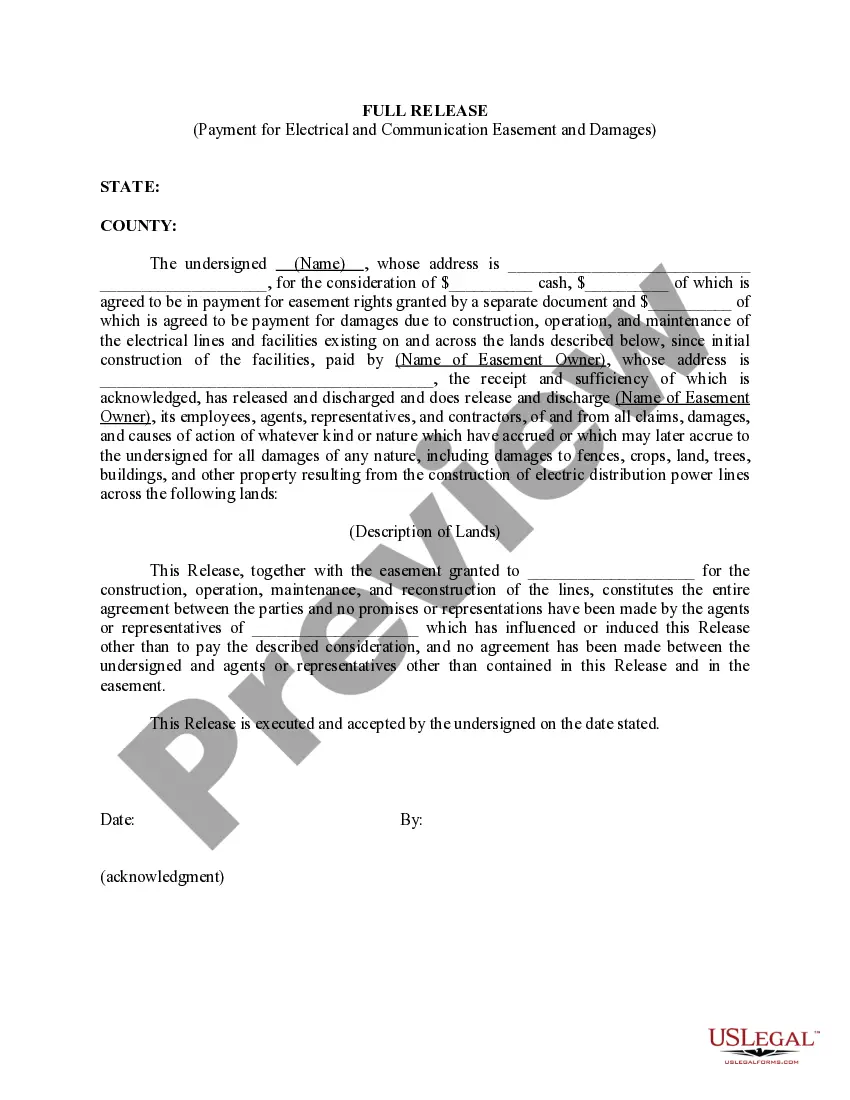
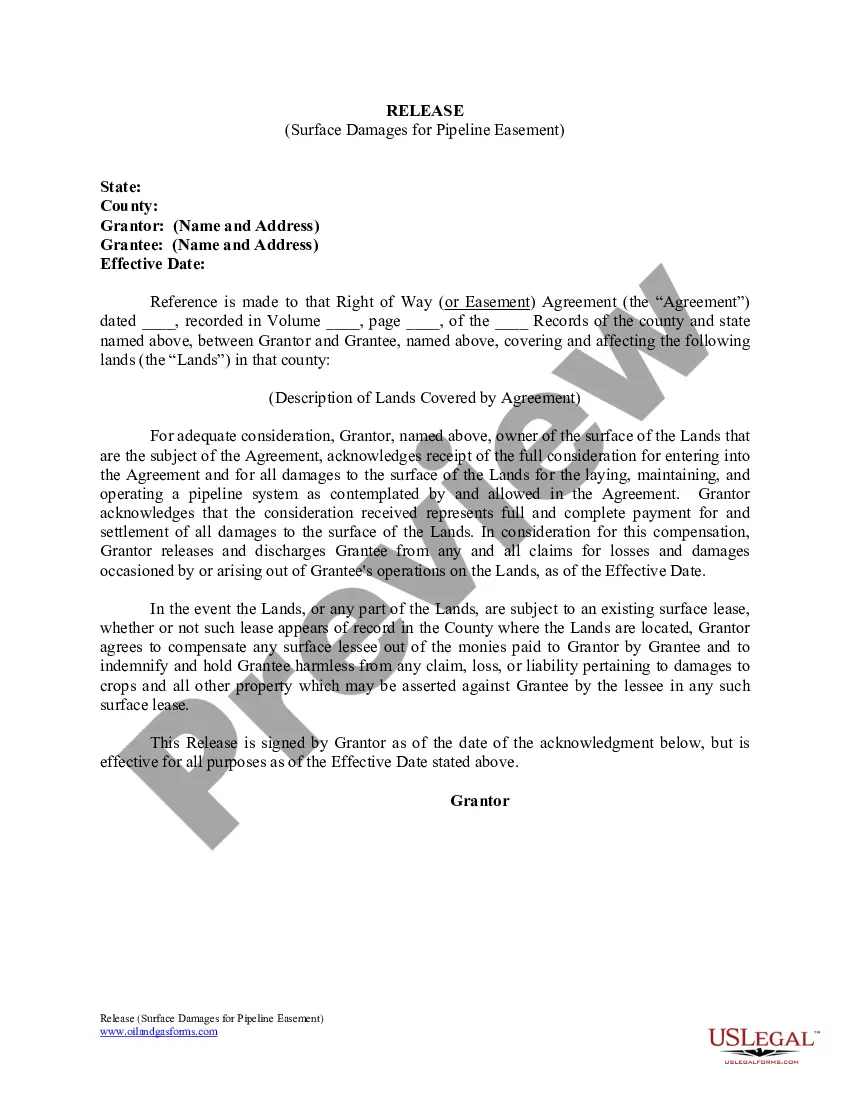
The Damage Release for Fiber Optic Easement is a legal document that allows property owners to release claims for damages resulting from the construction of fiber optic telecommunications infrastructure on their land. This form is crucial for resolving disputes related to damages sustained during construction, ensuring that both parties have clarity on their rights and obligations. Unlike general release forms, this specific document pertains specifically to fiber optic easement scenarios, offering focused protections and responsibilities for those involved.
What’s included in this form
- Identification of the party making the release
- Statement acknowledging receipt of settlement funds
- Reference to the specific right of way and easement agreement
- Discharge clauses releasing the other party from claims
- Exclusions for future damages from operation and maintenance
When to use this document
This form should be utilized when a property owner has incurred damages due to the construction of a fiber optic telecommunications system. It is typically used after the property owner has negotiated a settlement with the entity constructing the fiber optic lines, ensuring that they relinquish any claims related to damages caused during the construction process.
Who should use this form
The following individuals or entities should consider using this form:
- Property owners who have had fiber optic lines constructed on their property
- Telecommunications companies seeking to finalize settlement agreements with landowners
- Legal representatives drafting agreements related to fiber optic easements
Instructions for completing this form
- Identify the parties involved, including the property owner and the telecommunications company.
- Specify the amount of settlement being received for the damages.
- Provide the details of the previous right of way and easement agreement, including dates and volume/page references.
- Include the date of signing at the bottom of the form.
- Ensure all parties sign the document to acknowledge agreement to the terms.
Is notarization required?
To make this form legally binding, it must be notarized. Our online notarization service, powered by Notarize, lets you verify and sign documents remotely through an encrypted video session.
Get your form ready online
Our built-in tools help you complete, sign, share, and store your documents in one place.
Make edits, fill in missing information, and update formatting in US Legal Forms—just like you would in MS Word.
Download a copy, print it, send it by email, or mail it via USPS—whatever works best for your next step.
Sign and collect signatures with our SignNow integration. Send to multiple recipients, set reminders, and more. Go Premium to unlock E-Sign.
If this form requires notarization, complete it online through a secure video call—no need to meet a notary in person or wait for an appointment.
We protect your documents and personal data by following strict security and privacy standards.

Make edits, fill in missing information, and update formatting in US Legal Forms—just like you would in MS Word.

Download a copy, print it, send it by email, or mail it via USPS—whatever works best for your next step.

Sign and collect signatures with our SignNow integration. Send to multiple recipients, set reminders, and more. Go Premium to unlock E-Sign.

If this form requires notarization, complete it online through a secure video call—no need to meet a notary in person or wait for an appointment.

We protect your documents and personal data by following strict security and privacy standards.
Common mistakes to avoid
- Failing to accurately identify the right of way and easement agreement.
- Not specifying the correct settlement amount.
- Omitting signatures from all necessary parties.
- Missing the date of the agreement, which can lead to enforceability issues.
Why use this form online
- Immediate access to a professionally drafted legal document.
- Ability to download and edit the form according to specific needs.
- Convenience of completing the form at your own pace.
- Reliability of ensuring compliance with legal standards.
Summary of main points
- The Damage Release for Fiber Optic Easement protects property owners by formally releasing claims post-construction.
- Correctly completing the form ensures that both parties understand their rights and obligations.
- Utilizing this form can help avoid future disputes over damages related to ongoing maintenance or operation.
Looking for another form?




Form popularity
FAQ
An easement gives a person the legal right to go through another person's land, as long as the usage is consistent with the specified easement restrictions. Although an easement grants a possessory interest in the land for a specific purpose, the landowner retains the title to the property.
Enter into an agreement with the easement holder to terminate the easement. Buy the adjoining property. Explore legal remedies to limit or terminate the easement.
So, having an easement on a property may have a permanent outcome on the property with rights of the home owner. But not all easements are bad.If you live in a rural area, you run into bad easement issues more often, typically where the easement was created by a parcel owner next to your land.
Give the document a simple title: Grant of Easement is sufficient. Identify the parties. You need to explain who the parties are to the agreement. The person granting the easement to his property is the Grantor and the person gaining access to the property is the Grantee.
The party gaining the benefit of the easement is the dominant estate (or dominant tenement), while the party granting the benefit or suffering the burden is the servient estate (or servient tenement). For example, the owner of parcel A holds an easement to use a driveway on parcel B to gain access to A's house.
Thus, the simplest method by which an owner can prevent an easement from being acquired on his or her property is by giving his consent to the other person's use. Once permission is given, the use by the neighbor (or the neighbor's tenant) is not adverse.
When one of the owners of either the dominant estate which an easement benefits or the servient estate over which the easement runs becomes the owner of both properties, then there is a unity of the two titles, and since an owner does not need an easement over the owner's own property, according to Florida law, the
You can terminate an easement by release. A release is a surrender of a right or interest, such as an easement. Only the person holding the right can release it, such as the owner of the dominant estate in an easement appurtenant or the holder of an easement in gross.
Rights of way (similar to the driveway example, but also including walkways or pathways); Public utilities, such as gas, electricity or water and sewer mains; Parking areas; Access to light and air; and. Shared walls.