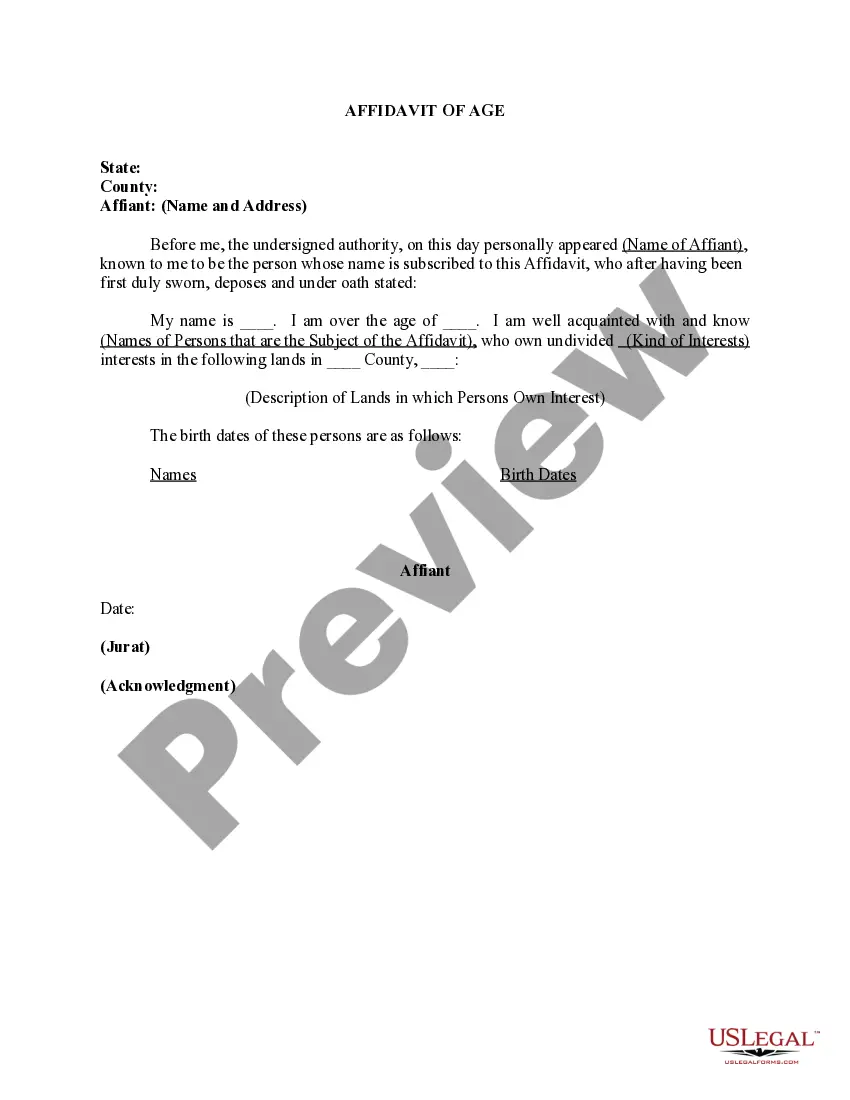
Affidavit of Age
What this document covers
The Affidavit of Age is a legal document in which an individual swears under oath that they meet a specific age requirement. This affidavit is often used to verify the age of individuals when official records are not available or need confirmation. Unlike other types of affidavits that may confirm different facts, this form specifically addresses age-related assertions, making it suitable for various legal purposes, including property and inheritance disputes or enrollment in certain programs requiring proof of age.
Form components explained
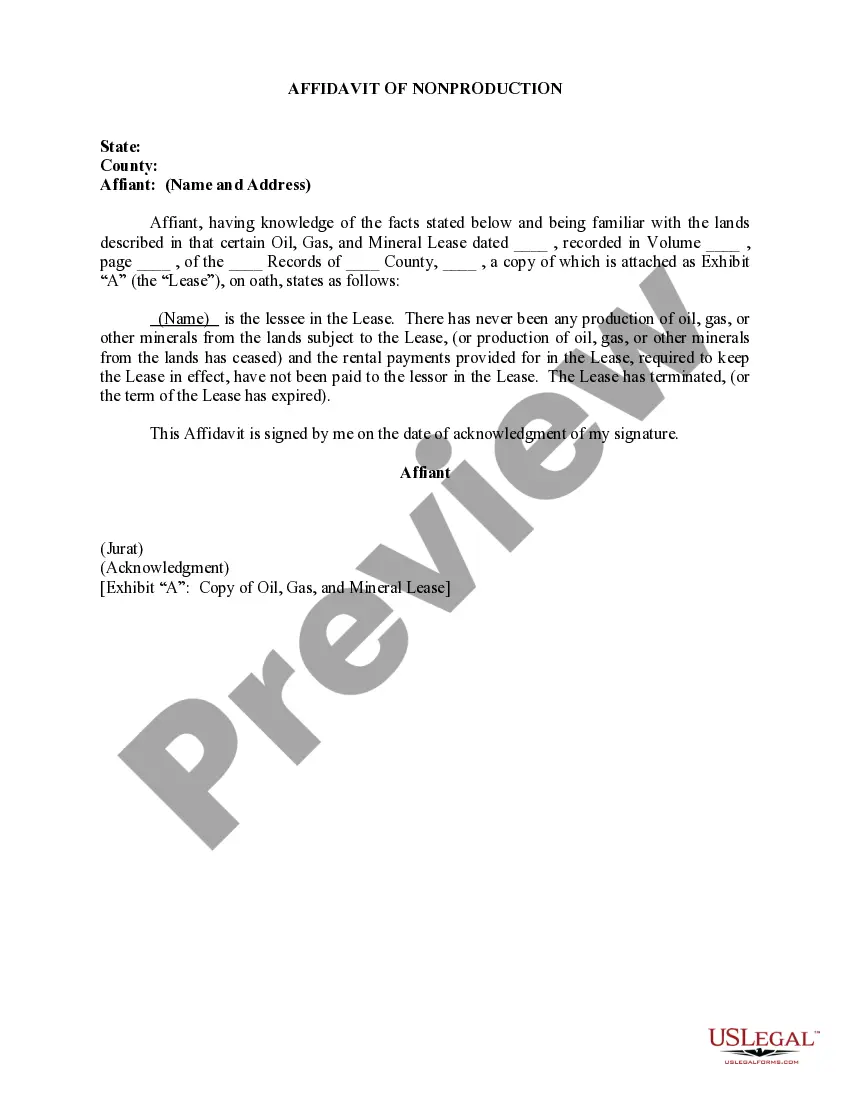
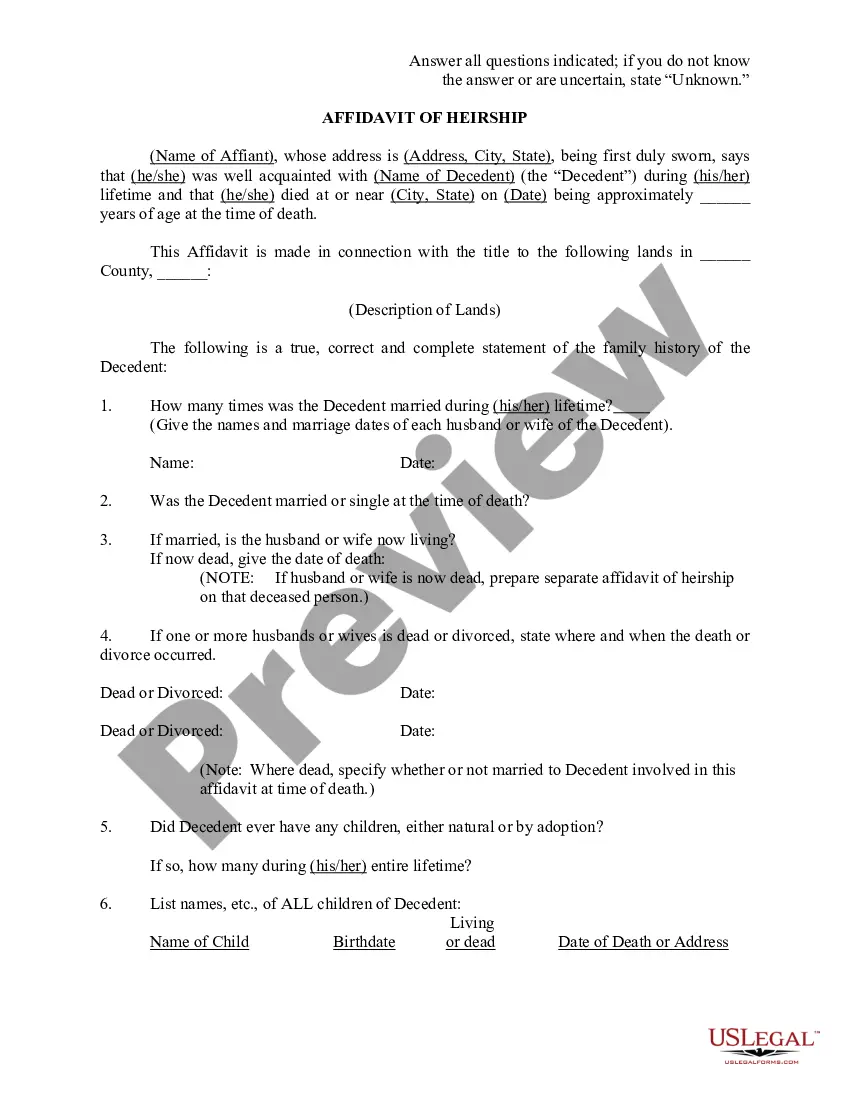
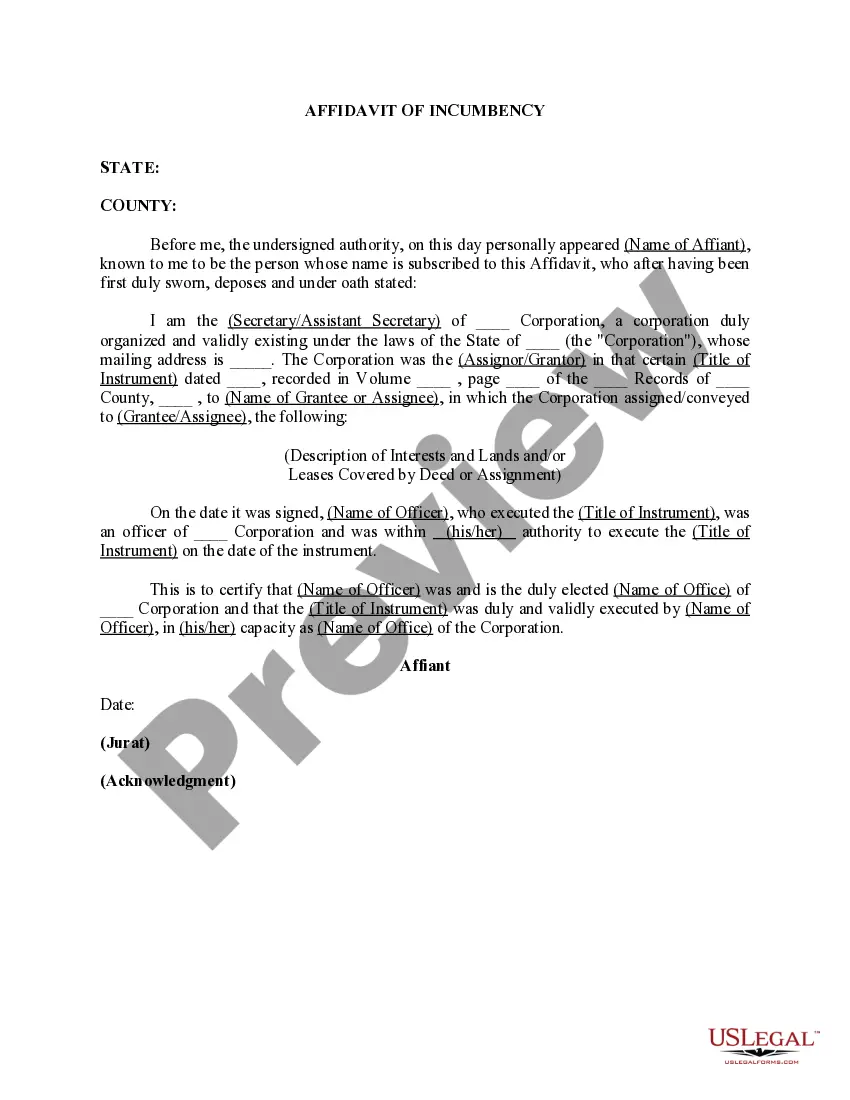
- Affiant's name and address
- Statement confirming the affiant's age
- Names and birth dates of individuals the affidavit pertains to
- Descriptions of interests in specific lands
- Affiant's signature and jurat
When this form is needed
This form is used in situations where an individual needs to attest to their age for legal reasons, such as when applying for legal agreements, confirming eligibility for certain programs, or settling disputes regarding property ownership. It can be particularly useful in cases where birth certificates or other identification documents are unavailable or disputed.
Who needs this form
- Individuals needing to verify their own age for legal purposes
- Family members or guardians providing age confirmation for minors
- Legal representatives managing property or inheritance matters
- Anyone involved in disputes requiring age verification
Completing this form step by step
- Fill in the affiant's name and address at the beginning of the affidavit.
- State the affiant's name and confirm they are over a specific age.
- List the names and birth dates of the individuals whose ages are being verified.
- Provide a description of the property or interests involved.
- Have the affiant sign the document in the presence of a notary if required.
Notarization requirements for this form
This form does not typically require notarization unless specified by local law. However, it is advisable to have the affidavit notarized to ensure its acceptance in legal proceedings, as notarization adds an additional layer of authenticity.
Get your form ready online
Our built-in tools help you complete, sign, share, and store your documents in one place.
Make edits, fill in missing information, and update formatting in US Legal Forms—just like you would in MS Word.
Download a copy, print it, send it by email, or mail it via USPS—whatever works best for your next step.
Sign and collect signatures with our SignNow integration. Send to multiple recipients, set reminders, and more. Go Premium to unlock E-Sign.
If this form requires notarization, complete it online through a secure video call—no need to meet a notary in person or wait for an appointment.
We protect your documents and personal data by following strict security and privacy standards.

Make edits, fill in missing information, and update formatting in US Legal Forms—just like you would in MS Word.

Download a copy, print it, send it by email, or mail it via USPS—whatever works best for your next step.

Sign and collect signatures with our SignNow integration. Send to multiple recipients, set reminders, and more. Go Premium to unlock E-Sign.

If this form requires notarization, complete it online through a secure video call—no need to meet a notary in person or wait for an appointment.

We protect your documents and personal data by following strict security and privacy standards.
Avoid these common issues
- Failing to include all required names and birth dates.
- Not having the affidavit signed by a notary when necessary.
- Incomplete property descriptions leading to confusion.
- Providing inaccurate age statements or information.
Why use this form online
- Easy access to a professionally drafted template.
- Quick download and print options for immediate use.
- Editability to customize the affidavit as needed.
- Reliability of having a document reviewed by legal experts.
Summary of main points
- The affidavit of age is essential for confirming age for legal purposes.
- It is required to be notarized for it to hold legal weight.
- Careful attention to detail is critical to avoid common mistakes.
- This form is applicable across multiple states but check local regulations.
Looking for another form?

Form popularity
FAQ
A person who makes an affidavit is called a Deponent or an Affiant. The person who has authority to attest a certificate may be a Magistrate who may in turn be either a Judicial or an Executive Magistrate, a Notary Public or a Commissioner of Oaths depending upon the affidavit which needs to be attested.
I am _____ and my name _______, appearing on the enclosed ID proof, is single name.Both names denote one and the same person. I solemnly state that the contents of this affidavit are true to the best of my knowledge and belief and that it conceals nothing and that no part of it is false.
Title the affidavit. First, you'll need to title your affidavit. Craft a statement of identity. The very next section of your affidavit is what's known as a statement of identity. Write a statement of truth. State the facts. Reiterate your statement of truth. Sign and notarize.
In the sentence, the person writing the statement must state that he or she is stating that the information is accurate. (Example: I, Jane Doe, solemnly swear that the contents of this document are true and correct, and that I agree to abide by the terms in this affidavit.)
In a nutshell, an affidavit is a sworn statement that is in writing. Affidavits are usually used in a court or in negotiations. They are common in family law cases and bankruptcy cases. They are also used in civil and criminal cases, though not as often as family or bankruptcy law cases.
Full name and address of affiant. Date and place of birth. Relationship to I-751 applicant and spouse. An account of your relationship explaining: How you met the couple. Details explaining how the person acquired this knowledge (i.e. friends) Date and signature.
Full name and address of affiant. Date and place of birth. Relationship to I-751 applicant and spouse. An account of your relationship explaining: How you met the couple. Details explaining how the person acquired this knowledge (i.e. friends) Date and signature.
Full name of the deponent and their signature. Statement indicating whether the affidavit has been sworn or not. Date and place where the affidavit is being signed. Designation and full name of the Notary or Magistrate (person attesting the affidavit)
Step 1 Making the Affidavit The deponent need to make their affidavit. Step 2 Authentications and signatures The deponent need to fill in the signatures needed in the allocated openings.
An affidavit is a written statement that is notarized.The information in an affidavit must be first-hand information. It cannot be second-hand information or speculation. Affidavits can be written in your own handwriting or typed.