Correction Deed to Correct Land Description
What this document covers
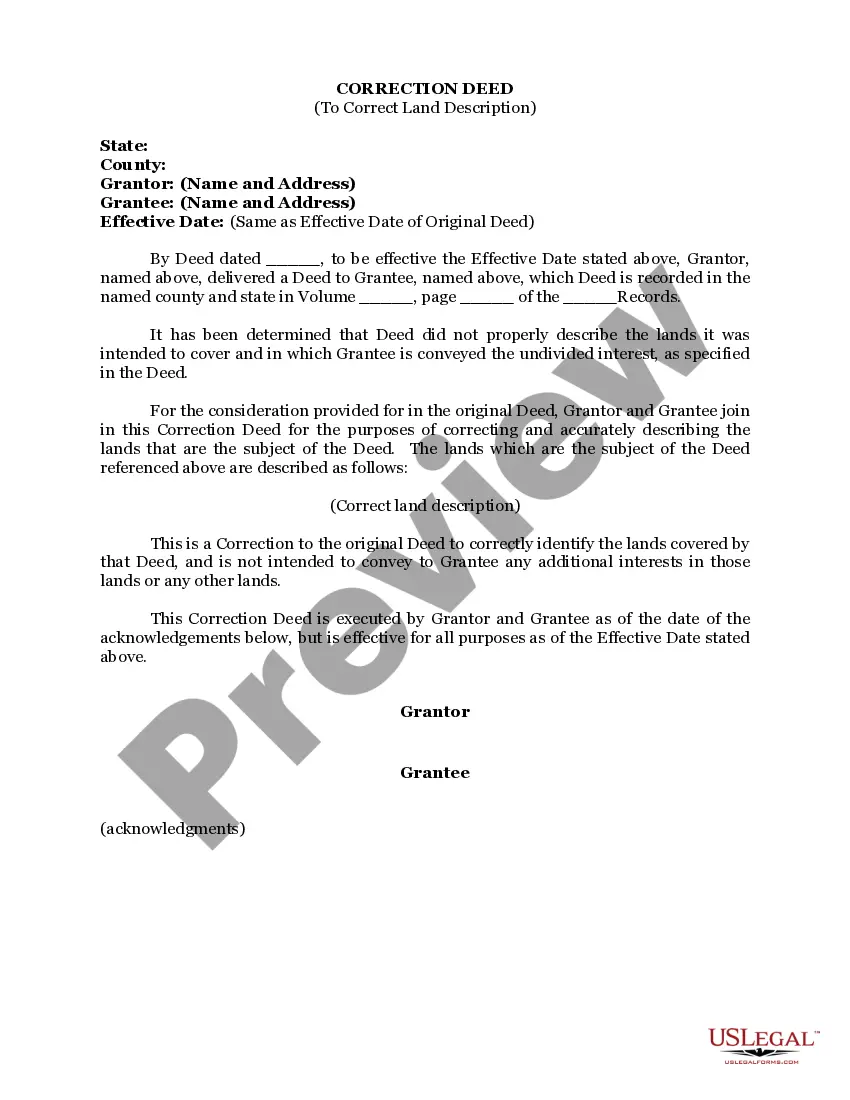
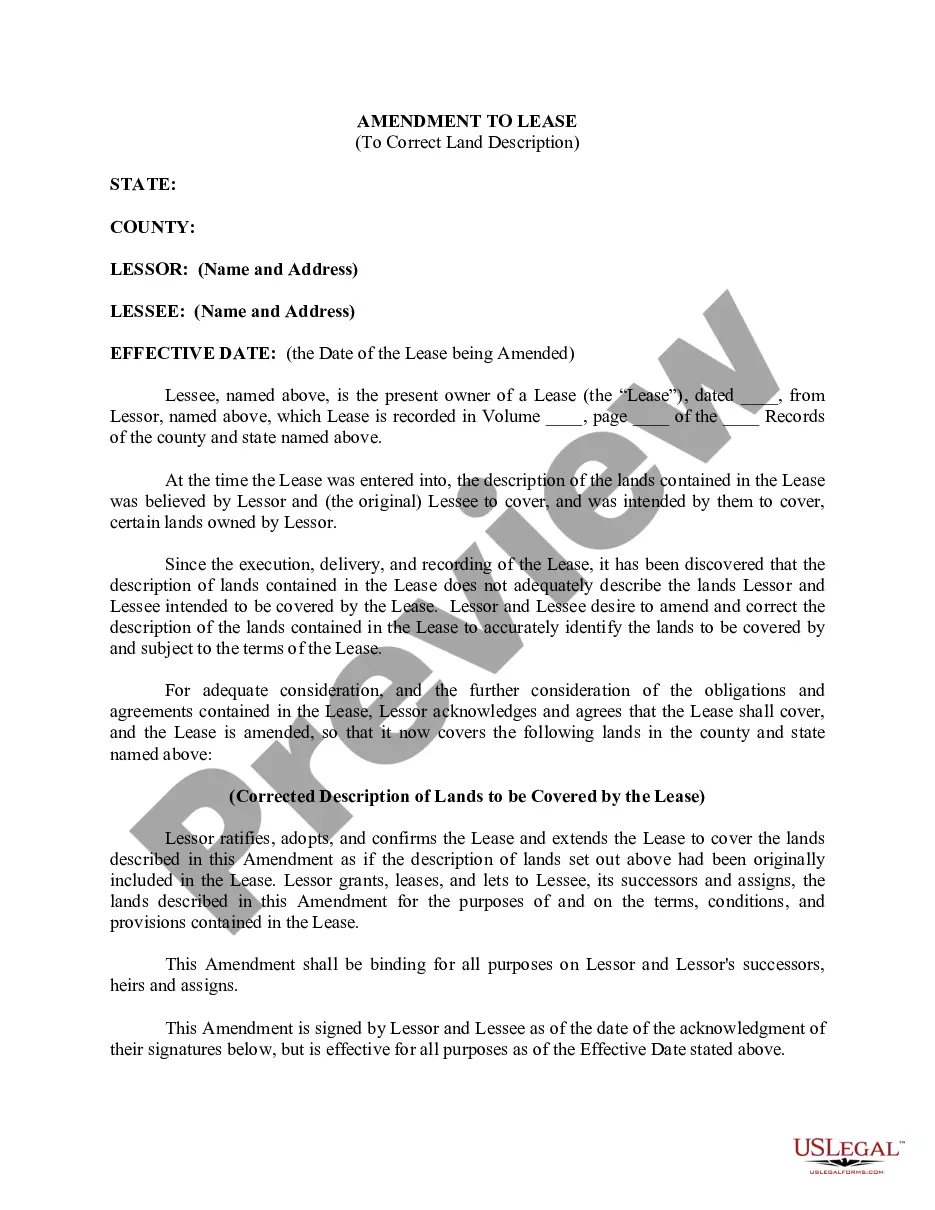
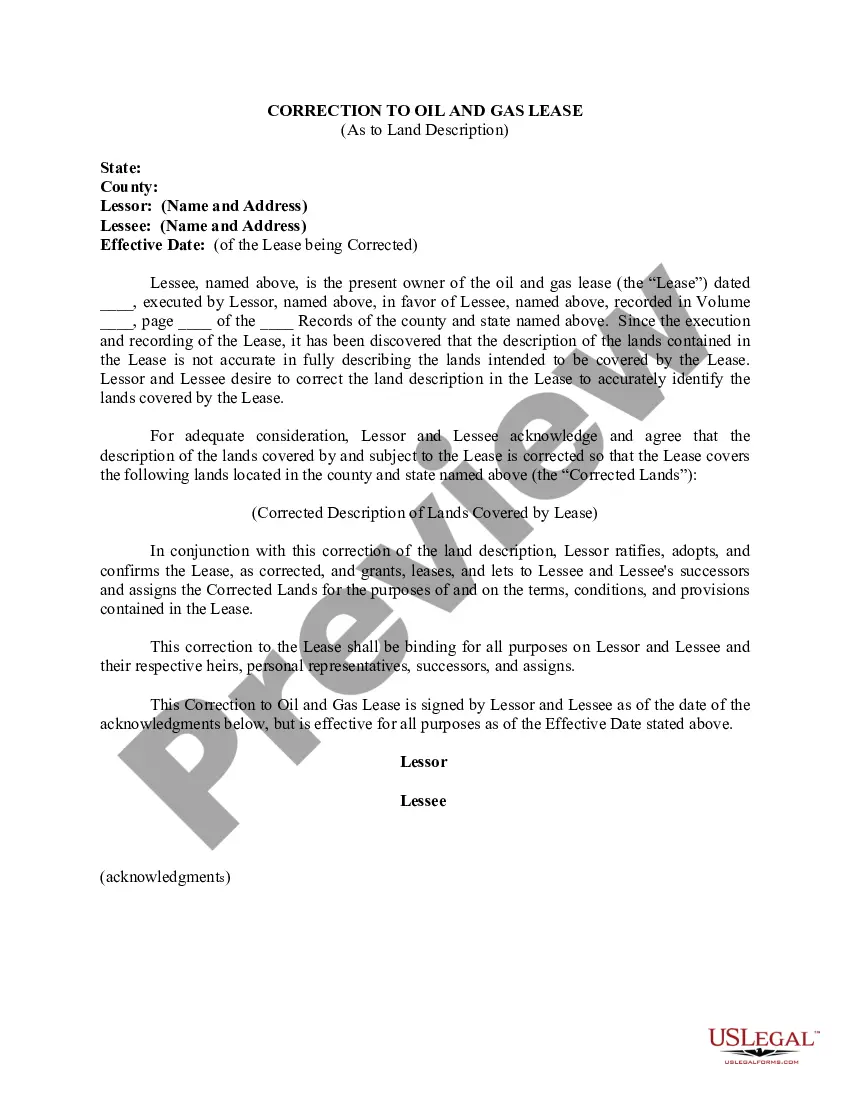
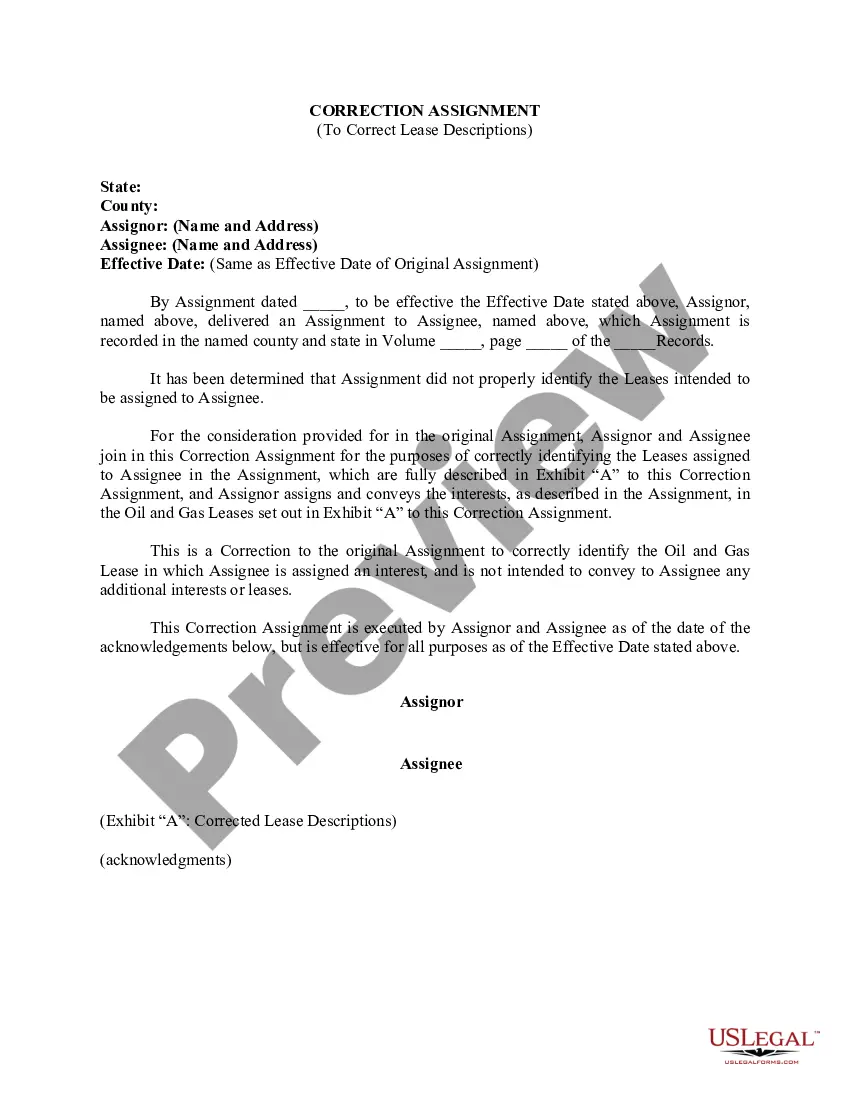
The Correction Deed to Correct Land Description is a legal document designed to amend a previous deed that inaccurately describes the land intended for conveyance. Unlike a standard deed, this correction deed explicitly addresses errors in the land description to ensure clarity and legal accuracy, without transferring any additional interests in the property beyond what was originally granted.
Form components explained
- Grantor and Grantee: Names and addresses of the parties involved in the deed.
- Effective Date: Date when the correction deed takes effect, usually the same as the original deed.
- Reference to Original Deed: Details of the previous deed, including recording information.
- Correct Land Description: Accurate description of the land intended to be conveyed.
- Execution: Signatures of both the Grantor and Grantee to validate the correction.
When to use this document
This form is needed when an error has been identified in the land description of a prior deed, affecting the conveyance of property. For instance, if a property boundary was incorrectly measured or a specific parcel of land was misidentified, this correction deed can effectively fix these inaccuracies without creating a new deed.
Intended users of this form
- Property owners who have identified mistakes in a previous deed.
- Buyers or sellers involved in a property transaction requiring clarification of deed descriptions.
- Real estate professionals handling corrections for clients.
- Legal representatives assisting clients with property matters.
Instructions for completing this form
- Identify the parties: Fill in the names and addresses of the Grantor and Grantee.
- Specify the effective date: Enter the date the correction deed will take effect.
- Reference the original deed: Include details such as the volume and page number where the original deed is recorded.
- Provide the correct land description: Clearly describe the property that is to be accurately conveyed.
- Gather signatures: Ensure that both the Grantor and Grantee sign the correction deed as required.
Notarization guidance
This form does not typically require notarization unless specified by local law. However, it is advisable to consult state regulations to ensure compliance with any specific recording requirements.
Get your form ready online
Our built-in tools help you complete, sign, share, and store your documents in one place.
Make edits, fill in missing information, and update formatting in US Legal Forms—just like you would in MS Word.
Download a copy, print it, send it by email, or mail it via USPS—whatever works best for your next step.
Sign and collect signatures with our SignNow integration. Send to multiple recipients, set reminders, and more. Go Premium to unlock E-Sign.
If this form requires notarization, complete it online through a secure video call—no need to meet a notary in person or wait for an appointment.
We protect your documents and personal data by following strict security and privacy standards.

Make edits, fill in missing information, and update formatting in US Legal Forms—just like you would in MS Word.

Download a copy, print it, send it by email, or mail it via USPS—whatever works best for your next step.

Sign and collect signatures with our SignNow integration. Send to multiple recipients, set reminders, and more. Go Premium to unlock E-Sign.

If this form requires notarization, complete it online through a secure video call—no need to meet a notary in person or wait for an appointment.

We protect your documents and personal data by following strict security and privacy standards.
Common mistakes
- Failing to provide accurate details of the original deed.
- Not including a clear and precise correction of the land description.
- Omitting signatures from either the Grantor or Grantee.
- Forgetting to enter the correct effective date.
Advantages of online completion
- Convenience: Download the form from anywhere, at any time.
- Editability: Make necessary changes easily before finalizing the document.
- Reliability: Use templates drafted by licensed attorneys ensuring legal compliance.
Summary of main points
- The Correction Deed is used to fix land description errors in a previous deed.
- Accurate information is crucial to avoid legal disputes later.
- Both parties must sign for the correction deed to be valid.
Looking for another form?

Form popularity
FAQ
In Texas, a correction deed is the deed issued to make changes to an erroneous deed, referred to as the corrected deed. These two instruments are closely linked, and all corrections are effective as of the date of the original recorded instrument (Property Code Sec. 5.030).
A corrective deed is an instrument filed in the public record in addition to the incorrect deed. It's known as a confirmatory instrument since it perfects an existing title by removing any defects, but it doesn't pass title on its own.
Once a deed has been recorded, it is part of the public record and cannot be changed. It is possible, however, to amend that record by adding a newly executed deed, usually called correction or corrective deed, deed of correction or, in some states, deed of confirmation.
A correction deed confirms the covenants and warranties of the prior deed. It needs to refer to that instrument by indicating its execution and recording date, the place of recording, and the number under which the document is filed. It also must identify the error or errors by type before supplying a correction.
A correction deed is a new deed signed and acknowledged by the grantor. A correction affidavit can be signed by either party but is used in limited situations. This press release was authorized by Mark W. Bidwell, an attorney licensed in California.
You can change your name on title deeds by completing form AP1 and providing the relevant documentation, such as a marriage certificate, deed poll certificate or a sworn declaration. You can also change your gender on title deeds using form CNG and providing appropriate proof of the change.
If a deed is to have any validity, it must be made voluntarily.If FRAUD is committed by either the grantor or grantee, a deed can be declared invalid. For example, a deed that is a forgery is completely ineffective. The exercise of UNDUE INFLUENCE also ordinarily serves to invalidate a deed.
Although it's possible to change the names on title deeds yourself, we recommend that you seek professional help from a solicitor. The value of property is sufficiently high to make it worthwhile getting the transfer right.
A Corrective Deed is a special type of deed used to fix problems in deeds that have already been recorded. Unlike other types of deeds that transfer interests in real estate, a Corrective Deed does not create a new interest. Instead, the Corrective Deed corrects the documents relating to the prior transfer of interest.