Lease Data Summary
About this form
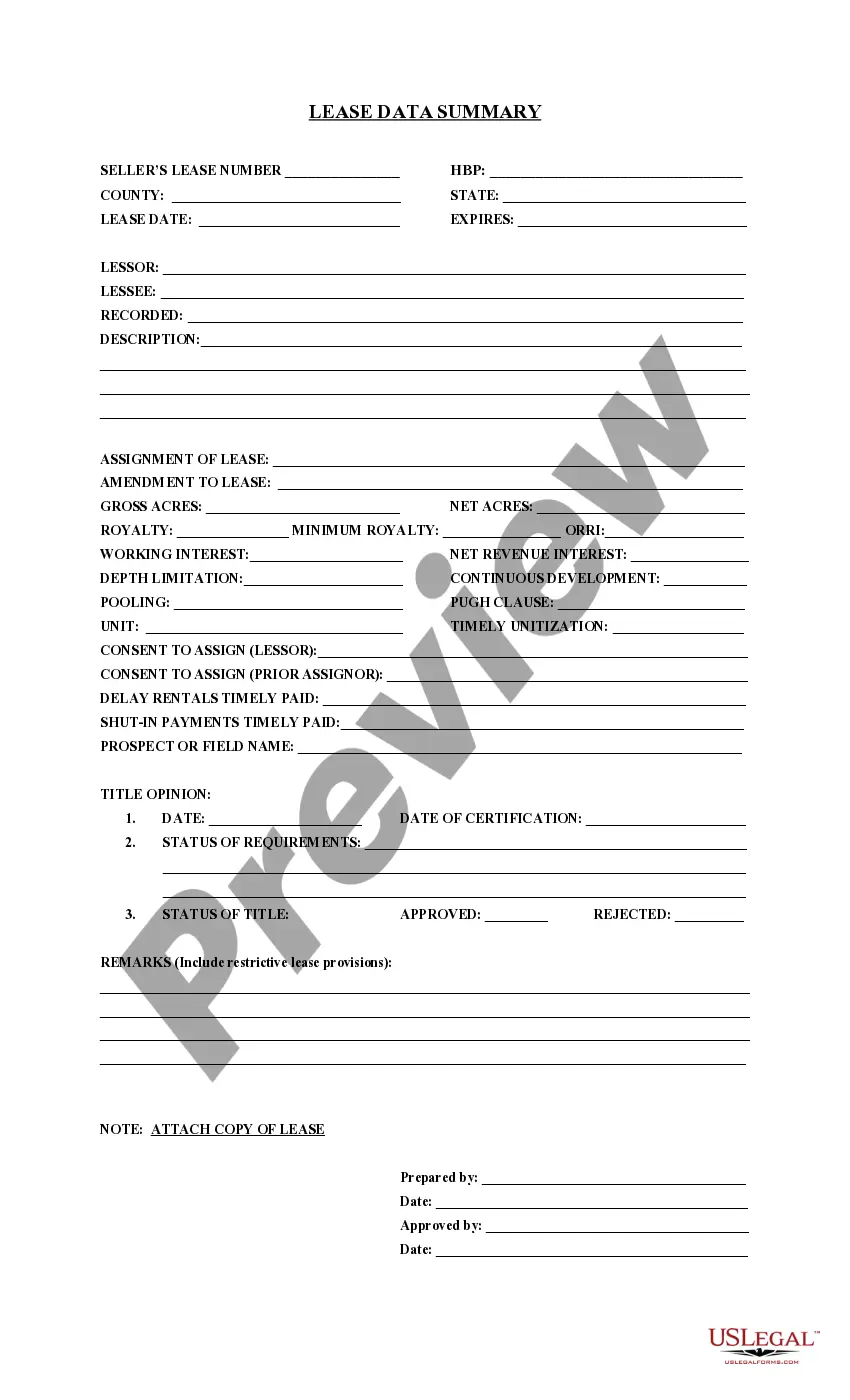
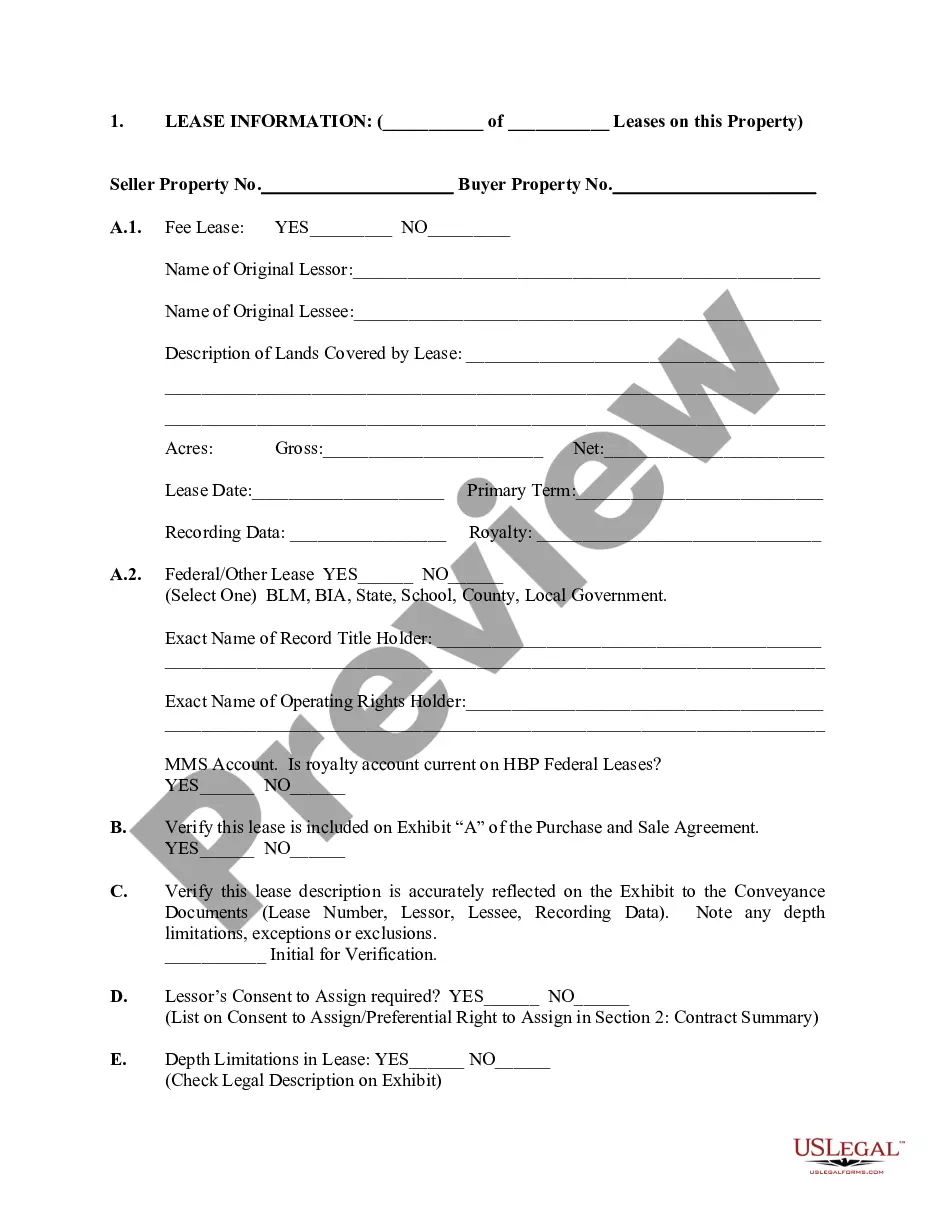
The Lease Data Summary is a legal document that provides a concise overview of essential details related to oil, gas, or mineral leases. This form differs from other lease agreements by summarizing crucial lease terms, such as lease date, parties involved, and financial interests, making it an essential tool for parties engaged in mineral dealings or transactions.
Main sections of this form
- Sellers lease number
- County and state of the lease
- Lease date and expiration date
- Names of lessor and lessee
- Gross and net acres involved
- Royalty terms and working interest
- Depth limitation and unitization details
- Consent to assign from both lessor and prior assignor
- Payment status for delay rentals and shut-in payments
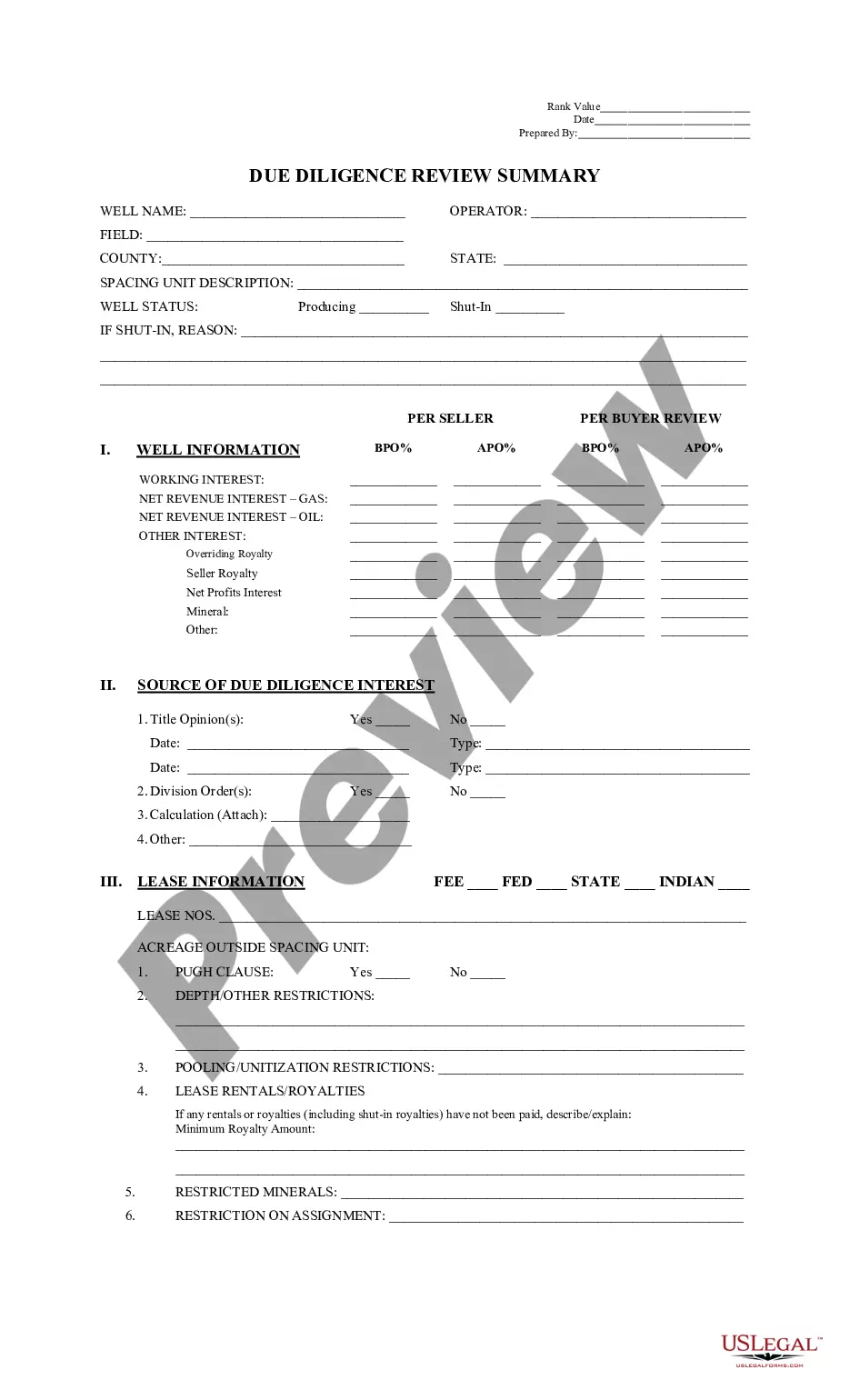
- Title opinion requirements and certification status
When to use this document
This form is essential when entering into or reviewing leases involving oil, gas, or mineral rights. It is commonly used by lessors and lessees who need to document lease terms for legal clarity, prepare for negotiations, or maintain accurate records of lease agreements. It is also useful during the sale or transfer of leased rights, ensuring all necessary details are readily available.
Intended users of this form
This form is ideally suited for:
- Landowners looking to lease their property for mineral extraction
- Companies or individuals engaged in oil or gas production
- Legal professionals assisting clients with lease agreements
- Buyers or sellers of mineral rights
- Investors analyzing lease terms for potential investments
Completing this form step by step
- Identify the sellers lease number and relevant county and state.
- Fill in the lease date and expiration date for clarity.
- Enter the names of the lessor and lessee accurately.
- Specify the number of gross and net acres involved in the lease.
- Document the royalty terms, minimum royalty, ORRI, and working interest.
- Add details regarding depth limitation and pooling provisions.
Notarization requirements for this form
This form does not typically require notarization unless specified by local law. However, it is advisable to check state regulations for any notarization requirements that may apply to lease agreements.
Get your form ready online
Our built-in tools help you complete, sign, share, and store your documents in one place.
Make edits, fill in missing information, and update formatting in US Legal Forms—just like you would in MS Word.
Download a copy, print it, send it by email, or mail it via USPS—whatever works best for your next step.
Sign and collect signatures with our SignNow integration. Send to multiple recipients, set reminders, and more. Go Premium to unlock E-Sign.
If this form requires notarization, complete it online through a secure video call—no need to meet a notary in person or wait for an appointment.
We protect your documents and personal data by following strict security and privacy standards.

Make edits, fill in missing information, and update formatting in US Legal Forms—just like you would in MS Word.

Download a copy, print it, send it by email, or mail it via USPS—whatever works best for your next step.

Sign and collect signatures with our SignNow integration. Send to multiple recipients, set reminders, and more. Go Premium to unlock E-Sign.

If this form requires notarization, complete it online through a secure video call—no need to meet a notary in person or wait for an appointment.

We protect your documents and personal data by following strict security and privacy standards.
Typical mistakes to avoid
- Failing to enter accurate dates can lead to legal issues.
- Missing signatures from lessors or lessees may invalidate the lease.
- Overlooking royalty calculation details can affect financial arrangements.
Why complete this form online
- Immediate access to professionally crafted legal templates.
- Edit and customize the document per specific needs.
- Reduces paperwork mistakes through guided completion.
Legal use & context
- The Lease Data Summary is crucial for establishing clear terms between lessor and lessee.
- Proper execution of the form can protect both parties' rights in case of disputes.
- Ensures that all financial and operational responsibilities are understood and agreed upon.
Main things to remember
- The Lease Data Summary is essential for documenting oil, gas, or mineral leases.
- Accurate completion is vital to avoid potential legal issues.
- Local regulations may affect how this form is utilized; always consult state laws.
Looking for another form?





Form popularity
FAQ
Names of all tenants. Limits on occupancy. Term of the tenancy. Rent. Deposits and fees. Repairs and maintenance. Entry to rental property. Restrictions on tenant illegal activity.
Collect each party's information. Include specifics about your property. Consider all of the property's utilities and services. Know the terms of your lease. Set the monthly rent amount and due date. Calculate any additional fees. Determine a payment method. Consider your rights and obligations.
Inspect the Property and Record Any Current Damages. Know What's Included in the Rent. Can You Make Adjustments and Customizations? Clearly Understand the Terms Within the Agreement and Anticipate Problems. Communicate with Your Landlord About Your Expectations.
The names and contact information for the landlord and tenant. The address of the rental property and unit number, if applicable. A reference to (or copy of) the original lease. The renewal terms or any changes to the terms of the original lease.
The lease becomes legally binding when all parties have signed: the landlord and all tenants living in the unit who are 18 and older. If you're worried about situations where a lease needs to end early, learn about breaking a lease and grounds for eviction.
The Lease Must be in Writing It does not matter if the lease is handwritten or typed.
The Lease Must be in Writing It does not matter if the lease is handwritten or typed. If the lease is for more than one year, it must be in written form and contain the following terms.
Date. Tenant name. Rent amount due. Rent due date. Rental period. Property address. Landlord name. Paid by.
A written agreement can act as a roadmap for the landlord-tenant relationship, especially if a dispute arises. Also, real estate (land) leases for more than one year must be in writing. If a lease for over one year is not in writing, it will generally not be enforceable in court.