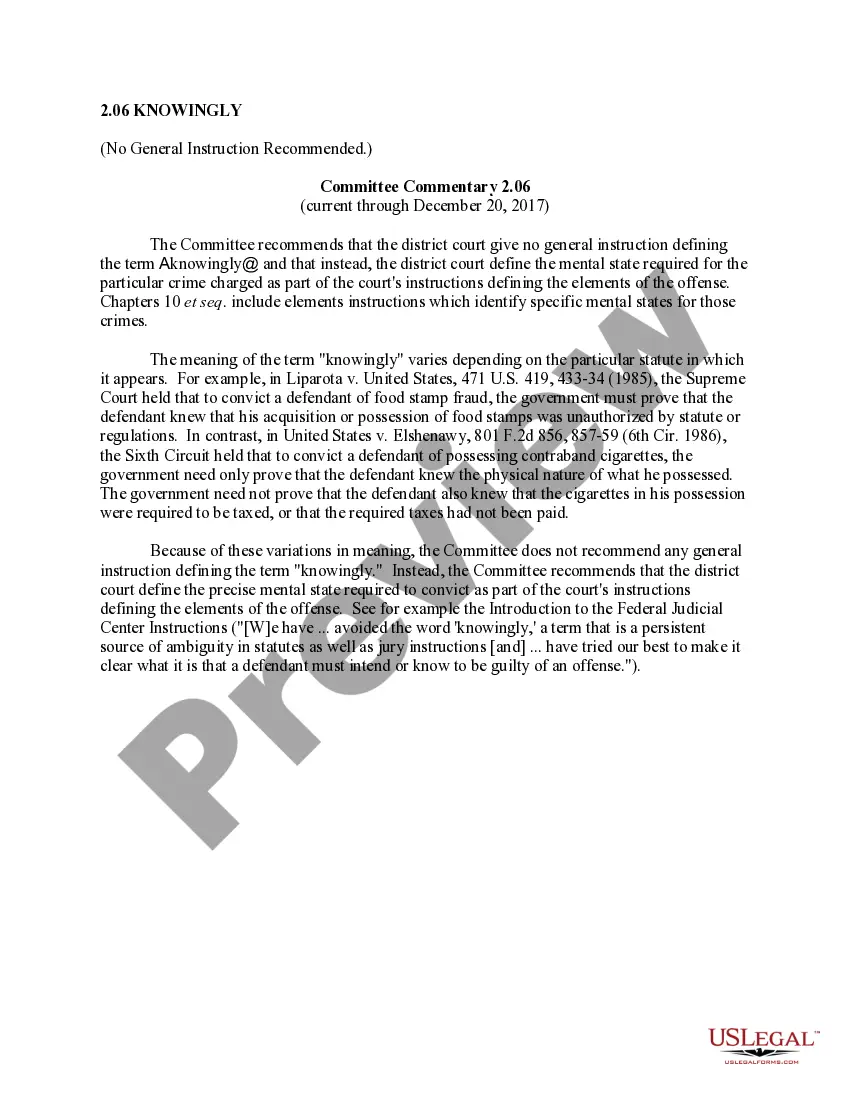
KNOWINGLY
What is this form?
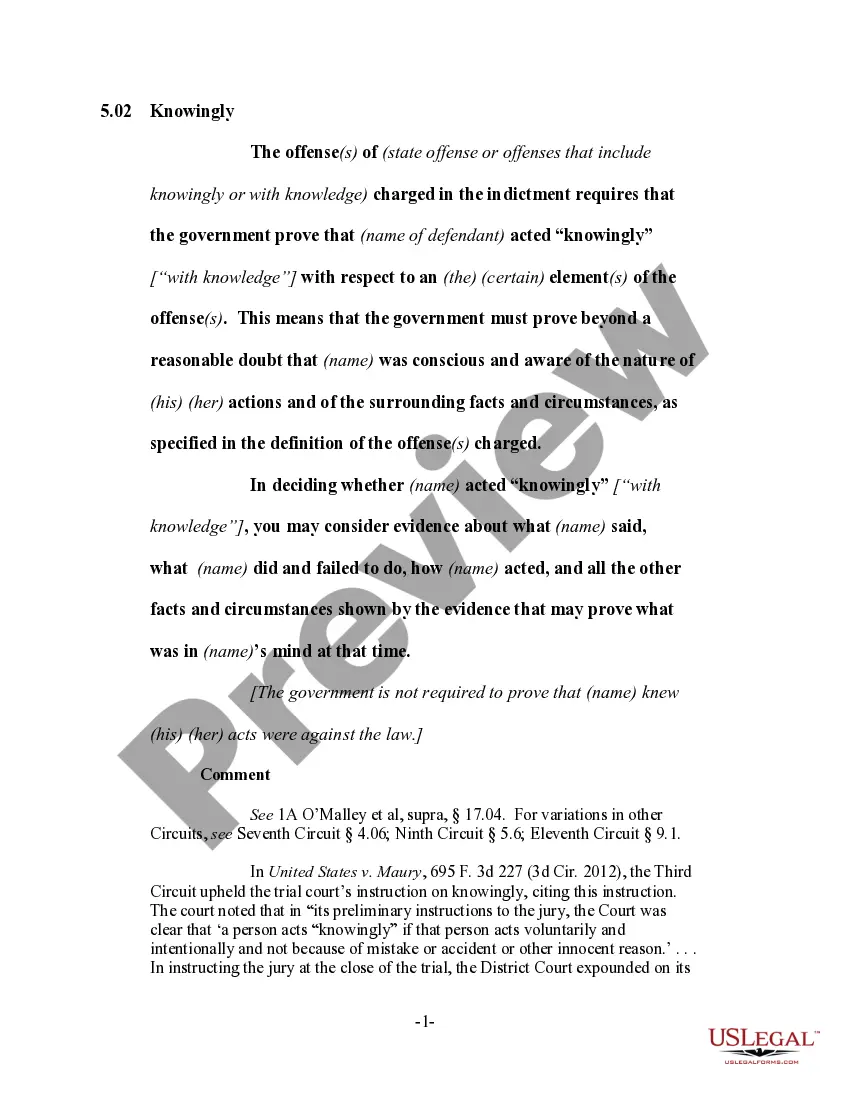
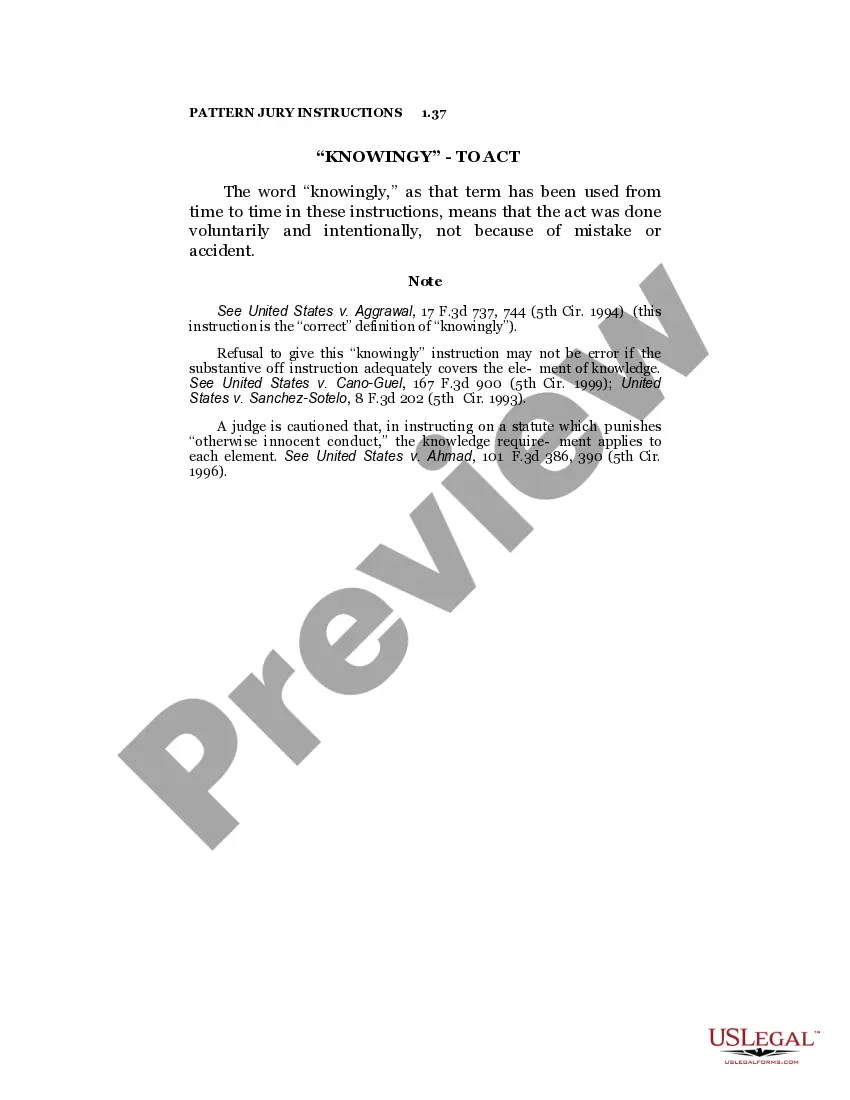
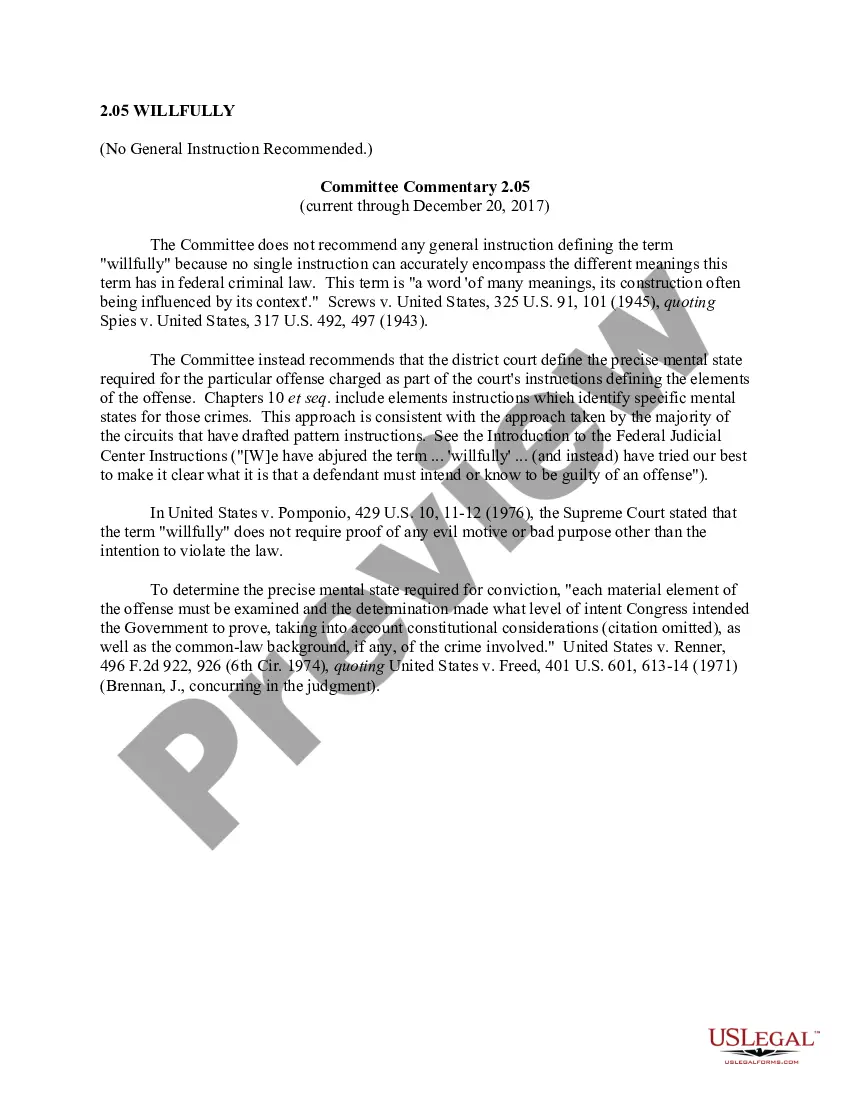
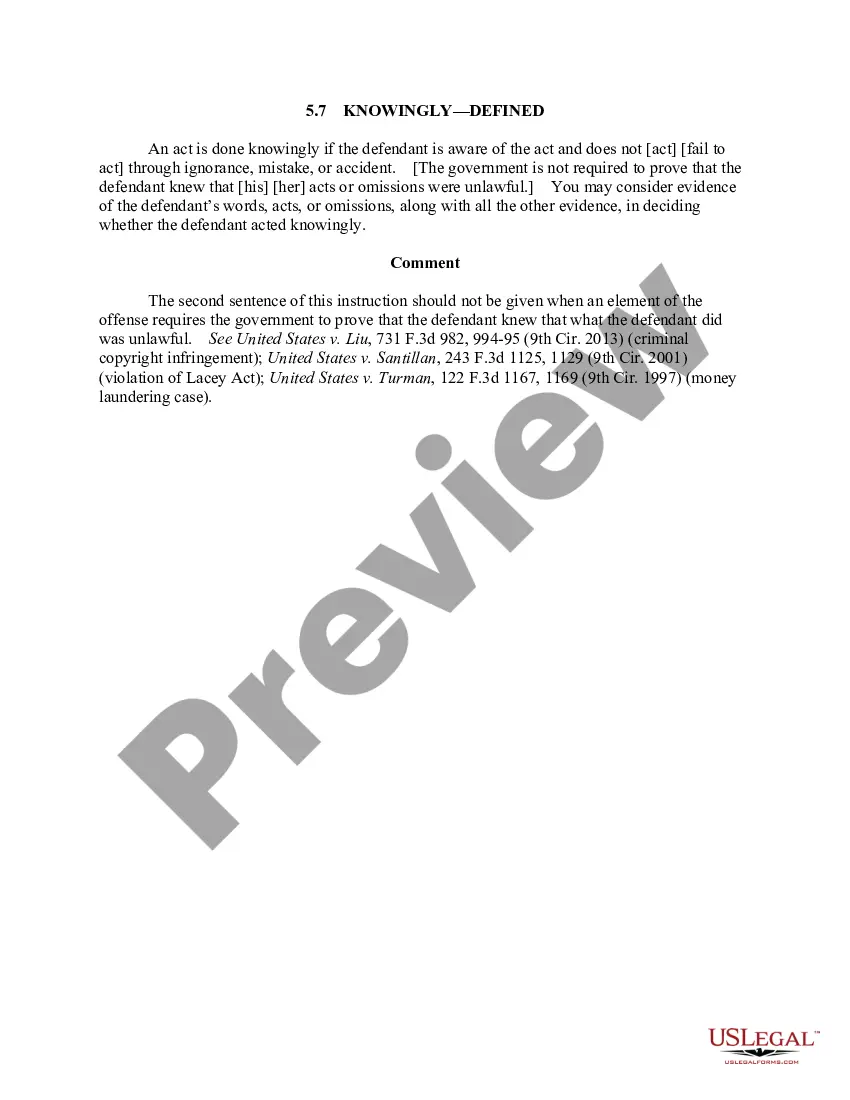
The Knowingly form addresses the legal concept of "knowingly" in the context of criminal law. This form is primarily used by courts to clarify the mental state required for specific crimes. Unlike other legal forms that may provide a broad definition, this form emphasizes that the term "knowingly" varies based on the statute involved, ensuring that a defendant's intent is clearly understood within the context of the charges against them.
Main sections of this form
- Definition of the term "knowingly" tailored to the specific crime charged.
- Guidelines for judges on how to provide instructions to juries regarding mental states.
- Reference to notable legal cases that illustrate variations in the interpretation of "knowingly."
- Emphasis on avoiding ambiguous language in jury instructions regarding intent.
When this form is needed
This form is used in criminal cases where the prosecution must establish a defendant's mental intent regarding the crime. It is applicable when the statute under which a defendant is charged requires a specific level of knowledge or intention, such as cases involving fraud, possession of illegal substances, or violations of regulatory laws.
Who should use this form
- Judges presiding over criminal cases needing to define mental states for jury instructions.
- Prosecutors who must clarify the requirements of proving knowledge in criminal charges.
- Defense attorneys preparing to challenge the sufficiency of evidence regarding a client's mental state.
How to complete this form
- Identify the specific crime charged and relevant statutory language.
- Review existing case law related to the crime to understand how "knowingly" has been defined by courts.
- Draft clear jury instructions that articulate the required mental state for the offense clearly.
- Ensure the instructions avoid ambiguous terms that may confuse jurors about the defendant's intent.
- Revise the instructions based on feedback from legal counsel if necessary.
Does this document require notarization?
Notarization is not commonly needed for this form. However, certain documents or local rules may make it necessary. Our notarization service, powered by Notarize, allows you to finalize it securely online anytime, day or night.
Get your form ready online
Our built-in tools help you complete, sign, share, and store your documents in one place.
Make edits, fill in missing information, and update formatting in US Legal Forms—just like you would in MS Word.
Download a copy, print it, send it by email, or mail it via USPS—whatever works best for your next step.
Sign and collect signatures with our SignNow integration. Send to multiple recipients, set reminders, and more. Go Premium to unlock E-Sign.
If this form requires notarization, complete it online through a secure video call—no need to meet a notary in person or wait for an appointment.
We protect your documents and personal data by following strict security and privacy standards.

Make edits, fill in missing information, and update formatting in US Legal Forms—just like you would in MS Word.

Download a copy, print it, send it by email, or mail it via USPS—whatever works best for your next step.

Sign and collect signatures with our SignNow integration. Send to multiple recipients, set reminders, and more. Go Premium to unlock E-Sign.

If this form requires notarization, complete it online through a secure video call—no need to meet a notary in person or wait for an appointment.

We protect your documents and personal data by following strict security and privacy standards.
Mistakes to watch out for
- Using vague language that does not specify the required mental state.
- Failing to consider key legal precedents that might affect the interpretation of "knowingly."
- Not tailoring the instructions to the specific crime, leading to potential misinterpretation by jurors.
Advantages of online completion
- Immediate access to downloadable legal templates drafted by licensed attorneys.
- Convenient to edit and customize based on specific legal needs.
- Reliable resources that adhere to current legal standards and regulations.
Looking for another form?


Form popularity
FAQ
Committing a Crime "Knowingly" Which part of the offense needs to be done knowingly depends on the crime. For example, a drug trafficking law might require that the person "knowingly" import an illegal drug into the United States.
Committing a Crime "Knowingly" Many criminal laws require a person to "knowingly" engage in illegal activity. Which part of the offense needs to be done knowingly depends on the crime. For example, a drug trafficking law might require that the person "knowingly" import an illegal drug into the United States.
§ 561.314 Knowingly. The term knowingly, with respect to conduct, a circumstance, or a result, means that a person has actual knowledge, or should have known, of the conduct, the circumstance, or the result.
Three types of criminal intent exist: (1) general intent, which is presumed from the act of commission (such as speeding); (2) specific intent, which requires preplanning and presdisposition (such as burglary); and (3) constructive intent, the unintentional results of an act (such as a pedestrian death resulting from
As in other situations, to commit an act "knowingly" is to do so with knowledge or awareness of the facts or situation, and not because of mistake, accident or some other innocent reason. See Fifth Circuit Pattern Jury Instructions, § 1.35 (1990). Knowledge of the criminal statute governing the conduct is not required.
Knowing criminal intent based upon knowing means an awareness of the consequences. For example, stabbing someone with a knife is done knowingly by an adult when it can be proved that he knew that a knife would pierce the skin of another and cause injury.
Knowingly indicates that the defendant is aware of the nature of the act and its probable consequences (Utah Code Ann., 2011). Knowingly differs from purposely in that the defendant is not acting to cause a certain result but is acting with the awareness that the result is practically certain to occur (State v.
In other words, a person acts knowingly if he is aware that it is practically certain that his conduct will cause a specific result. For example: I fire my pistol into a crowd of people, knowing that the result will almost certainly be that a person is shot.