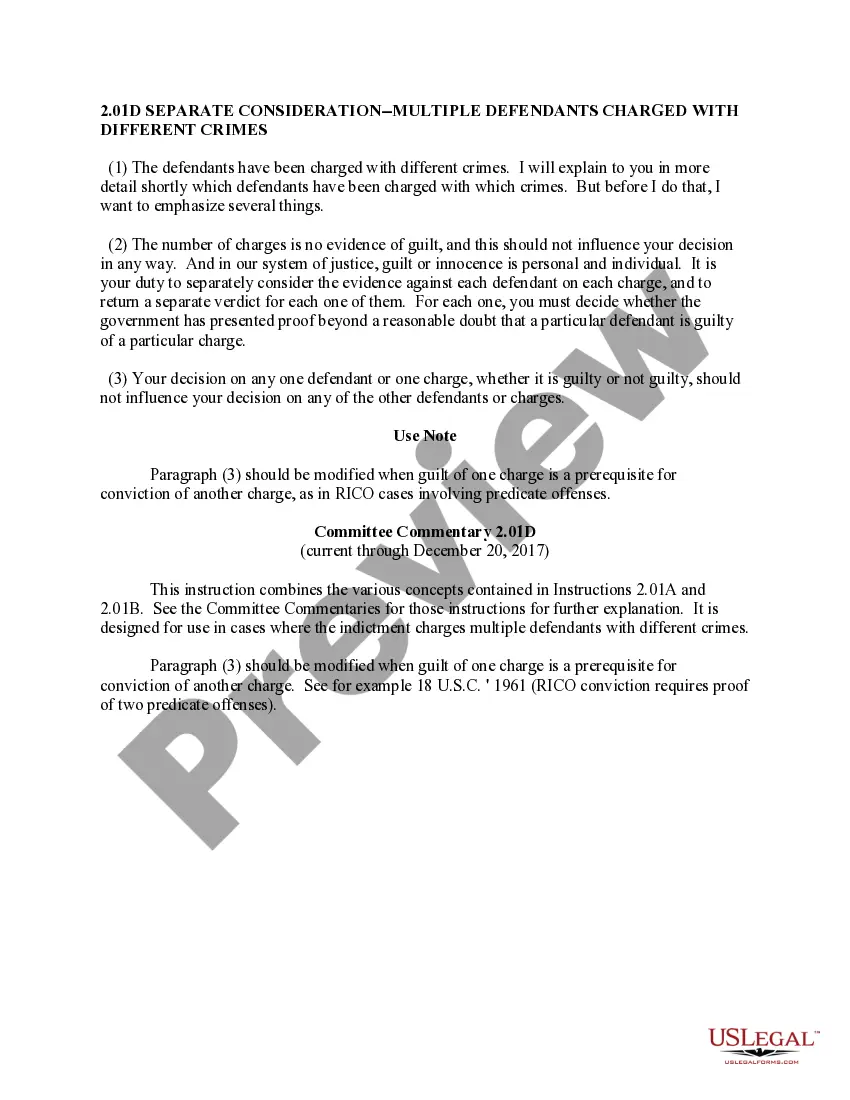
SEPARATE CONSIDERATION--MULTIPLE DEFENDANTS CHARGED WITH DIFFERENT CRIMES
What this document covers
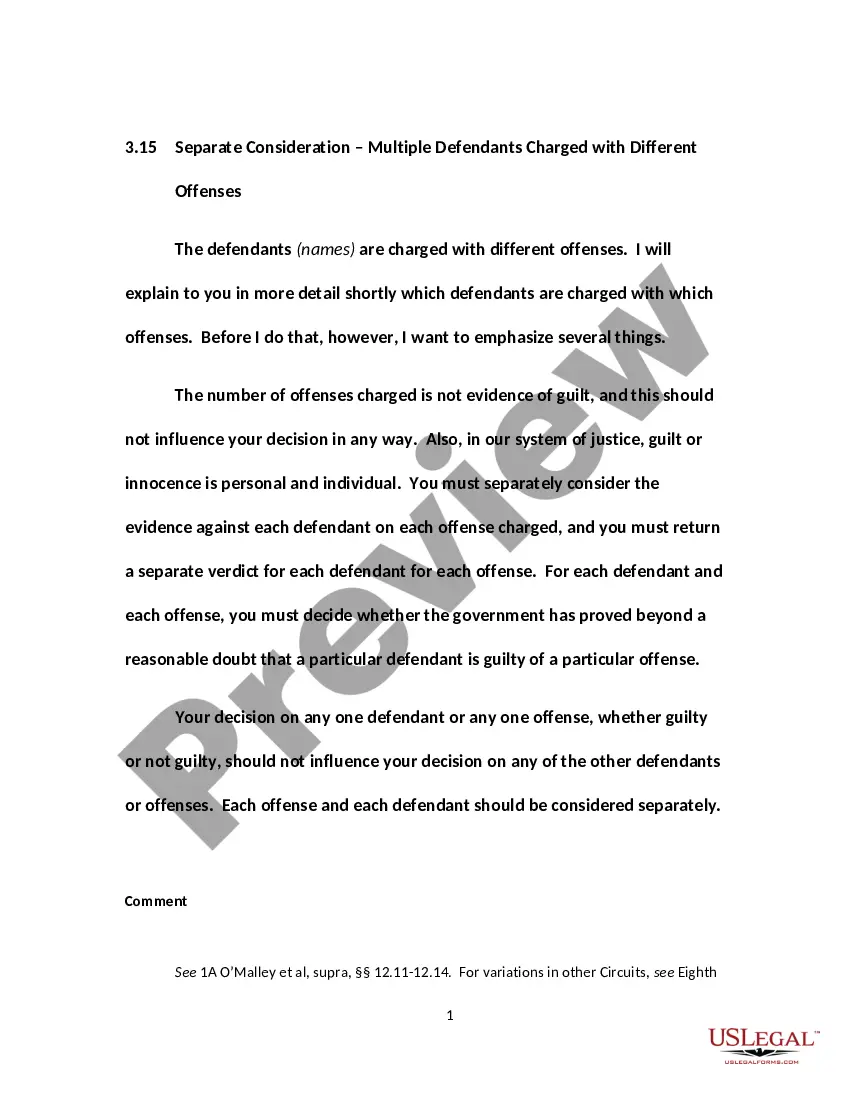
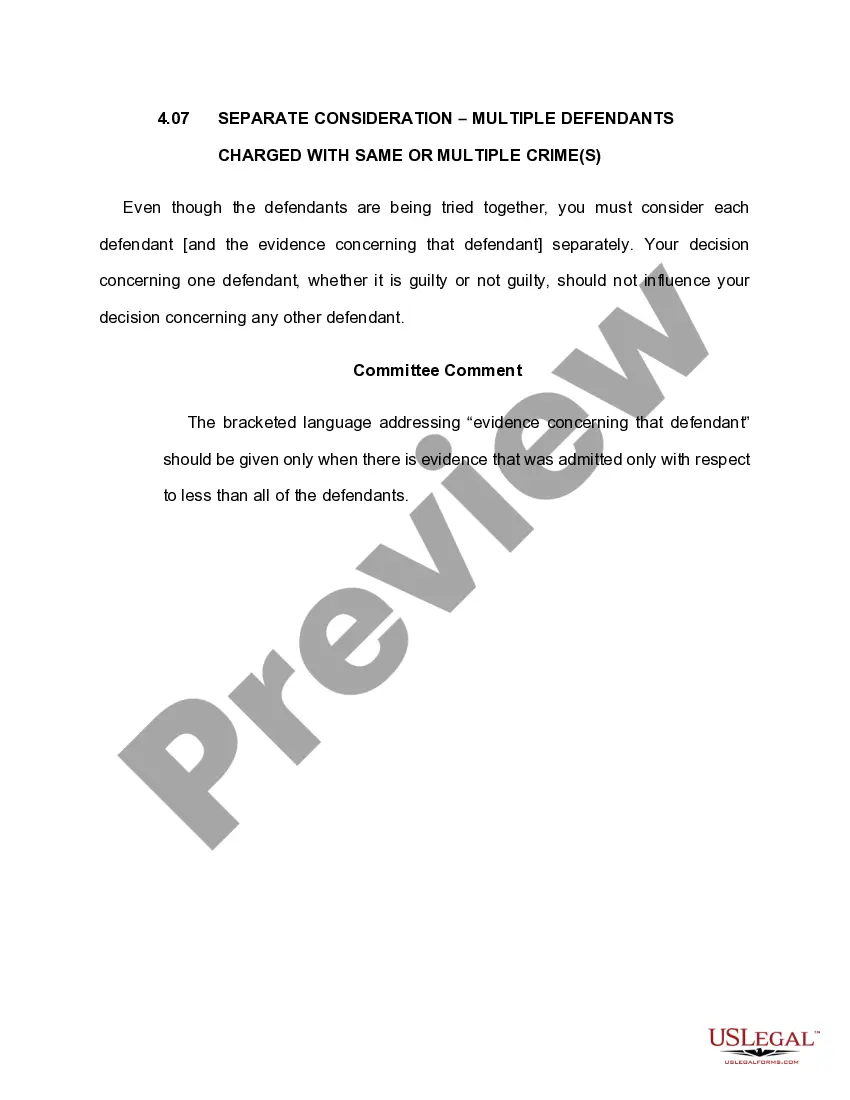
The Separate Consideration form for multiple defendants charged with different crimes is a legal instruction used in court cases where several defendants are accused of distinct offenses. This form ensures that each defendant is evaluated individually for their specific charges, promoting fairness in the legal process. Unlike other legal forms that may lump together multiple defendants, this form emphasizes the need for separate verdicts based on the evidence provided against each individual.
Key parts of this document
- Statement that defendants are charged with different crimes.
- Emphasis on the presumption of innocence and the requirement to consider evidence individually.
- Instruction that decisions regarding one defendant should not influence those regarding others.
- Guidelines for modification in specific cases, such as RICO offenses.

When this form is needed
This form is essential in situations where multiple defendants face distinct charges, ensuring that jurors understand their obligation to evaluate each case separately. It is applicable in criminal trials involving multiple defendants that could potentially affect the overall verdict if not handled individually.
Intended users of this form
- Judges overseeing cases with multiple defendants.
- Attorneys representing defendants charged with different crimes.
- Jurors assigned to cases involving separate criminal charges against multiple individuals.
Instructions for completing this form
- Identify the defendants and the specific crimes they are charged with.
- Emphasize that the number of charges does not indicate guilt.
- Explain the individual assessment required for each defendant.
- Communicate that decisions on one defendant should not impact others.
- Make necessary modifications if charges are interrelated, such as in RICO cases.
Notarization guidance
In most cases, this form does not require notarization. However, some jurisdictions or signing circumstances might. US Legal Forms offers online notarization powered by Notarize, accessible 24/7 for a quick, remote process.
Get your form ready online
Our built-in tools help you complete, sign, share, and store your documents in one place.
Make edits, fill in missing information, and update formatting in US Legal Forms—just like you would in MS Word.
Download a copy, print it, send it by email, or mail it via USPS—whatever works best for your next step.
Sign and collect signatures with our SignNow integration. Send to multiple recipients, set reminders, and more. Go Premium to unlock E-Sign.
If this form requires notarization, complete it online through a secure video call—no need to meet a notary in person or wait for an appointment.
We protect your documents and personal data by following strict security and privacy standards.

Make edits, fill in missing information, and update formatting in US Legal Forms—just like you would in MS Word.

Download a copy, print it, send it by email, or mail it via USPS—whatever works best for your next step.

Sign and collect signatures with our SignNow integration. Send to multiple recipients, set reminders, and more. Go Premium to unlock E-Sign.

If this form requires notarization, complete it online through a secure video call—no need to meet a notary in person or wait for an appointment.

We protect your documents and personal data by following strict security and privacy standards.
Typical mistakes to avoid
- Failing to recognize the need for separate evaluations of each defendant.
- Misapplying the presumption of innocence to multiple defendants as a group.
- Ignoring modifications necessary for cases involving interrelated charges.
Why complete this form online
- Quick access to legal instructions specifically tailored for complex cases.
- Easy editing options allow for customization based on specific case requirements.
- Reliable content drafted by licensed attorneys ensures legal accuracy.
What to keep in mind
- Each defendant must be considered for their specific charge.
- The number of charges does not affect the guilt of individual defendants.
- Modifications may be necessary for cases involving linked offenses.
Looking for another form?










Form popularity
FAQ
In criminal law, if a defendant commits a single act that simultaneously fulfills the definition of two separate offenses, merger will occur. This means that the lesser of the two offenses will drop out, and the defendant will only be charged with the greater offense.
Criminal Cases with Co-Defendants When going through the legal process, they can either have separate trials or have them together, depending on the case.
(a) A prosecutor should seek or file criminal charges only if the prosecutor reasonably believes that the charges are supported by probable cause, that admissible evidence will be sufficient to support conviction beyond a reasonable doubt, and that the decision to charge is in the interests of justice.
A joint trial of codefendants (also known as "joinder") occurs when a judge merges the cases of two or more defendants. Joint trials happen when the issues in the defendants' cases overlap enough to make a single trial both fair and more efficient.
Duplicity is the joining in a single count of two or more distinct and separate offenses; multiplicity is the charging of a single offense in several counts.
The Federal Rules of Criminal Procedure 19 and all their state counterparts 20 permit prosecutors to charge multiple offenses ? officially known as ?charge joinder? ? by joining multiple counts of a crime upon a single defendant.
A judge in a criminal case may feel that it is appropriate to combine the cases of multiple defendants when their charges involve the same set of circumstances. This can help a judge streamline their calendar and resolve a case more efficiently.