INTRODUCTION
Overview of this form
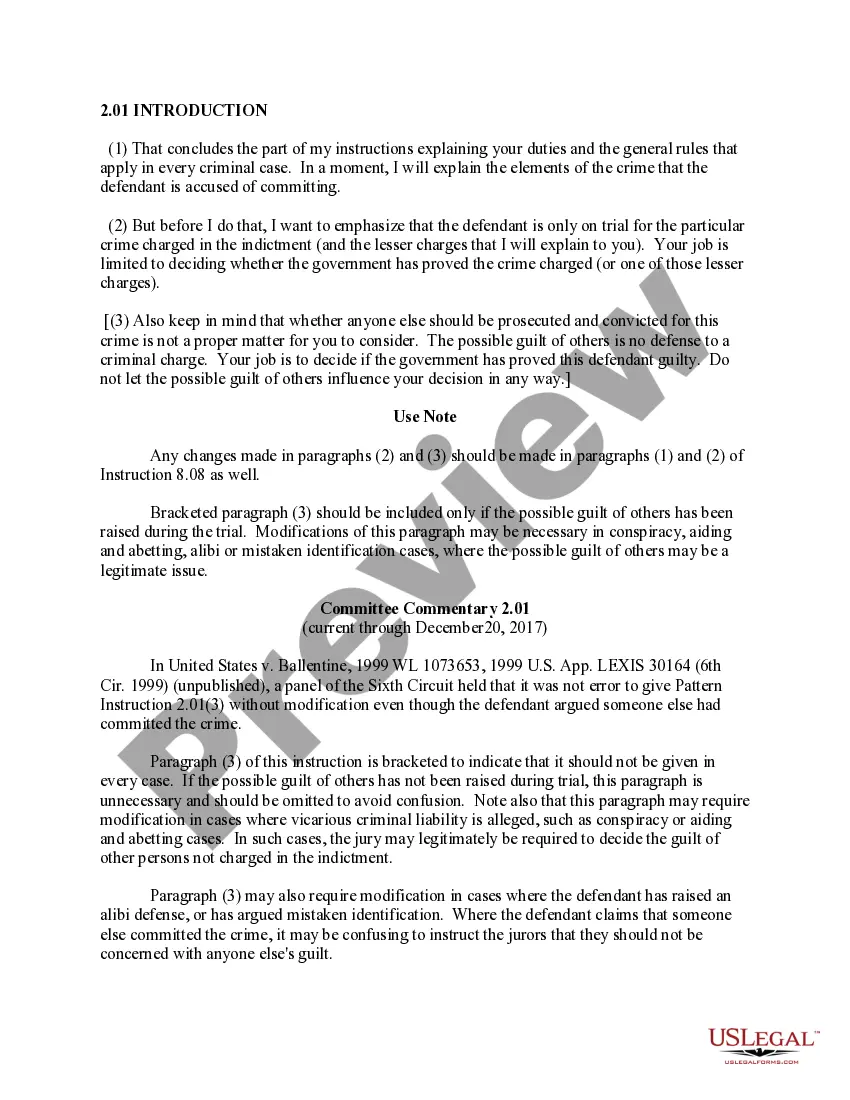
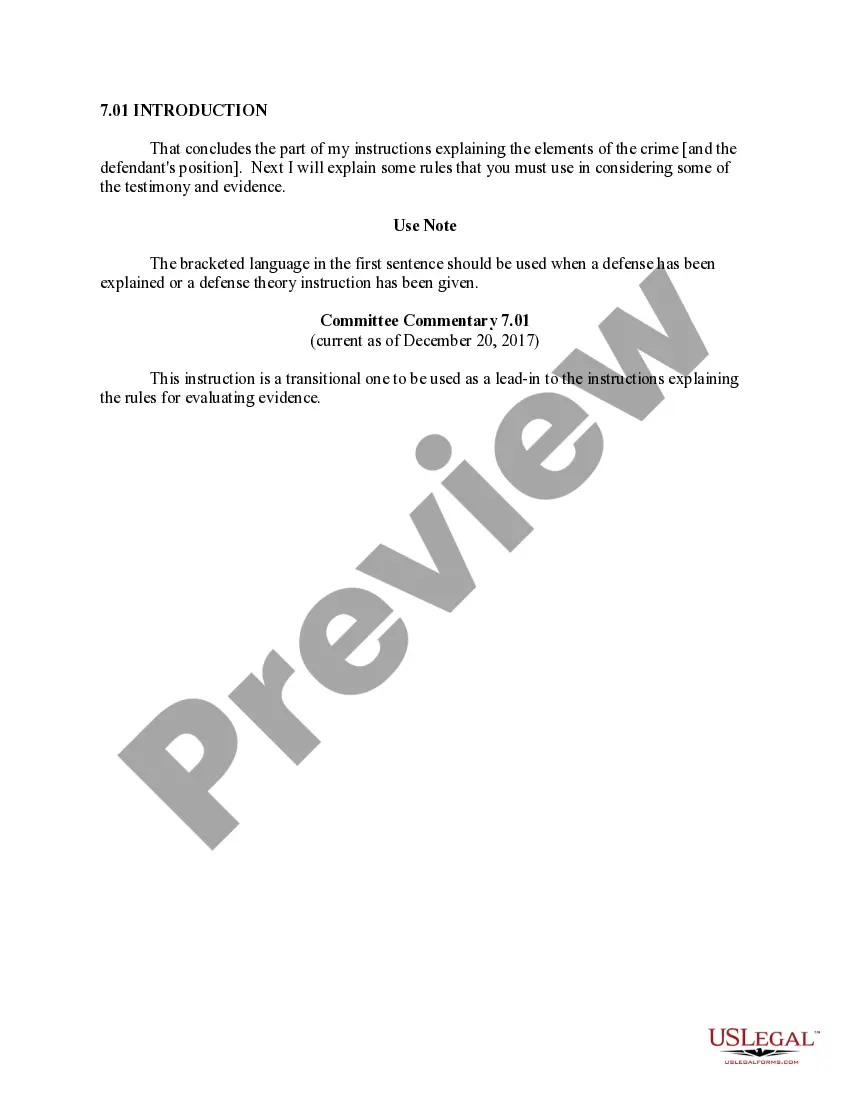
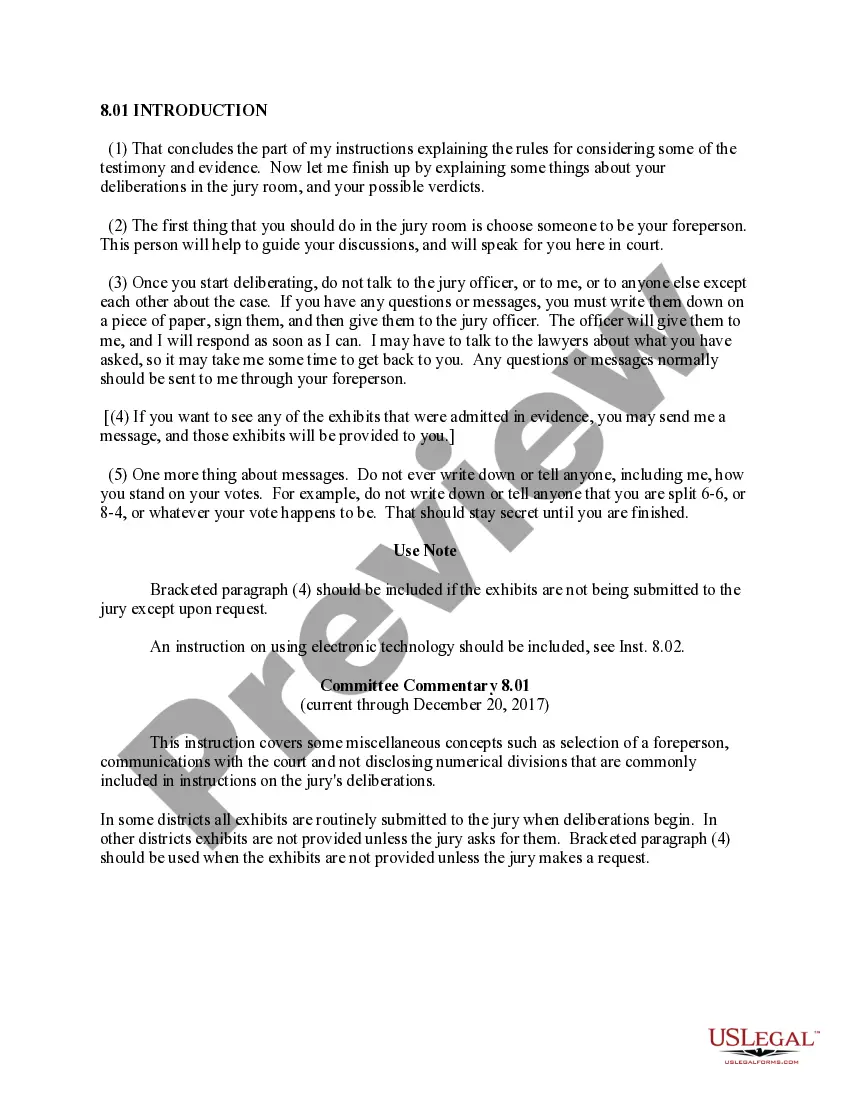
The Introduction form is a guide used in criminal trials to clarify jurors' responsibilities regarding the assessment of a defendant's guilt. It provides essential instructions to ensure clarity on their duty to focus solely on the defendant and the specific charges they face, differentiating them from broader considerations about other potential guilt.
Main sections of this form
- Overview of jurors' duties and general rules applicable in criminal cases.
- Clarification that the trial focuses on the defendant's specific charges, not on potential guilt of others.
- Instructions on when to consider the possible guilt of others, based on trial developments.
- Guidance on necessary modifications for specific types of cases, such as conspiracy or mistaken identity.


When this form is needed
This form should be used during the jury instruction phase of a criminal trial. It is relevant when jurors need clear guidance on how to deliberate on the charges against the defendant without being influenced by the guilt or innocence of others who may not be involved in the case.
Who should use this form
- Judges overseeing criminal trials.
- Legal counsel for the defense or prosecution.
- Court administrators preparing jury instructions.
- Jurors selected to decide on a criminal case.
Completing this form step by step
- Review the specific charges against the defendant outlined in the indictment.
- Emphasize the importance of focusing on the evidence pertaining to the defendant only.
- Decide whether the bracketed paragraph regarding the guilt of other parties needs to be included based on trial discussions.
- Make any necessary modifications to the form to comply with specific case circumstances, such as conspiracy or alibi defenses.
- Provide this instruction to the jury at the appropriate time during the trial.
Does this document require notarization?
In most cases, this form does not require notarization. However, some jurisdictions or signing circumstances might. US Legal Forms offers online notarization powered by Notarize, accessible 24/7 for a quick, remote process.
Get your form ready online
Our built-in tools help you complete, sign, share, and store your documents in one place.
Make edits, fill in missing information, and update formatting in US Legal Forms—just like you would in MS Word.
Download a copy, print it, send it by email, or mail it via USPS—whatever works best for your next step.
Sign and collect signatures with our SignNow integration. Send to multiple recipients, set reminders, and more. Go Premium to unlock E-Sign.
If this form requires notarization, complete it online through a secure video call—no need to meet a notary in person or wait for an appointment.
We protect your documents and personal data by following strict security and privacy standards.

Make edits, fill in missing information, and update formatting in US Legal Forms—just like you would in MS Word.

Download a copy, print it, send it by email, or mail it via USPS—whatever works best for your next step.

Sign and collect signatures with our SignNow integration. Send to multiple recipients, set reminders, and more. Go Premium to unlock E-Sign.

If this form requires notarization, complete it online through a secure video call—no need to meet a notary in person or wait for an appointment.

We protect your documents and personal data by following strict security and privacy standards.
Common mistakes
- Forgetting to modify the form based on specific case needs, such as alibi defenses.
- Including unnecessary paragraphs if the guilt of other parties was not raised during the trial.
- Failing to clarify juror responsibilities adequately, leading to confusion during deliberation.
Advantages of online completion
- Convenient access to authoritative legal guidance drafted by licensed attorneys.
- Easy to download and print for use in court proceedings.
- Editable format allows legal professionals to customize content as required.
Looking for another form?




Form popularity
FAQ
An introduction is the first paragraph of your paper. The goal of your introduction is to let your reader know the topic of the paper and what points will be made about the topic. The thesis statement that is included in the introduction tells your reader the specific purpose or main argument of your paper.
Introduce Yourself Start with a quotation. Open with a relevant stat or fun fact. Start with a fascinating story. Ask your readers an intriguing question. Set the scene.
There are four different ways of writing an introduction to an academic essay. These include; funnel, quotations, dramatic, and the turn-about form.
Introducing one person to a group of people For example: "Ladies and gentlemen, without further ado, it is my pleasure to introduce you to the Founder and CEO of Tasty Sweets, Mrs. Rachel Malloy." "Emily, Luis and Trent, I would like to introduce you to my grandmother, Mrs. Joan O'Malley."
Here are a few examples of statements you can use to inform others you are making an introduction: "I would like you to meet..." "It's a pleasure to introduce..." "I would like to introduce..." "I would like to present..."
This lesson explains seven ways to write an introduction. Funnel. Anecdote. Survey. Quotation. Question. Setting the Scene. Definition.
A good introduction should identify your topic, provide essential context, and indicate your particular focus in the essay. It also needs to engage your readers' interest.
The act of introducing or fact of being introduced. a presentation of one person to another or others. a means of presenting a person to another person, group, etc, such as a letter of introduction or reference. a preliminary part, as of a book, speech, etc.