Startup Package
Overview of this form package
The Startup Package is a comprehensive collection of essential forms specifically designed for new businesses. This package includes critical documents that assist in the formation and operation of a company, distinguishing it from other packages by providing sector-specific agreements and guidelines to help entrepreneurs navigate the initial stages of establishing a business.
Forms you’ll find in this package
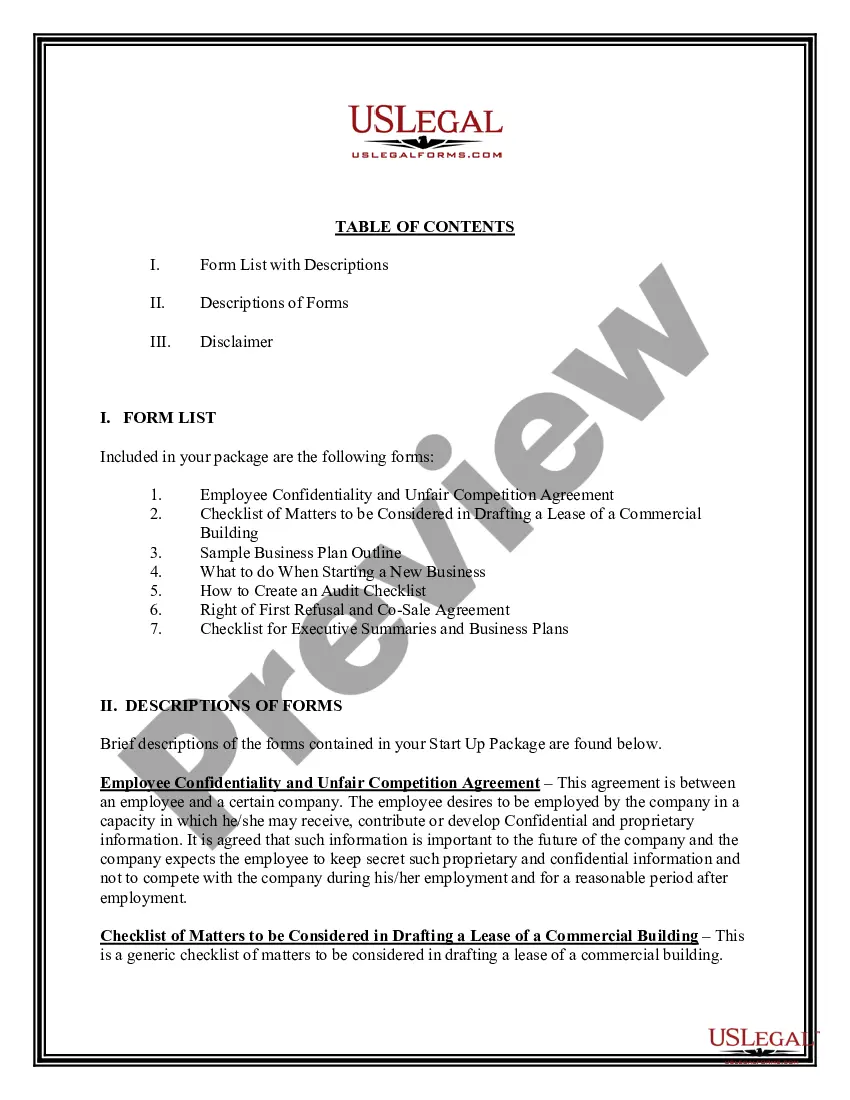
- Confidentiality Agreements - Noncompetition in Employment
- Checklist of Matters to be Considered in Drafting a Lease of a Commercial Building
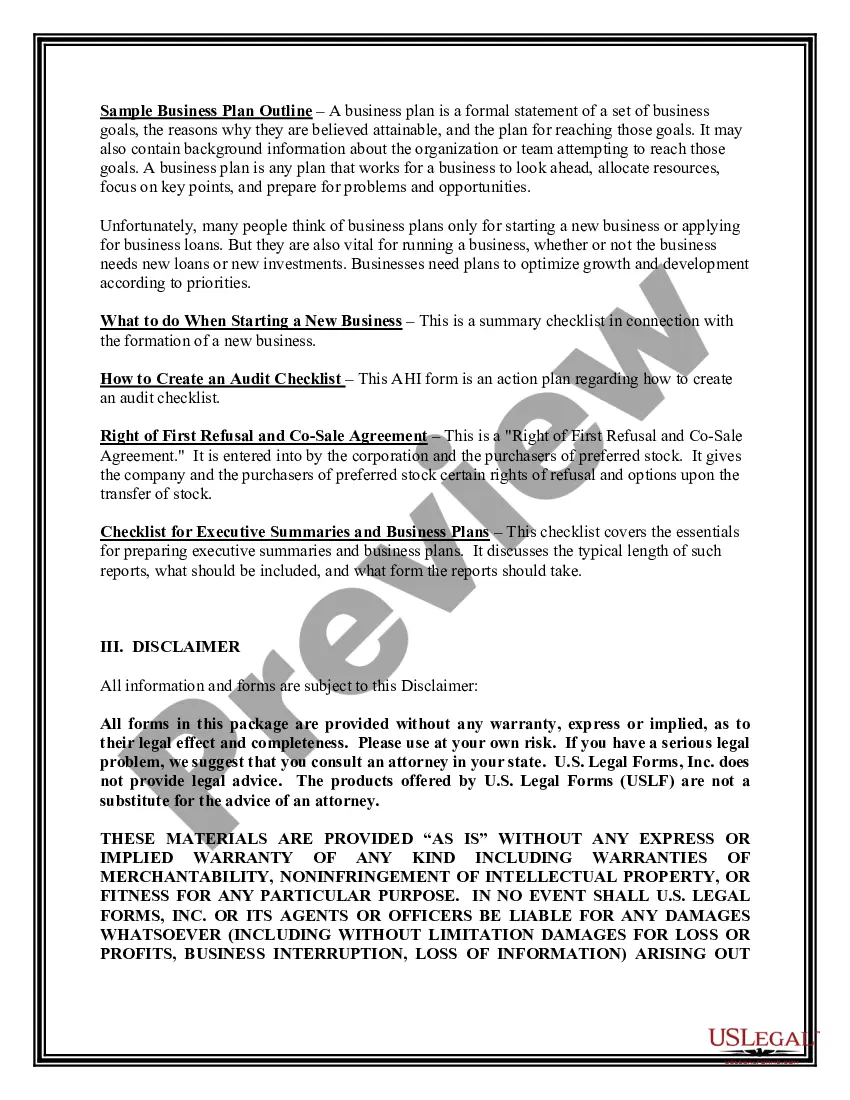
- Sample Business Plan Outline
- What To Do When Starting a New Business
- PA Action Plan - How to Create an Audit Checklist
- Right of First Refusal and Co-Sale Agreement
- Checklist for Executive Summaries and Business Plans


When to use this form package
This form package is particularly useful in the following scenarios:
- You are starting a new business and need essential legal documentation.
- You want to ensure confidentiality and prevent unfair competition among employees.
- You are drafting a lease agreement for a commercial property.
- You need to devise a business plan to attract investors or guide your company's direction.
- You want to create an audit checklist to ensure compliance and readiness for assessments.
Who needs this form package
- Entrepreneurs launching new business ventures.
- Small business owners seeking legal and financial structure.
- Startups looking for guidance on compliance and operational procedures.
- Individuals wanting to protect their business ideas and proprietary information.
Steps to complete these forms
- Review the contents of each included form to understand their requirements.
- Complete the Employee Confidentiality and Unfair Competition Agreement by entering the employee and company details.
- Use the Sample Business Plan Outline to create your unique business plan tailored to your goals.
- Follow the Checklist of Matters to be Considered in Drafting a Lease to ensure all essential elements are included in your lease agreement.
- Fill out the audit checklist and plan according to your business needs.
Notarization details for included forms
Notarization is not commonly needed for forms in this package. However, if your state’s laws require it, our notarization service, powered by Notarize, allows you to finalize documents online 24/7 without in-person visits.
Get your form ready online
Our built-in tools help you complete, sign, share, and store your documents in one place.
Make edits, fill in missing information, and update formatting in US Legal Forms—just like you would in MS Word.
Download a copy, print it, send it by email, or mail it via USPS—whatever works best for your next step.
Sign and collect signatures with our SignNow integration. Send to multiple recipients, set reminders, and more. Go Premium to unlock E-Sign.
If this form requires notarization, complete it online through a secure video call—no need to meet a notary in person or wait for an appointment.
We protect your documents and personal data by following strict security and privacy standards.

Make edits, fill in missing information, and update formatting in US Legal Forms—just like you would in MS Word.

Download a copy, print it, send it by email, or mail it via USPS—whatever works best for your next step.

Sign and collect signatures with our SignNow integration. Send to multiple recipients, set reminders, and more. Go Premium to unlock E-Sign.

If this form requires notarization, complete it online through a secure video call—no need to meet a notary in person or wait for an appointment.

We protect your documents and personal data by following strict security and privacy standards.
Typical mistakes to avoid
- Overlooking local business laws and regulations based on your state.
- Failing to properly fill out and sign the Employee Confidentiality Agreement.
- Not tailoring the Sample Business Plan Outline to reflect your unique business situation.
- Neglecting to oversee the practical use of the audit checklist, leading to compliance issues.
Advantages of online completion
- Convenience of downloading necessary forms all at once.
- Editability allows customization to fit your business needs.
- Reliability of documents crafted by licensed attorneys ensuring legal soundness.
- Cost-effective solution for new business owners compared to traditional legal services.
Key takeaways
- The Startup Package is essential for new businesses needing legal documentation.
- Included forms are designed to protect your business and guide operational processes.
- This package is suitable for entrepreneurs across multiple states.
- Completing these forms diligently can save time and ensure legal compliance.
Looking for another form?


Form popularity
FAQ
Under Generally Accepted Accounting Principles, you report startup costs as expenses incurred at the time you spend the money. Some of your initial expenses, such as buying equipment, are not classified as startup costs under GAAP and have to be capitalized, not expensed.
Calculate your business startup costs before you launch. Identify your startup expenses. Estimate how much your expenses will cost. Add up your expenses for a full financial picture. Use your startup cost calculations to get startup funding.
Key Takeaways. Startup costs are the expenses incurred during the process of creating a new business. Pre-opening startup costs include a business plan, research expenses, borrowing costs, and expenses for technology. Post-opening startup costs include advertising, promotion, and employee expenses.
Salary. Summer support. Moving costs. Tech, grant, and/or teaching support. Travel and development. Reduced teaching load. TA or RA support.
Such examples of typical pre-launch start-up costs include digital and traditional advertising in readiness for launch, office or studio furnishings and equipment, damage deposits with commercial property landlords, salaries for staff training and installation charges for digital infrastructure e.g. Wi-Fi.
What are four common types of startup costs? (1.0 points) Location, utilities, employees, supplies.
Under Generally Accepted Accounting Principles, you report startup costs as expenses incurred at the time you spend the money. Some of your initial expenses, such as buying equipment, are not classified as startup costs under GAAP and have to be capitalized, not expensed.
Know your minimum number. Leverage sites like PayScale and Glassdoor to learn to learn what employers in your city are paying for similar roles and industries. Provide a salary range. Consider the whole package not just salary. Ensure your pay increases with funding.