Transcript of Recording in Foreign Language
About this form
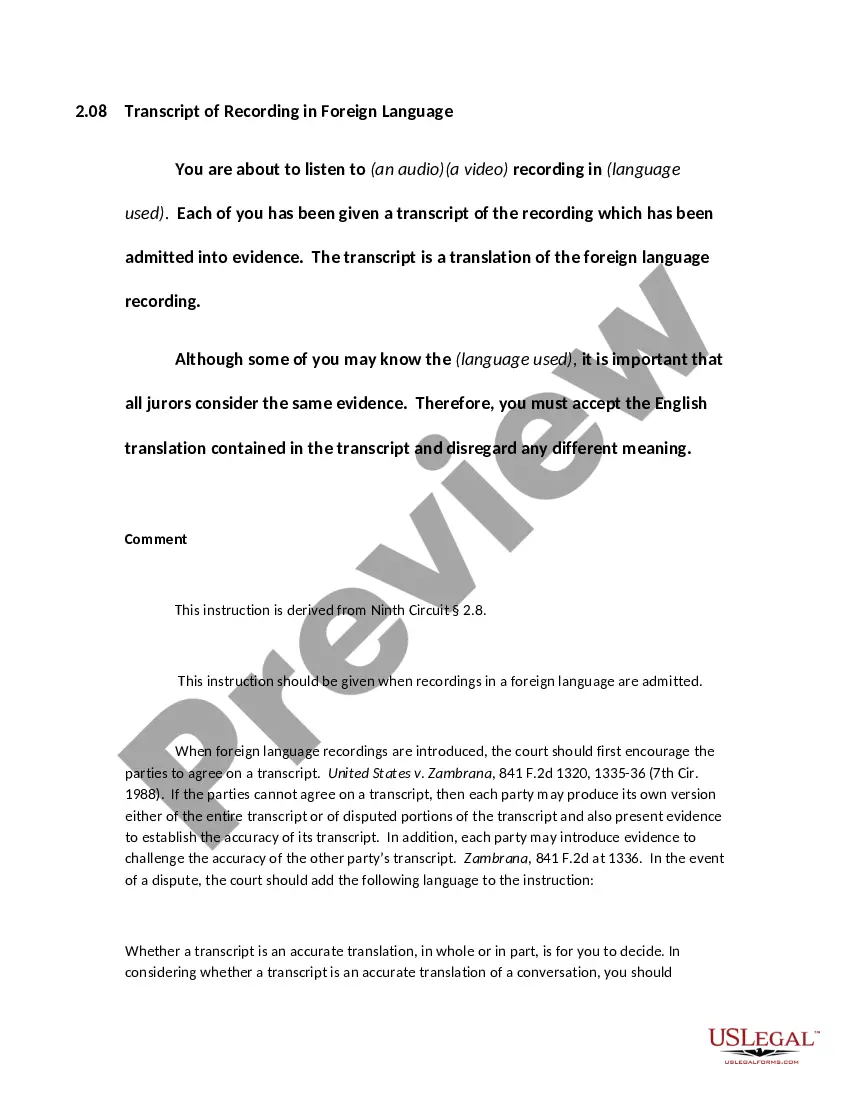
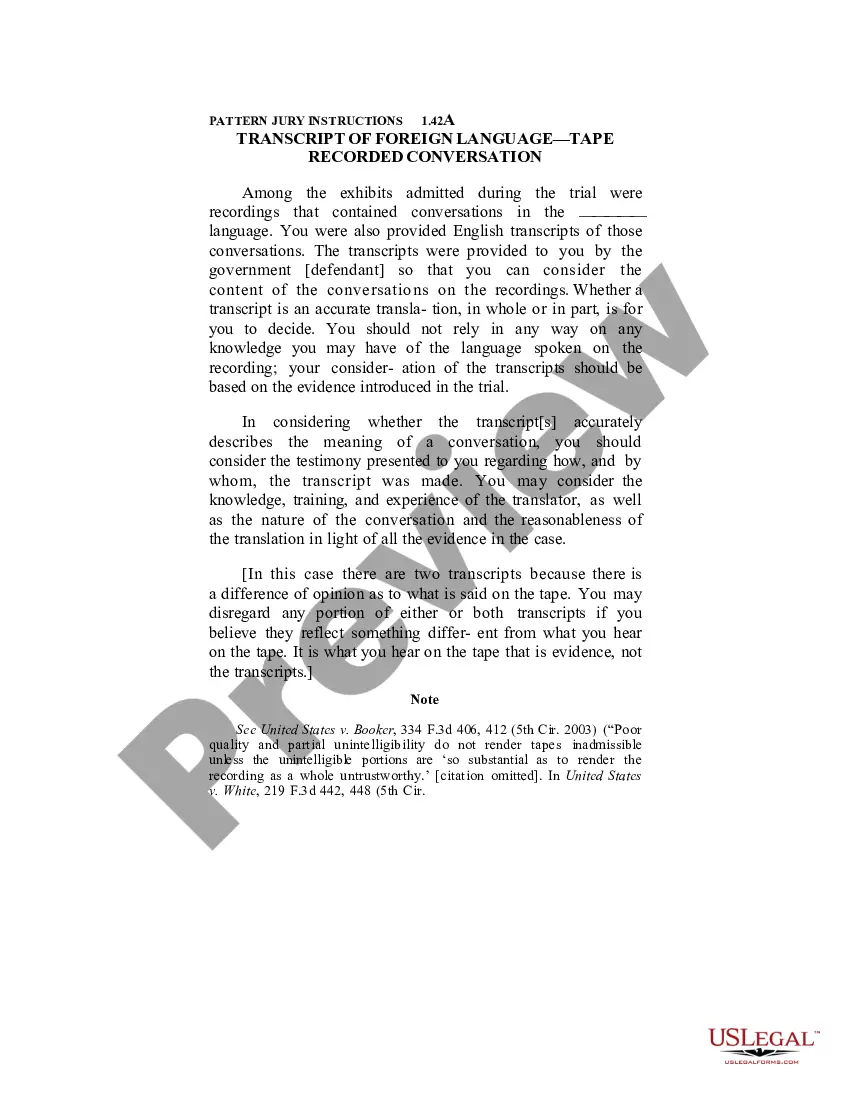
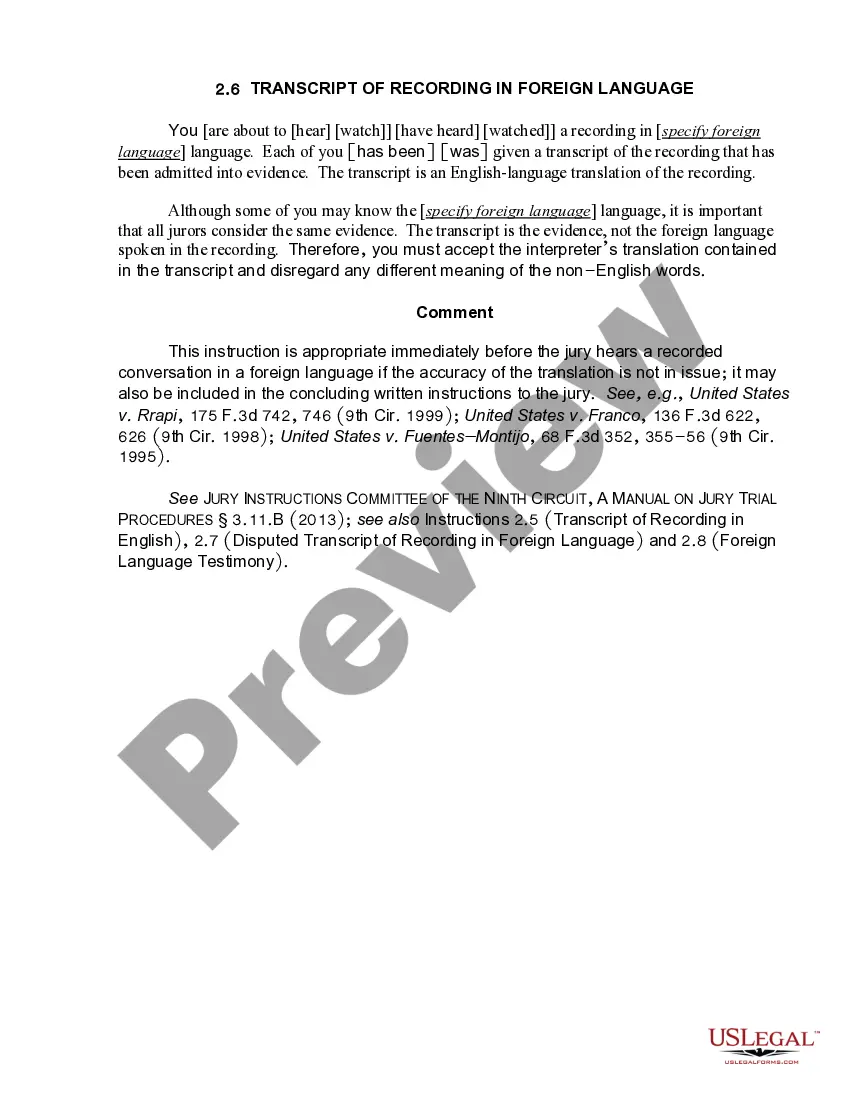
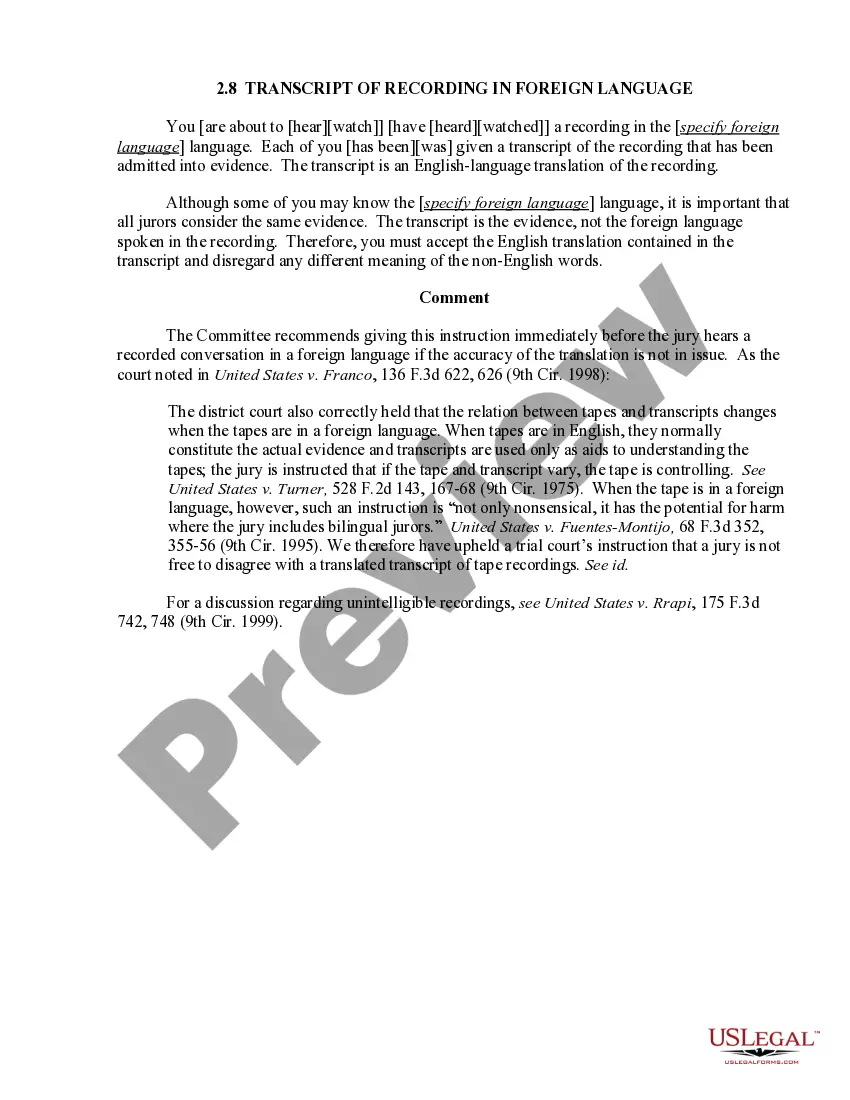
The Transcript of Recording in Foreign Language is a legal document that provides a written translation of audio or video recordings made in a foreign language. This form is essential in legal proceedings where such recordings are submitted as evidence. It ensures that all parties, regardless of their linguistic capabilities, communicate and understand the content in a common language. Unlike other types of transcripts, this form specifically addresses translations of foreign language materials, emphasizing the importance of a standardized version for legal clarity and fairness.
Key components of this form
- A statement indicating the language of the recording.
- The translated transcript of the foreign language recording.
- Instructions for jurors regarding the acceptance of the English translation.
- Guidelines for determining the accuracy of the translation.
- Allowances for disputes between parties regarding the transcript's accuracy.



Common use cases
This form should be used in court proceedings where recordings in a foreign language have been submitted as evidence. It is particularly relevant when the evidence must be comprehensible to all jurors, ensuring that they consider the same translation. Use this form when there is a need to document and illustrate the translation process of a foreign language recording to avoid misunderstandings or discrepancies in interpretation.
Who can use this document
This form is intended for use by:
- Attorneys representing clients in legal cases involving foreign language recordings.
- Judges and court officials needing to establish a clear understanding of recorded evidence.
- Jurors who require an accurate translation to make informed decisions based on the evidence presented.
How to complete this form
- Identify the original language of the recording.
- Provide a detailed, written translation of the audio or video content.
- Certify the accuracy of the translation and any qualifications of the translator.
- Prepare instructions for jurors regarding the acceptance of the transcript.
- Include any relevant disclaimers about the potential for disputes over translation accuracy.
Does this form need to be notarized?
This form does not typically require notarization to be legally valid. However, some jurisdictions or document types may still require it. US Legal Forms provides secure online notarization powered by Notarize, available 24/7 for added convenience.
Get your form ready online
Our built-in tools help you complete, sign, share, and store your documents in one place.
Make edits, fill in missing information, and update formatting in US Legal Forms—just like you would in MS Word.
Download a copy, print it, send it by email, or mail it via USPS—whatever works best for your next step.
Sign and collect signatures with our SignNow integration. Send to multiple recipients, set reminders, and more. Go Premium to unlock E-Sign.
If this form requires notarization, complete it online through a secure video call—no need to meet a notary in person or wait for an appointment.
We protect your documents and personal data by following strict security and privacy standards.

Make edits, fill in missing information, and update formatting in US Legal Forms—just like you would in MS Word.

Download a copy, print it, send it by email, or mail it via USPS—whatever works best for your next step.

Sign and collect signatures with our SignNow integration. Send to multiple recipients, set reminders, and more. Go Premium to unlock E-Sign.

If this form requires notarization, complete it online through a secure video call—no need to meet a notary in person or wait for an appointment.

We protect your documents and personal data by following strict security and privacy standards.
Common mistakes to avoid
- Failing to ensure that the translation is accurate and certified.
- Not providing clear instructions for jurors on how to interpret the transcript.
- Overlooking dispute resolution procedures for conflicting translations.
Why complete this form online
- Convenience of downloading and customizing the form at any time.
- Ensures compliance with legal standards through professionally drafted templates.
- Quick access to updates or revisions reflecting current legal practices.
Looking for another form?
Form popularity
FAQ
To present a document in court and enter it as evidence you usually need someone, a witness or a party (this could be you), to introduce it to the court. They will need to swear that it is the authentic document and may be needed to explain the content of the document.
You should lay some basic foundation, i.e., you asked the witness, ?Do you recall your deposition was taken on such date, you were sworn to tell the truth, you were given an opportunity to review and make corrections,? etc. You then read the portion of the deposition containing the inconsistent statement.
How Do You Introduce Exhibits at Trial? Mark the exhibit for identification. Show the exhibit to the opposing attorney. Request permission to approach the witness or hand the exhibit to the bailiff (learn more about courtroom etiquette) Show the exhibit to the witness. Lay the proper foundation for the exhibit.
The primary difference between translation and transcription is that translation involves converting material into another language, while transcription involves only the source language. Additionally, translation is often far more complex than transcription.
Foreign language transcription can be a single-step process, requiring only the conversion of audio documents into written format, or it can be a multi-step process, followed by translation into one or more languages, as well as ancillary multimedia services such as subtitles, voice over, and layout.
Often judges will include in a pre-trial order that you must designate the deposition and parts of them you want to read into evidence....The basic legal procedure: file original deposition, ask the judge for permission, explain any failure to designate, read the deposition aloud into the record.
What is transcribing? Transcribing entails listening to recorded audio (or video) and typing what you hear word-for-word. The audio files are varied and can include focus groups for market research, interviews, meetings, phone calls, zoom calls etc.
Foreign language transcription is the process of taking spoken words on an audio or video recording in one language and converting them into written text in another language.
1. Provide a copy of the recording on a storage device (and the transcript if you intend to use one) to the other party (or his or her attorney) in advance of the court date. 2. Ask the court clerk to mark the storage device and/or transcript with an exhibit number.