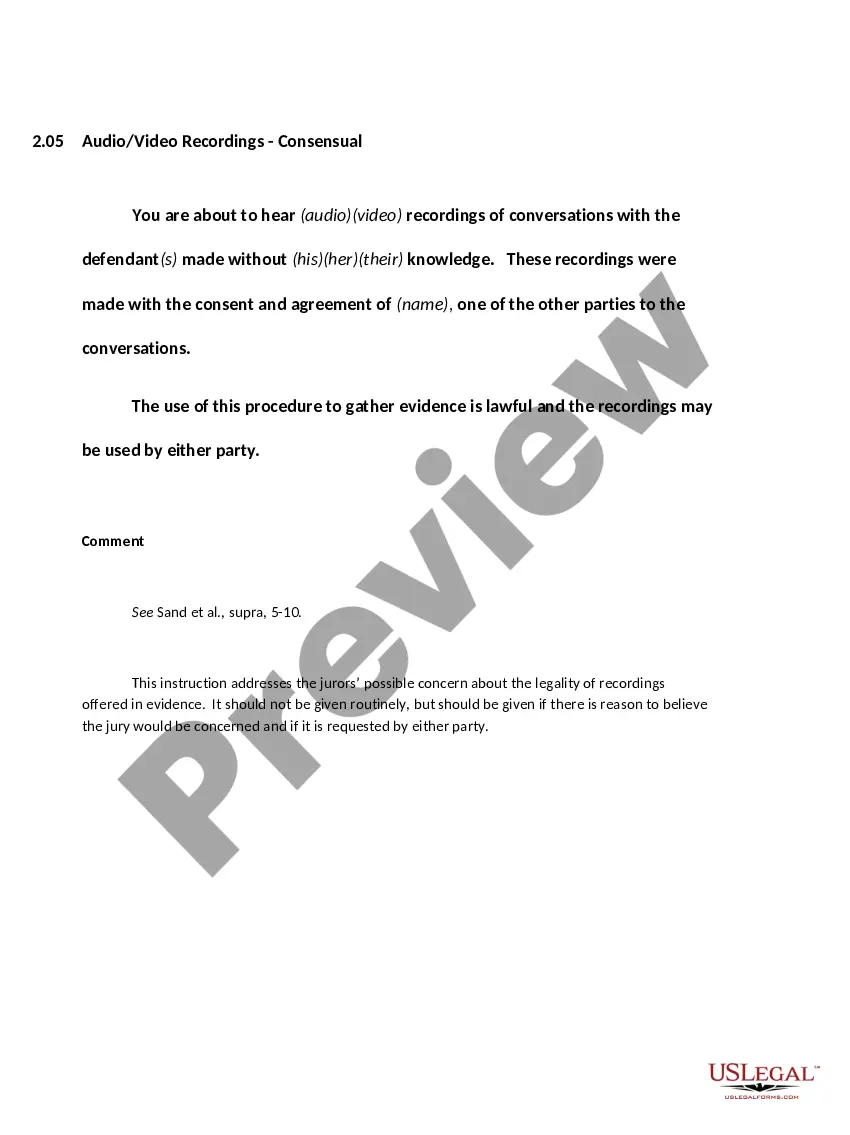
Audio/Video Recordings - Consensual
About this form
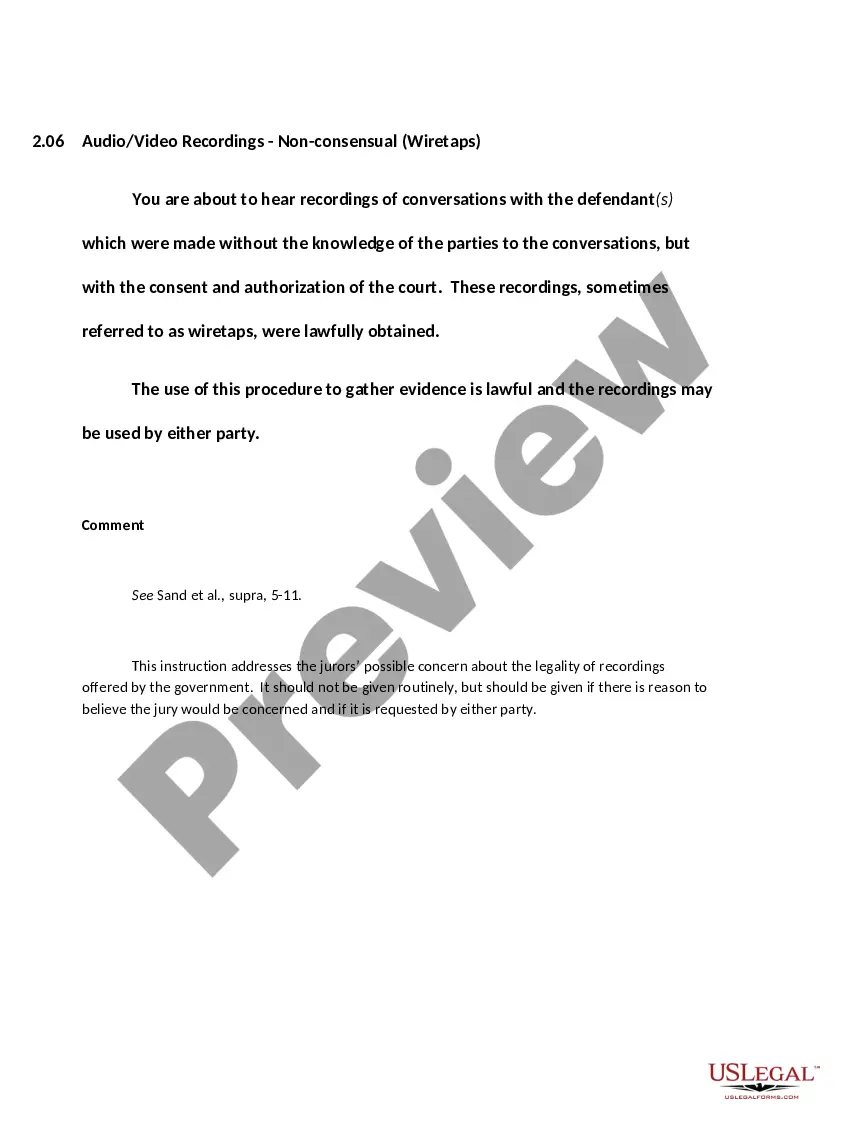
The Audio/Video Recordings - Consensual form is designed to acknowledge and clarify the legality of audio or video recordings made during conversations with a party's consent. This form is essential for ensuring that the recorded material can be appropriately used as evidence in legal proceedings. It differs from other recording-related forms by specifically addressing consensual recording practices and the resulting legal considerations presented to a jury.
Form components explained
- Identification of the parties involved in the conversations.
- Clarification that recordings are made with consent from one party.
- Instructions for the jury regarding the legality of such recordings.
- Guidelines for when the instruction should be presented during a trial.


Situations where this form applies
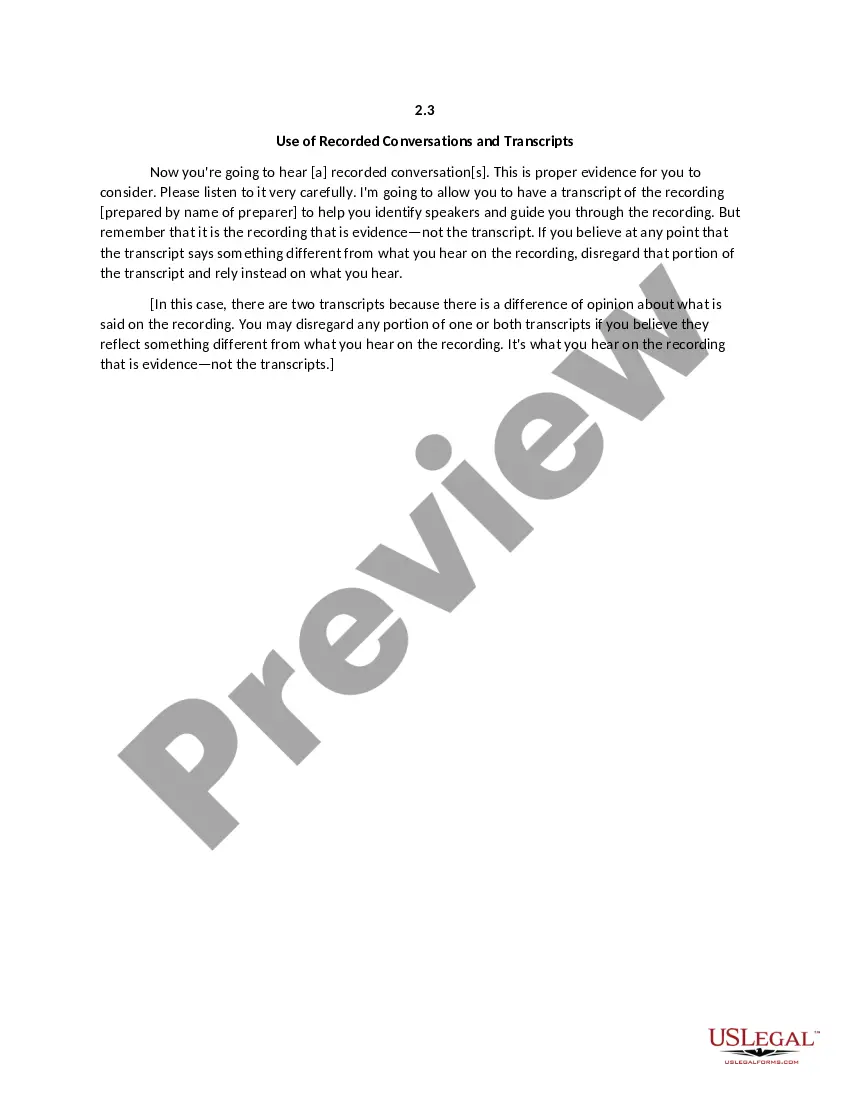
This form is used in legal scenarios where audio or video recordings are presented as evidence. It is especially relevant in criminal or civil cases where one party wishes to use such recordings to support their argument, demonstrating that the recordings were made with the necessary consent. It is crucial to ensure that the jury understands the legality of the recordings to prevent concerns about their admissibility in court.
Who should use this form
This form is intended for:
- Legal professionals needing to introduce consensually recorded evidence in court.
- Parties involved in conversations that have been recorded with mutual consent.
- Individuals seeking clarity on the legality of using such recordings in legal contexts.
How to complete this form
- Identify the names of all parties involved in the recorded conversations.
- Clearly document the consent of the party from whom the recordings were made.
- Complete any required fields indicating the context and nature of the conversations recorded.
- Sign and date the form to finalize the legal acknowledgment of the recordings.
Does this document require notarization?
This form does not typically require notarization to be legally valid. However, some jurisdictions or document types may still require it. US Legal Forms provides secure online notarization powered by Notarize, available 24/7 for added convenience.
Get your form ready online
Our built-in tools help you complete, sign, share, and store your documents in one place.
Make edits, fill in missing information, and update formatting in US Legal Forms—just like you would in MS Word.
Download a copy, print it, send it by email, or mail it via USPS—whatever works best for your next step.
Sign and collect signatures with our SignNow integration. Send to multiple recipients, set reminders, and more. Go Premium to unlock E-Sign.
If this form requires notarization, complete it online through a secure video call—no need to meet a notary in person or wait for an appointment.
We protect your documents and personal data by following strict security and privacy standards.

Make edits, fill in missing information, and update formatting in US Legal Forms—just like you would in MS Word.

Download a copy, print it, send it by email, or mail it via USPS—whatever works best for your next step.

Sign and collect signatures with our SignNow integration. Send to multiple recipients, set reminders, and more. Go Premium to unlock E-Sign.

If this form requires notarization, complete it online through a secure video call—no need to meet a notary in person or wait for an appointment.

We protect your documents and personal data by following strict security and privacy standards.
Avoid these common issues
- Failing to ensure that all parties have consented to the recording.
- Not documenting the specific context in which the recordings were made.
- Assuming that the legality of recording does not need to be clarified to the jury.
Advantages of online completion
- Convenient access to a legally reviewed template that complies with current laws.
- Edit and customize the form to fit specific legal needs quickly.
- Save time by downloading and filling out the form at your own pace.
Legal use & context
- Consensual recordings are generally admissible in court when proper consent is given.
- Legal instructions may be necessary to clarify the permissibility of recordings to a jury.
- Each state may have specific regulations regarding audio/video recordings, impacting legality and admissibility.
Summary of main points
- The Audio/Video Recordings - Consensual form is vital for legal clarity in using recorded evidence.
- Ensure that all parties involved consent to the recording to avoid legal complications.
- This form plays a crucial role in educating jurors about the legitimacy of consensual recordings.
Looking for another form?


Form popularity
FAQ
The main idea & purpose behind AV recording of the consent process is to ensure that the clinical trial participants are adequately informed about all aspects of the clinical trial including risks and benefits and chances of failure of the Investigational Medicinal Product (IMP) to give intended therapeutic effect and
Audiovisual records include motion picture film, still photographs, filmstrips, sound and video recordings, posters and other graphic works, and multimedia productions with related finding aids and production files.
In a legal context, consent is the most significant factor in determining whether the video recording you have made could land you in hot water. California is a two-party consent state, which means you must get permission from all involved parties before making your recording.
The main idea & purpose behind AV recording of the consent process is to ensure that the clinical trial participants are adequately informed about all aspects of the clinical trial including risks and benefits and chances of failure of the Investigational Medicinal Product (IMP) to give intended therapeutic effect and
The 16 states that require two-party consent are California, Connecticut, Delaware, Florida, Hawaii, Illinois, Kansas, Maryland, Massachusetts, Michigan, Montana, Nevada, New Hampshire, Pennsylvania, Utah, and Washington. Laws change constantly. Please check your state's current laws before engaging in recording.
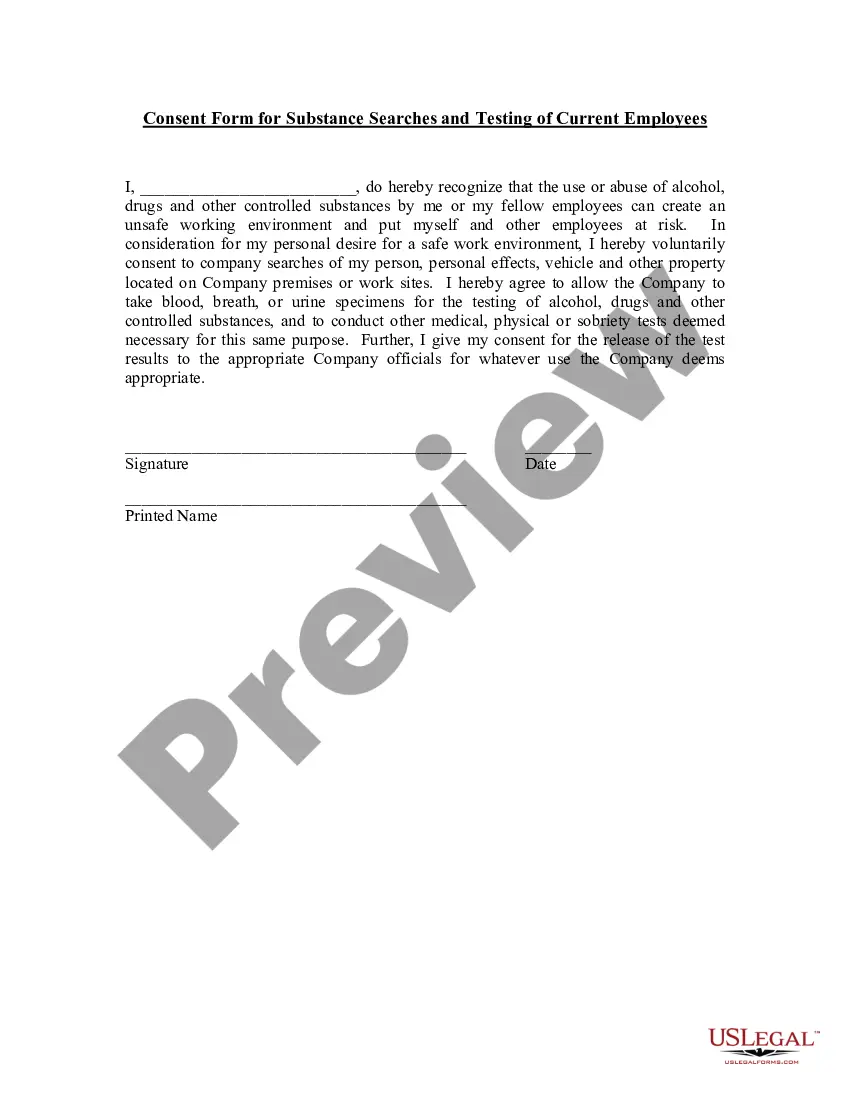
I, (recorded person's full name), do hereby consent to the use by (entrant's full name) of my image, video, voice, or all three of them, in the item described above. In addition, I waive any right to inspect or approve the finished video recording.
Federal law requires one-party consent, enabling you to record a conversation in person or over the phone, but only if you are participating in the conversation. If you are not part of the conversation but you are recording it, then you are engaging in illegal eavesdropping or wiretapping.