Jury Instruction - Insanity
About this form
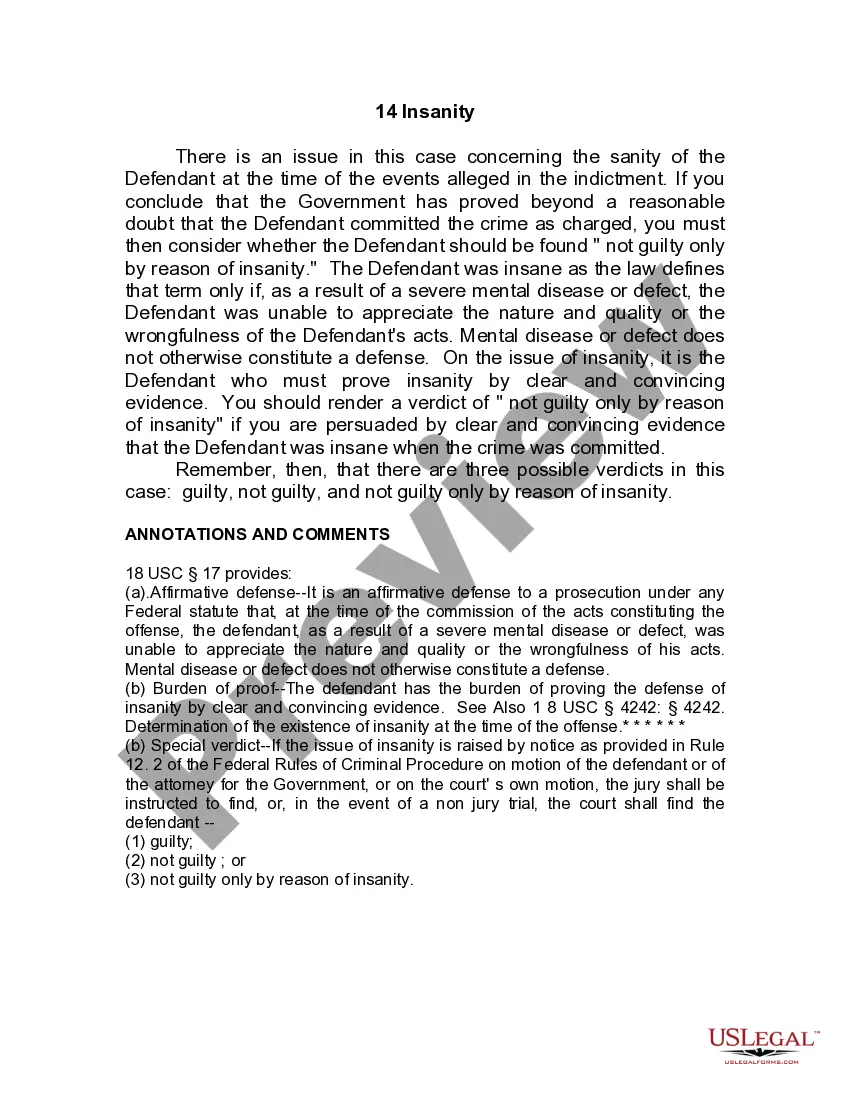
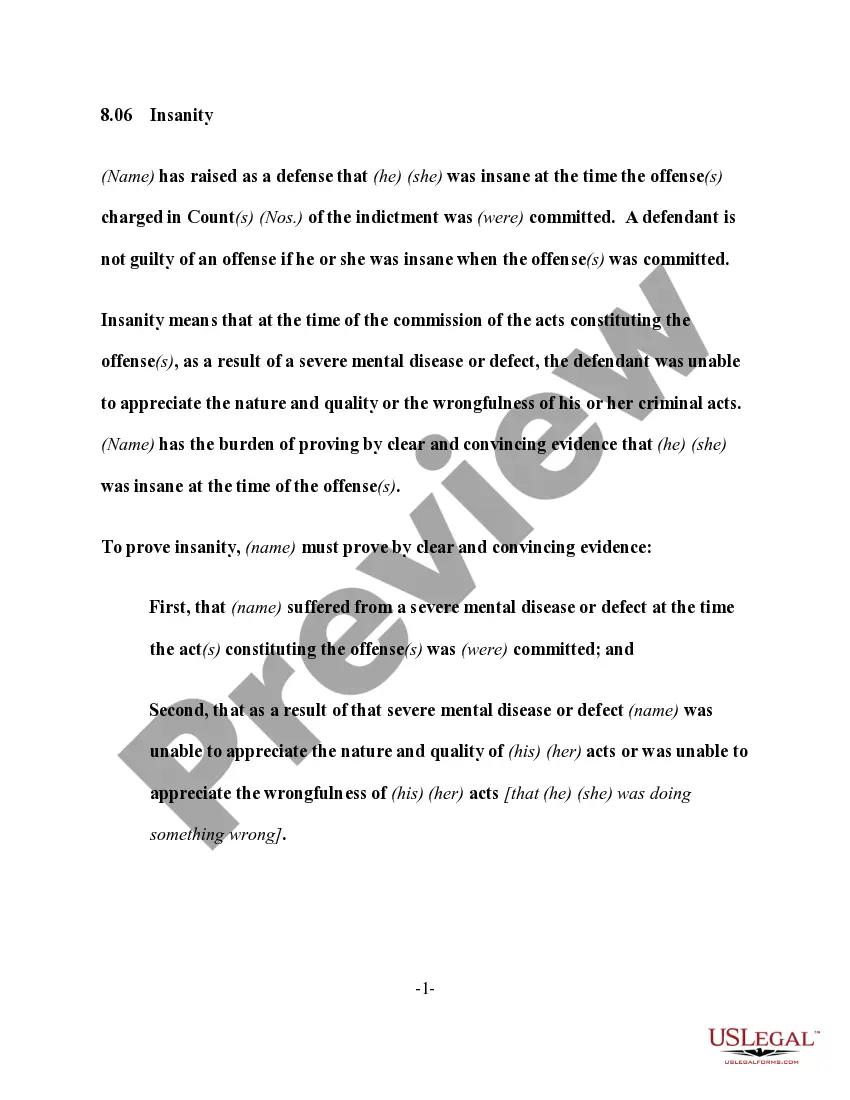
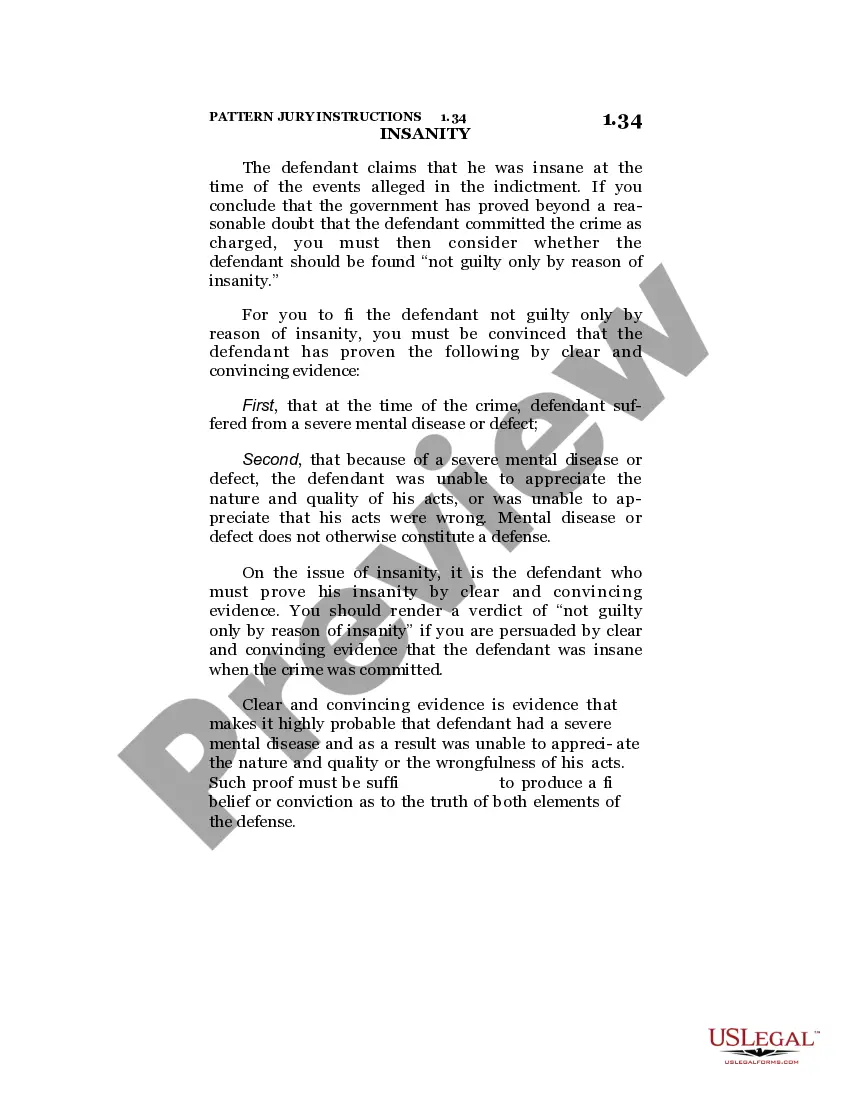
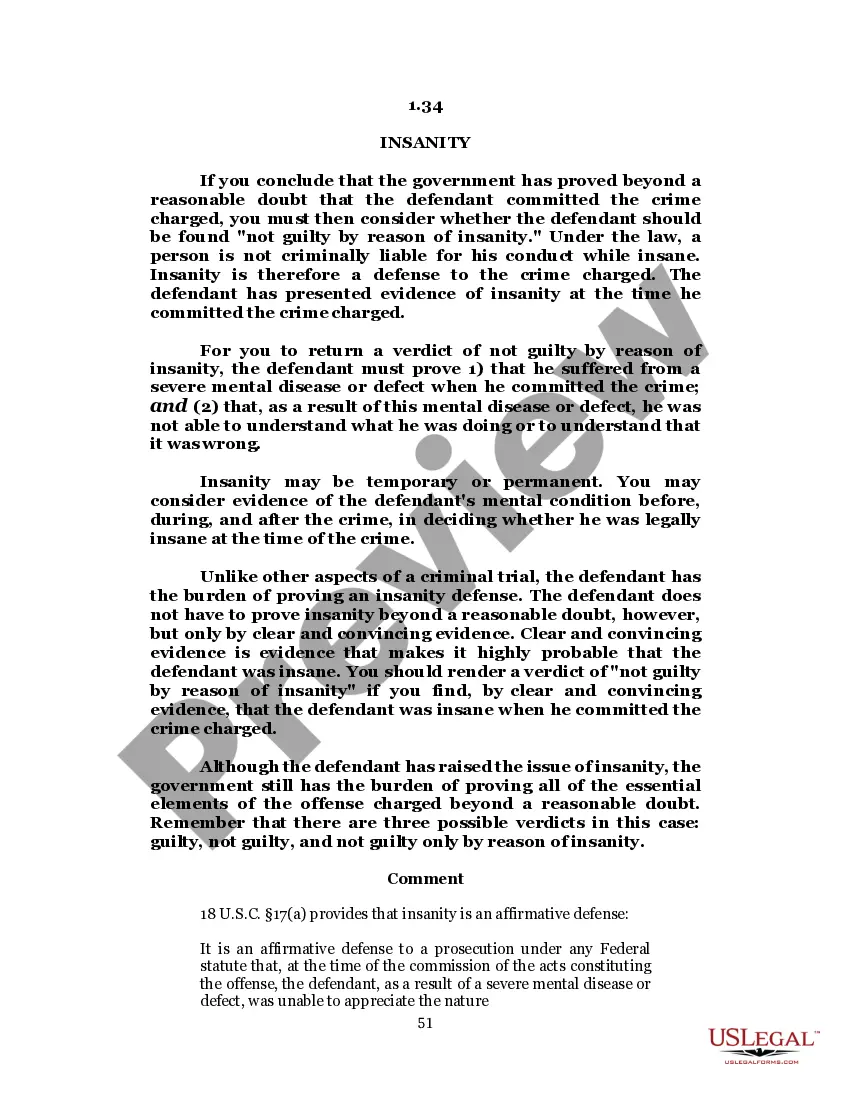
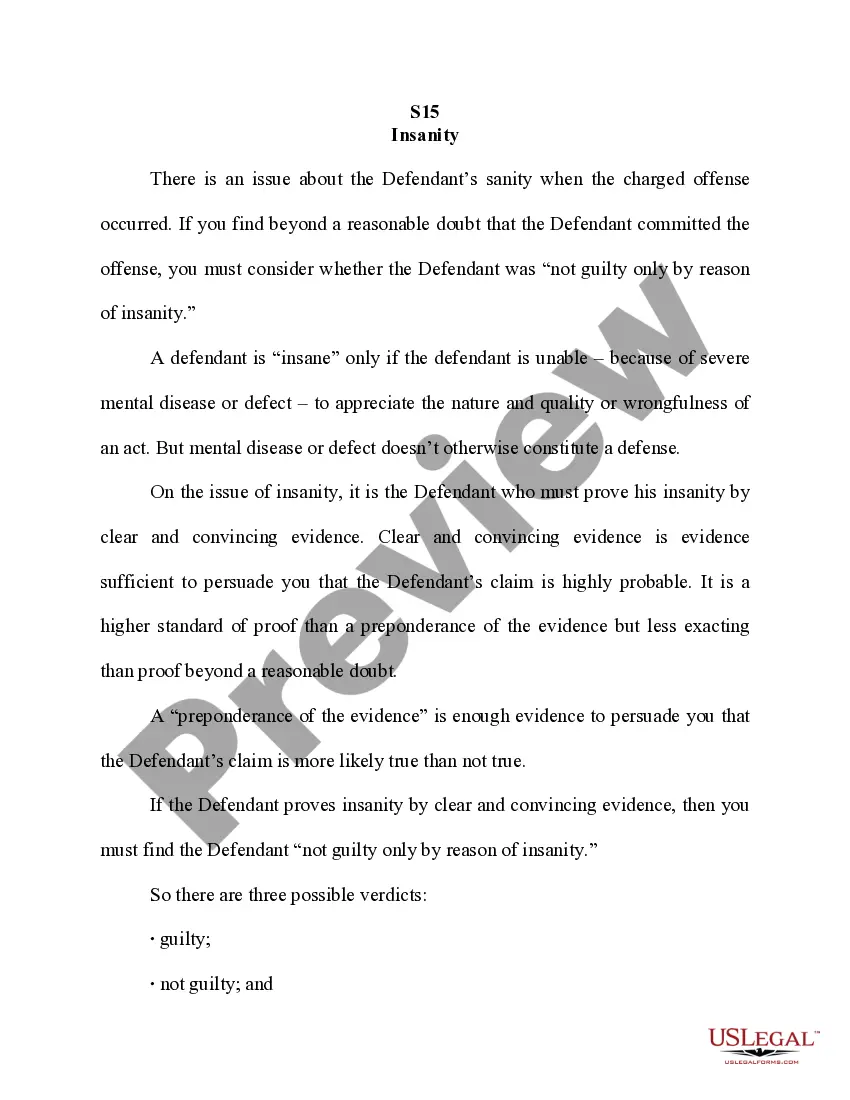
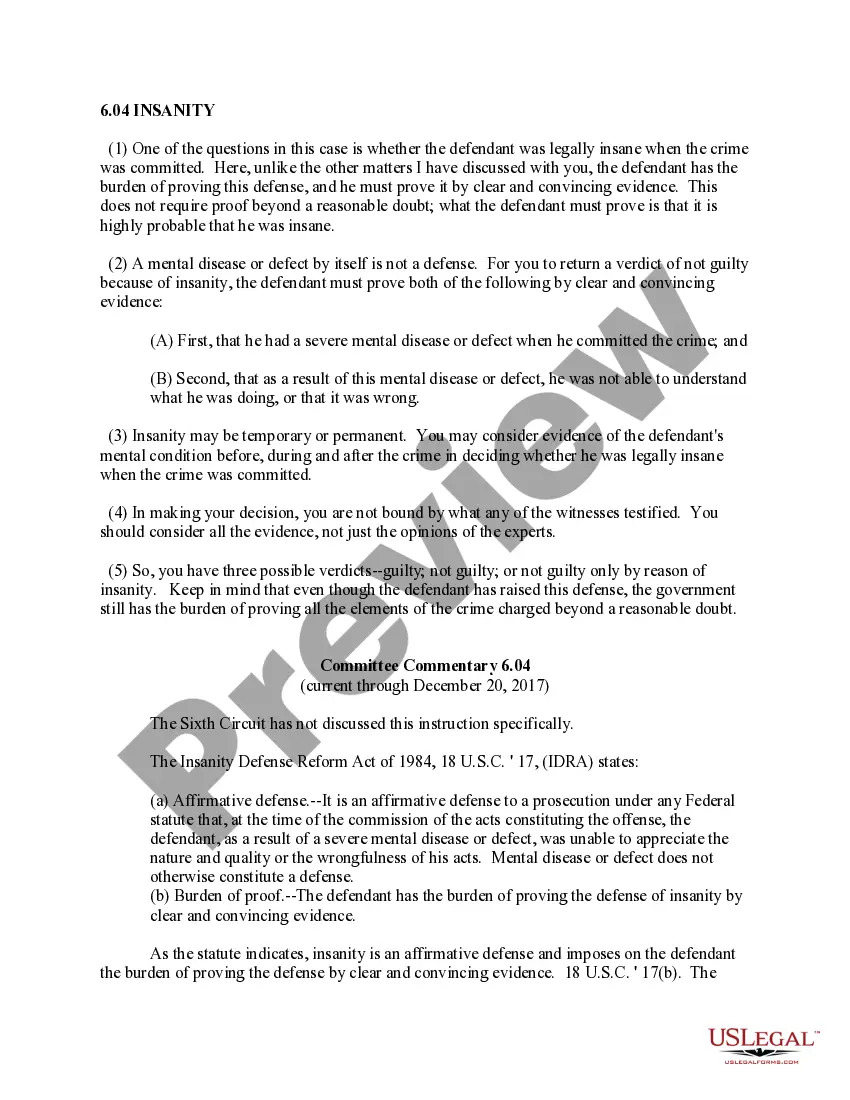
The Jury Instruction - Insanity form provides sample jury instructions that guide jurors in determining the sanity of a defendant at the time a crime was committed. It outlines the legal standards for insanity defenses and the burden of proof required for the defendant. This form is essential for cases where mental health issues may impact the verdict, distinguishing it from other types of jury instructions that may not address insanity defenses specifically.
Key components of this form
- Legal standard: Defines what constitutes insanity under the law.
- Burden of proof: Clarifies that the defendant must prove insanity by clear and convincing evidence.
- Verdict options: Lists the possible verdicts of guilty, not guilty, and not guilty by reason of insanity.
- Jury's responsibility: Outlines the jury's role in determining the mental state of the defendant during the commission of the crime.
Common use cases
This form should be used in criminal cases where the defendant raises an insanity defense. It is applicable in situations where mental illness may have influenced the defendant's ability to understand the nature and wrongfulness of their actions at the time of the crime. This helps ensure that the jury is appropriately instructed on the legal considerations of insanity and the necessary evidential standards.
Who should use this form
- Defense attorneys representing clients with mental health issues.
- Prosecutors who need to understand the implications of an insanity defense.
- Judges presiding over cases involving jury instructions on insanity.
- Law students studying jury instructions and insanity defenses.
Completing this form step by step
- Understand the legal definition of insanity as provided in the instructions.
- Determine the applicable burden of proof and ensure clarity on who must prove insanity.
- Provide clear options for the jury's verdict in the instructions section.
- Review the instructions for necessary modifications to fit the specifics of the case.
- Ensure that all relevant legal standards and definitions are included for the jury's understanding.
Does this document require notarization?
This form usually doesn’t need to be notarized. However, local laws or specific transactions may require it. Our online notarization service, powered by Notarize, lets you complete it remotely through a secure video session, available 24/7.
Get your form ready online
Our built-in tools help you complete, sign, share, and store your documents in one place.
Make edits, fill in missing information, and update formatting in US Legal Forms—just like you would in MS Word.
Download a copy, print it, send it by email, or mail it via USPS—whatever works best for your next step.
Sign and collect signatures with our SignNow integration. Send to multiple recipients, set reminders, and more. Go Premium to unlock E-Sign.
If this form requires notarization, complete it online through a secure video call—no need to meet a notary in person or wait for an appointment.
We protect your documents and personal data by following strict security and privacy standards.

Make edits, fill in missing information, and update formatting in US Legal Forms—just like you would in MS Word.

Download a copy, print it, send it by email, or mail it via USPS—whatever works best for your next step.

Sign and collect signatures with our SignNow integration. Send to multiple recipients, set reminders, and more. Go Premium to unlock E-Sign.

If this form requires notarization, complete it online through a secure video call—no need to meet a notary in person or wait for an appointment.

We protect your documents and personal data by following strict security and privacy standards.
Typical mistakes to avoid
- Failing to clearly define the legal standards for insanity.
- Neglecting to specify the burden of proof for the defendant.
- Leaving out any possible verdict options which can confuse the jury.
- Using unclear language that may lead to misinterpretation of the instructions.
Benefits of completing this form online
- Easy access to professionally drafted instructions tailored for jury considerations.
- Editability allows for customization according to specific case needs.
- Immediate availability for download streamlines the preparation process.
- Reliability of content drafted by licensed attorneys ensures legal compliance.
Looking for another form?
Form popularity
FAQ
The four versions of the insanity defense are M'Naghten, irresistible impulse, substantial capacity, and Durham. The two elements of the M'Naghten insanity defense are the following: The defendant must be suffering from a mental defect or disease at the time of the crime.
Most states use what is called the M'Naghten test to determine if someone is legally insane. It is a cognitive test that assesses the thought processes and perceptions that the defendant had at the time that he or she committed the crime.
The four versions of the insanity defense are M'Naghten, irresistible impulse, substantial capacity, and Durham. The two elements of the M'Naghten insanity defense are the following: The defendant must be suffering from a mental defect or disease at the time of the crime.
The federal insanity defense now requires the defendant to prove, by "clear and convincing evidence," that "at the time of the commission of the acts constituting the offense, the defendant, as a result of a severe mental disease or defect, was unable to appreciate the nature and quality or the wrongfulness of his acts
Insanity. n. mental illness of such a severe nature that a person cannot distinguish fantasy from reality, cannot conduct her/his affairs due to psychosis, or is subject to uncontrollable impulsive behavior. Insanity is distinguished from low intelligence or mental deficiency due to age or injury.
Defendants found not guilty by reason of insanity are rarely set free. Instead, they are almost always confined in mental health institutions. They may remain confined for a longer period of time than had they been found guilty and sentenced to a term in prison.
Insanity. The legal concept referring to the criminal's state of mind at the time the crime was committed. It requires that, due to a mental illness, a defendant lacks moral responsibility and culpability for the crime, and therefore should not be punished.
(The defendant was legally insane if: 1 When (he/she) committed the crimes, (he/she) had a mental disease or defect; AND 2 Because of that disease or defect, (he/she) was incapable of knowing or understanding the nature and quality of (his/her) act or was incapable of knowing or understanding that (his/her) act was
In states that allow the insanity defense, defendants must prove to the court that they didn't understand what they were doing; failed to know right from wrong; acted on an uncontrollable impulse; or some variety of these factors.