Sample Letter for Decline to Give Advice
Understanding this form
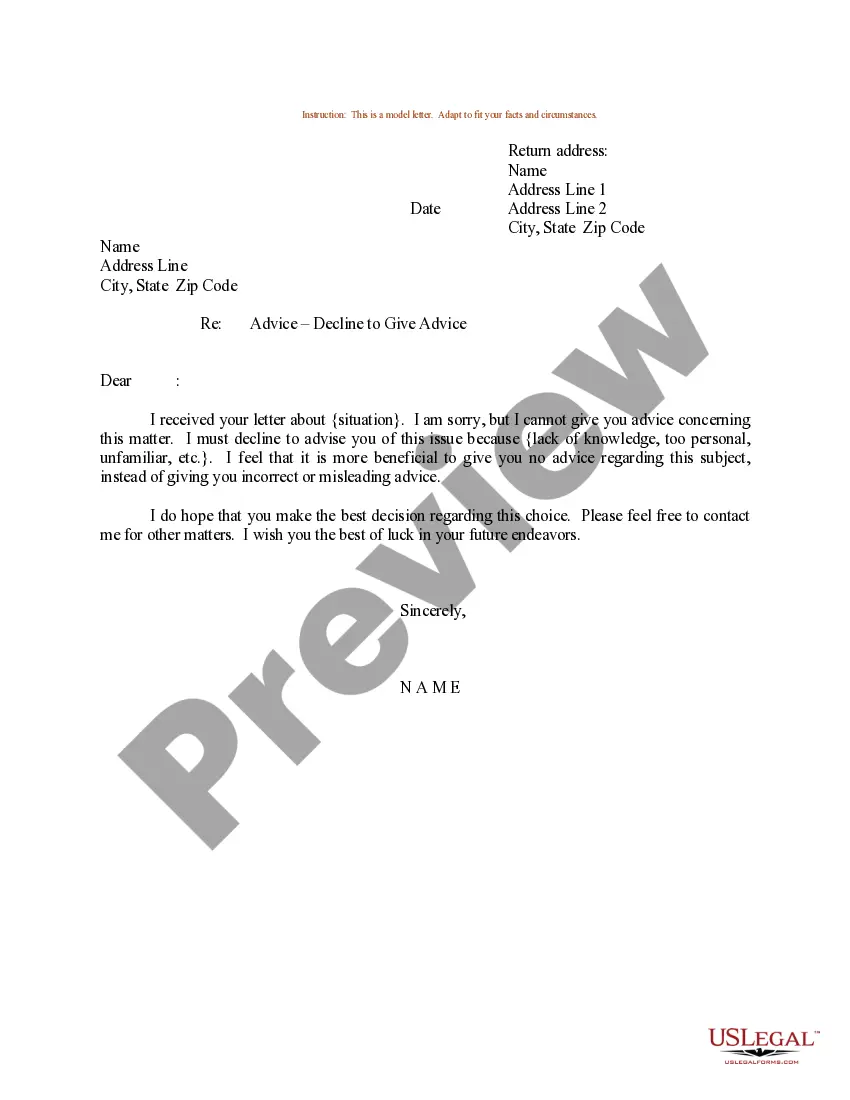
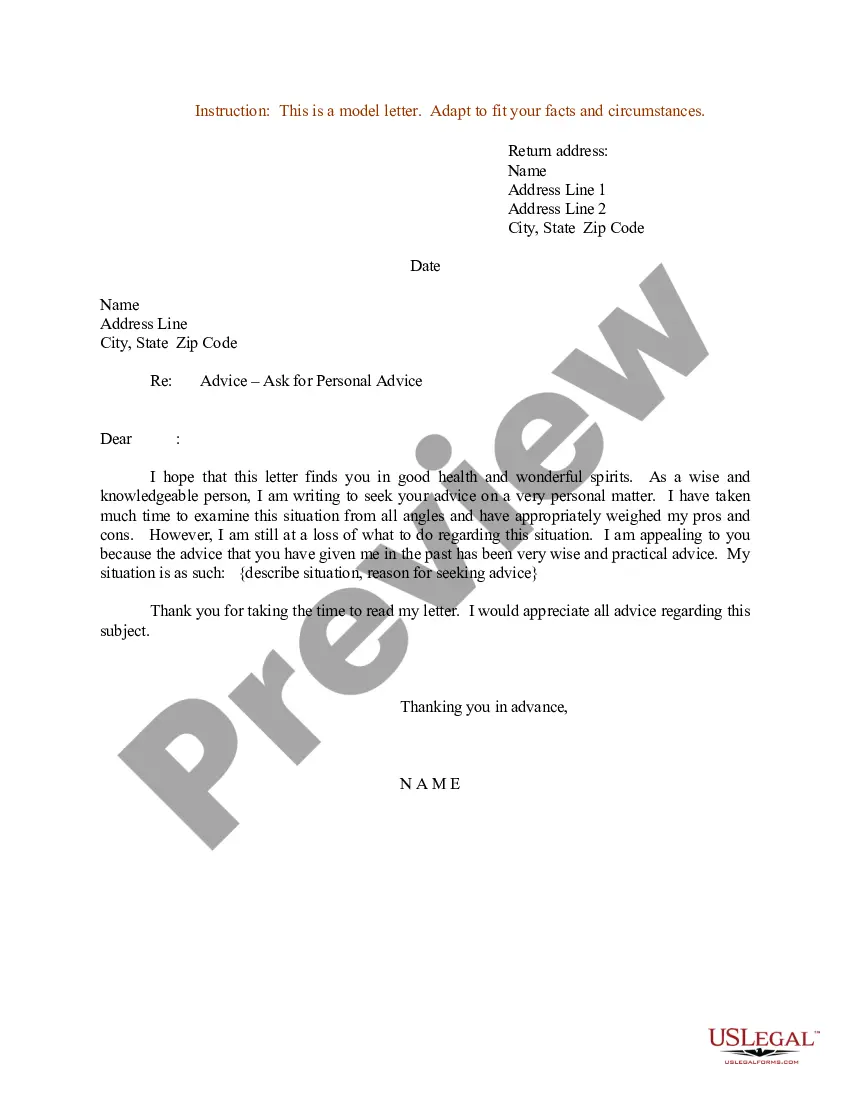
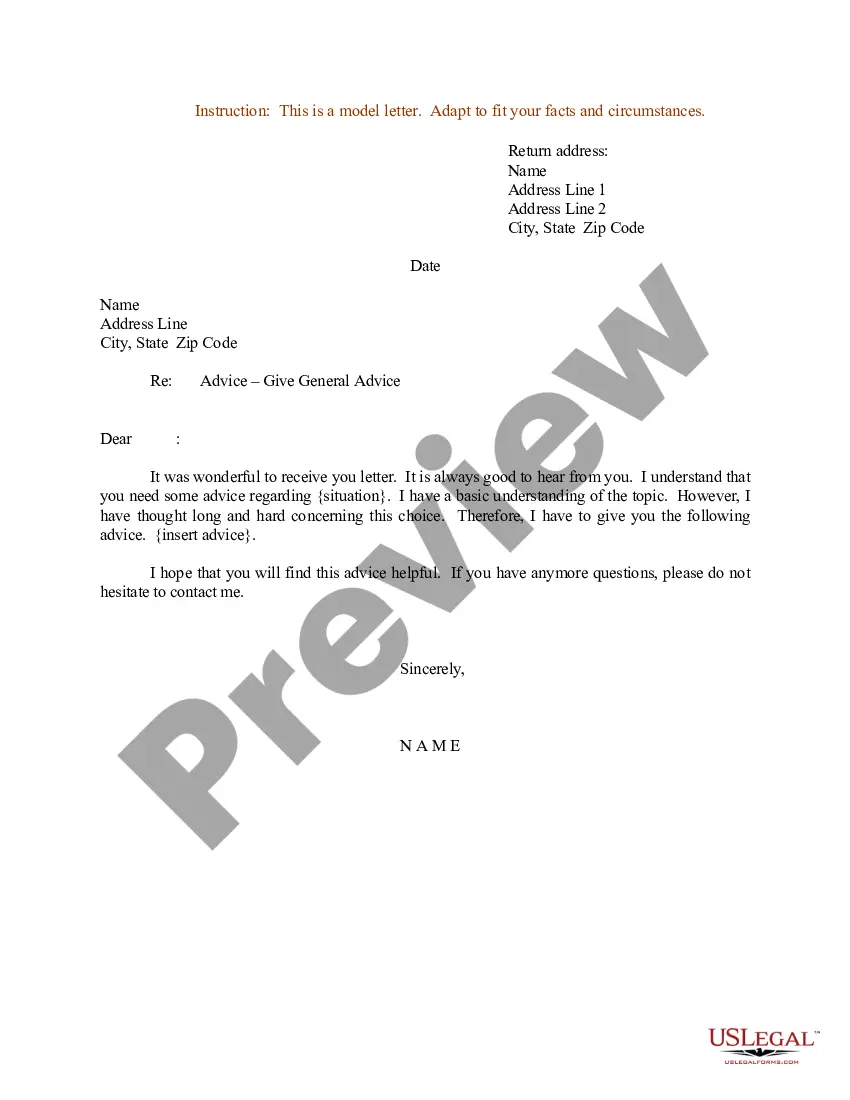
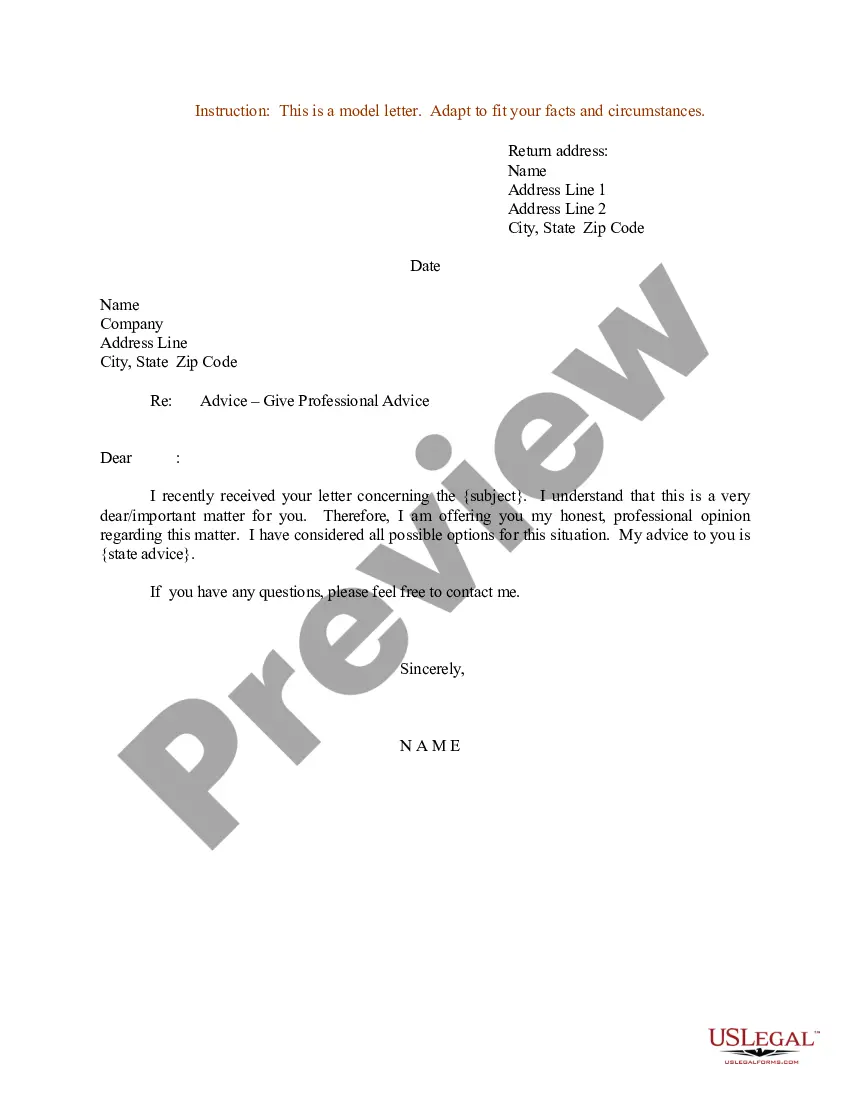
This Sample Letter for Decline to Give Advice is a template designed to formally notify an individual that you are unable to provide them with advice on a specific issue. This document serves as a professional and courteous way to communicate your decision, differing from other advisory forms by focusing specifically on the rejection of providing advice rather than the offering of it.
Form components explained
- Return address of the sender, including name and contact details.
- Date of the letter.
- Recipient's address.
- Subject line indicating the purpose of the letter (Advice Decline).
- Polite closing remarks wishing the recipient good luck.
- Signature and printed name of the sender.
When this form is needed
This form is useful in situations where you have been approached for advice but have determined that you cannot or do not wish to provide it. Common scenarios may include professional relationships, such as between attorney and client, or personal relationships where providing advice may lead to misunderstandings or complications. It helps maintain clear boundaries while still showing respect and goodwill.
Who this form is for
- Professionals, such as attorneys or consultants, who are asked for advice.
- Individuals in personal relationships looking to refuse advice in a considerate manner.
- Managers or supervisors who wish to clarify boundaries with employees regarding advice and guidance.
How to complete this form
- Enter your return address at the top of the letter.
- Write the date of the letter.
- Fill in the recipient's name and address.
- Draft a clear subject line to indicate the letter's purpose.
- Add your message politely declining to give advice while wishing them well.
- Sign the letter and print your name at the bottom.
Does this document require notarization?
This form does not typically require notarization unless specified by local law. It functions effectively as a written communication that conveys your decision without the need for notarization.
Get your form ready online
Our built-in tools help you complete, sign, share, and store your documents in one place.
Make edits, fill in missing information, and update formatting in US Legal Forms—just like you would in MS Word.
Download a copy, print it, send it by email, or mail it via USPS—whatever works best for your next step.
Sign and collect signatures with our SignNow integration. Send to multiple recipients, set reminders, and more. Go Premium to unlock E-Sign.
If this form requires notarization, complete it online through a secure video call—no need to meet a notary in person or wait for an appointment.
We protect your documents and personal data by following strict security and privacy standards.

Make edits, fill in missing information, and update formatting in US Legal Forms—just like you would in MS Word.

Download a copy, print it, send it by email, or mail it via USPS—whatever works best for your next step.

Sign and collect signatures with our SignNow integration. Send to multiple recipients, set reminders, and more. Go Premium to unlock E-Sign.

If this form requires notarization, complete it online through a secure video call—no need to meet a notary in person or wait for an appointment.

We protect your documents and personal data by following strict security and privacy standards.
Common mistakes
- Using overly complex language that may confuse the recipient.
- Failing to include a polite closing statement.
- Omitting the date or any contact information.
Benefits of completing this form online
- Convenience of accessing and downloading the form easily.
- Editability allows personal customization per individual circumstances.
- Reliability of a professionally drafted template that reduces legal risks.
Main things to remember
- The form serves as a professional notification declining to provide advice.
- Ideal for various contexts, emphasizing clear communication.
- Easy to customize and use for a variety of situations.
Looking for another form?
Form popularity
FAQ
Be honest. They don't say that honesty is the best policy for nothing. Prepare yourself. Do it face to face. Stick with "I" statements. Know that what you're feeling is normal. Avoid putting it off. Don't give false hope.
Be polite but straight to the point. Explain the reason why you chose to decline, but don't bad mouth the company as it may reflect bad on you in the future. Always be appreciative that they selected you and thank them for their time.
Thank the Person. Deliver the News Directly. Explain Your Reasoning. Suggest Other Ways of Partnership (If Appropriate) Keep the Professional Tone of Voice. Don't Explain Rejection with Price. End Your Email Appropriately. Rejection with a Willingness to Receive Other Service Offers.
When you write a letter of refusal, it's customary to start by thanking the applicant for their interest and time. You would then deliver the news in a professional manner and offer a clear, objective reason for rejection before finishing by wishing them well for the future.
Think before you respond. If possible, don't give your answer immediately. Accentuate the positive. Give a reason when possiblenot a fabrication. Be straightforward about the future. Listen to their response. Stand your ground. No language examples.
"Let me think about it." This is a polite and professional way of asking for more time to consider the request. "The idea sounds great! It's just that . . . " "I can't today. "I'm sorry, but I can't." 4 steps to back out of a commitment gracefully.
If you're not sure, say you need time to think it over and let the person know when you will have an answer. Ask for clarification if you don't fully understand what is requested of you. Be as brief as possible, i.e., give a legitimate reason for your refusal, but avoid long elaborate explanations and justifications.
Ask them Questions about the Problem and their Feelings. Point out Positive Qualities about them to build their confidence in decision making. Share Stories only to offer a perspective or help them feel they are not alone. Do Not make the story about yourself. Offer Options.
I'm sorry, but we had to refuse your request to move to another department. I'm sorry but I can't help you, I have something planned out for tomorrow. No, I'm afraid I can't do that for you. As I said, I'm afraid I can't help you at the moment.