Notice and Tender by Debtor
About this form
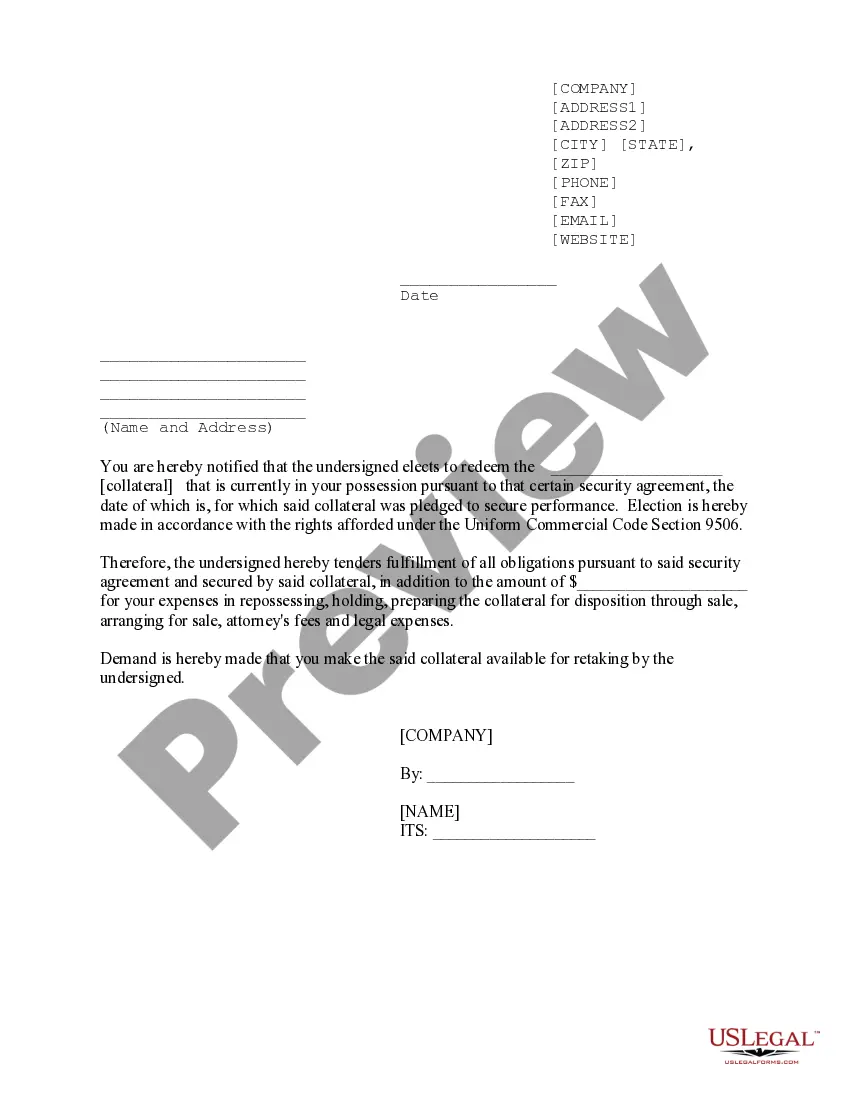
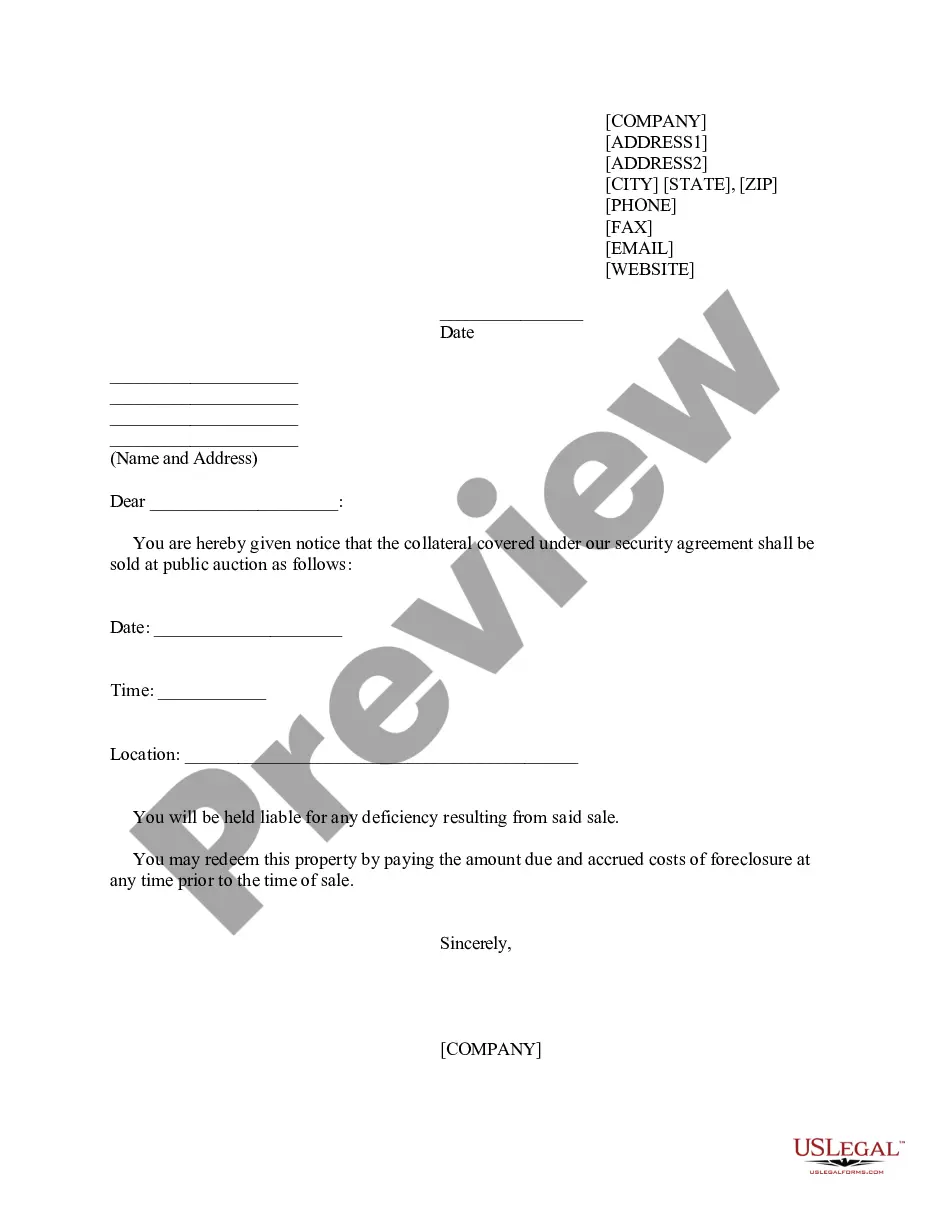
The Notice and Tender by Debtor is a legal document used by a debtor who wishes to redeem collateral that has been repossessed or is in possession of a creditor. This form provides notice to the creditor of the debtor's intent to fulfill their obligations under a security agreement. It is an important step in protecting the debtor's rights and facilitating the return of their collateral, and it is distinct from other forms of notice due to its specific focus on redemption and payment of expenses associated with the collateral.
Key parts of this document
- Debtorâs contact information: Includes address, phone, fax, email, and website.
- Date of notice: Specifies the date on which the notice is issued.
- Details of collateral: Clearly identifies the collateral being redeemed.
- Reference to the security agreement: States the agreement under which the collateral was pledged.
- Tender of payment: Indicates the total amount being offered to redeem the collateral, including any related fees.
- Signature section: Provides space for the debtor and their representative to sign.
Common use cases
This form should be used when a debtor wishes to reclaim their collateral after it has been repossessed by a creditor. It is appropriate in situations where the debtor has the financial means to tender payment for the collateral and any associated costs, such as repossession and legal fees. Using this form helps to assert the debtor's rights under the Uniform Commercial Code and ensures that the process follows legal protocols.
Who can use this document
- Individuals or entities who have had their collateral repossessed by a creditor.
- Debtors who intend to redeem their items according to a valid security agreement.
- People seeking to ensure compliance with legal standards under the Uniform Commercial Code.
Steps to complete this form
- Enter your contact information in the designated fields including address, phone number, and email.
- Fill in the date on which you are issuing the notice.
- Clearly identify the collateral you are redeeming by providing a description.
- State the date of the security agreement and the amount you are tendering for redemption.
- Sign the form and provide your title if you are representing a business or organization.
Is notarization required?
This form does not typically require notarization unless specified by local law. However, it is advisable to check the regulations in your jurisdiction to ensure compliance.
Get your form ready online
Our built-in tools help you complete, sign, share, and store your documents in one place.
Make edits, fill in missing information, and update formatting in US Legal Forms—just like you would in MS Word.
Download a copy, print it, send it by email, or mail it via USPS—whatever works best for your next step.
Sign and collect signatures with our SignNow integration. Send to multiple recipients, set reminders, and more. Go Premium to unlock E-Sign.
If this form requires notarization, complete it online through a secure video call—no need to meet a notary in person or wait for an appointment.
We protect your documents and personal data by following strict security and privacy standards.

Make edits, fill in missing information, and update formatting in US Legal Forms—just like you would in MS Word.

Download a copy, print it, send it by email, or mail it via USPS—whatever works best for your next step.

Sign and collect signatures with our SignNow integration. Send to multiple recipients, set reminders, and more. Go Premium to unlock E-Sign.

If this form requires notarization, complete it online through a secure video call—no need to meet a notary in person or wait for an appointment.

We protect your documents and personal data by following strict security and privacy standards.
Mistakes to watch out for
- Failing to provide complete and accurate contact information.
- Not clearly identifying the collateral in question.
- Omitting the required signature or failing to include the signatory's title, when applicable.
Advantages of online completion
- Convenience of immediate access and downloading from any location.
- Editable form allows for customization to fit specific legal needs.
- Reliable templates drafted by licensed attorneys enhance legal compliance.
Legal use & context
- This form is a legally recognized document under the Uniform Commercial Code, which facilitates the rights of debtors to redeem collateral.
- Proper completion and submission of the form help protect the debtor against claims of default on the security agreement.
Key takeaways
- The Notice and Tender by Debtor facilitates the redemption of collateral after repossession.
- It's crucial to fill out the form accurately to assert your rights effectively.
- This form should be used in compliance with local laws and regulations regarding secured transactions.
Looking for another form?

Form popularity
FAQ
Payment implies an acceptance and appropriation of that which is offered by one party to another, whereas tender is the act of offering that which is admitted to be due and owing, but which is not accepted by the creditor. ' The tender does not discharge the debt whereas payment does.
Search the Definitions. all words any words phrase. tender. 1) v. to present to another person an unconditional offer to enter into a contract.
If a tender of goods or the performance of an act is refused, the person making the offer: is relieved of the obligation to perform. If a tender of payment is refused by the creditor: the debt is not canceled.
B : to offer as an amount in settlement of a claim by an injured party against an insured NOTE: An insurance company might be obligated to tender the limits of a policy to an injured party when a higher amount is likely to be awarded at trial.
Legal tender is any currency declared legal by a government. Many governments issue a fiat currency and then make it legal tender by setting it as the standard for repaying debt.
Legal Tender refers to all U.S. coins and currency that issued by the government. U.S. Cash dollars are also a valid form of legal tender.
Tender is to unconditionally offer money or performance to meet an obligation. The term most commonly arises in the context of the contractual sale of goods.
A tender of payment is essentially an offer by the maker of the note to pay his obligation to the holder when it becomes due.