Sample Letter to Client regarding Time and Date of Final Dissolution Hearing
What this document covers
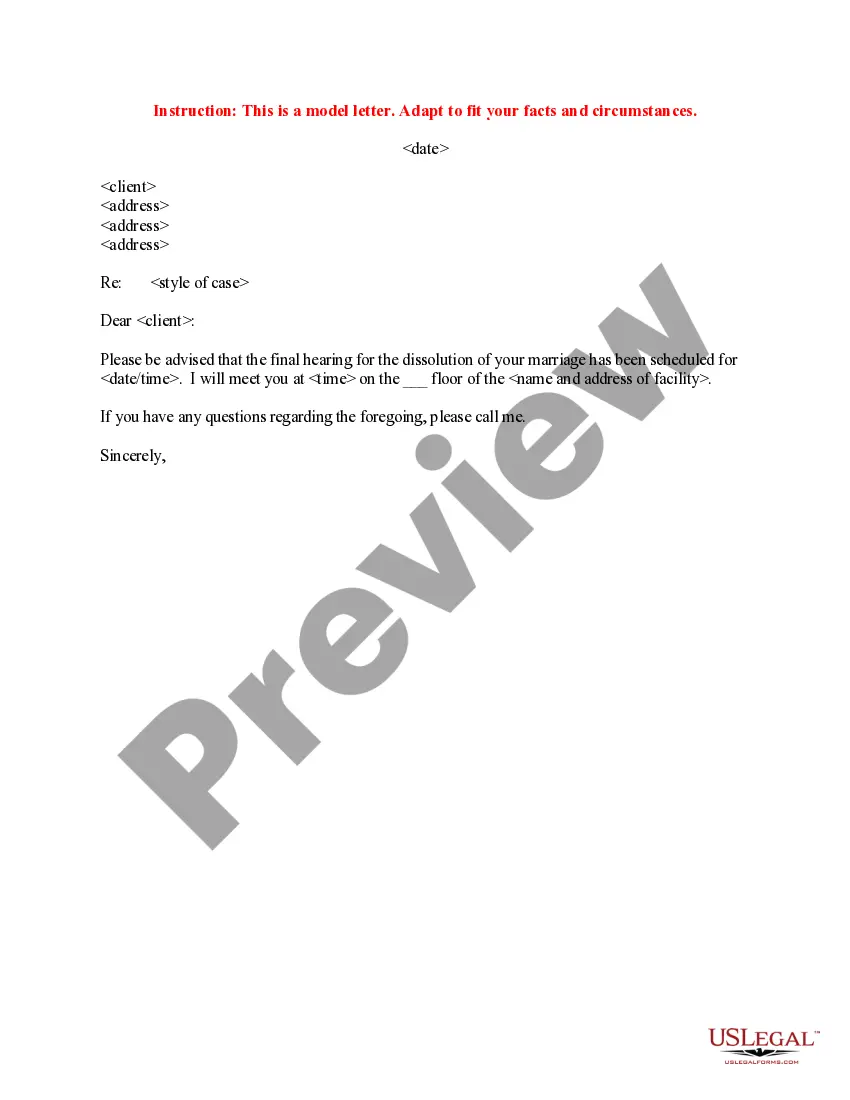
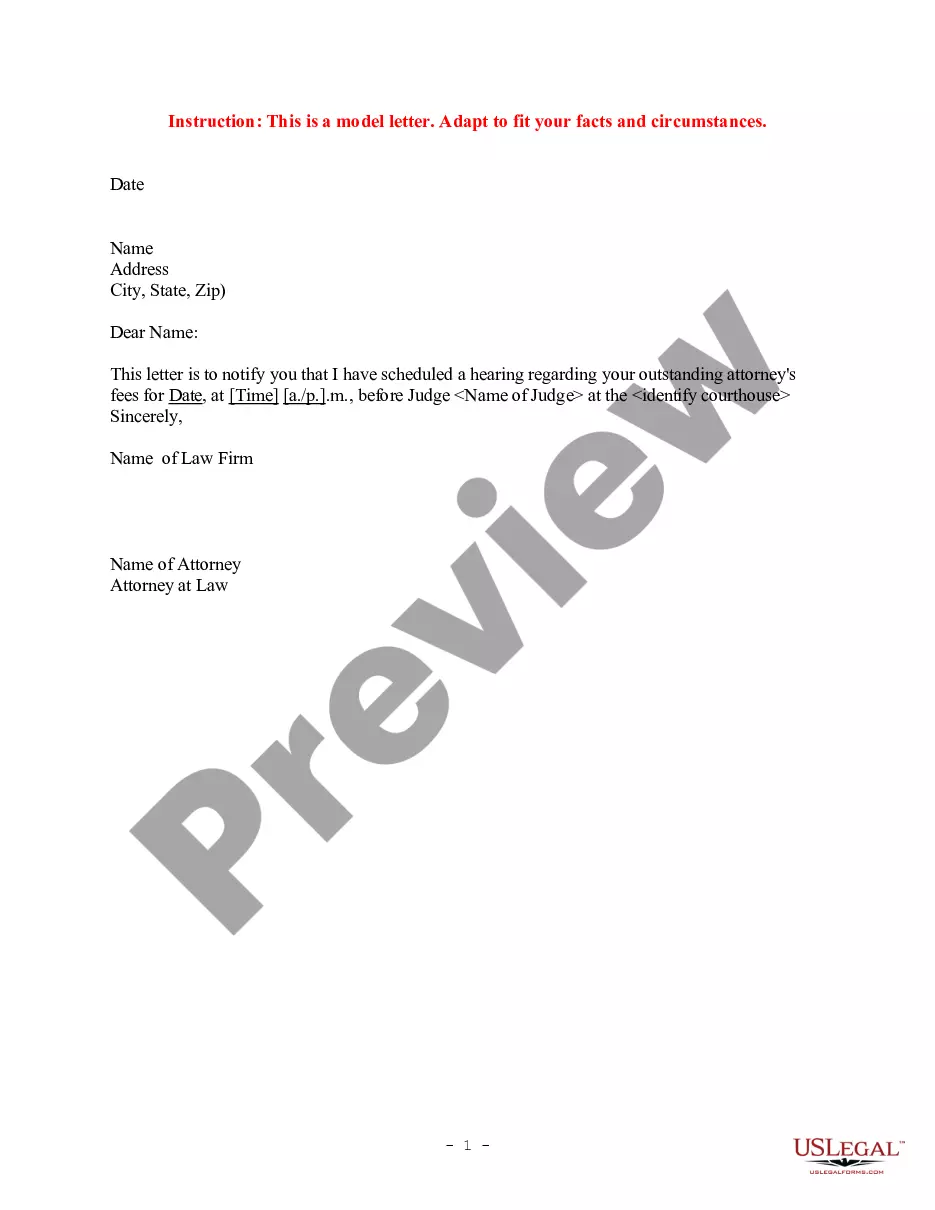
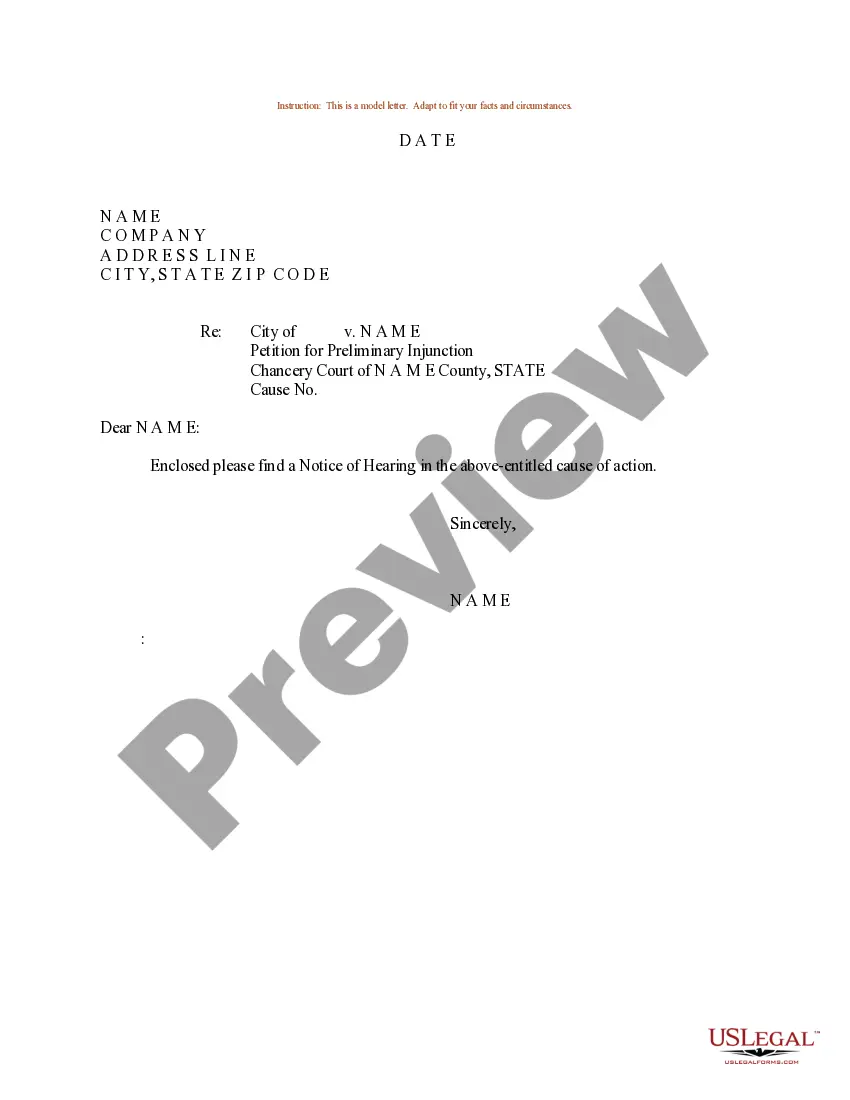
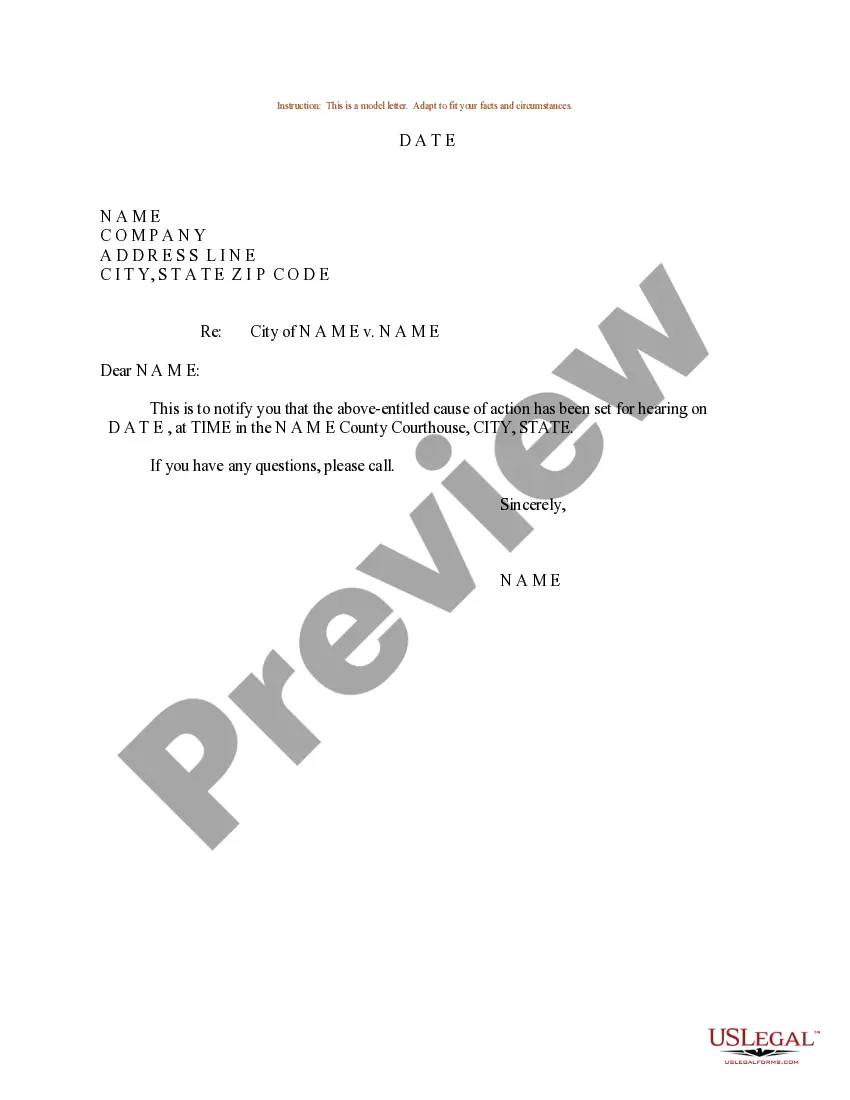
This Sample Letter to Client regarding Time and Date of Final Dissolution Hearing is a template designed to formally communicate important information to clients during the divorce process. The letter notifies the client about the scheduled final hearing for the dissolution of marriage, which is crucial for meeting legal requirements. Unlike other legal forms, this document specifically outlines the time and place of the hearing, ensuring clients are adequately prepared.
What’s included in this form
- Date and time of the final hearing
- Client's name and address
- Lawyer's name and contact information
- Details about the meeting location (facility name and address)
- Invitation for questions or clarification
When to use this document
This form should be used when a client requires notification about the time and date of their final dissolution hearing. It is typically employed by attorneys to ensure that their clients are informed well in advance, allowing for adequate preparation for the hearing.
Who needs this form
- Family law attorneys needing to inform clients about court hearing details
- Clients undergoing divorce proceedings who are awaiting a final hearing
- Legal professionals looking to maintain clear communication with their clients
Steps to complete this form
- Fill in the date and time of the scheduled final hearing.
- Input the client's name and full address accurately.
- Enter your name and contact information as the attorney.
- Specify the location of the hearing by providing the facility name and complete address.
- Encourage the client to reach out with any questions regarding the information provided in the letter.
Does this form need to be notarized?
This form does not typically require notarization unless specified by local law. It serves primarily as a communication tool rather than a binding legal document.
Get your form ready online
Our built-in tools help you complete, sign, share, and store your documents in one place.
Make edits, fill in missing information, and update formatting in US Legal Forms—just like you would in MS Word.
Download a copy, print it, send it by email, or mail it via USPS—whatever works best for your next step.
Sign and collect signatures with our SignNow integration. Send to multiple recipients, set reminders, and more. Go Premium to unlock E-Sign.
If this form requires notarization, complete it online through a secure video call—no need to meet a notary in person or wait for an appointment.
We protect your documents and personal data by following strict security and privacy standards.

Make edits, fill in missing information, and update formatting in US Legal Forms—just like you would in MS Word.

Download a copy, print it, send it by email, or mail it via USPS—whatever works best for your next step.

Sign and collect signatures with our SignNow integration. Send to multiple recipients, set reminders, and more. Go Premium to unlock E-Sign.

If this form requires notarization, complete it online through a secure video call—no need to meet a notary in person or wait for an appointment.

We protect your documents and personal data by following strict security and privacy standards.
Common mistakes to avoid
- Forgetting to include the correct date and time of the hearing.
- Providing inaccurate or incomplete client or facility addresses.
- Neglecting to offer contact information for follow-up questions.
Advantages of online completion
- Convenience of downloading and customizing the letter quickly.
- Editable format allows for personalization based on client and case.
- Reliability, as the template is drafted and vetted by licensed attorneys.
Looking for another form?


Form popularity
FAQ
State the facts: The facts are the answers to the client's questions. Analysis: For an easy analysis, first set out the provision of the law and the law itself. Answer the query: To answer the query, you will rely on the fact and analysis sections.
The opening paragraph states the legal issue the letter is addressing followed by the facts, a discussion of the law as it applies to the facts and a conclusion which is essentially the advice to the client. Often attorneys include headings to lead the client through this process to arrive at the same conclusion.
Start by Saying Thank You Use Everyday Language and Stick to One Idea per Sentence. Use Headings and Bullet Point Large Chunks of Information. Avoid Cold, Overly Formal Language. Direct the Customer to any Supportive Documents. Set Expectations With Timeframes.
Type your letter. Concisely review the main facts. Be polite. Write with your goal in mind. Ask for exactly what you want. Set a deadline. End the letter by stating you will promptly pursue legal remedies if the other party does not meet your demand. Make and keep copies.
It can begin with the word Dear followed by the person's name or the word To. Include a date at the top of the letter. Begin the letter with a brief introduction. Keep the introduction pleasant and conversational. Thank the client for using your firm and indicate the reason for the letter.
Today's date, or the date you are sending the letter. The sender's address. The inside address. The salutation. The body of the letter.
Maintain focus throughout the process. Both intended and unintended audiences can read legal letters. Come up with coherent and consistent arguments. Use short sentences and paragraphs in your letter. Make sure your language has precision.