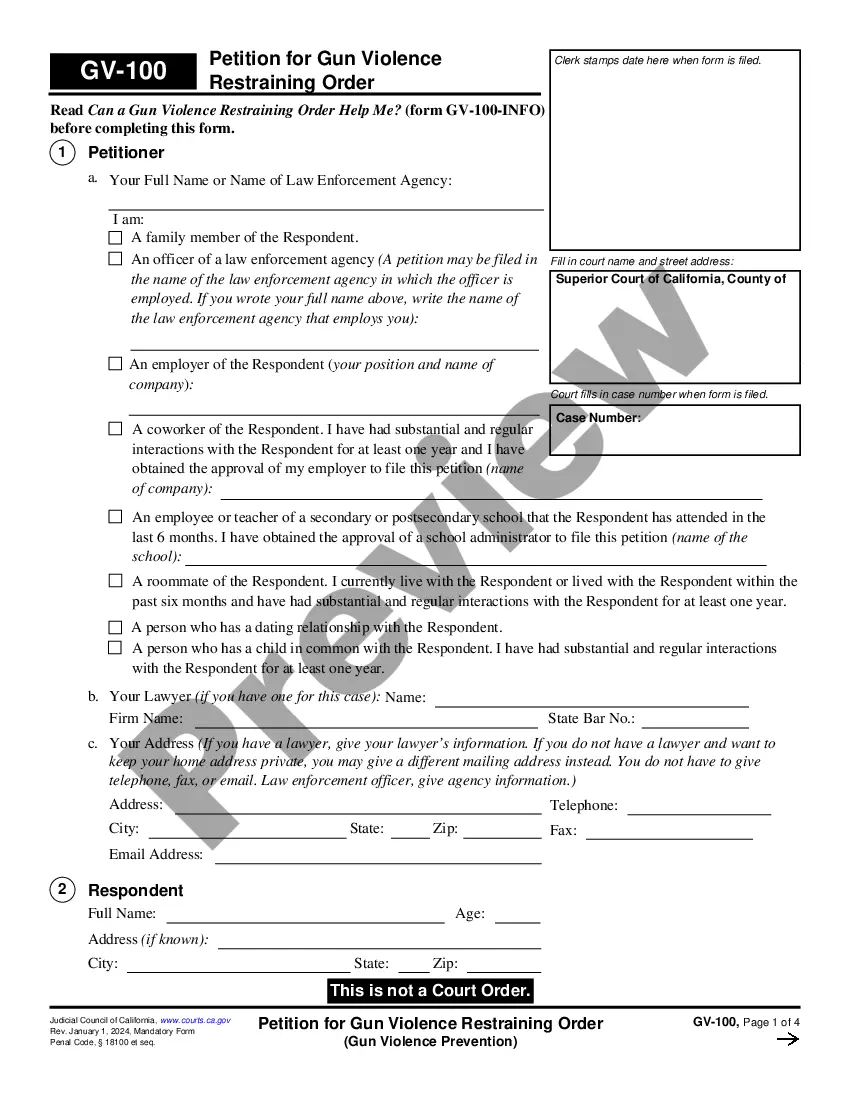
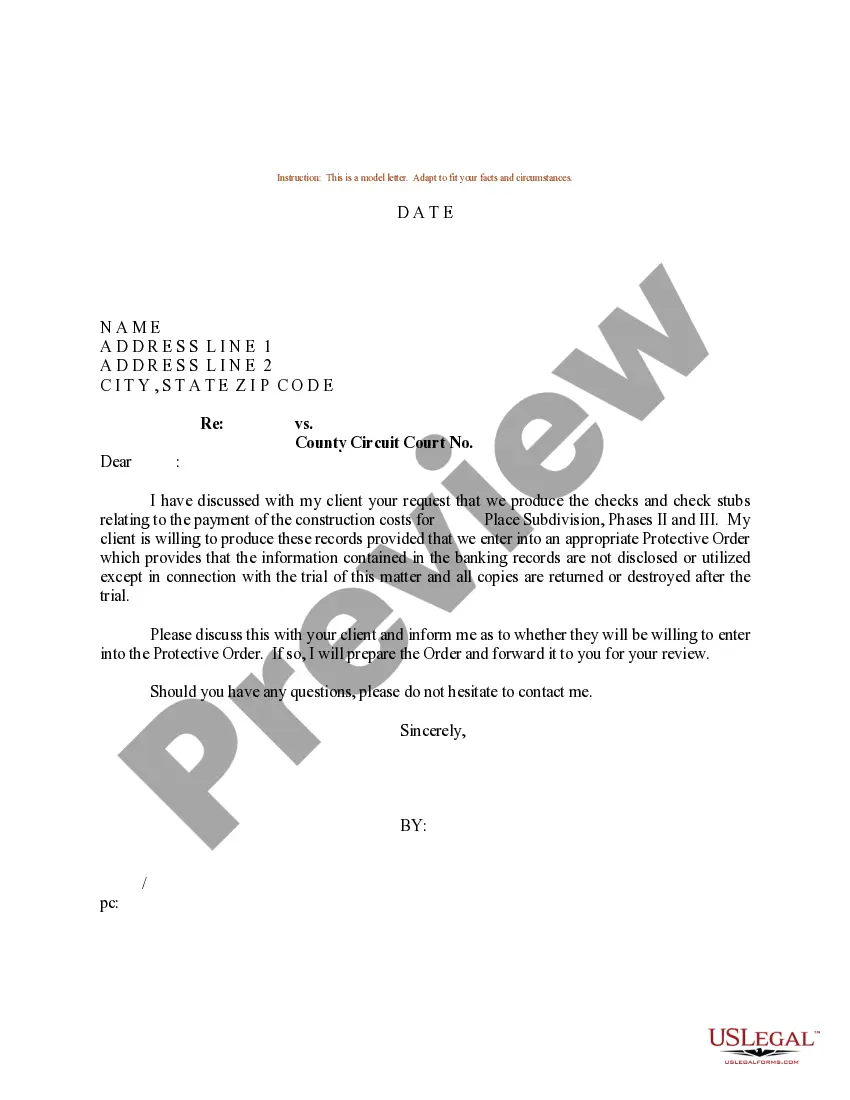
Sample Letter requesting Protective Order for Documents
Overview of this form
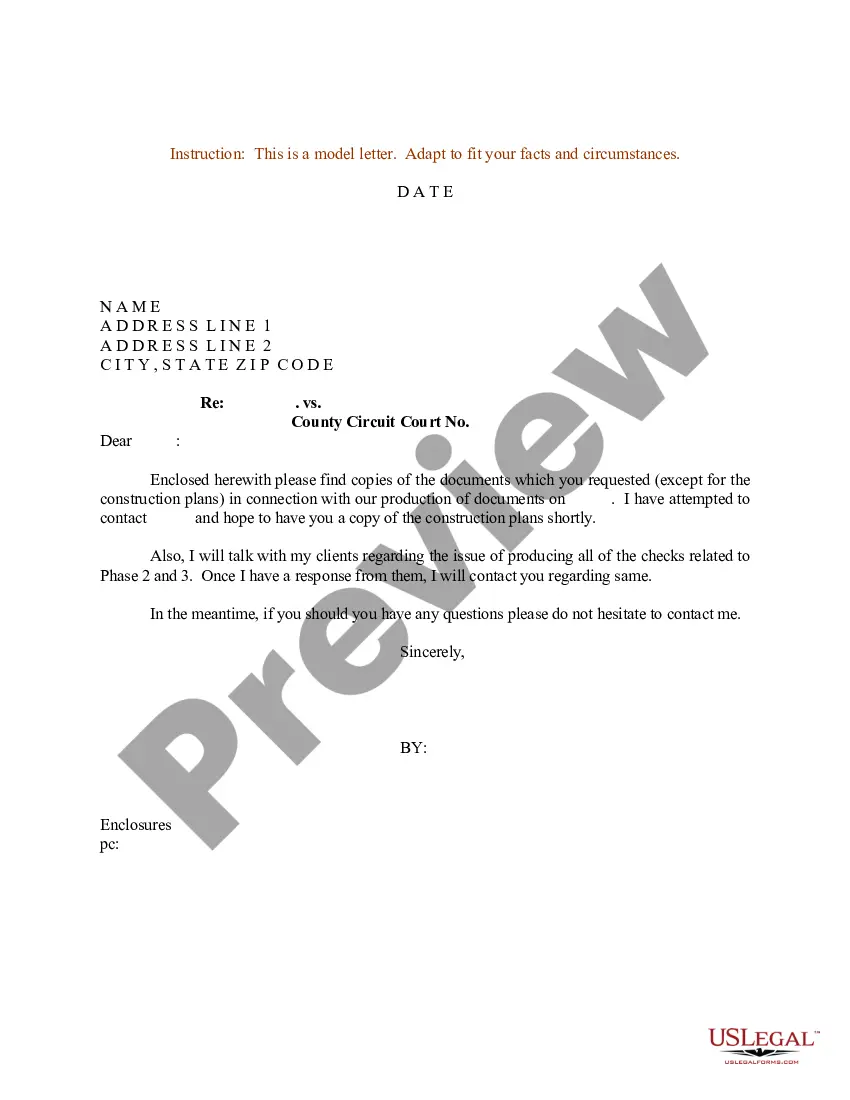
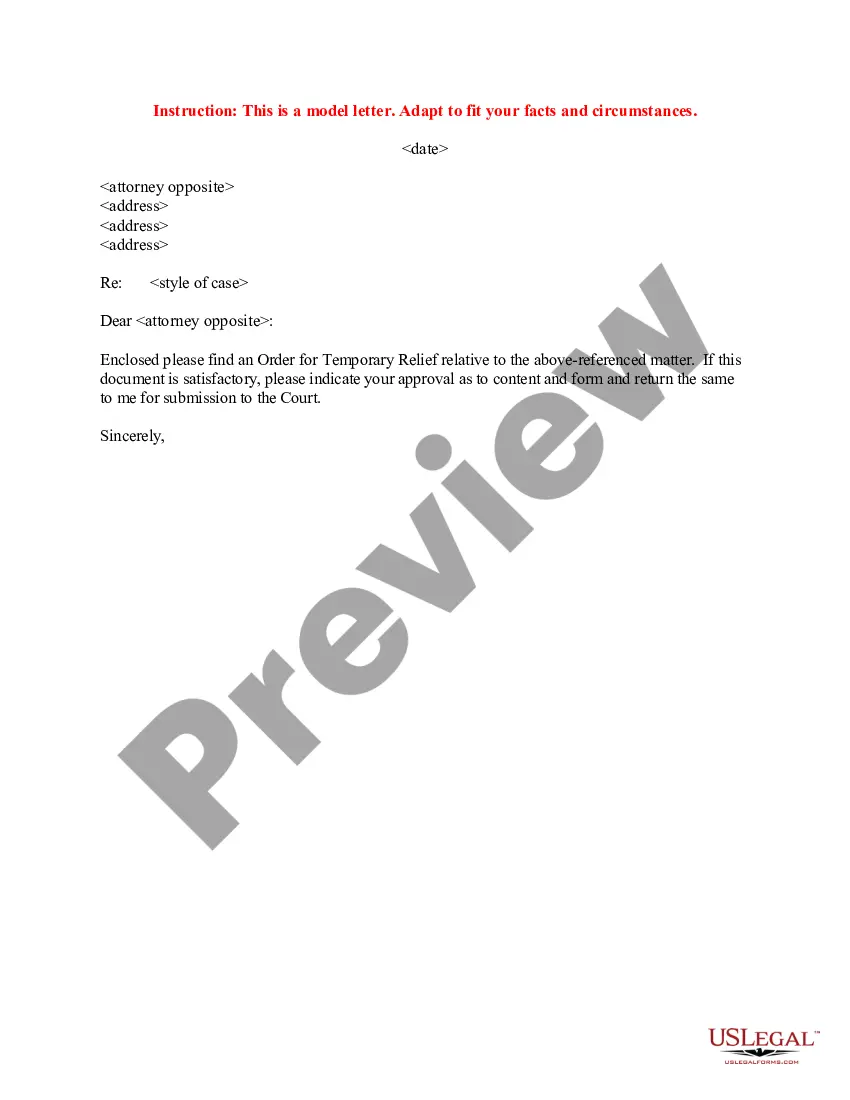
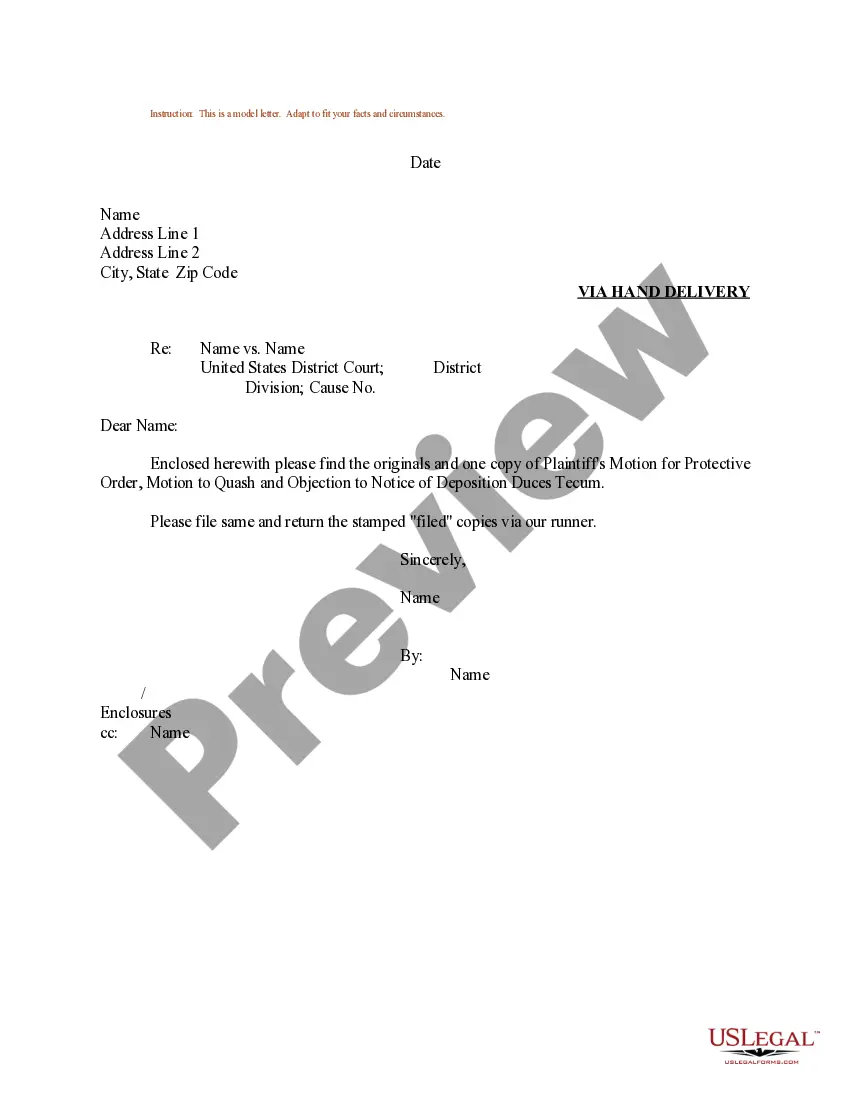
This form is a sample letter requesting a protective order for documents. It outlines the procedure for requesting confidential handling of documents involved in legal proceedings. The sample letter serves as a template, allowing users to customize it for their specific case, ensuring that sensitive information is properly protected from unauthorized disclosure.
Key components of this form
- Date of the letter
- Recipientâs name and address
- Request for discussion regarding the protective order
- Offer to prepare the protective order for review
- Contact information for further inquiries
- Sender's signature
When this form is needed
This letter should be used when legal representatives need to request a protective order to ensure that documents presented in a legal proceeding remain confidential. It is applicable when there is a risk of sensitive information being disclosed during discovery, depositions, or other legal processes.
Who can use this document
- Attorneys representing clients in legal matters
- Legal professionals seeking to protect sensitive information
- Parties involved in litigation who require confidentiality for specific documents
Instructions for completing this form
- Insert the date at the top of the letter.
- Provide the recipientâs name and address.
- Clearly state the purpose of the letter and the request for a protective order.
- Include an offer to draft the protective order for review.
- Add your contact information for any follow-up questions.
- Sign the letter before sending it to the recipient.
Is notarization required?
This form does not typically require notarization unless specified by local law. However, it is advisable to check state-specific requirements for any additional steps that may be necessary.
Get your form ready online
Our built-in tools help you complete, sign, share, and store your documents in one place.
Make edits, fill in missing information, and update formatting in US Legal Forms—just like you would in MS Word.
Download a copy, print it, send it by email, or mail it via USPS—whatever works best for your next step.
Sign and collect signatures with our SignNow integration. Send to multiple recipients, set reminders, and more. Go Premium to unlock E-Sign.
If this form requires notarization, complete it online through a secure video call—no need to meet a notary in person or wait for an appointment.
We protect your documents and personal data by following strict security and privacy standards.

Make edits, fill in missing information, and update formatting in US Legal Forms—just like you would in MS Word.

Download a copy, print it, send it by email, or mail it via USPS—whatever works best for your next step.

Sign and collect signatures with our SignNow integration. Send to multiple recipients, set reminders, and more. Go Premium to unlock E-Sign.

If this form requires notarization, complete it online through a secure video call—no need to meet a notary in person or wait for an appointment.

We protect your documents and personal data by following strict security and privacy standards.
Common mistakes
- Failing to include all necessary recipient details.
- Using vague language that does not clearly state the request.
- Neglecting to provide contact information for follow-up.
- Omitting the date, which is crucial for legal documents.
Why complete this form online
- Convenient access to a customizable letter template.
- Easy to edit and tailor to specific cases without legal jargon.
- Quick download in Word format for immediate use.
- Provides peace of mind knowing the template is prepared by licensed attorneys.
Looking for another form?

Form popularity
FAQ
If you're the person who asked for the no contact order, you can ask the judge in your case to drop it. While there's no guarantee that the judge will do so, if you can show that you're not being forced or coerced into doing it, you'll have a better chance of getting it dropped.
State to the court that you would like a restraining order and what you would like the court to order. Be as specific as possible. Examples: I am asking the court to grant me a _____ month/year injunction. I want no contact in person, at home, by phone, at work, by mail or through third parties.
Follow the Order. You will receive a notification of the order along with a hearing date where you can argue your case. Prepare Your Case. Contact witnesses if the order said there was physical violence or threats during an altercation and others were around when the event took place. Attend the Hearing. After the Hearing.
Typically, either the victim or the defendant can ask the court to lift the restraining order. This is usually completed by filing a motion with the court, such as a Motion to Modify Conditions of Pretrial Release or a Motion to Lift Restraining Order. This legal motion must usually identify the parties.
Consult with a family law attorney experienced in defending people against false restraining orders. You must go to court for the final restraining order hearing and present your evidence proving why the accusations against you are false. The evidence can be police reports, witnesses, text messages and or emails.
Reconciliation. Strangers do not perpetrate DV, someone they love does. When someone you love is the perpetrator, leaving for good is the hardest part. Children. Kids miss their parents, and parents miss their kids. There is a constant pressure for a parent to return to being a "family."
If you intend to apply to the court to revoke or vary a restraining order, you will need to prove that a change of circumstances has occurred. If everything has remained the same, then it is unlikely that the court will be willing to adapt or dissolve the order. A change of situation is case-specific.