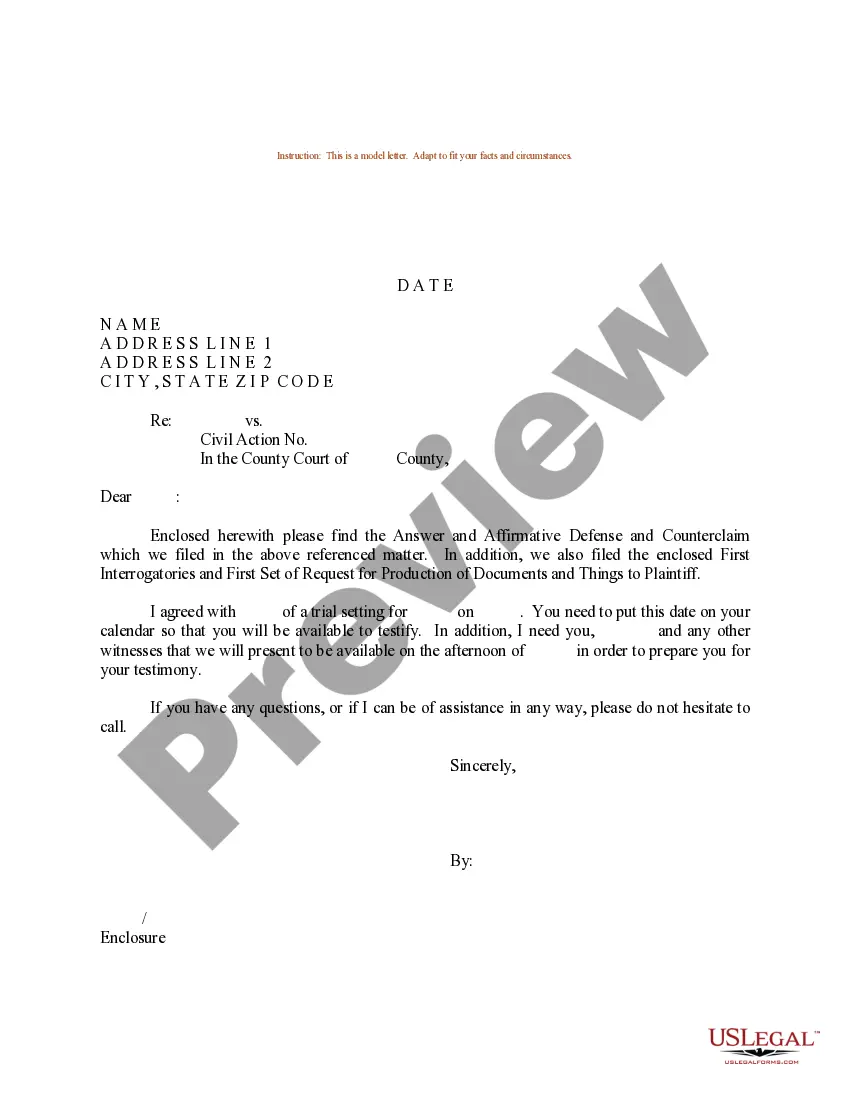
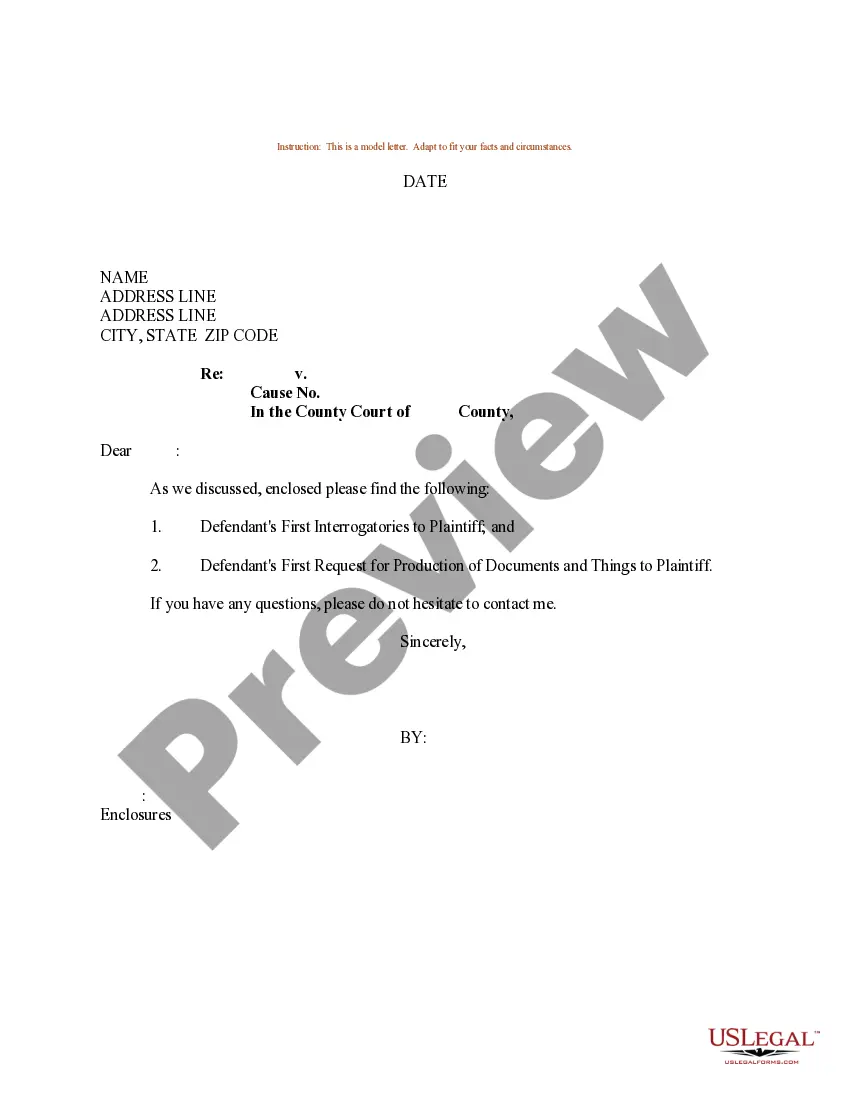
Sample Letter for First Interrogatories and First Set of Request for Production of Documents
About this form
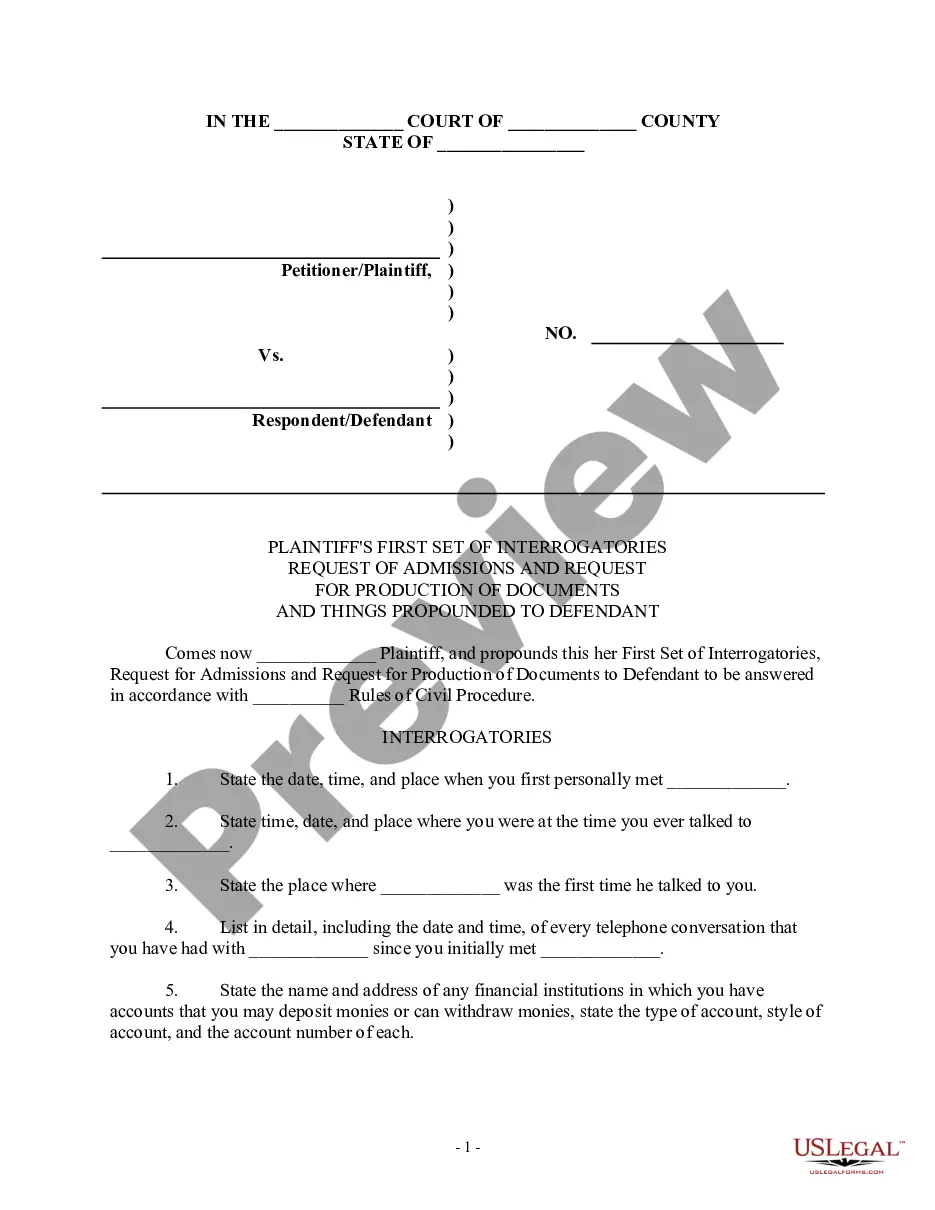
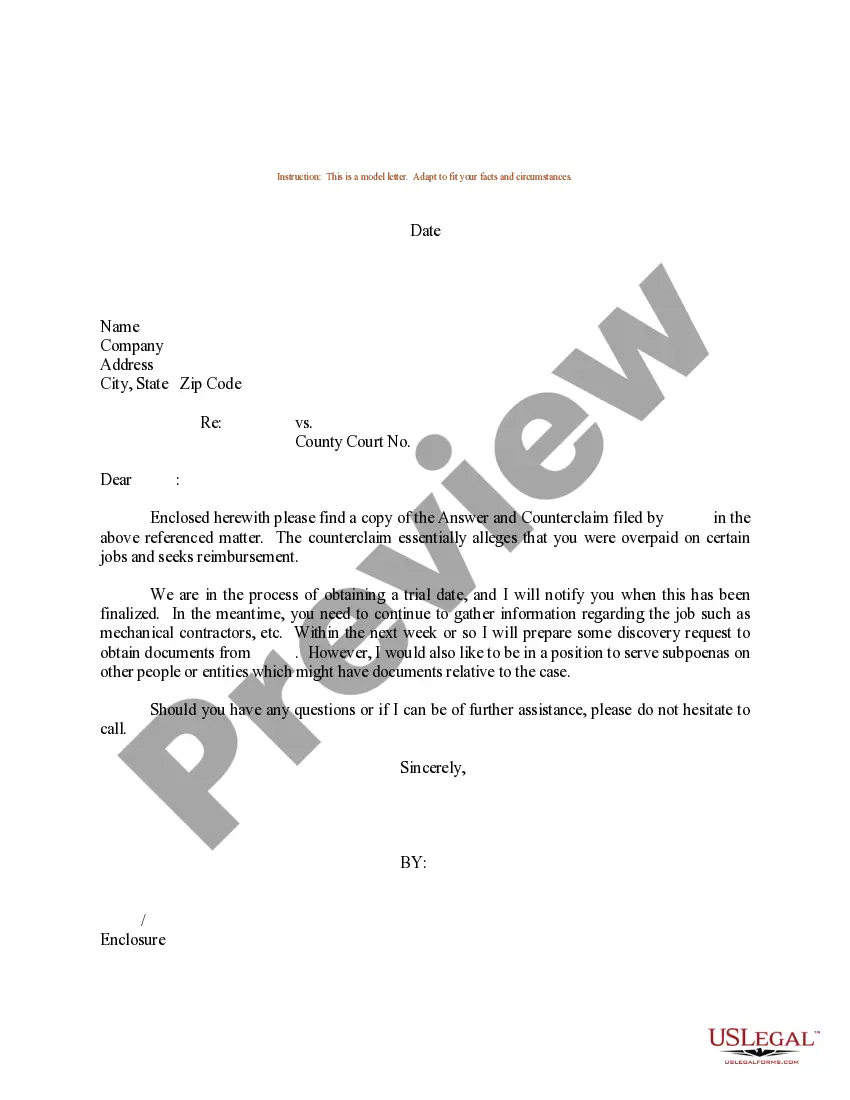
The Sample Letter for First Interrogatories and First Set of Request for Production of Documents is a useful legal document designed to facilitate the discovery process in a lawsuit. This form serves as a sample template to request specific information and documents from the opposing party. It differs from other legal forms in its focus on formal requests for information, which are critical in preparing for trial or settlement discussions.
Key parts of this document
- Date of the letter
- Sender's name and address
- Recipient's name and address
- Introduction outlining the purpose of the letter
- Detailed sections for interrogatories
- Sections for requests for the production of documents


Situations where this form applies
This form is used when a party in a legal case needs to obtain evidence and information from another party. It is typically used early in a civil lawsuit, where clarifying questions and document requests are essential for building a case. For instance, you should use this form when initiating discovery after filing a lawsuit or in response to a request for discovery from the opposing party.
Who needs this form
This form is intended for:
- Individuals or parties involved in a civil litigation process
- Legal professionals seeking to gather evidence for a case
- Defendants or plaintiffs who need to request information from the opposing side
- Anyone preparing for trial who requires specific details from another party
How to prepare this document
- Enter the date at the top of the letter.
- Fill in your name and address as the sender.
- Enter the recipient's name and address, ensuring accuracy.
- Draft an introduction that briefly explains the purpose of the letter.
- List the specific interrogatories you wish to ask.
- Outline your requests for production of documents clearly.
Notarization guidance
Notarization is generally not required for this form. However, certain states or situations might demand it. You can complete notarization online through US Legal Forms, powered by Notarize, using a verified video call available anytime.
Get your form ready online
Our built-in tools help you complete, sign, share, and store your documents in one place.
Make edits, fill in missing information, and update formatting in US Legal Forms—just like you would in MS Word.
Download a copy, print it, send it by email, or mail it via USPS—whatever works best for your next step.
Sign and collect signatures with our SignNow integration. Send to multiple recipients, set reminders, and more. Go Premium to unlock E-Sign.
If this form requires notarization, complete it online through a secure video call—no need to meet a notary in person or wait for an appointment.
We protect your documents and personal data by following strict security and privacy standards.

Make edits, fill in missing information, and update formatting in US Legal Forms—just like you would in MS Word.

Download a copy, print it, send it by email, or mail it via USPS—whatever works best for your next step.

Sign and collect signatures with our SignNow integration. Send to multiple recipients, set reminders, and more. Go Premium to unlock E-Sign.

If this form requires notarization, complete it online through a secure video call—no need to meet a notary in person or wait for an appointment.

We protect your documents and personal data by following strict security and privacy standards.
Typical mistakes to avoid
- Failing to provide correct names and addresses.
- Including vague or unclear questions in interrogatories.
- Not adhering to specific state rules governing discovery.
- Neglecting to sign the document before sending.
Benefits of using this form online
- Convenient access to a professionally drafted template.
- Editable format that allows for customization based on your needs.
- Immediate download for quick use.
- Reliable legal information sourced from licensed attorneys.
Summary of main points
- This form is essential for obtaining information during the discovery process.
- Accurate completion and clarity in requests can facilitate smoother legal proceedings.
- Be mindful of state-specific rules that may affect how this form is used.
Looking for another form?
Form popularity
FAQ
You may object to Form Interrogatories, but be careful to use the proper objection. Using the wrong one or using every single one may lead the court to view you as misusing the discovery process and make you pay sanctions.
Your answers to the interrogatories should usually be short, clear, and direct and should answer only the question that is being asked. This is not the time to set out your entire case or defense to the other side. Take the time to make sure your answers are correct and truthful.
Have a strategy. Adjust the scope of your requests to the questions at issue. Send clear requests. Always consider how your client would be prepared to respond to similar requests. Make your objections clear and specific.
In law, interrogatories (also known as requests for further information) are a formal set of written questions propounded by one litigant and required to be answered by an adversary in order to clarify matters of fact and help to determine in advance what facts will be presented at any trial in the case.
Personal/Corporate information of opposing party. Identifying information of witnesses. Contact information & background of expert witnesses. Insurance information.
Your name and address. The Court's name. The title of the case. Case number. Fill your name in as the Requesting Party. On the following pages, choose which questions you wish to ask by checking boxes next to the questions you wish to ask.
Thank you for your inquiry regarding our product or service. Thank you for your interest in our product or service. We would like to thank you for your letter inquiring about our product. We truly appreciate your letter asking for information about our service.
You must answer each interrogatory separately and fully in writing under oath, unless you object to it. You must explain why you object. You must sign your answers and objections.
If a request asks for a document, make a copy of the document; in your response, describe the document and say that a copy is attached; and attach a copy of the document to the responses you send back to the other side.