Sample Letter for Trial - Defendant's First Interrogatories to Plaintiff
Overview of this form
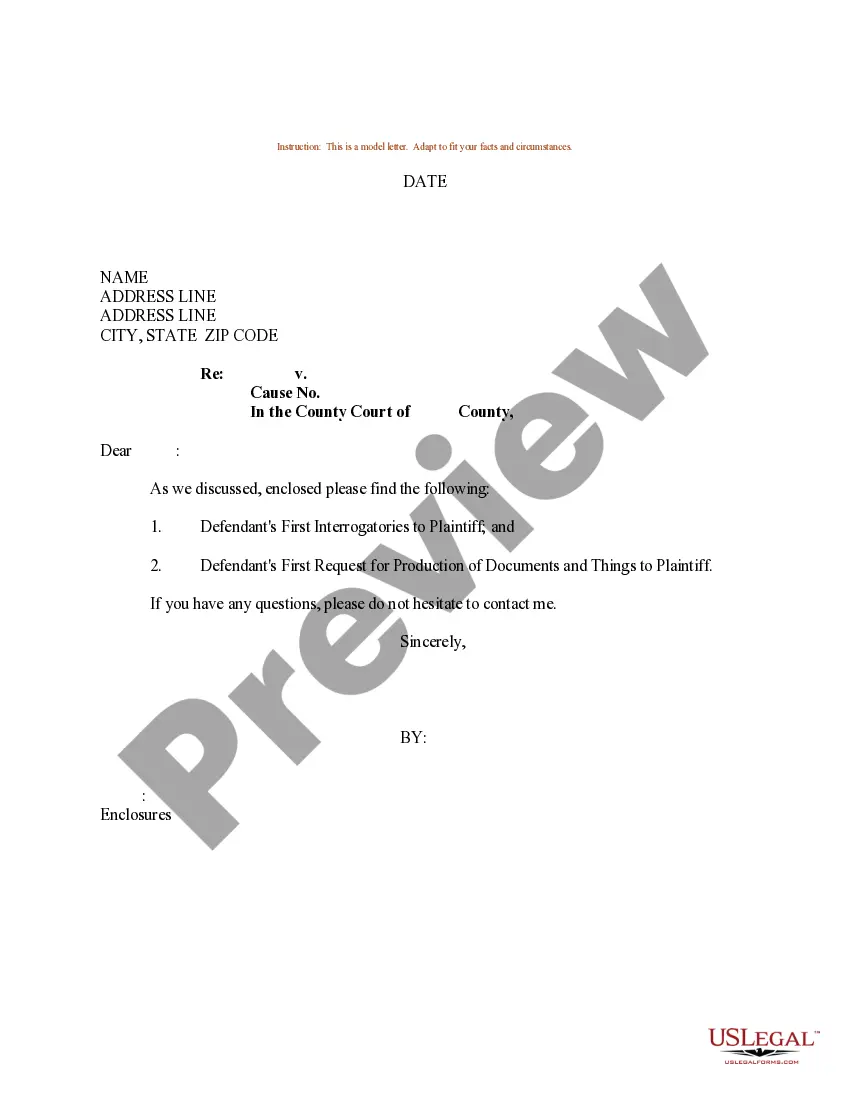
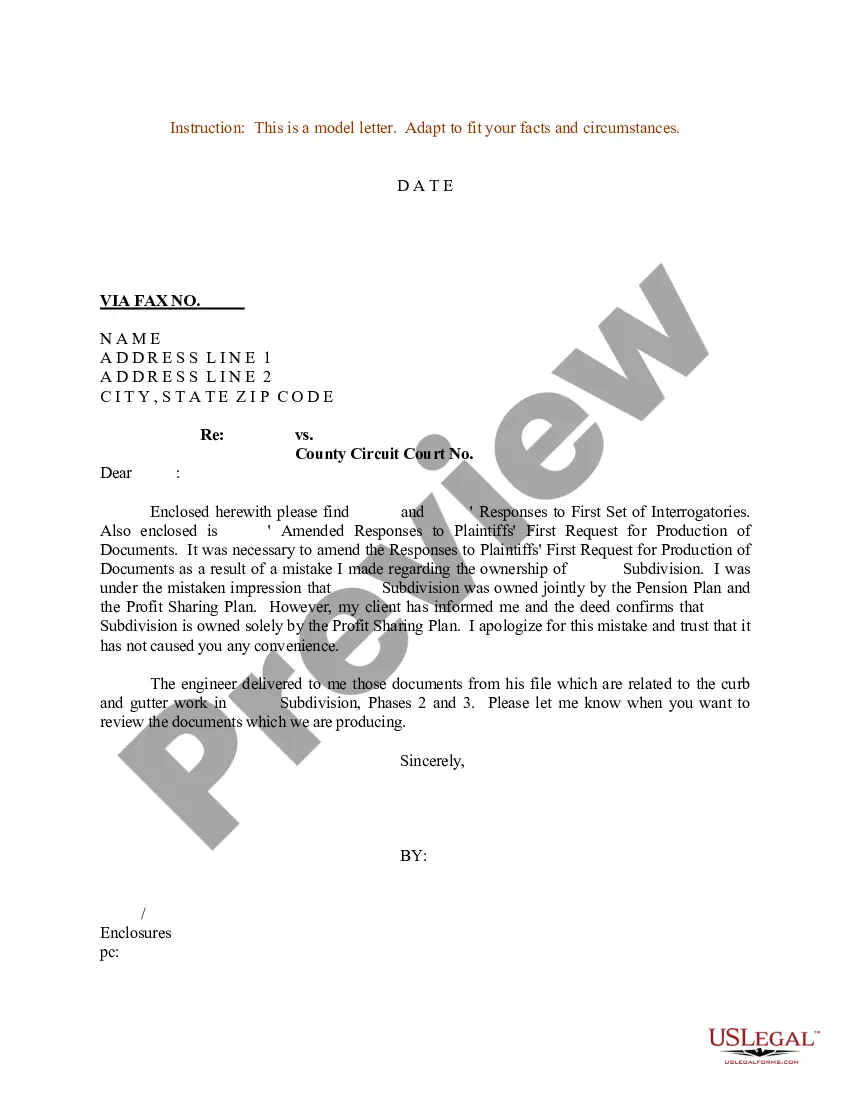
This form is a Sample Letter for Trial, specifically used to submit the Defendant's First Interrogatories to Plaintiff. It serves as a formal communication in a legal context, outlining specific questions the defendant wishes to pose to the plaintiff for clarification about the case. This letter helps gather necessary information to mount an effective defense, differing from other forms such as notices or motions in that it focuses solely on the interrogatory process.
Key parts of this document
- Date: The date when the form is filled out.
- Recipient Information: Name and address of the plaintiff.
- Introductory Paragraph: Brief statement introducing the purpose of the letter.
- Interrogatories: List of questions directed to the plaintiff that require detailed answers.

Situations where this form applies
This form is needed when the defendant wants to formally request information from the plaintiff before trial. It is typically used in civil litigation to clarify facts, gather evidence, or gain insight into the plaintiff's claims, enabling the defendant to prepare a more effective strategy for the upcoming trial.
Who this form is for
This form is intended for:
- Defendants in civil lawsuits who need information from plaintiffs.
- Individuals or entities involved in litigation requiring more clarification before trial.
- Legal representatives, including attorneys, handling cases on behalf of clients.
Instructions for completing this form
- Enter the date at the top of the letter.
- Fill in the name and address of the plaintiff.
- Begin with an introductory statement outlining the purpose of the letter.
- List the questions in the interrogatories section, ensuring clarity and specificity.
- Provide a closing statement and include any necessary signatures.
Does this document require notarization?
This form does not typically require notarization unless specified by local law. It's advisable to check with your jurisdiction's requirements or consult a legal professional to confirm.
Get your form ready online
Our built-in tools help you complete, sign, share, and store your documents in one place.
Make edits, fill in missing information, and update formatting in US Legal Forms—just like you would in MS Word.
Download a copy, print it, send it by email, or mail it via USPS—whatever works best for your next step.
Sign and collect signatures with our SignNow integration. Send to multiple recipients, set reminders, and more. Go Premium to unlock E-Sign.
If this form requires notarization, complete it online through a secure video call—no need to meet a notary in person or wait for an appointment.
We protect your documents and personal data by following strict security and privacy standards.

Make edits, fill in missing information, and update formatting in US Legal Forms—just like you would in MS Word.

Download a copy, print it, send it by email, or mail it via USPS—whatever works best for your next step.

Sign and collect signatures with our SignNow integration. Send to multiple recipients, set reminders, and more. Go Premium to unlock E-Sign.

If this form requires notarization, complete it online through a secure video call—no need to meet a notary in person or wait for an appointment.

We protect your documents and personal data by following strict security and privacy standards.
Avoid these common issues
- Failing to include the date, which may delay the process.
- Asking leading or ambiguous questions that could lead to confusion.
- Not providing enough detail in the interrogatories.
- Neglecting to proofread for spelling or grammatical errors.
Benefits of using this form online
- Convenience: Obtain the form quickly from anywhere at any time.
- Editability: Easily customize the form according to your specific case details.
- Reliability: Access forms that are drafted by licensed attorneys to ensure compliance with legal standards.
Legal use & context
- This form is legally recognized within the context of discovery in civil litigation.
- Failure to respond to interrogatories may lead to legal consequences, including sanctions.
- Interrogatories can be used to assess the strength of the plaintiff's case and prepare a defense.
Looking for another form?


Form popularity
FAQ
Written interrogatories may be used effectively in almost every lawsuit. They may be used to particularize and elaborate notice pleadings and to refine and narrow the eventual issues for trial.
Your name and address. The Court's name. The title of the case. Case number. Fill your name in as the Requesting Party. On the following pages, choose which questions you wish to ask by checking boxes next to the questions you wish to ask.
Personal/Corporate information of opposing party. Identifying information of witnesses. Contact information & background of expert witnesses. Insurance information.
Responding to Form InterrogatoriesAnswer each question, being careful to answer each subpart, if one exists. Read the question carefully, and answer only what it asks. You may attach exhibits, if necessary. The response must be verified, meaning you must swear that the responses given are true.
You must answer each interrogatory separately and fully in writing under oath, unless you object to it. You must explain why you object. You must sign your answers and objections.
You may object to Form Interrogatories, but be careful to use the proper objection. Using the wrong one or using every single one may lead the court to view you as misusing the discovery process and make you pay sanctions.
As the defendant you can respond to each interrogatory in one of three ways: provide a plain answer, object to the questions giving grounds as to why you object, or object to part of the question and respond to the other part.
Your answers to the interrogatories should usually be short, clear, and direct and should answer only the question that is being asked. This is not the time to set out your entire case or defense to the other side. Take the time to make sure your answers are correct and truthful.
Your answers to the interrogatories should usually be short, clear, and direct and should answer only the question that is being asked. This is not the time to set out your entire case or defense to the other side. Take the time to make sure your answers are correct and truthful.