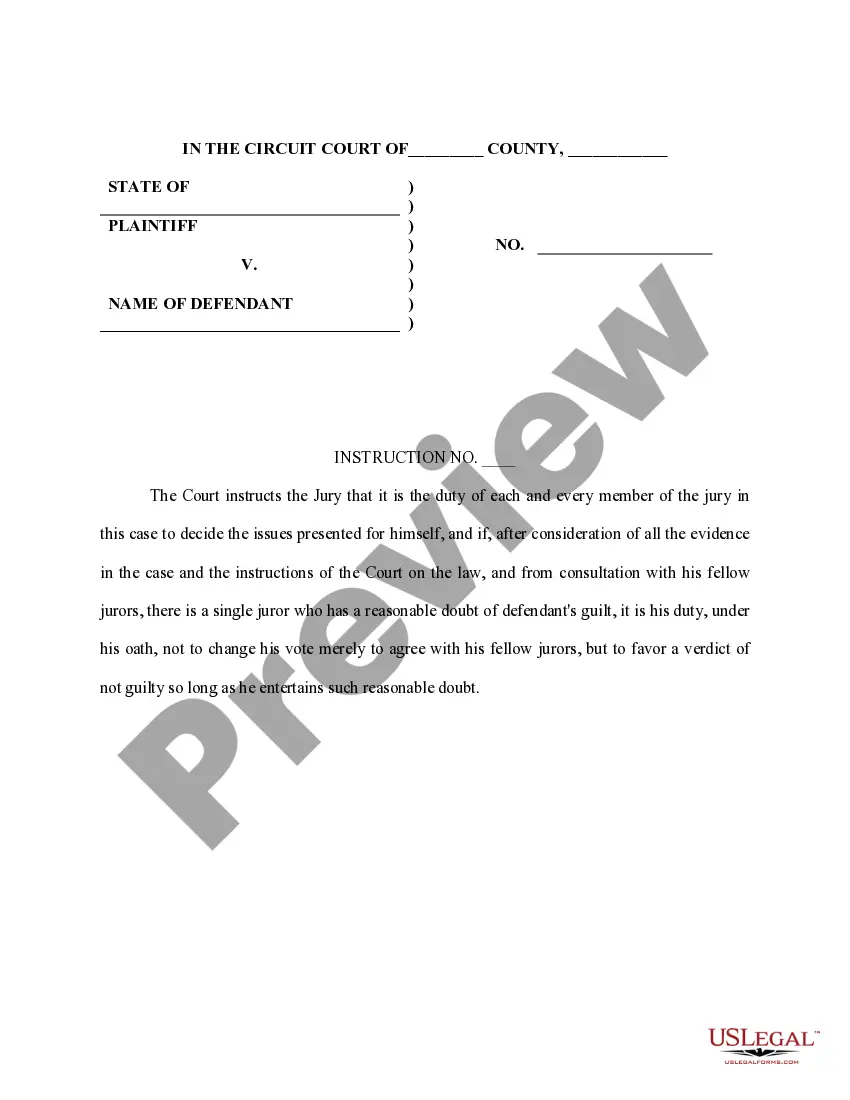
Reasonable Doubt by Single Juror
Understanding this form
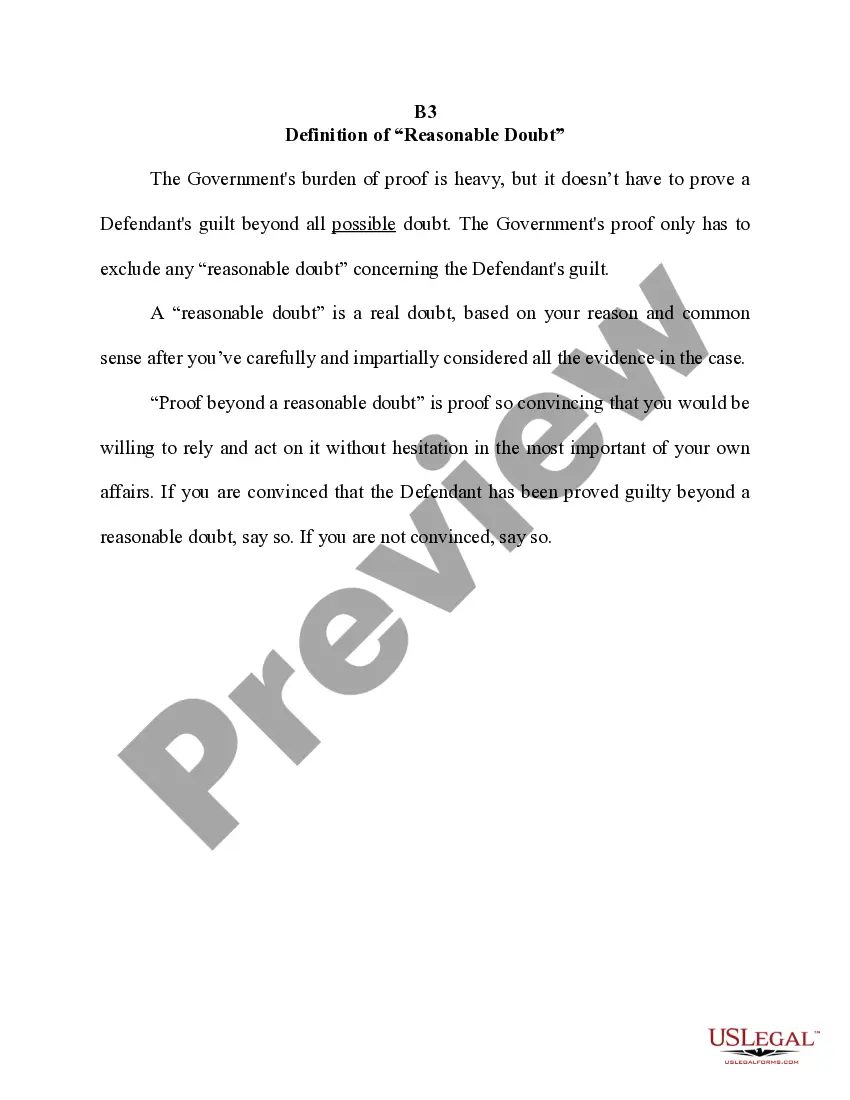
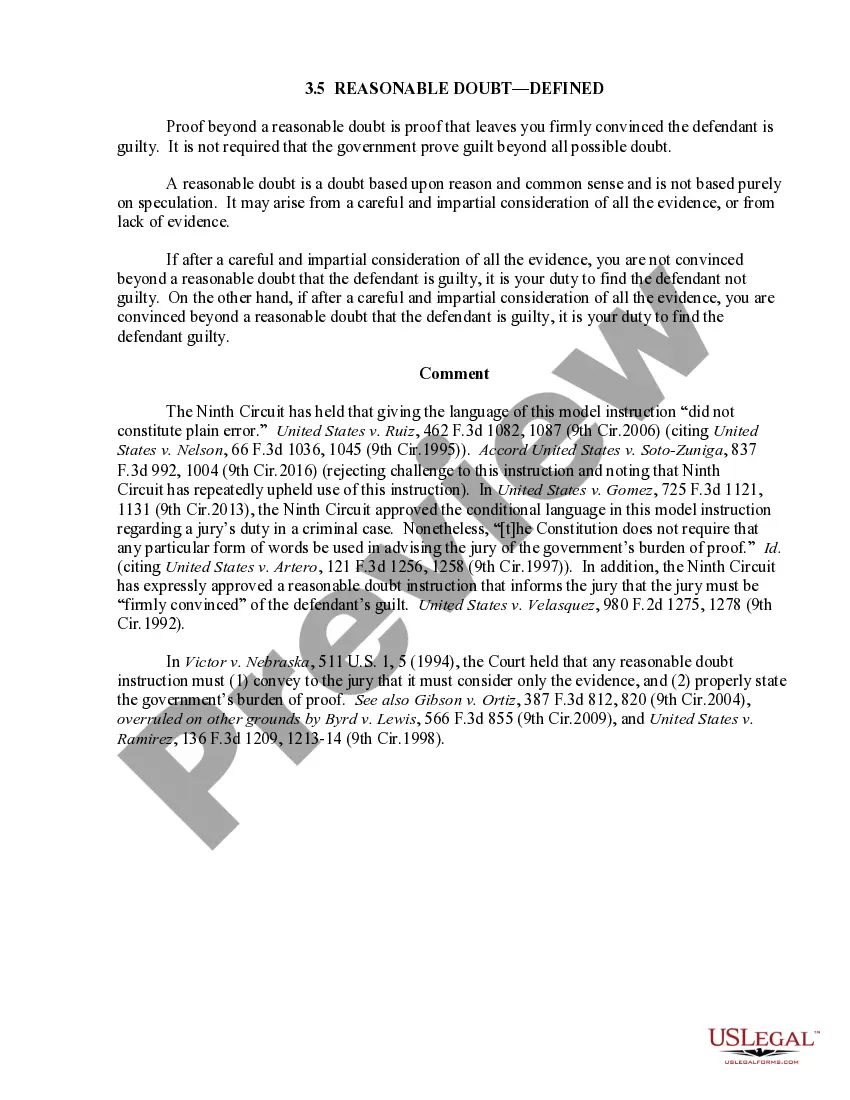
The Reasonable Doubt by Single Juror form is a jury instruction that outlines each juror's responsibility in a criminal trial. This form emphasizes that if any juror has a reasonable doubt regarding a defendant's guilt after reviewing the evidence and engaging with their fellow jurors, that individual should not alter their vote solely to reach consensus. This principle ensures the integrity of the jury's verdict and upholds the rights of the defendant.
What’s included in this form
- Instruction for jurors to evaluate evidence independently.
- Clarification that a juror with reasonable doubt should favor a verdict of not guilty.
- Emphasis on the duty of each juror to uphold their oath.
- Requirement to engage in discussion with fellow jurors without compromising personal convictions.
Common use cases
This form is utilized in criminal trials where the jury is tasked with determining the guilt of a defendant. It is essential in cases where jurors may have varying opinions or uncertainties about the evidence presented. This instruction is crucial for maintaining a fair trial, particularly when a single juror believes that the evidence does not meet the standard of proof beyond a reasonable doubt.
Who can use this document
- Judges presiding over criminal trials.
- Attorneys involved in the prosecution or defense of a case.
- Courts aiming to ensure ethical jury deliberation.
- Jurors needing clarification on their roles and responsibilities.
Completing this form step by step
- Review the legal definition of reasonable doubt as provided by the court.
- Present the instruction to the jury at the appropriate time during the trial.
- Ensure all jurors understand their duty to deliberate independently.
- Encourage jurors to discuss the evidence thoroughly before reaching a verdict.
- Reiterate that a single reasonable doubt is sufficient for a not guilty verdict.
Does this form need to be notarized?
This form does not typically require notarization unless specified by local law. It is primarily used within jury proceedings and is presented directly to the jury by the presiding judge.
Get your form ready online
Our built-in tools help you complete, sign, share, and store your documents in one place.
Make edits, fill in missing information, and update formatting in US Legal Forms—just like you would in MS Word.
Download a copy, print it, send it by email, or mail it via USPS—whatever works best for your next step.
Sign and collect signatures with our SignNow integration. Send to multiple recipients, set reminders, and more. Go Premium to unlock E-Sign.
If this form requires notarization, complete it online through a secure video call—no need to meet a notary in person or wait for an appointment.
We protect your documents and personal data by following strict security and privacy standards.

Make edits, fill in missing information, and update formatting in US Legal Forms—just like you would in MS Word.

Download a copy, print it, send it by email, or mail it via USPS—whatever works best for your next step.

Sign and collect signatures with our SignNow integration. Send to multiple recipients, set reminders, and more. Go Premium to unlock E-Sign.

If this form requires notarization, complete it online through a secure video call—no need to meet a notary in person or wait for an appointment.

We protect your documents and personal data by following strict security and privacy standards.
Common mistakes to avoid
- Failing to clearly communicate the definition of reasonable doubt to jurors.
- Overemphasizing consensus among jurors, leading to peer pressure.
- Misstating the jurors' obligations under their oath.
Why complete this form online
- Convenient access to the form allows for timely use in trial settings.
- Easy editing capabilities enable customization to meet specific legal requirements.
- Reliability of forms drafted by licensed attorneys ensures legal compliance.
What to keep in mind
- The Reasonable Doubt by Single Juror is vital for ensuring fair jury deliberations.
- Each juror must act according to their personal belief in the evidence, even against majority opinion.
- Proper use of this instruction helps uphold justice in criminal trials.
Looking for another form?

Form popularity
FAQ
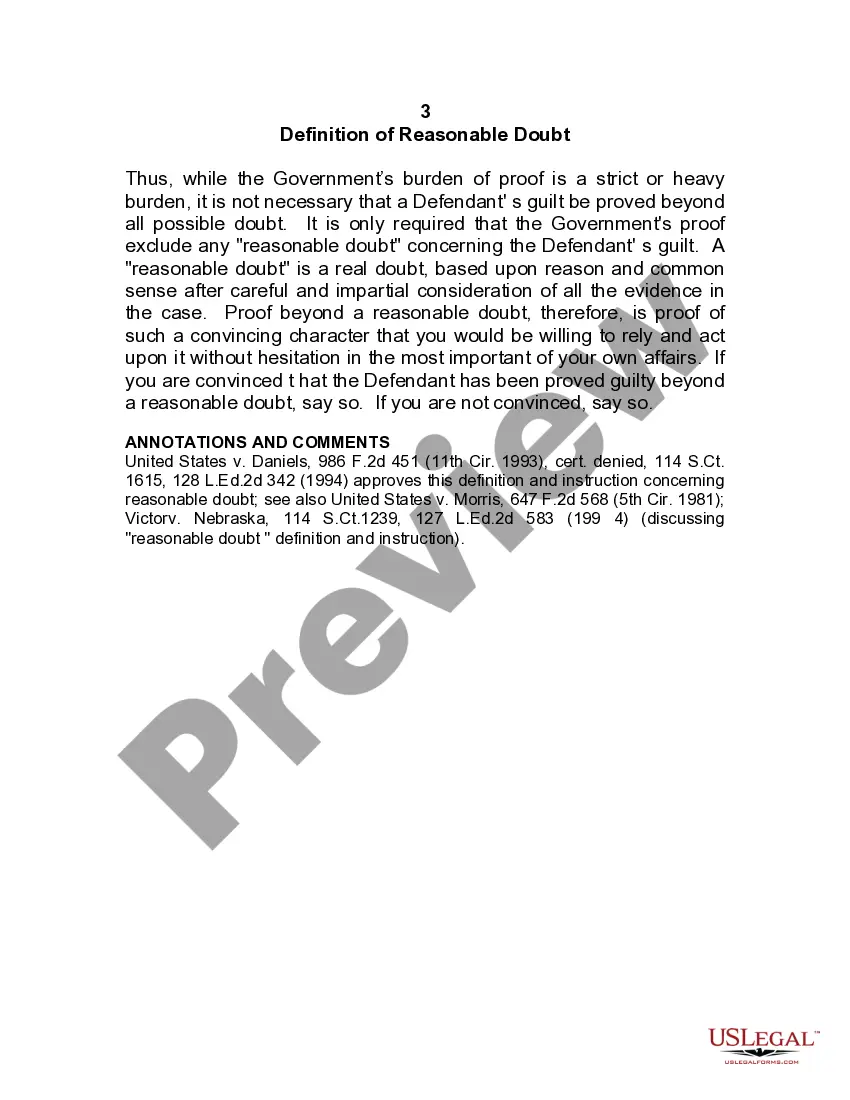
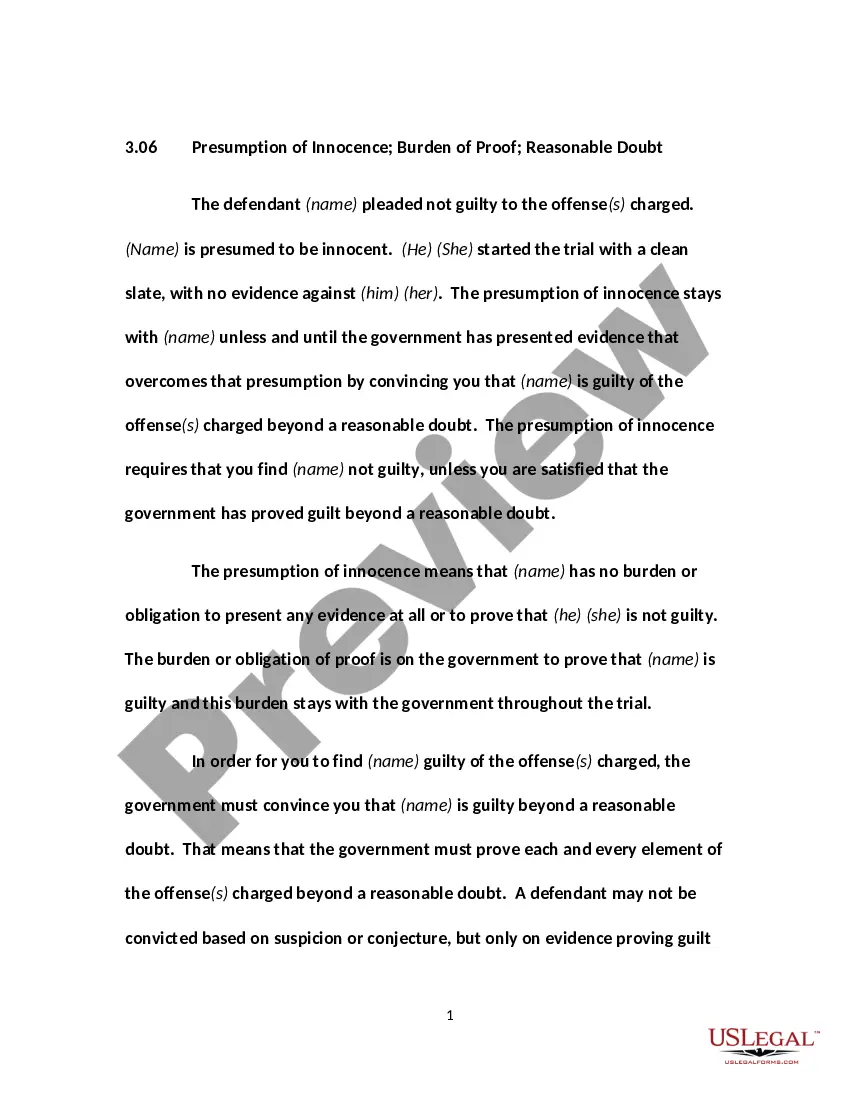
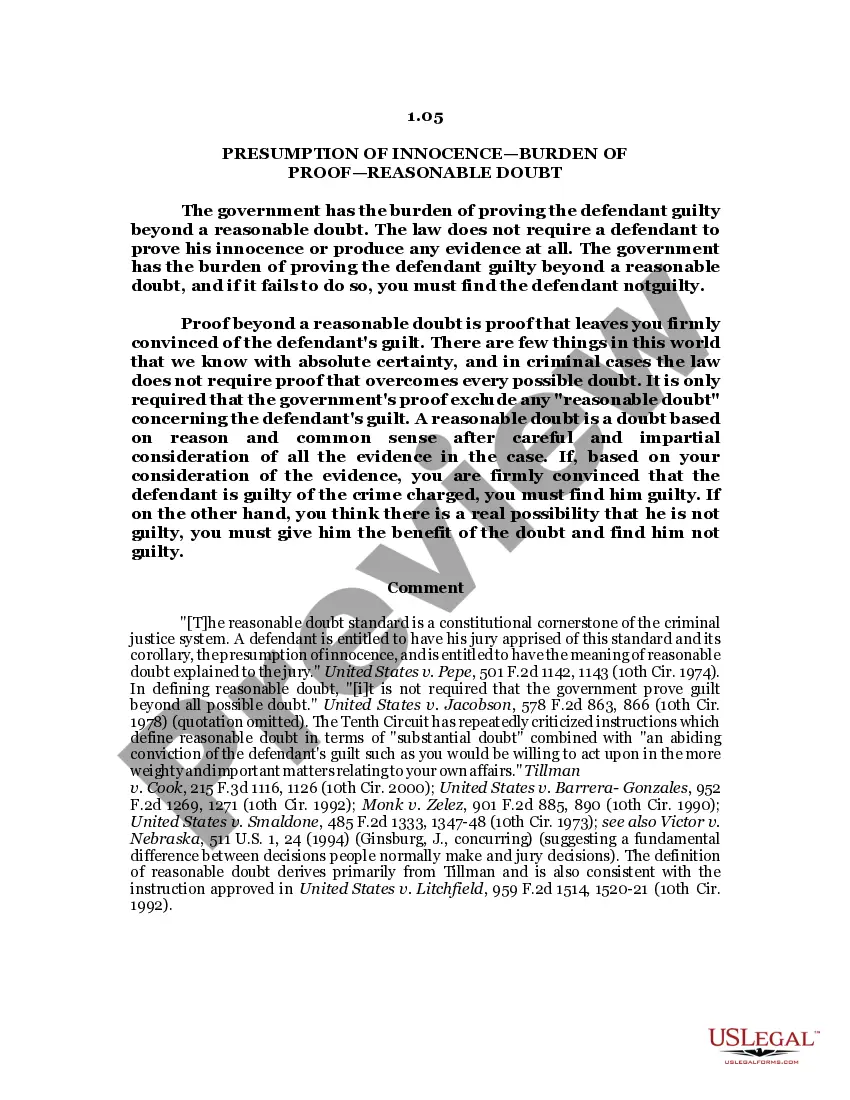
Understanding Reasonable Doubt Under U.S. law, a defendant is considered innocent until proven guilty. If the judge or jury has a reasonable doubt about the defendant's guilt, the defendant cannot be convicted. Simply put, reasonable doubt is the highest standard of proof used in any court of law.
If the jury cannot agree on a verdict on one or more counts, the court may declare a mistrial on those counts.A common axiom in criminal cases is that "it takes only one to hang," referring to the fact that in some cases, a single juror can defeat the required unanimity.
Beyond a reasonable doubt is the legal burden of proof required to affirm a conviction in a criminal case.This means that the prosecution must convince the jury that there is no other reasonable explanation that can come from the evidence presented at trial.
A reasonable doubt exists when a factfinder cannot say with moral certainty that a person is guilty or a particular fact exists. It must be more than an imaginary doubt, and it is often defined judicially as such doubt as would cause a reasonable person to hesitate before acting in a matter of importance.
If a juror feels that the definition of reasonable doubt implies that 80% certainty is required to convict, then 80% is the juror's perceived standard of reasonable doubt. In a given case, if the juror feels that it is 90% likely that the defendant committed the crime, then the juror's level of perceived guilt is 90%.
A reasonable doubt is not a doubt based upon sympathy or prejudice, and instead, is based on reason and common sense. Reasonable doubt is logically connected to the evidence or absence of evidence. Proof beyond a reasonable doubt does not involve proof to an absolute certainty.
Finally, Juror #8 helps convince some of the last holdouts by showing them that the other key witness was almost certainly not wearing her glasses when she allegedly saw the boy kill his father. For most of the jurors, this is the final nail in the coffin, and the verdict eventually turns to Not Guilty.
Juror #8: Nobody has to prove otherwise. The burden of proof is on the prosecution. The defendant doesn't even have to open his mouth. That's in the Constitution.