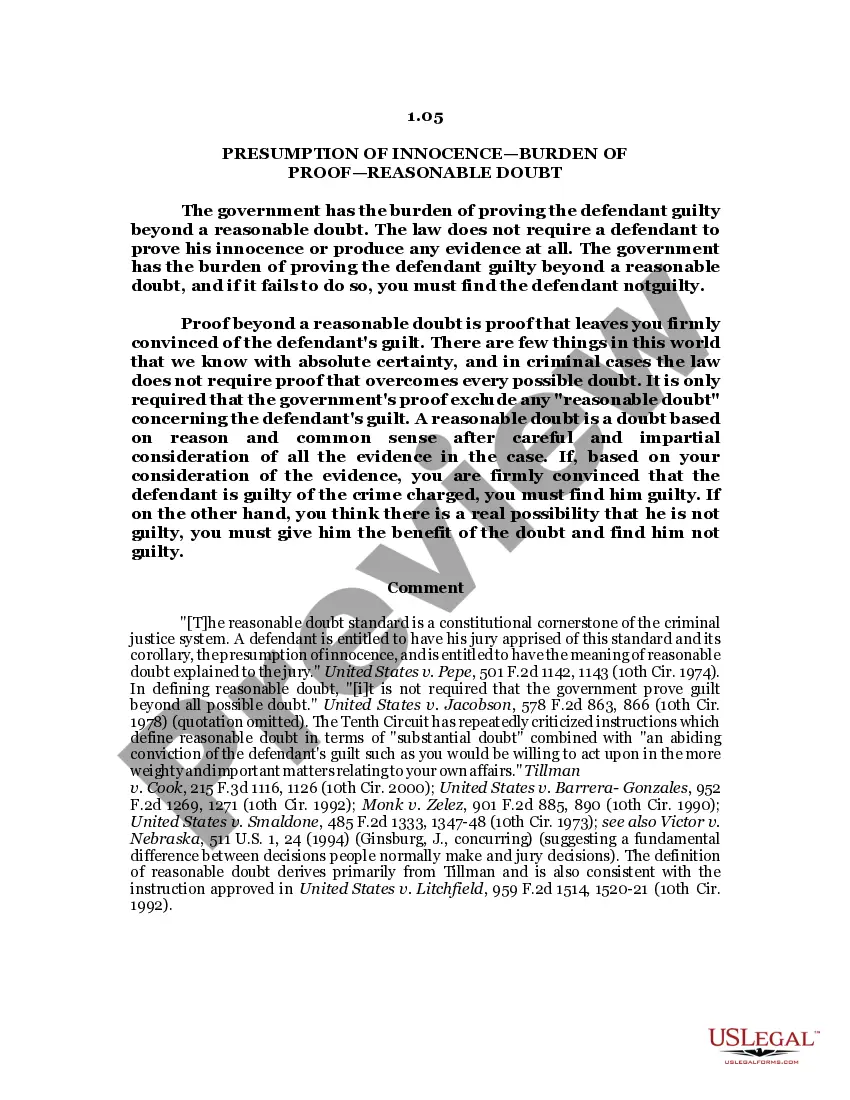
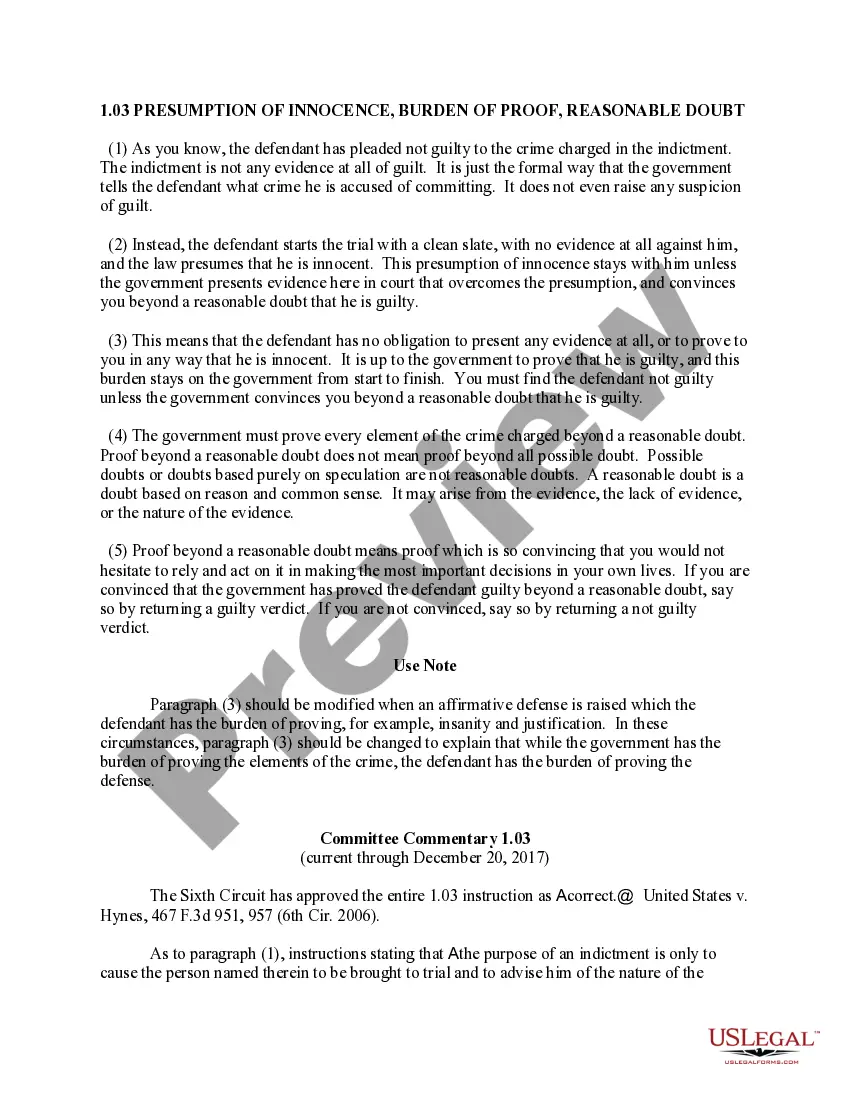
Presumption of Innocence: Also known as the ‘innocent until proven guilty’ principle, this is a legal principle which states that an accused person should be considered innocent until proven guilty in a court of law. This is an important principle of criminal justice which ensures that the defendant is given the benefit of the doubt until the prosecutor proves otherwise. Burden of Proof: The burden of proof is the responsibility of the prosecutor to prove beyond a reasonable doubt that the defendant is guilty of the crime in question. This is done by providing evidence that the defendant committed the crime and that no other reasonable explanation could explain the evidence. Reasonable Doubt: Reasonable doubt is the highest standard of proof that must be met for a criminal conviction. This means that in order for a defendant to be found guilty, the prosecution must prove their case beyond a reasonable doubt. This means that any doubts that are raised which are reasonable must be given consideration and the defendant must be acquitted if the prosecution cannot prove their case beyond this standard. There are two types of reasonable doubt, namely: direct reasonable doubt, which is evidence against the defendant directly, and circumstantial reasonable doubt, which is evidence that supports the defendant’s innocence.
Presumption of Innocence; Burden of Proof; Reasonable Doubt
Description

How to fill out Presumption Of Innocence; Burden Of Proof; Reasonable Doubt?
US Legal Forms is the most easy and cost-effective way to locate appropriate formal templates. It’s the most extensive online library of business and personal legal documentation drafted and verified by attorneys. Here, you can find printable and fillable templates that comply with national and local regulations - just like your Presumption of Innocence; Burden of Proof; Reasonable Doubt.
Obtaining your template takes only a few simple steps. Users that already have an account with a valid subscription only need to log in to the web service and download the form on their device. Later, they can find it in their profile in the My Forms tab.
And here’s how you can obtain a professionally drafted Presumption of Innocence; Burden of Proof; Reasonable Doubt if you are using US Legal Forms for the first time:
- Look at the form description or preview the document to guarantee you’ve found the one corresponding to your needs, or find another one utilizing the search tab above.
- Click Buy now when you’re certain about its compatibility with all the requirements, and select the subscription plan you prefer most.
- Create an account with our service, log in, and pay for your subscription using PayPal or you credit card.
- Choose the preferred file format for your Presumption of Innocence; Burden of Proof; Reasonable Doubt and download it on your device with the appropriate button.
After you save a template, you can reaccess it at any time - just find it in your profile, re-download it for printing and manual fill-out or import it to an online editor to fill it out and sign more proficiently.
Take full advantage of US Legal Forms, your reputable assistant in obtaining the corresponding official documentation. Give it a try!
Form popularity
FAQ
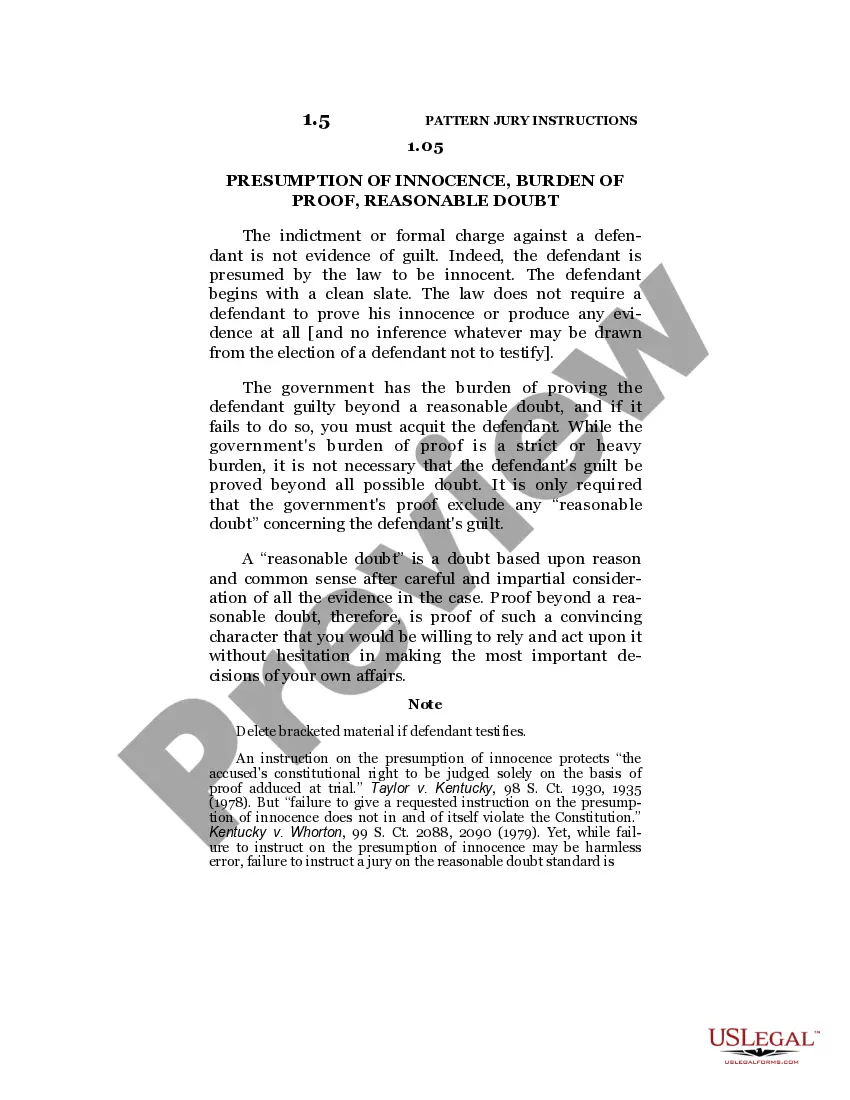
The presumption of innocence until proven guilty means that the burden of proof is always on the government to satisfy you that defendant is guilty of the crime with which he/she is charged beyond a reasonable doubt.
Proof beyond a reasonable doubt is proof that leaves you firmly convinced the defendant is guilty. It is not required that the government prove guilt beyond all possible doubt. A reasonable doubt is a doubt based upon reason and common sense and is not based purely on speculation.
In a legal dispute, one party has the burden of proof to show that they are correct, while the other party had no such burden and is presumed to be correct. The burden of proof requires a party to produce evidence to establish the truth of facts needed to satisfy all the required legal elements of the dispute.
In a criminal case, the prosecution bears the burden of proving that the defendant is guilty beyond all reasonable doubt. This means that the prosecution must convince the jury that there is no other reasonable explanation that can come from the evidence presented at trial.
' In most cases, a presumption imposes the burden of proof upon the party against whom the presumption is operable. In certain cases, however, a presumption creates a burden which legally cannot be overcome. It is this interplay between presumptions and burden of proof which is the focus of this article.
The burden of proof is a legal standard that requires parties to provide evidence to demonstrate that a claim is valid. Three levels of the burden of proof, "beyond a reasonable doubt," a "preponderance of the evidence," and "clear and convincing" determine the level of evidence required for a claim.
Under our constitutions, all defendants in criminal cases are presumed to be innocent until proven guilty beyond a reasonable doubt. The burden of proving guilt is entirely on the State. The defendant does not have to prove his innocence.
THE PROSECUTION IN A CRIMINAL CASE BEARS THE BURDEN OF PROVING TO THE JURY BEYOND A REASONABLE DOUBT ALL OF THE ELEMENTS NECESSARY TO ESTABLISH THE GUILT OF THE DEFENDANT.