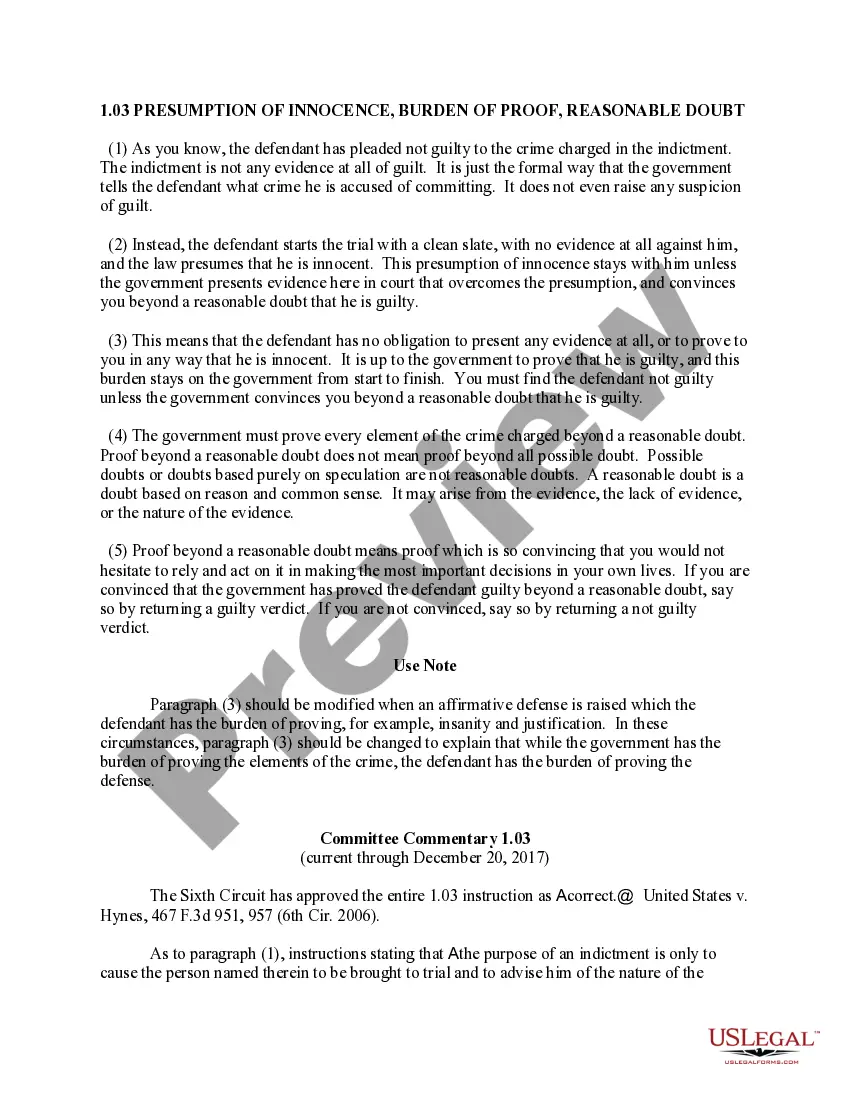
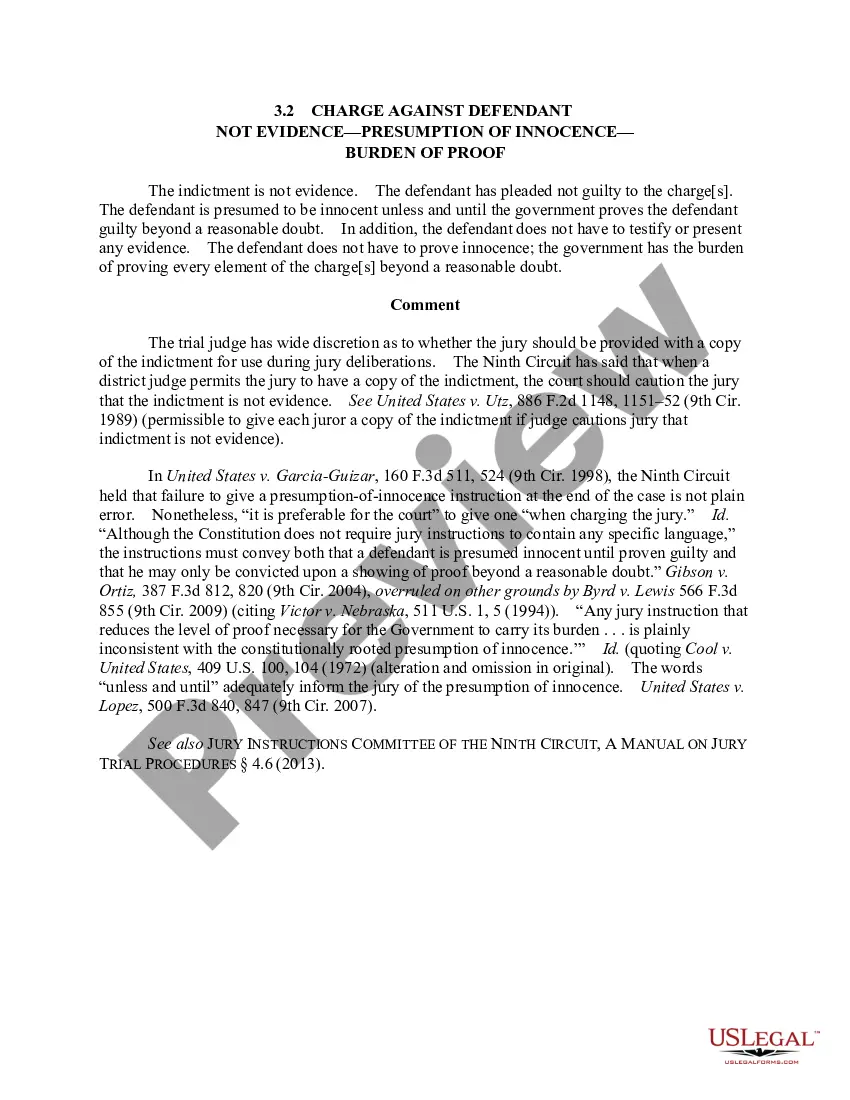
Presumption of Innocence: This is a principle that is used in criminal law and is designed to protect the accused from being convicted of a crime without sufficient evidence. It requires that the prosecution must prove beyond a reasonable doubt that the defendant is guilty of the crime in question. There are two types of presumption of innocence: the legal presumption of innocence, which is a presumption that is established by law, and the constitutional presumption of innocence, which is established by the U.S. Constitution. Burden of Proof: This is a legal concept that is used in criminal law and civil law in order to determine which party has the responsibility of proving a point or allegation. In criminal law, the burden of proof usually rests with the prosecution, who must prove beyond a reasonable doubt that the accused is guilty of the crime in question. In civil law, the burden of proof usually rests with the plaintiff, who must prove that their claim is more likely true than not true. Reasonable Doubt: This is a legal standard that must be met in order for a defendant to be found guilty of a crime. It requires that the prosecution must prove that the defendant is guilty beyond a reasonable doubt, which is a higher standard than the preponderance of the evidence, which is a lower standard. In other words, if there is any reasonable doubt as to the defendant’s guilt, then the defendant must be acquitted.
Presumption of Innocence, Burden of Proof, Reasonable Doubt
Description
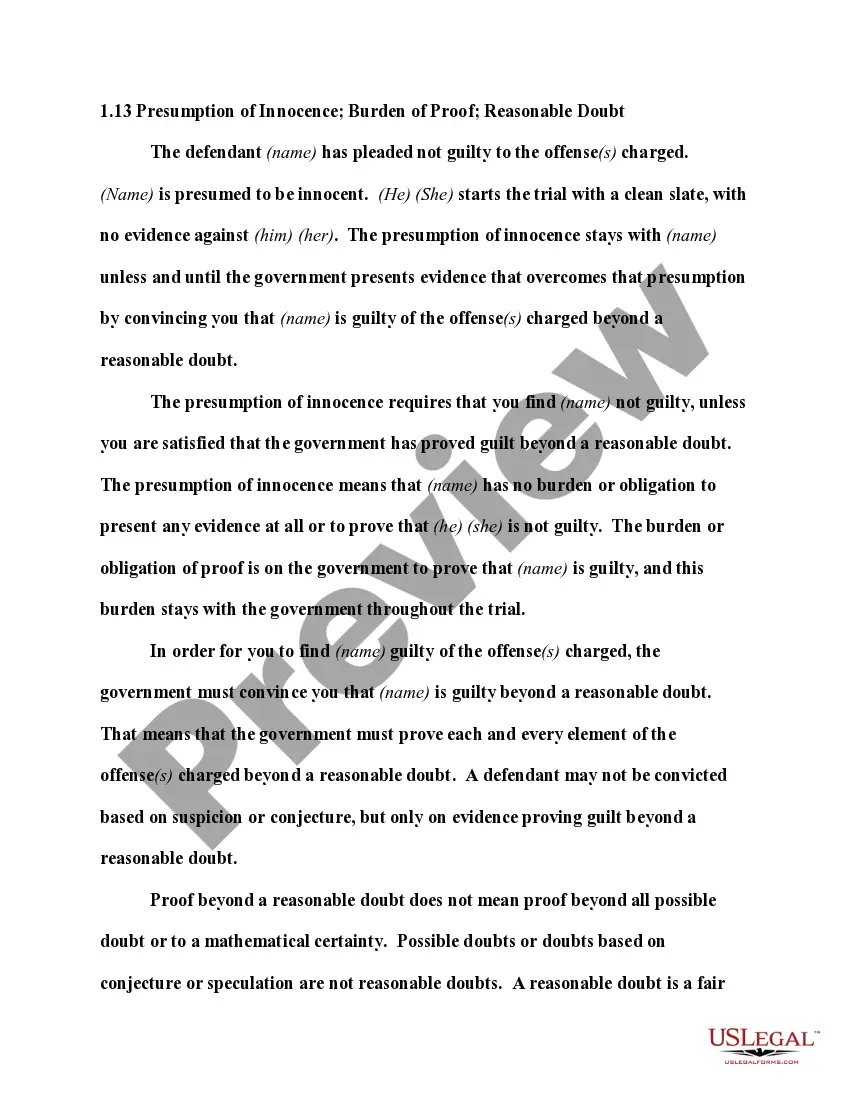
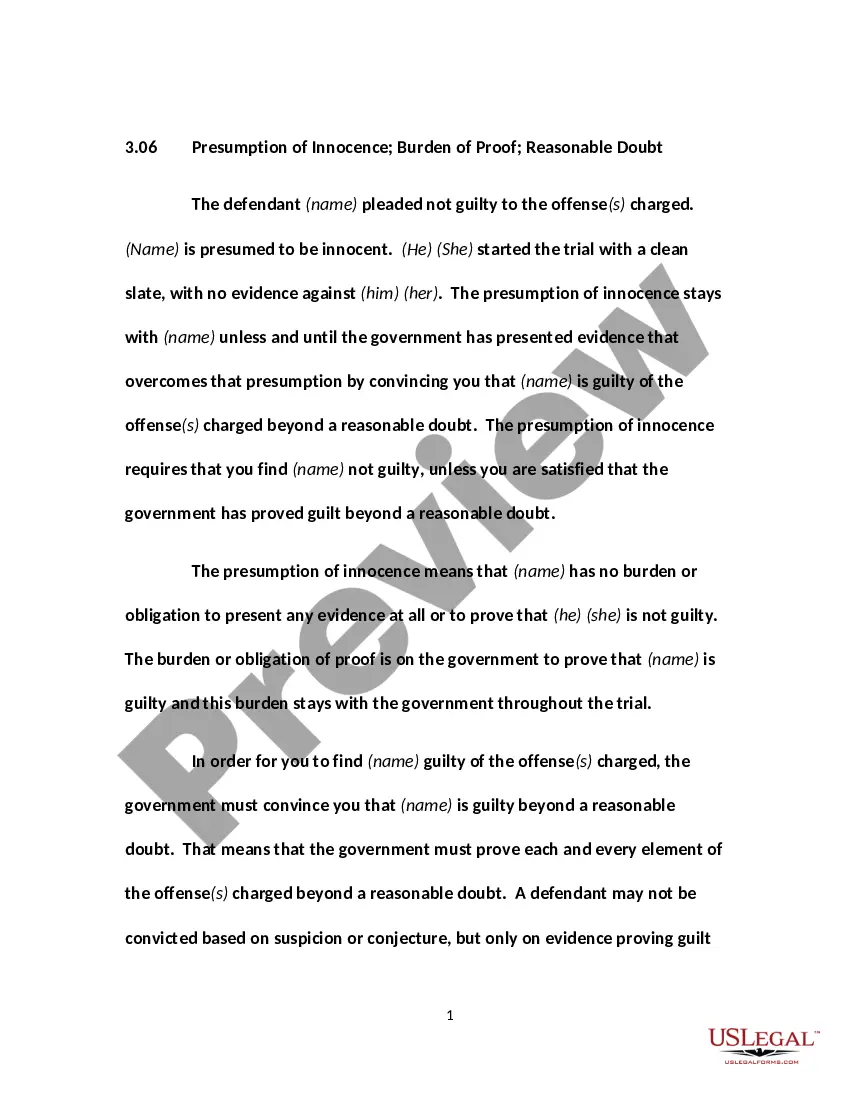
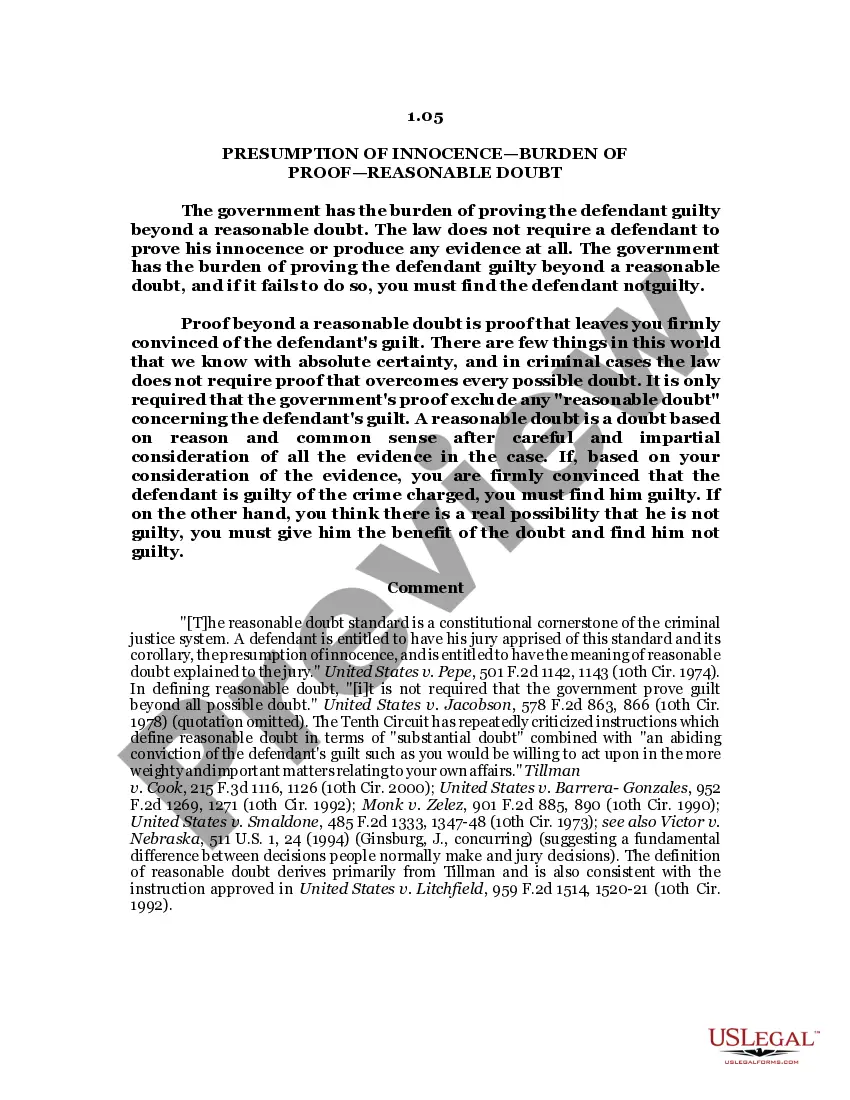



How to fill out Presumption Of Innocence, Burden Of Proof, Reasonable Doubt?
If you’re looking for a way to appropriately prepare the Presumption of Innocence, Burden of Proof, Reasonable Doubt without hiring a legal professional, then you’re just in the right spot. US Legal Forms has proven itself as the most extensive and reliable library of formal templates for every individual and business scenario. Every piece of documentation you find on our web service is drafted in accordance with federal and state regulations, so you can be sure that your documents are in order.
Follow these straightforward instructions on how to get the ready-to-use Presumption of Innocence, Burden of Proof, Reasonable Doubt:
- Make sure the document you see on the page corresponds with your legal situation and state regulations by examining its text description or looking through the Preview mode.
- Type in the document name in the Search tab on the top of the page and select your state from the list to locate another template in case of any inconsistencies.
- Repeat with the content check and click Buy now when you are confident with the paperwork compliance with all the requirements.
- Log in to your account and click Download. Create an account with the service and select the subscription plan if you still don’t have one.
- Use your credit card or the PayPal option to purchase your US Legal Forms subscription. The blank will be available to download right after.
- Decide in what format you want to save your Presumption of Innocence, Burden of Proof, Reasonable Doubt and download it by clicking the appropriate button.
- Upload your template to an online editor to fill out and sign it rapidly or print it out to prepare your paper copy manually.
Another great advantage of US Legal Forms is that you never lose the paperwork you purchased - you can find any of your downloaded blanks in the My Forms tab of your profile whenever you need it.
Form popularity
FAQ
In a criminal case, the prosecution bears the burden of proving that the defendant is guilty beyond all reasonable doubt. This means that the prosecution must convince the jury that there is no other reasonable explanation that can come from the evidence presented at trial.
Proof beyond a reasonable doubt is proof that leaves you firmly convinced the defendant is guilty. It is not required that the government prove guilt beyond all possible doubt. A reasonable doubt is a doubt based upon reason and common sense and is not based purely on speculation.
A reasonable doubt may arise either from the evidence or from a lack of evidence. Reasonable doubt exists when you are not firmly convinced of the Defendant's guilt, after you have weighed and considered all the evidence. A Defendant must not be convicted on suspicion or speculation.
The person charged is considered innocent until proven guilty. As such, the burden of proof falls upon the prosecution to prove its case beyond a reasonable doubt. Proof beyond a reasonable doubt is required only in criminal cases because the potential penalties are severe.
THE PROSECUTION IN A CRIMINAL CASE BEARS THE BURDEN OF PROVING TO THE JURY BEYOND A REASONABLE DOUBT ALL OF THE ELEMENTS NECESSARY TO ESTABLISH THE GUILT OF THE DEFENDANT.
An example of this would be a trial for manslaughter in which the prosecution was only able to convince the jury panel that you had a 75% chance of committing the crime. Because the jury is 25% uncertain, the prosecution was not successful in proving beyond a reasonable doubt that you are guilty.
Under our constitutions, all defendants in criminal cases are presumed to be innocent until proven guilty beyond a reasonable doubt. The burden of proving guilt is entirely on the State. The defendant does not have to prove his innocence.
The burden of proof (?onus probandi? in Latin) is the obligation to provide sufficient supporting evidence for claims that you make. For example, if someone claims that ghosts exist, then the burden of proof means that they need to provide evidence that supports this.