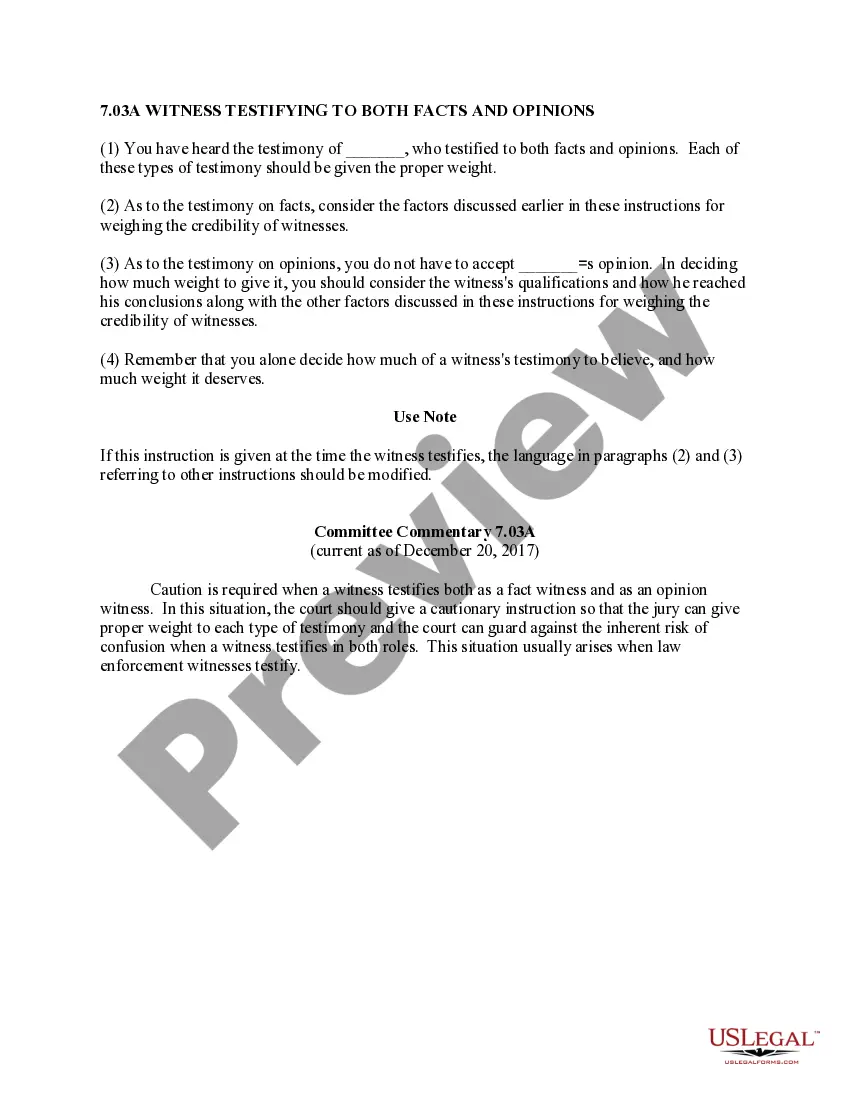
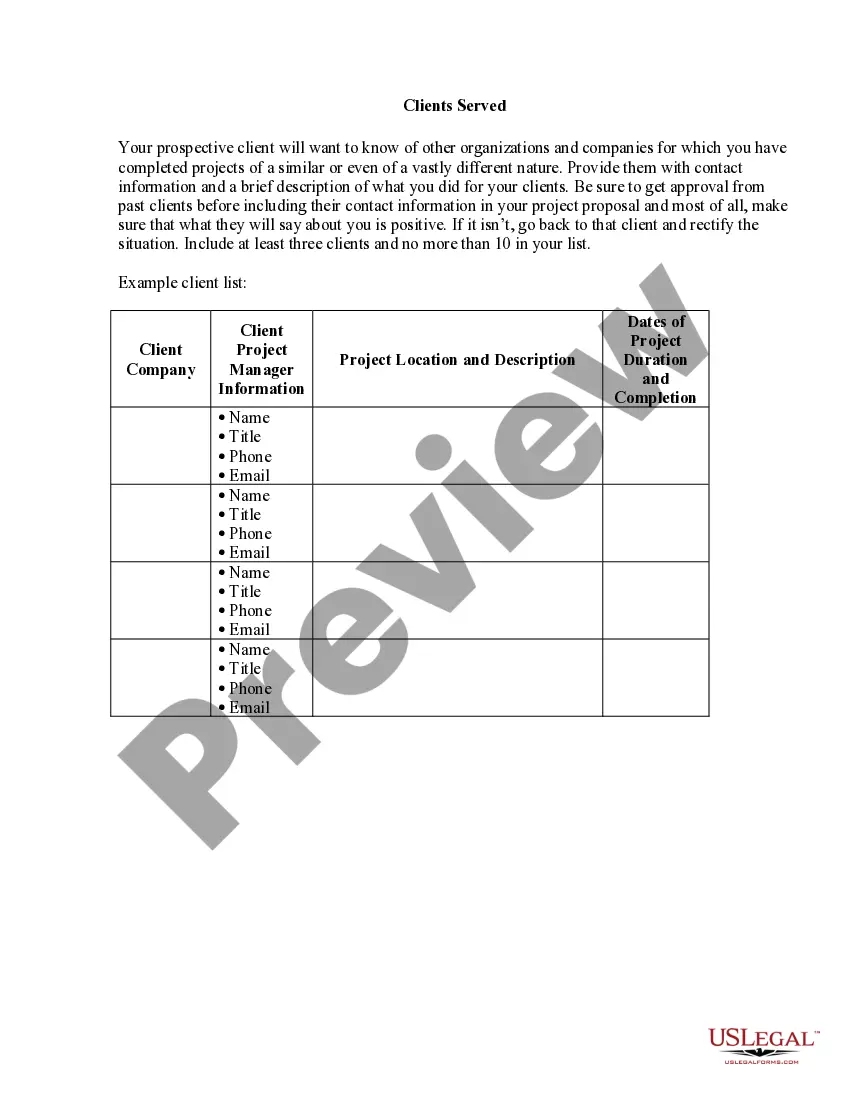
Clients Served
What this document covers
The Clients Served form is a document designed to help businesses showcase their past clients and projects. This form is particularly useful for service-oriented businesses aiming to establish credibility and attract new prospects by providing potential clients with relevant references and contact information. Unlike other marketing materials, this form focuses specifically on documenting client relationships and project details to ensure transparency and trust.
What’s included in this form
- Client company name
- Project manager's contact information
- Project location and a brief description
- Project dates, including duration and completion
- Approval status from past clients for including their details
Situations where this form applies
This form should be utilized when you are preparing a proposal for a prospective client and wish to substantiate your experience with verifiable client references. It becomes essential in industries where trust and past performance significantly influence client decisions, such as construction, consulting, or technology services. Incorporating this form into your proposal can enhance your credibility and improve your chances of winning new contracts.
Who should use this form
Eligibility for using the Clients Served form includes:
- Businesses seeking new clients in service-oriented sectors
- Freelancers and consultants wanting to showcase their portfolio
- Contractors and service providers aiming to enhance client proposals
- Established companies looking to validate their past client relationships for new projects
Steps to complete this form
- Identify at least three clients and their corresponding project details.
- Gather contact information of the project managers or responsible individuals for each client.
- Provide a brief description of the projects completed for each client, focusing on outcomes and benefits.
- Ensure that you have received consent from all clients to include their details in your proposal.
- Review the document for accuracy and clarity before finalizing it for submission.
Is notarization required?
Notarization is not commonly needed for this form. However, certain documents or local rules may make it necessary. Our notarization service, powered by Notarize, allows you to finalize it securely online anytime, day or night.
Get your form ready online
Our built-in tools help you complete, sign, share, and store your documents in one place.
Make edits, fill in missing information, and update formatting in US Legal Forms—just like you would in MS Word.
Download a copy, print it, send it by email, or mail it via USPS—whatever works best for your next step.
Sign and collect signatures with our SignNow integration. Send to multiple recipients, set reminders, and more. Go Premium to unlock E-Sign.
If this form requires notarization, complete it online through a secure video call—no need to meet a notary in person or wait for an appointment.
We protect your documents and personal data by following strict security and privacy standards.

Make edits, fill in missing information, and update formatting in US Legal Forms—just like you would in MS Word.

Download a copy, print it, send it by email, or mail it via USPS—whatever works best for your next step.

Sign and collect signatures with our SignNow integration. Send to multiple recipients, set reminders, and more. Go Premium to unlock E-Sign.

If this form requires notarization, complete it online through a secure video call—no need to meet a notary in person or wait for an appointment.

We protect your documents and personal data by following strict security and privacy standards.
Avoid these common issues
- Failing to obtain approval from past clients before listing their information.
- Including vague project descriptions that do not clearly convey the nature of the work done.
- Listing too many clients, which can dilute the focus and impact of the references provided.
- Neglecting to check for updated contact information for past clients.
Advantages of online completion
- Convenience of easily filling out and editing the form as needed.
- Access to professionally drafted templates that can enhance the credibility of your proposal.
- Time-saving process of downloading and using the form without the need for in-person legal assistance.
- Reliable formats that are compliant with general standards and can be adapted for specific needs.
Quick recap
- The Clients Served form is essential for businesses to present their past client work effectively.
- Always secure client consent before listing contact details and project information.
- Focus on clarity and relevance in project descriptions to maximize impact.
- This form can be adapted for use in various states without specific legal variations needed.
Looking for another form?
Form popularity
FAQ
17 types of clients and how to work with them Uncertain clients. Some clients may not know exactly what they want from your business.Urgent clients.Unresponsive clients.Unrealistic clients.Empathetic clients.Clients concerned with costs.Clients who monitor your work closely.Clients who request changes after delivery.
Client's singular possessive is used to show possession of an item or thought (displeasure) belonging to only one client. clients' plural possessive is used to show possession of items or thoughts (representatives) belonging to more than one client.
17 types of clients and how to work with them Uncertain clients. Some clients may not know exactly what they want from your business.Urgent clients.Unresponsive clients.Unrealistic clients.Empathetic clients.Clients concerned with costs.Clients who monitor your work closely.Clients who request changes after delivery.
4 Different Types of Clients in Counseling Director (logical and dominating) Director. The first type of client in counseling is a director.Socializer (emotional and dominating) Socializer. The second type of client is a socializer.Analyst (logical and adapting) Analytical. One of the most interesting types of customers.
?One of our clients is correct?. ?One of our client's? refers to something that they own and can't be used on its own.
The four primary customer types are: Price buyers. These customers want to buy products and services only at the lowest possible price.Relationship buyers.Value buyers.Poker player buyers.
Counseling is a collaborative partnership between counselor and client, in which the client can be an individual, couple, family or group.
A form of counseling in which different counselors work with families, individuals, couples and also communities in one or the other way.