DEFENDANT'S ELECTION NOT TO TESTIFY OR PRESENT EVIDENCE
Understanding this form
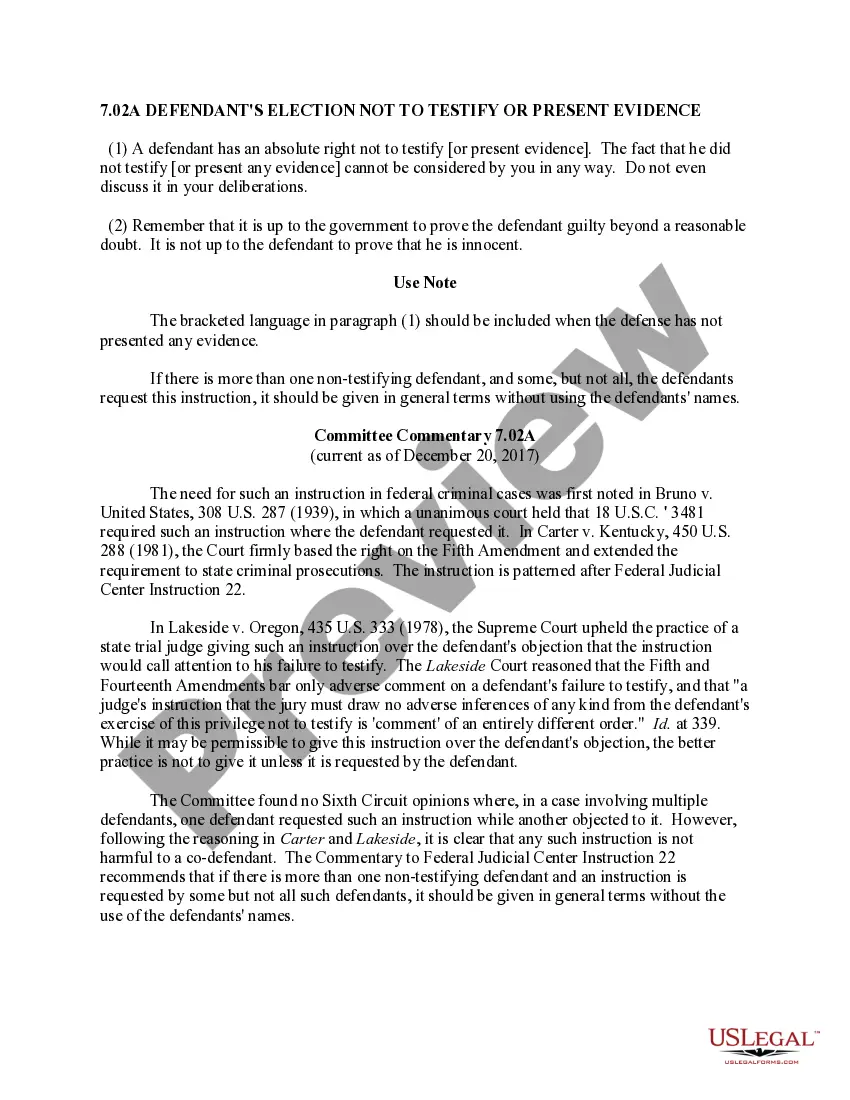
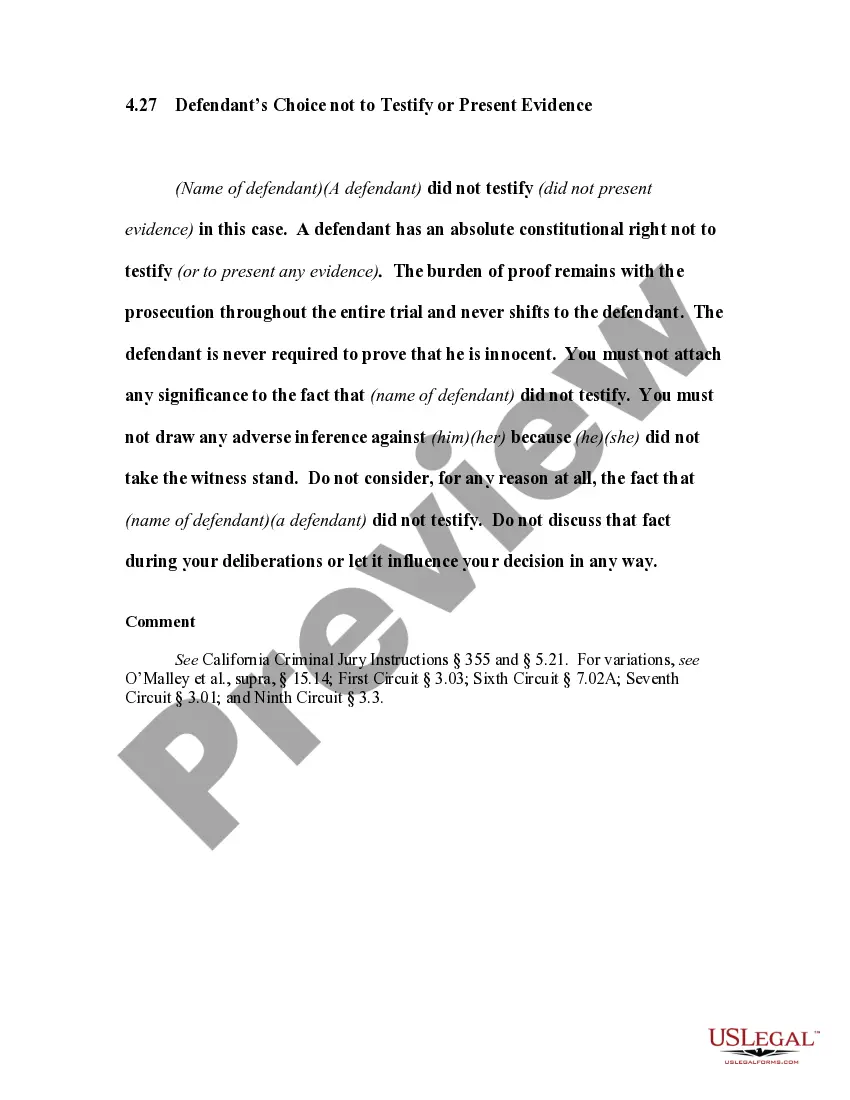
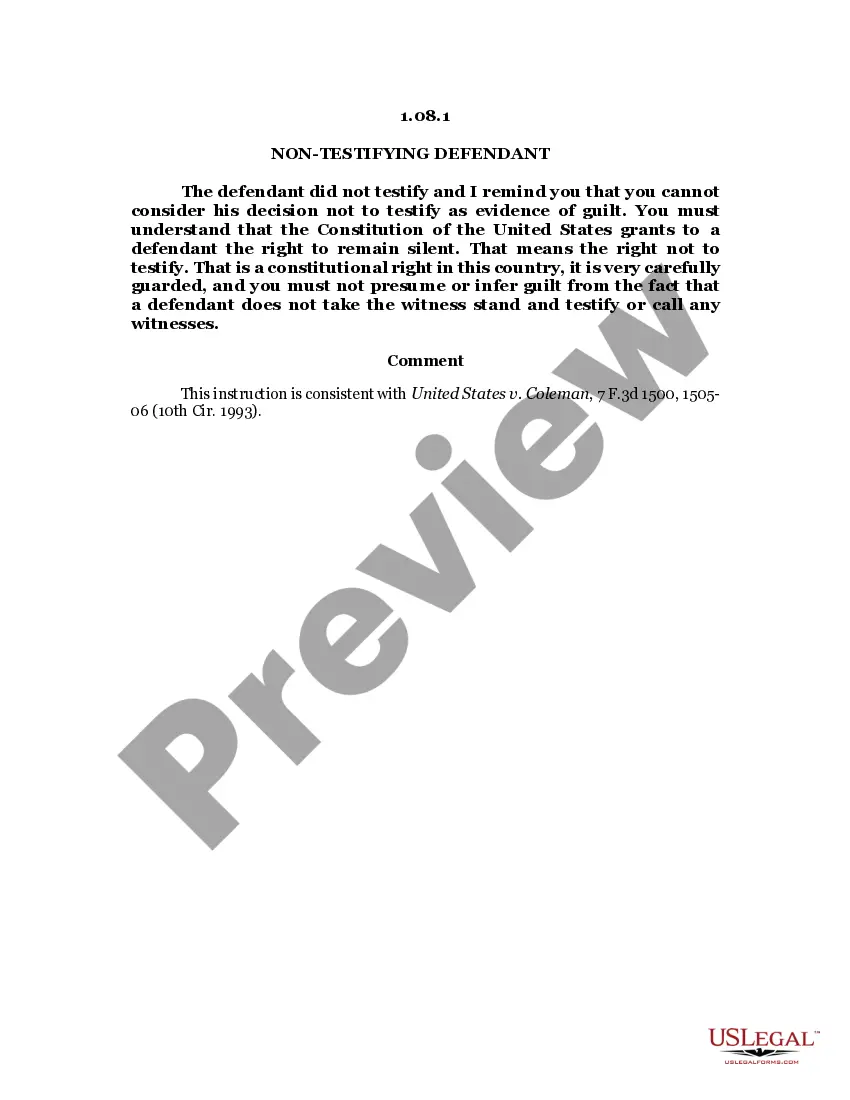
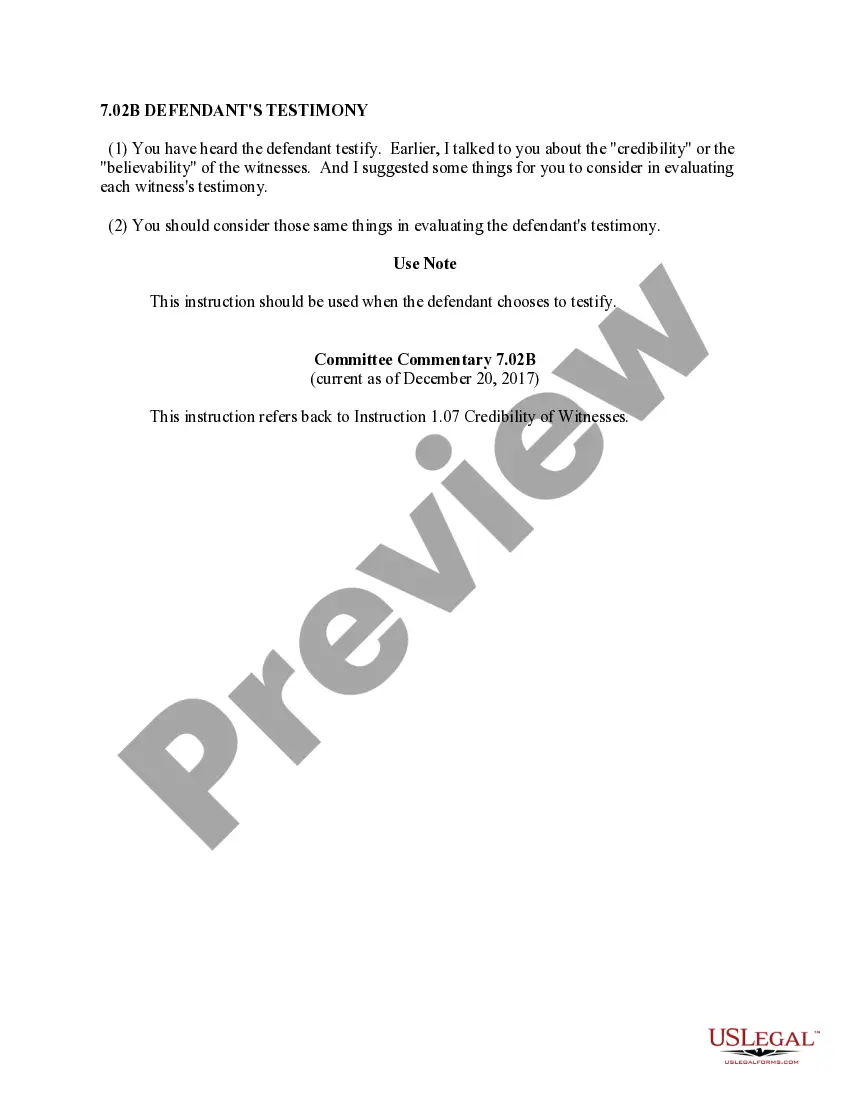
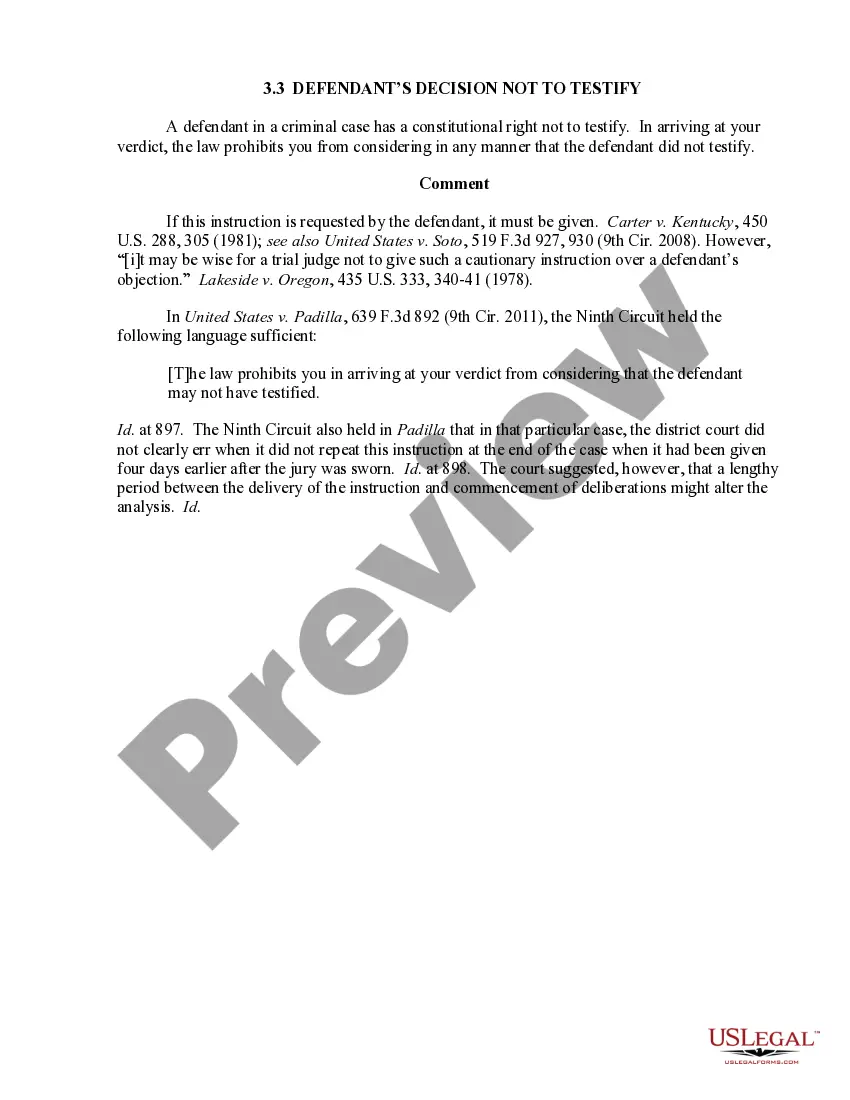
The Defendant's Election Not to Testify or Present Evidence is a legal document that affirms a defendant's right not to testify during a trial. This form ensures that the jury understands that the defendant's choice not to provide testimony or evidence cannot be used against them in determining guilt or innocence. It is crucial for safeguarding the defendant's rights in both federal and state criminal proceedings.
Form components explained
- Statement affirming the defendant's right not to testify.
- Instruction to the jury that failure to testify cannot be discussed or considered in deliberations.
- Emphasis on the government's burden to prove guilt beyond a reasonable doubt.
- Usage notes for including optional language based on case specifics.
- Contextual commentary regarding case law supporting the instruction.
When to use this document
This form should be used in criminal trials when the defendant chooses not to testify or present evidence. It is particularly relevant in situations where the defense strategy is to rely on the prosecution's inability to meet the burden of proof rather than providing counter-evidence or testimony. Utilizing this form helps establish the jury's understanding of the legal implications of the defendant's choice.
Who this form is for
- Defendants in criminal cases who decide not to testify.
- Defense attorneys representing clients in court.
- Legal practitioners looking for guidance on jury instructions regarding the defendant's rights.
How to prepare this document
- Determine whether the defendant will exercise the right not to testify.
- Include the appropriate bracketed language if the defense has not presented any evidence.
- Ensure the jury instructions are clear and in compliance with local court requirements.
- Review and finalize the form with the defendant's acknowledgment of their choice.
- File the completed form according to court protocols.
Notarization requirements for this form
This form does not typically require notarization unless specified by local law. However, it is essential to verify specific jurisdictional requirements before submission to avoid complications.
Get your form ready online
Our built-in tools help you complete, sign, share, and store your documents in one place.
Make edits, fill in missing information, and update formatting in US Legal Forms—just like you would in MS Word.
Download a copy, print it, send it by email, or mail it via USPS—whatever works best for your next step.
Sign and collect signatures with our SignNow integration. Send to multiple recipients, set reminders, and more. Go Premium to unlock E-Sign.
If this form requires notarization, complete it online through a secure video call—no need to meet a notary in person or wait for an appointment.
We protect your documents and personal data by following strict security and privacy standards.

Make edits, fill in missing information, and update formatting in US Legal Forms—just like you would in MS Word.

Download a copy, print it, send it by email, or mail it via USPS—whatever works best for your next step.

Sign and collect signatures with our SignNow integration. Send to multiple recipients, set reminders, and more. Go Premium to unlock E-Sign.

If this form requires notarization, complete it online through a secure video call—no need to meet a notary in person or wait for an appointment.

We protect your documents and personal data by following strict security and privacy standards.
Mistakes to watch out for
- Failing to include the necessary instructions for the jury regarding the defendant's election.
- Using incorrect or outdated legal language that may confuse the jury.
- Neglecting to address multiple non-testifying defendants properly in jury instructions.
Benefits of completing this form online
- Convenience of downloading and accessing legal forms anytime, anywhere.
- Editability allows customization to fit specific case needs.
- Reliability of forms drafted by licensed attorneys ensuring compliance with legal standards.
Looking for another form?
Form popularity
FAQ
The Fifth Amendment to the United States Constitution provides that no person shall be compelled in any criminal case to be a witness against himself or herself. The self-incrimination privilege of the Fifth Amendment means that a defendant cannot be compelled to testify at his or her criminal trial.
The Fifth Amendment to the U.S. Constitution guarantees that an individual cannot be compelled by the government to provide incriminating information about herself ? the so-called ?right to remain silent.? When an individual ?takes the Fifth,? she invokes that right and refuses to answer questions or provide
U.S. Constitution - Sixth Amendment Resources Constitution Annotated Congress.gov Library of Congress.
Steps in a Trial Because the Fifth Amendment to the U.S. Constitution protects against self-incrimination, the prosecution cannot require the defendant to take the stand and explain what happened, nor can it comment or speculate on the reasons the defendant has chosen not to testify.
Privilege Invoking: A defendant invokes privilege by refusing to take the stand. Thus, the court cannot compel them to testify, and the prosecutor cannot take their failure to take the stand to the jury's attention. If the prosecutor made a comment, it would trigger the harmless-error test.
The Fifth Amendment to the United States Constitution provides that no person shall be compelled in any criminal case to be a witness against himself or herself. The self-incrimination privilege of the Fifth Amendment means that a defendant cannot be compelled to testify at his or her criminal trial.
Many defendants choose not to testify because prosecutors have the burden of proof and to make sure that they don't incriminate themselves or open themselves up to cross-examination.
The Sixth Amendment guarantees the rights of criminal defendants, including the right to a public trial without unnecessary delay, the right to a lawyer, the right to an impartial jury, and the right to know who your accusers are and the nature of the charges and evidence against you.