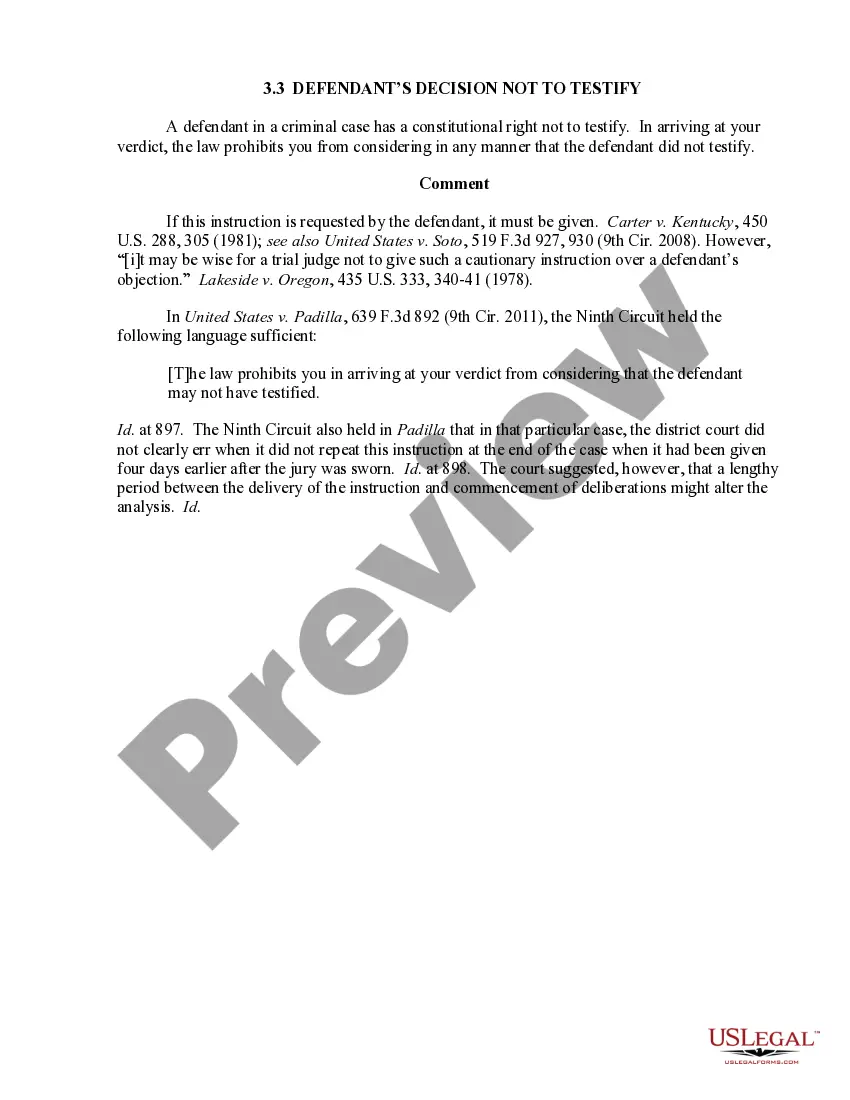
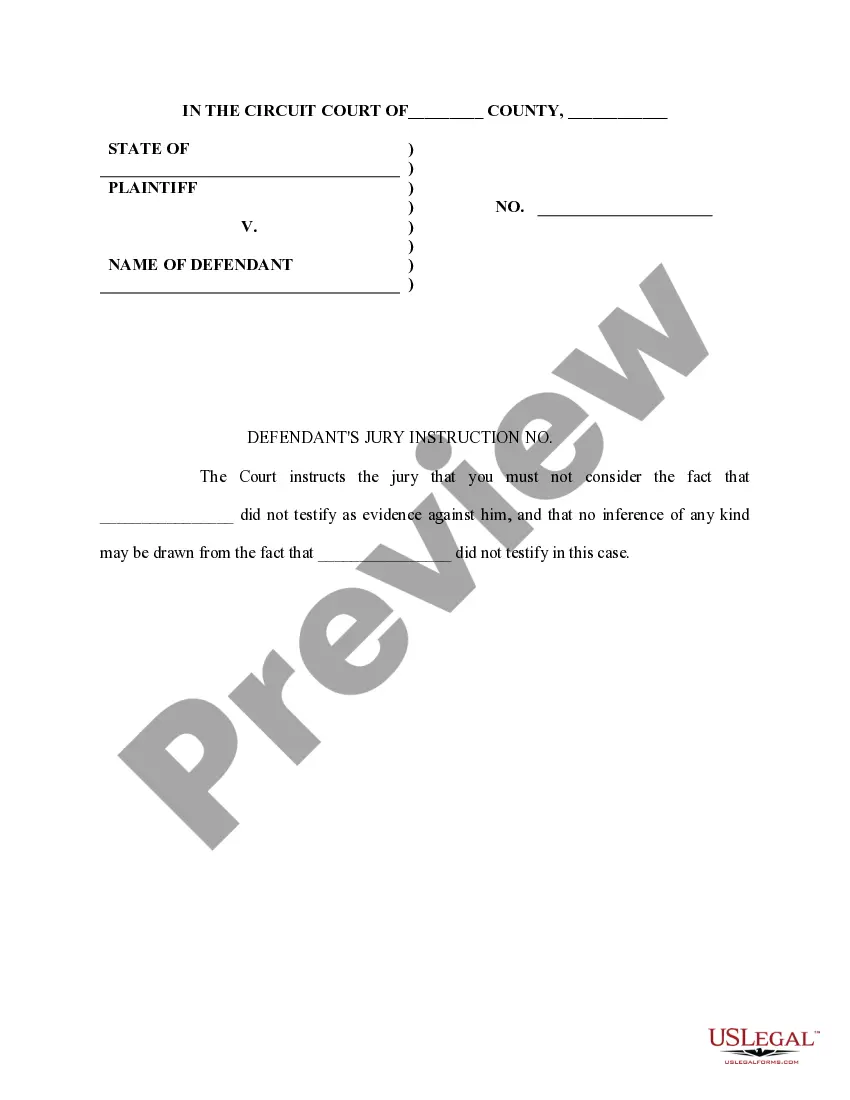
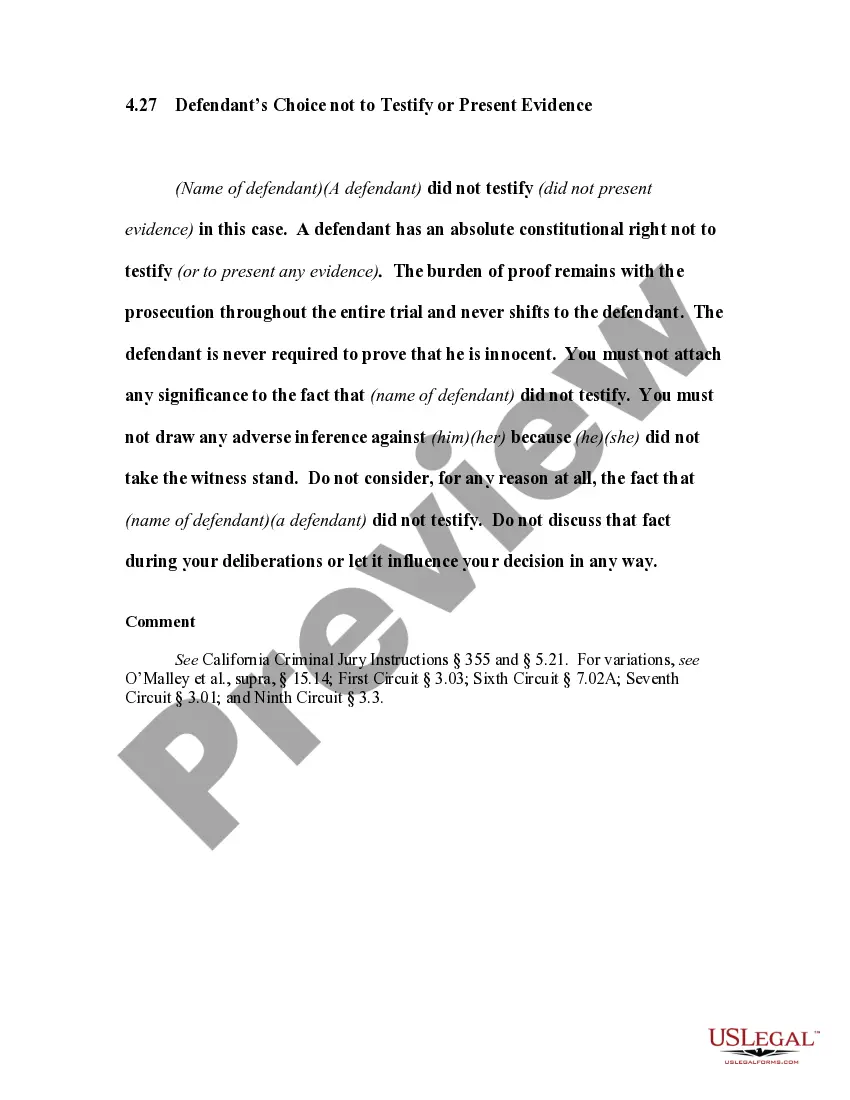
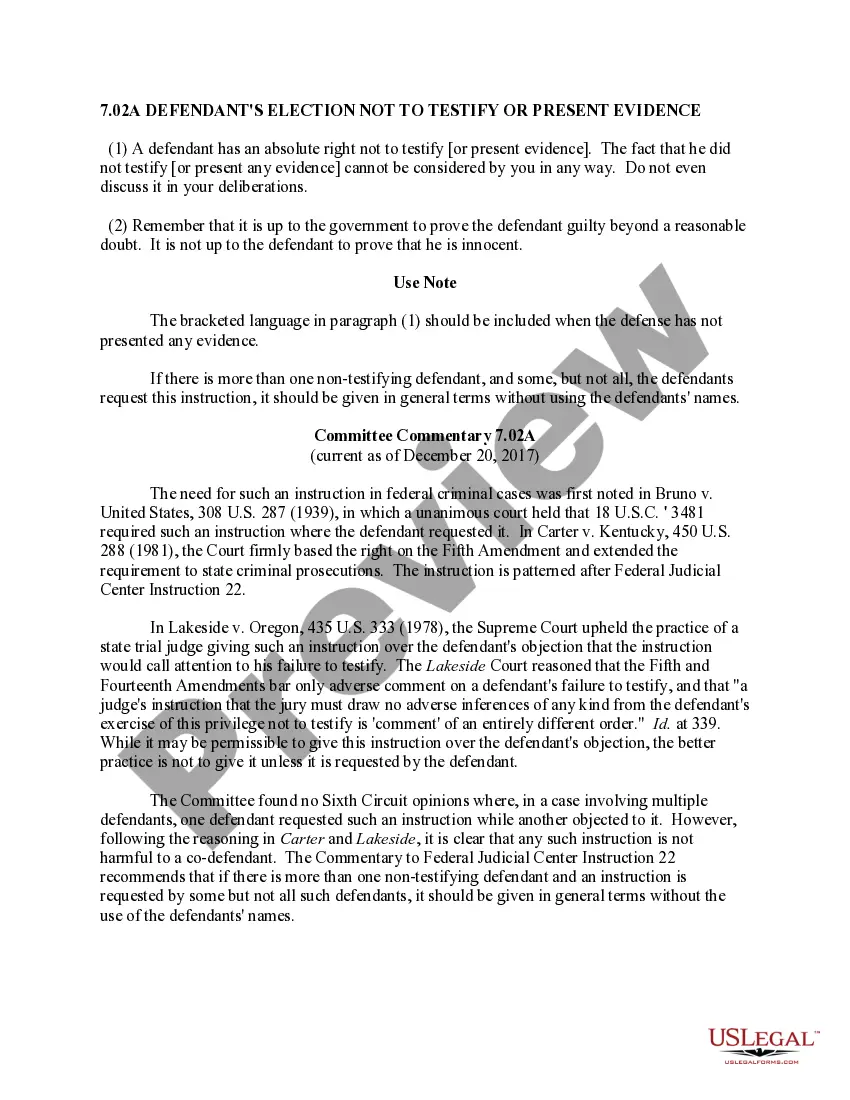
3.3 Defendant's Decision Not to Testify.

Notarization requirements for this form
In most cases, this form does not require notarization. However, some jurisdictions or signing circumstances might. US Legal Forms offers online notarization powered by Notarize, accessible 24/7 for a quick, remote process.
Get your form ready online
Our built-in tools help you complete, sign, share, and store your documents in one place.
Make edits, fill in missing information, and update formatting in US Legal Forms—just like you would in MS Word.
Download a copy, print it, send it by email, or mail it via USPS—whatever works best for your next step.
Sign and collect signatures with our SignNow integration. Send to multiple recipients, set reminders, and more. Go Premium to unlock E-Sign.
If this form requires notarization, complete it online through a secure video call—no need to meet a notary in person or wait for an appointment.
We protect your documents and personal data by following strict security and privacy standards.

Make edits, fill in missing information, and update formatting in US Legal Forms—just like you would in MS Word.

Download a copy, print it, send it by email, or mail it via USPS—whatever works best for your next step.

Sign and collect signatures with our SignNow integration. Send to multiple recipients, set reminders, and more. Go Premium to unlock E-Sign.

If this form requires notarization, complete it online through a secure video call—no need to meet a notary in person or wait for an appointment.

We protect your documents and personal data by following strict security and privacy standards.
Looking for another form?
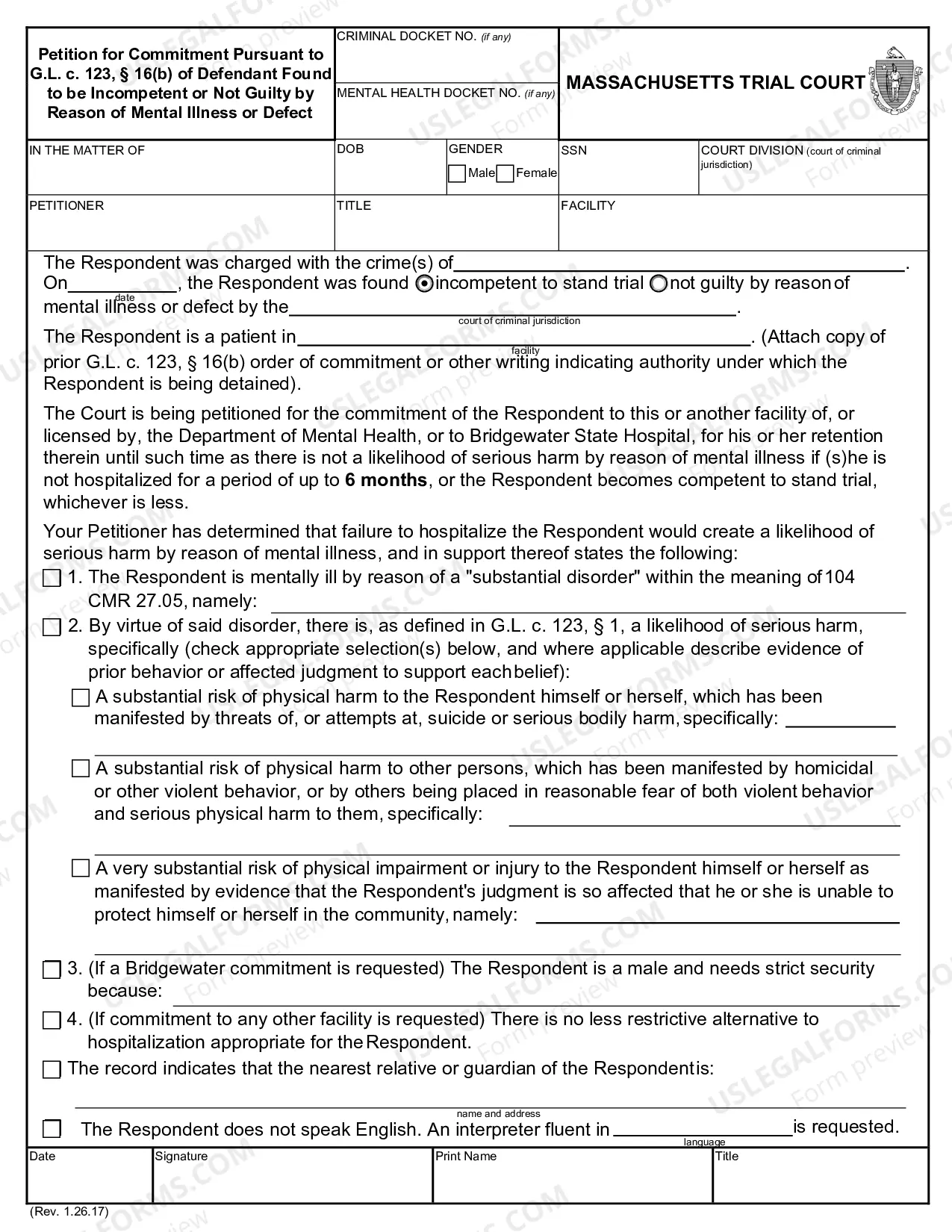

Form popularity
FAQ
About 50% of defendants generally testify in their own criminal trials, ing to Jeffrey Bellin, a William & Mary Law School professor and jury researcher.
If a victim or witness receives a subpoena for a deposition or trial, it is a court order requiring them to appear and testify. Those who defy court orders by refusing to testify may be held in contempt of court and face penalties such as steep fines and possible jail time.
Ingly, criminal defendants are generally advised not to testify in their own defense at trial. One of the great dangers of a defendant testifying in a criminal case is waiver of his right to remain silent which thus subjects him to cross-examination by the prosecution.
In a criminal case, a defendant has the right to testify at trial ? but they are not required to do so. The Fifth Amendment of the U.S. Constitution protects a defendant from self-incrimination ? this includes the right not to testify at trial or respond to any questions posed by the prosecution or the judge.
In a criminal case, a defendant has the right to testify at trial ? but they are not required to do so. The Fifth Amendment of the U.S. Constitution protects a defendant from self-incrimination ? this includes the right not to testify at trial or respond to any questions posed by the prosecution or the judge.
Many defendants choose not to testify because prosecutors have the burden of proof and to make sure that they don't incriminate themselves or open themselves up to cross-examination.
A defendant may waive the constitutional right to testify as long as the waiver is knowing and voluntary.
Ingly, criminal defendants are generally advised not to testify in their own defense at trial. One of the great dangers of a defendant testifying in a criminal case is waiver of his right to remain silent which thus subjects him to cross-examination by the prosecution.