Oregon Timber Deed
About this form
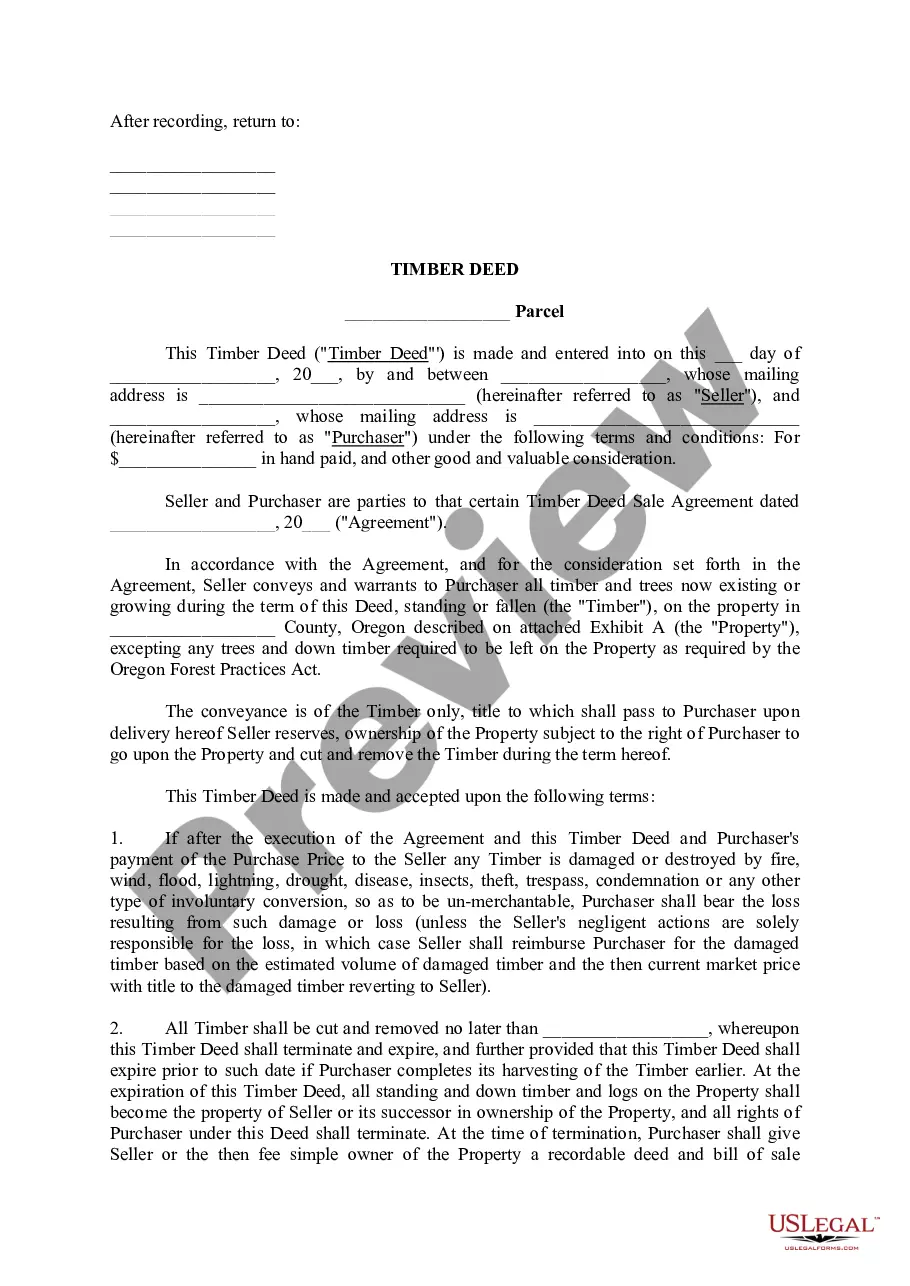
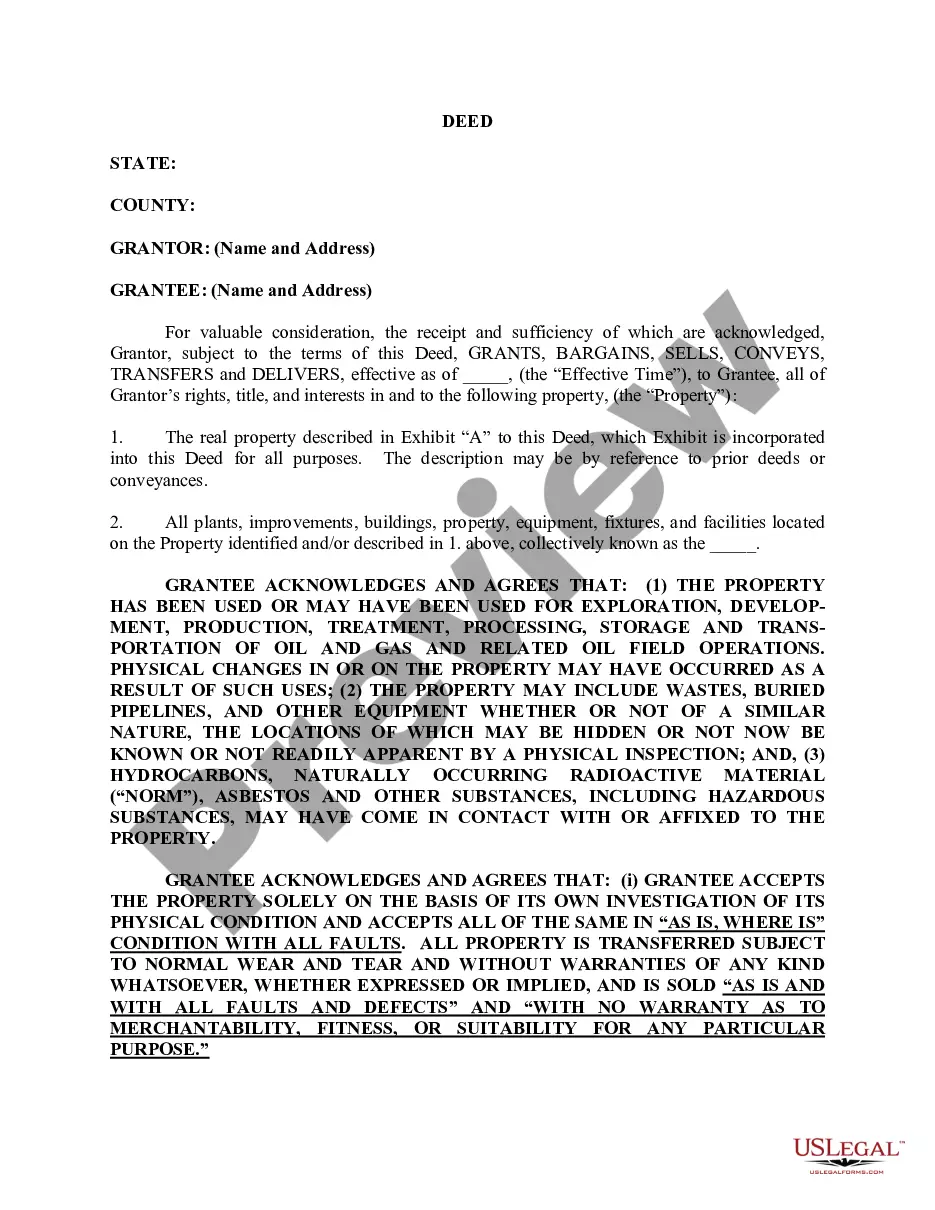
The Timber Deed is a legal document used to transfer ownership of timber from a seller to a buyer. This form is critical for anyone looking to sell timber or buy timber rights, as it establishes clear ownership and the terms under which the timber may be harvested. It differs from other property-related documents by focusing specifically on the sale and transfer of timber trees rather than real estate itself.
Key components of this form
- Identification of the seller and purchaser, including their addresses.
- Details of the property where the timber is located.
- Terms of sale, including the purchase price and considerations.
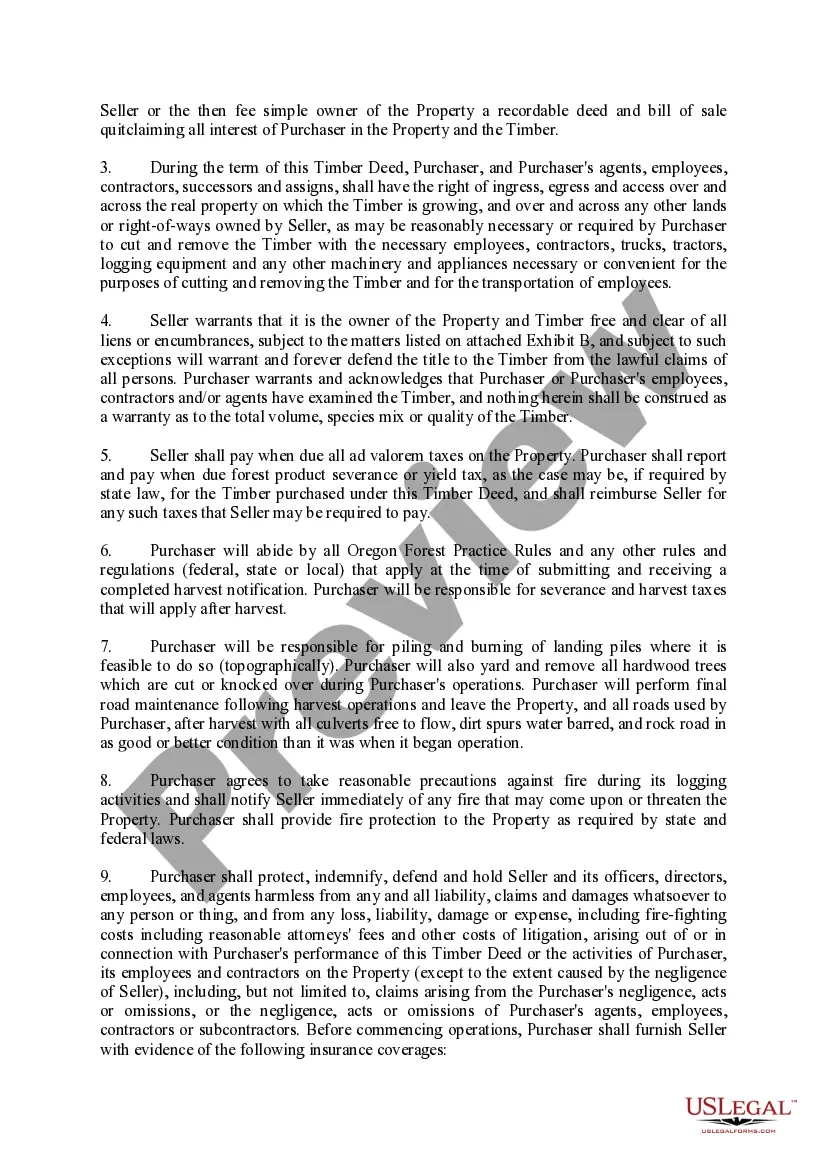
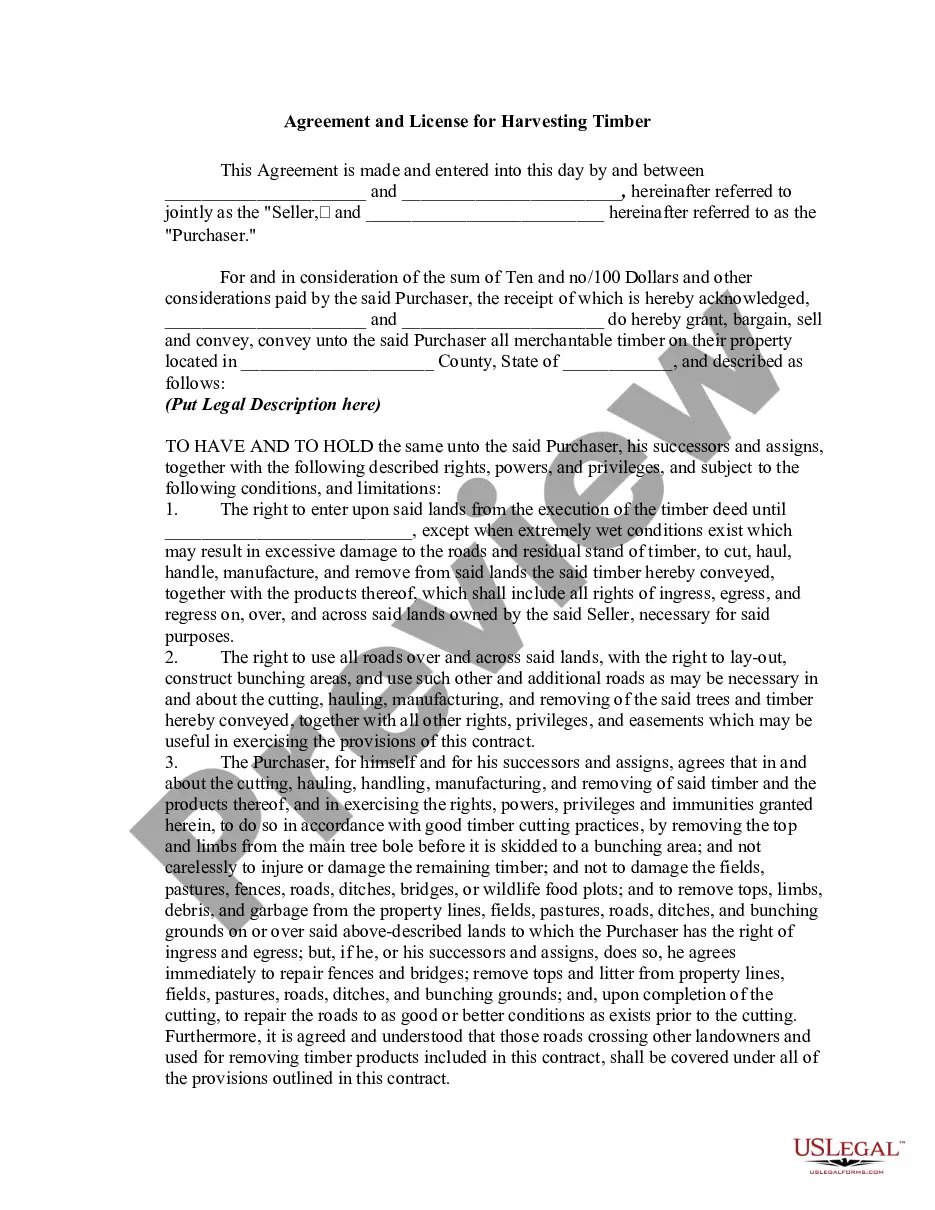
- Rights and responsibilities regarding harvesting the timber.
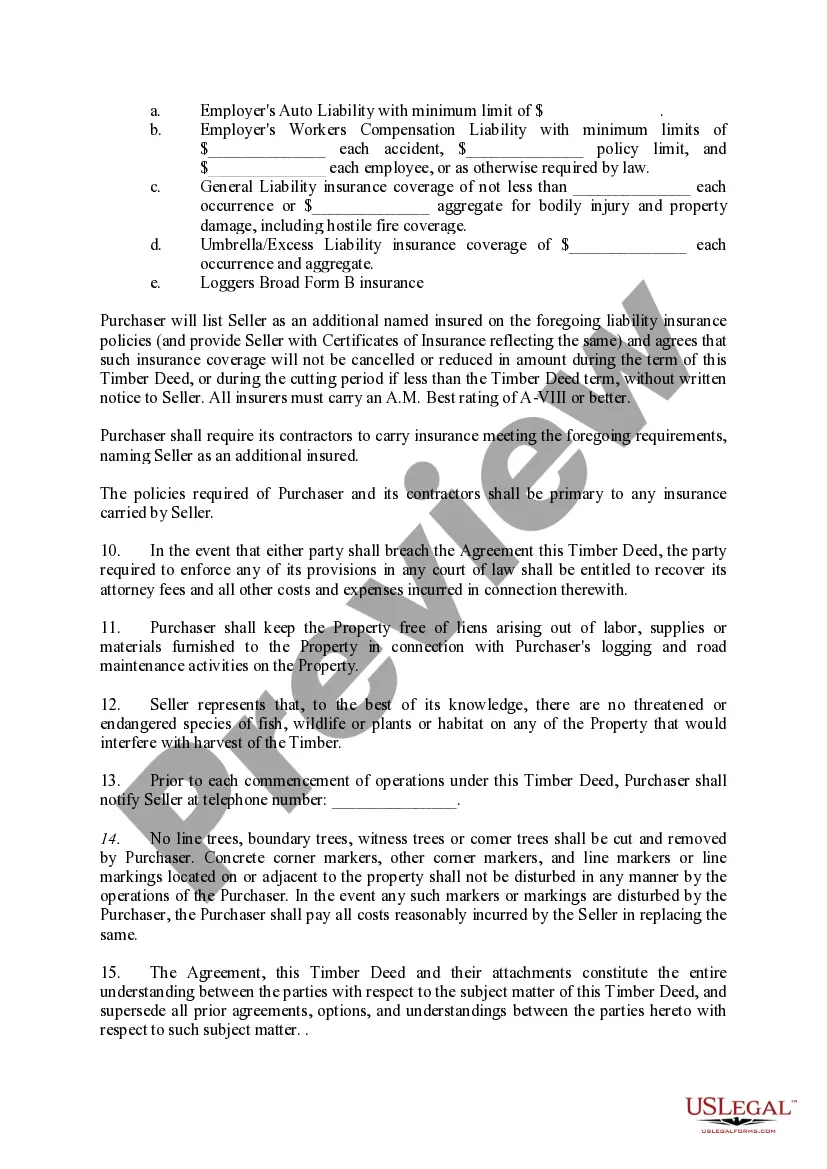
- Warranties and conditions from both parties regarding the ownership and condition of the timber.
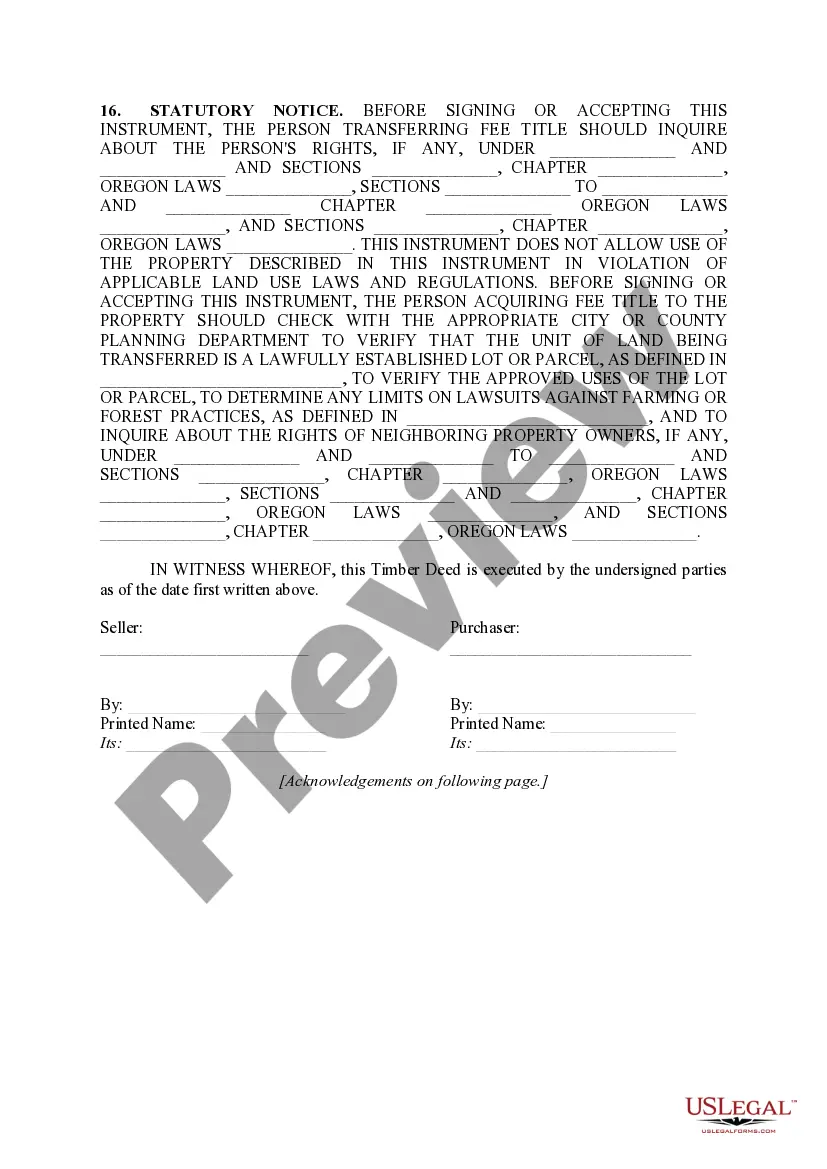
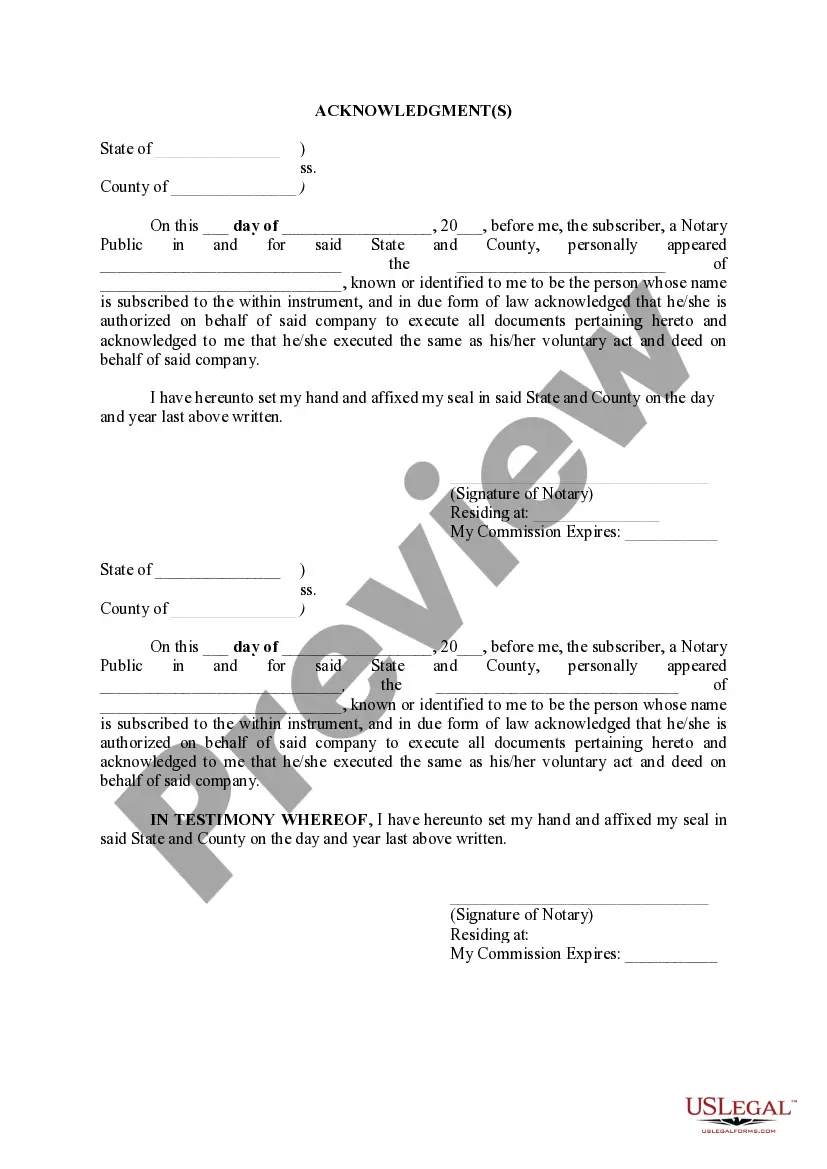
- Notarization requirements to validate the deed.
Situations where this form applies
This form is used when a landowner (seller) wishes to sell timber or harvesting rights to another party (purchaser). It is particularly useful in scenarios where a forest owner wants to capitalize on their timber resources while retaining ownership of the land. It is also used when buyers need to establish their legal rights for timber harvesting on specified properties.
Who needs this form
- Owners of timberland who wish to sell timber.
- Individuals or companies looking to purchase timber for logging and other uses.
- Real estate attorneys acting on behalf of clients involved in timber sale agreements.
- Loggers and forestry contractors needing to formalize their rights to harvest timber.
How to complete this form
- Identify the parties involved: enter the names and addresses of the seller and purchaser.
- Specify the property description where the timber is located, referencing any attached exhibits.
- Enter the sale price agreed upon by both parties.
- Outline the terms of timber access and harvest rights for the purchaser.
- Provide necessary signatures and dates for both parties, ensuring the form is notarized if required.
Notarization guidance
Yes, this form must be notarized to be legally valid. This ensures that the signatures on the Timber Deed are verified and that the agreement is authentic. US Legal Forms offers integrated online notarization services, making it easy to complete the notarization process securely and efficiently.
Get your form ready online
Our built-in tools help you complete, sign, share, and store your documents in one place.
Make edits, fill in missing information, and update formatting in US Legal Forms—just like you would in MS Word.
Download a copy, print it, send it by email, or mail it via USPS—whatever works best for your next step.
Sign and collect signatures with our SignNow integration. Send to multiple recipients, set reminders, and more. Go Premium to unlock E-Sign.
If this form requires notarization, complete it online through a secure video call—no need to meet a notary in person or wait for an appointment.
We protect your documents and personal data by following strict security and privacy standards.

Make edits, fill in missing information, and update formatting in US Legal Forms—just like you would in MS Word.

Download a copy, print it, send it by email, or mail it via USPS—whatever works best for your next step.

Sign and collect signatures with our SignNow integration. Send to multiple recipients, set reminders, and more. Go Premium to unlock E-Sign.

If this form requires notarization, complete it online through a secure video call—no need to meet a notary in person or wait for an appointment.

We protect your documents and personal data by following strict security and privacy standards.
Avoid these common issues
- Failing to clearly specify the property boundaries in the deed.
- Omitting necessary signatures or notary acknowledgment.
- Not adequately defining the terms of timber access and harvesting rights.
- Ignoring local laws and regulations concerning timber harvest practices.
Benefits of using this form online
- Quick access to professionally drafted Timber Deed templates.
- Ability to easily customize and modify the form to fit specific needs.
- Convenience of downloading and completing forms at your own pace.
- Secure storage options for preserving important legal documents.
Summary of main points
- The Timber Deed is essential for legally transferring timber ownership.
- It outlines specific conditions and rights for harvesting timber.
- Proper completion and notarization are crucial for legal validity.
- Understanding state laws, particularly for Oregon, is important when using this form.
Looking for another form?
Form popularity
FAQ
Salaries for loggers depend on the task in which they specialize. Fallers cut down trees using mobile felling machines and powered chainsaws. They earned a median $21.46 per hour or $44,650 per year as of May 2019, according to the Bureau of Labor Statistics.
The average stumpage price is $300/MBF, or $1,800 per acre total value.
Would-be lumberjacks should expect to pay $1,000 to $2,000 per acre, plus the value of the timber growing on it, which can add anything from zero to up to $15,000 an acre to the price for stands averaging 50 years of age.
The going price for property at timber value in Oregon is $2,000 to $4,000 an acre. If it's sold as a home site, it's worth $30,000 an acre.
A written timber sale agreement or contract is generally the preferable and safest method of selling timber. A written contract is a legally binding document that protects both the buyer and the seller (the landowner) from misunderstandings that may develop in the absence of such an agreement.
Hire a Reputable Forestry Professional. Develop a Forest Management Plan. Plan the Pre-Harvest. Determine a Selling Method. Have a Contract. Conduct the Sale and Harvest. Monitor the Harvest. Closeout with Buyer/Logger.
To estimate the value of your timber, take the volume, divided by 1,000, and multiply it by the price quoted in your states standing timber stumpage report.
A timber deed is one method of selling timber. Where a timber deed is used, the title to the timber passes to the buyer when a properly executed deed is delivered and recorded. Under a timber deed: Seller conveys all liability and risk in timber to buyer upon deed execution and payment.
The term "timber sale" is used to refer to any significant harvest of wood products involving an exchange of monies. Timber sales may involve sales of trees used to make lumber (sawtimber), fuelwood, whole tree chips, pulp, or any combination of these products.