Maryland Contract for Deed Package
About this form package
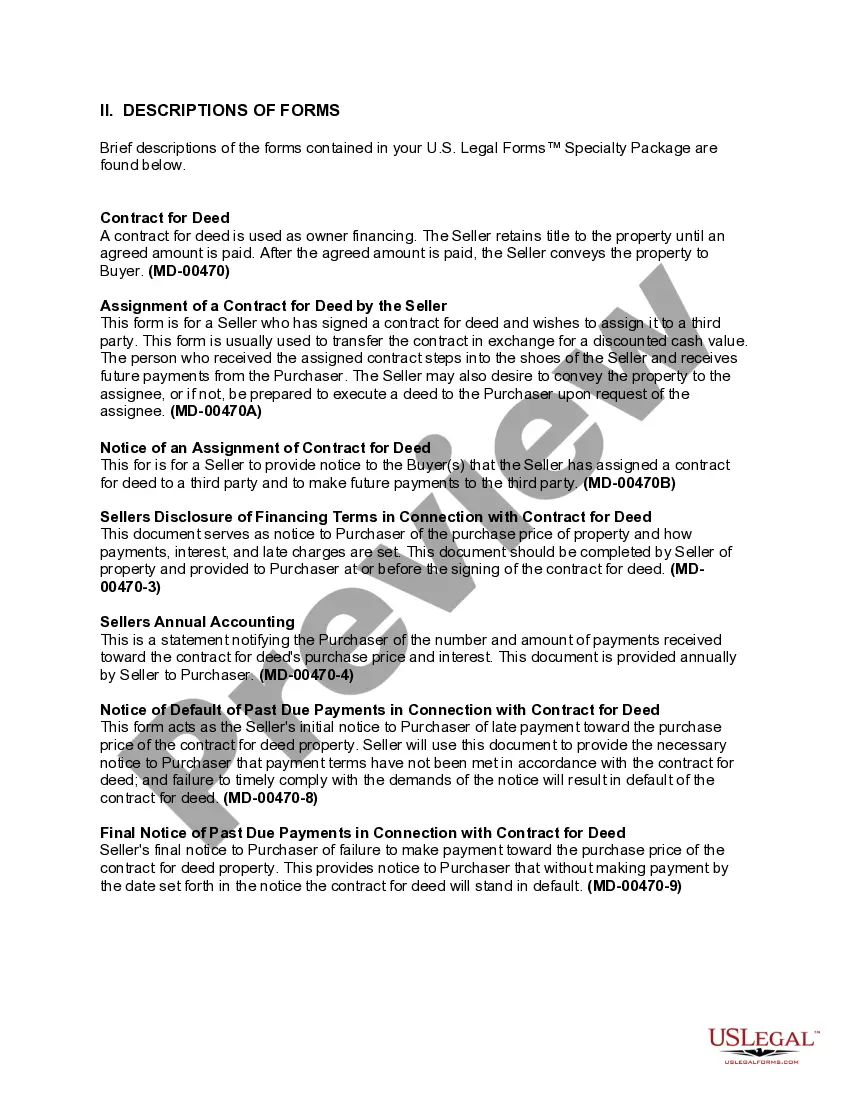
The Maryland Contract for Deed Package includes essential legal documents for owner financing in real estate transactions. This package simplifies the process by offering state-specific forms that facilitate the use of a Contract for Deed, setting it apart from generic options. Whether you are a seller or a buyer, this comprehensive package ensures that all necessary legal documentation is readily available and tailored for Maryland laws.
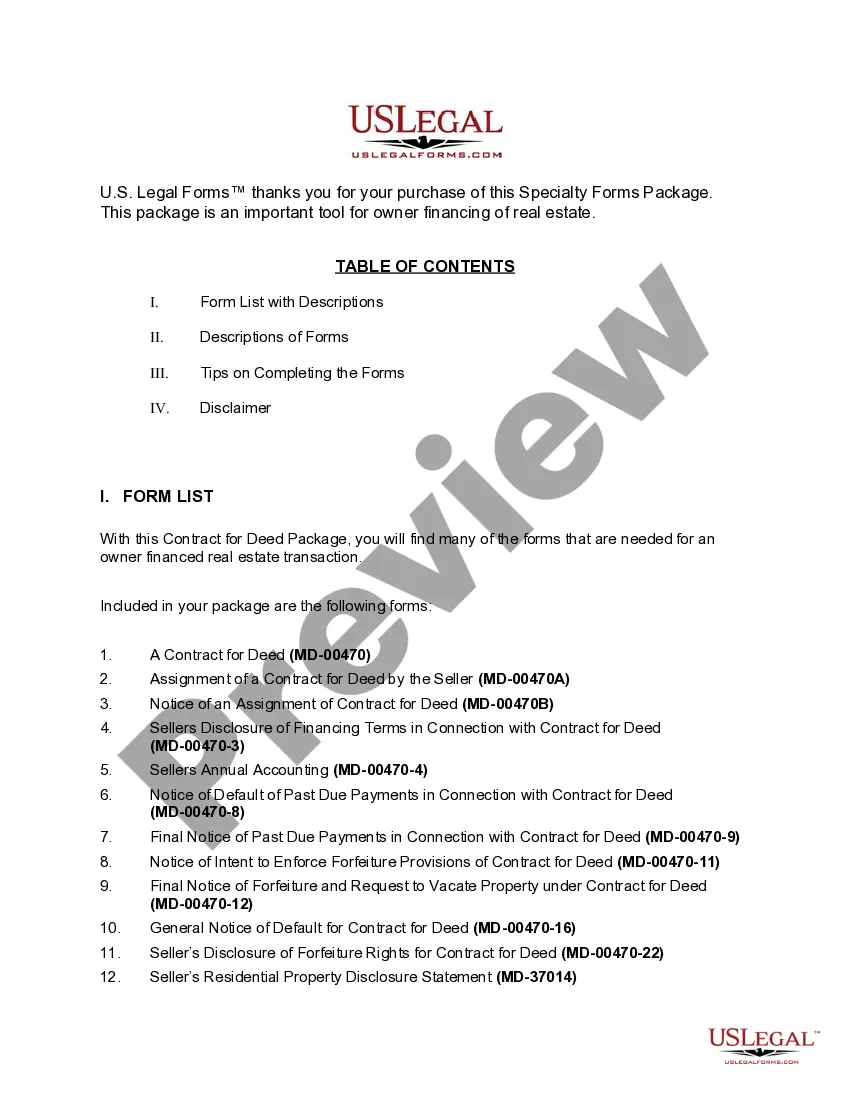
Forms included in this package
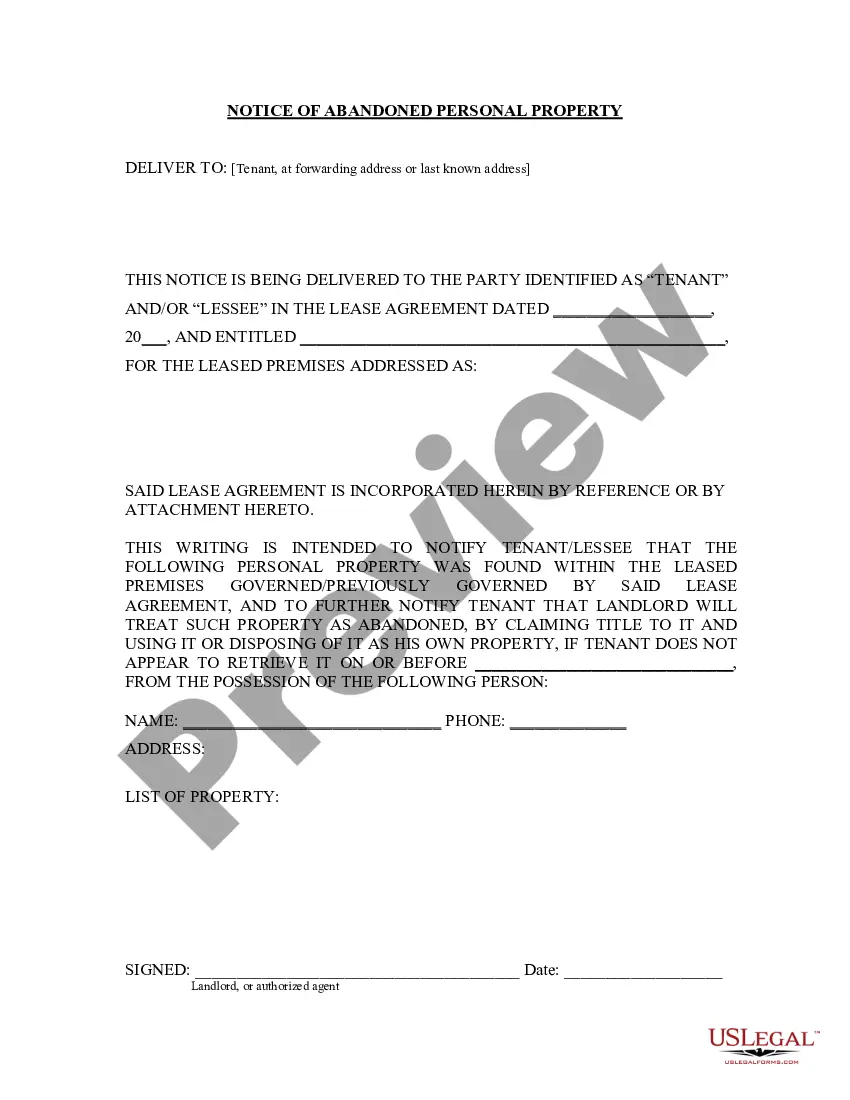
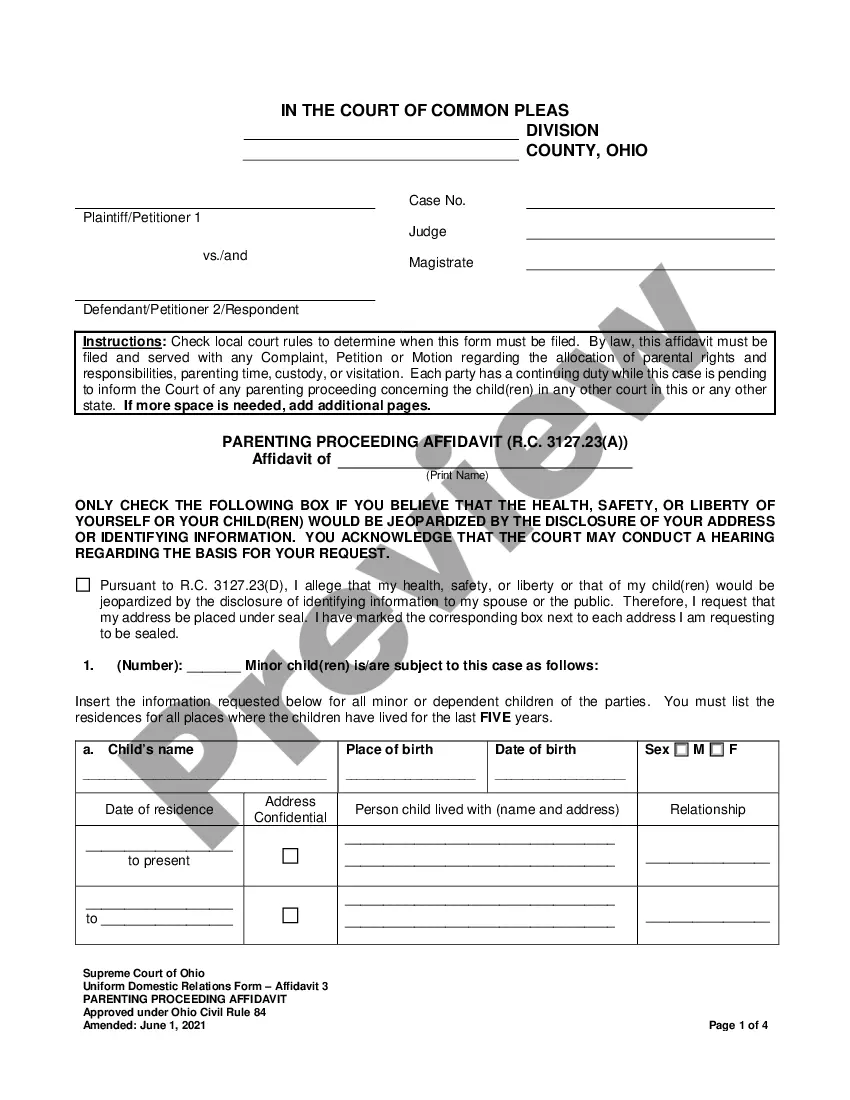
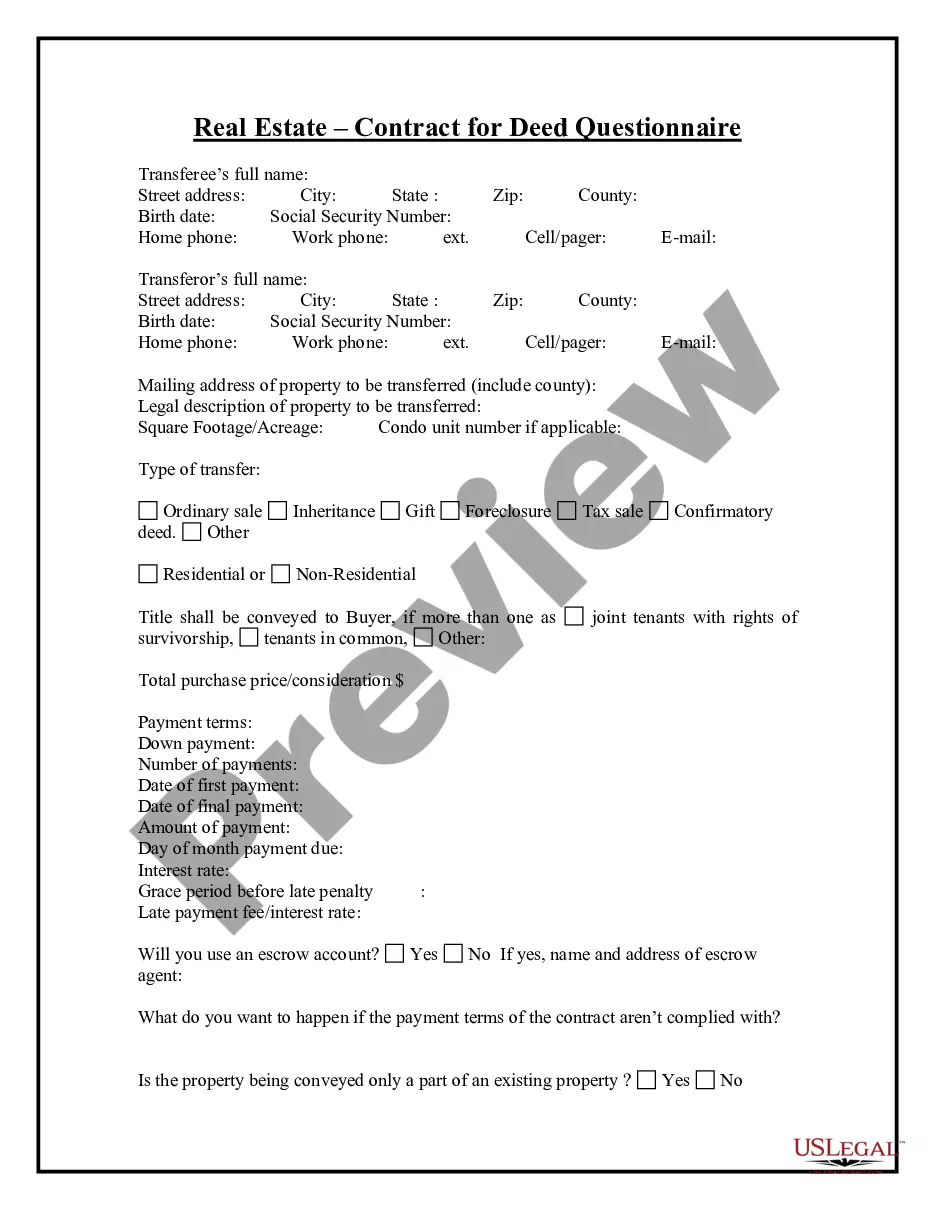
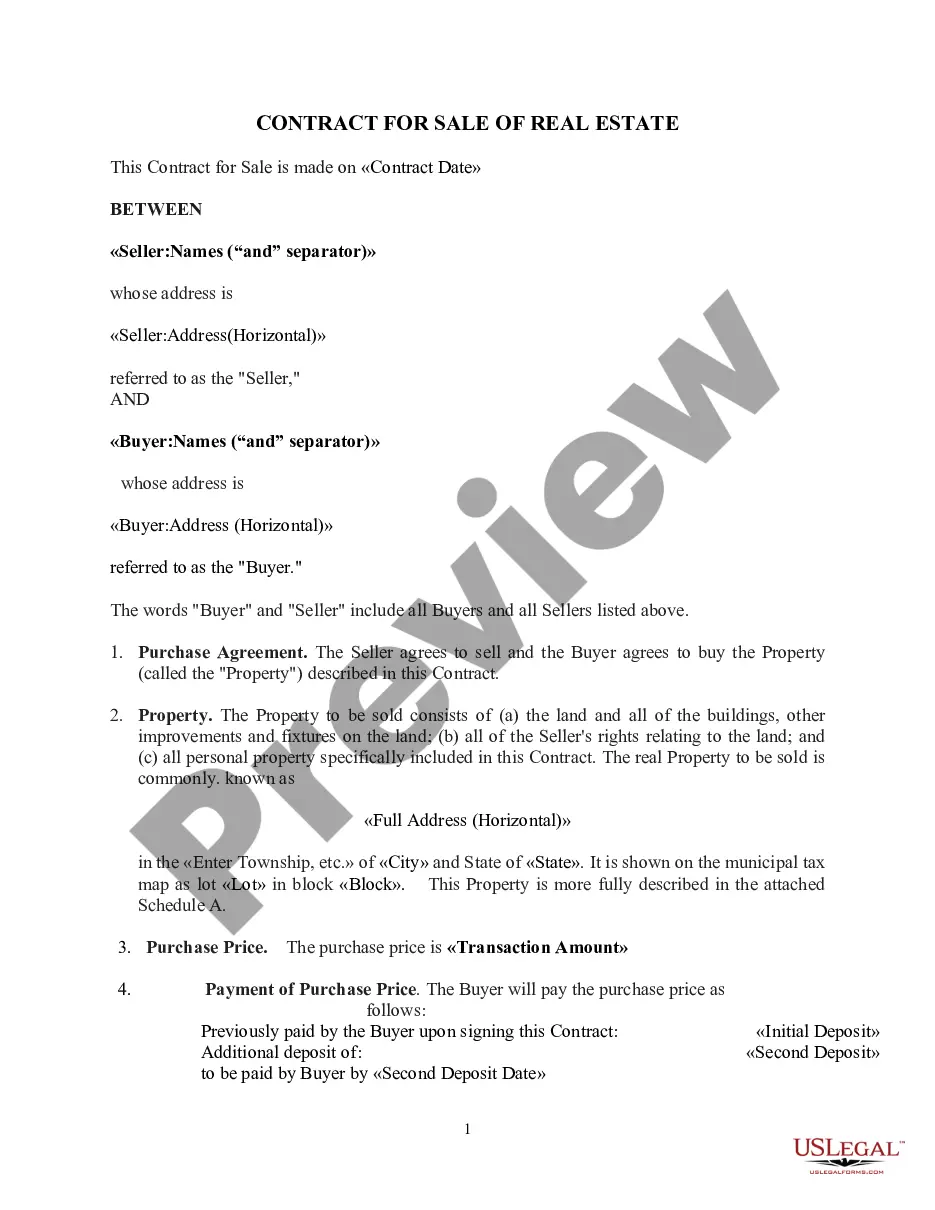
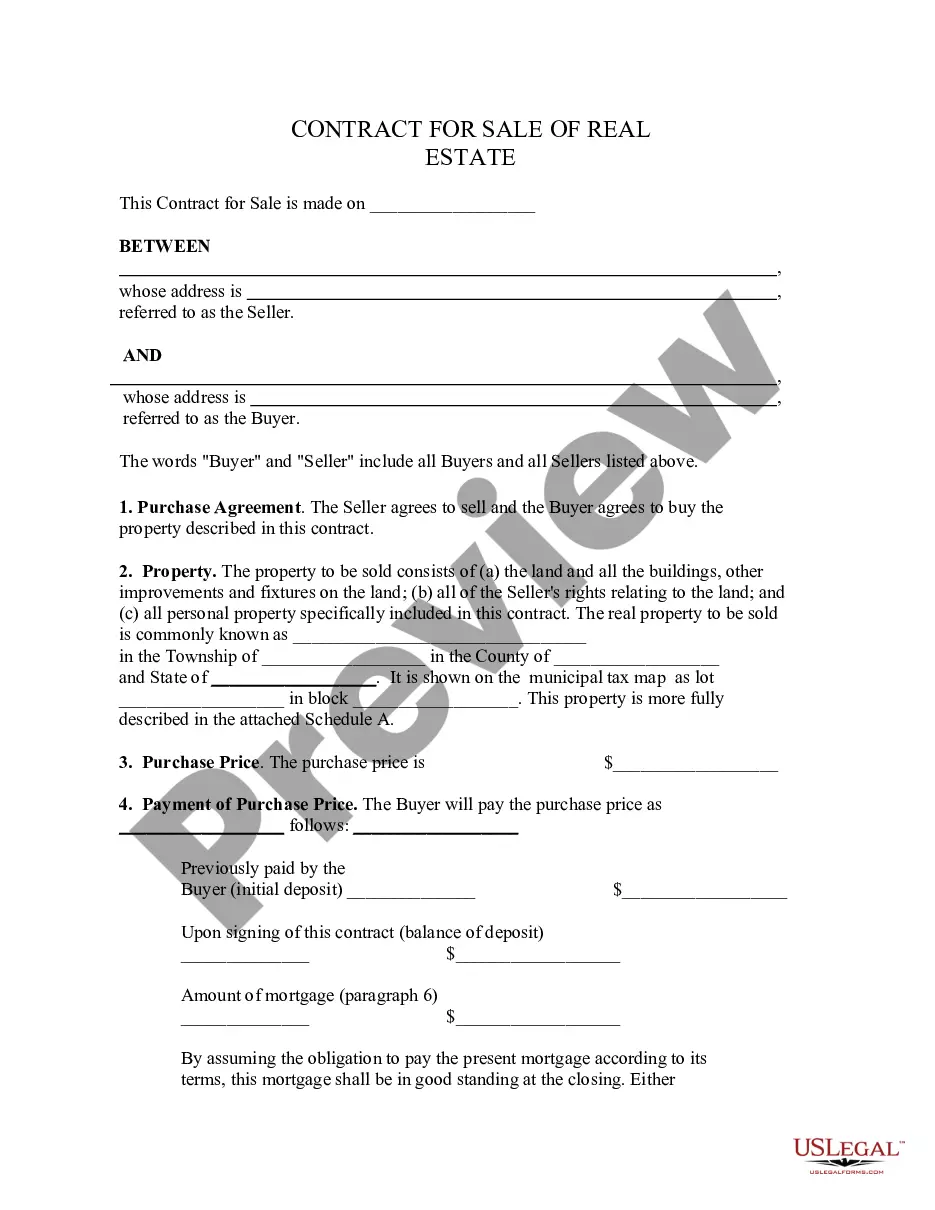
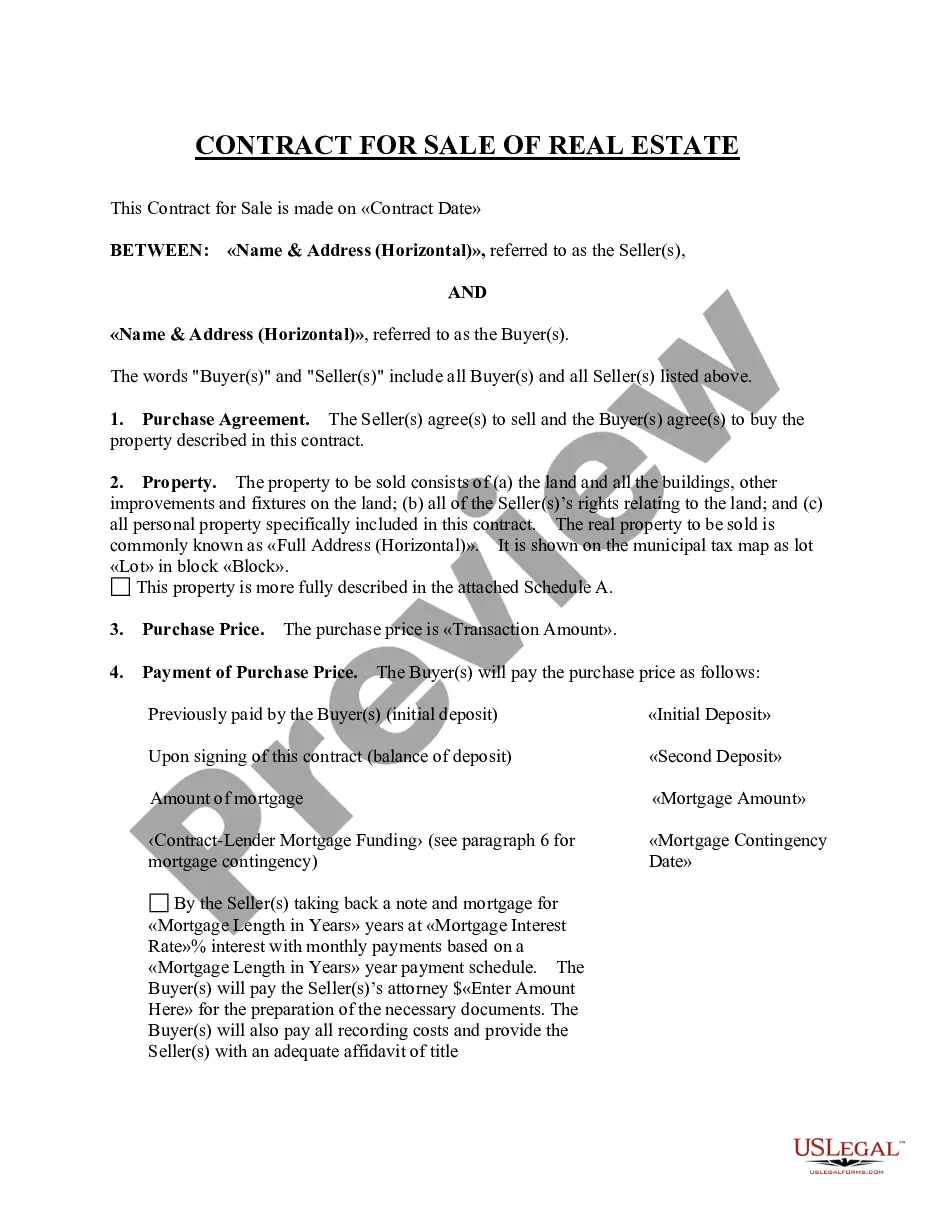
- Agreement or Contract for Deed for Sale and Purchase of Real Estate a/k/a Land or Executory Contract
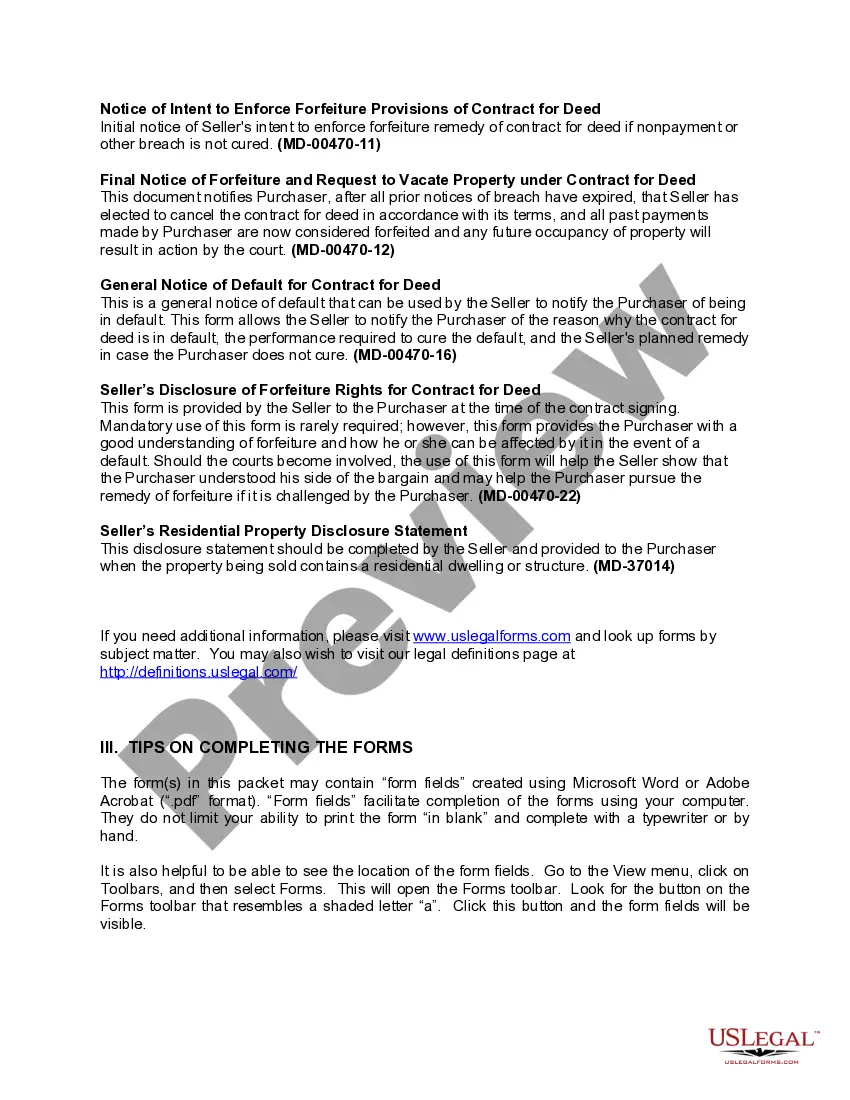
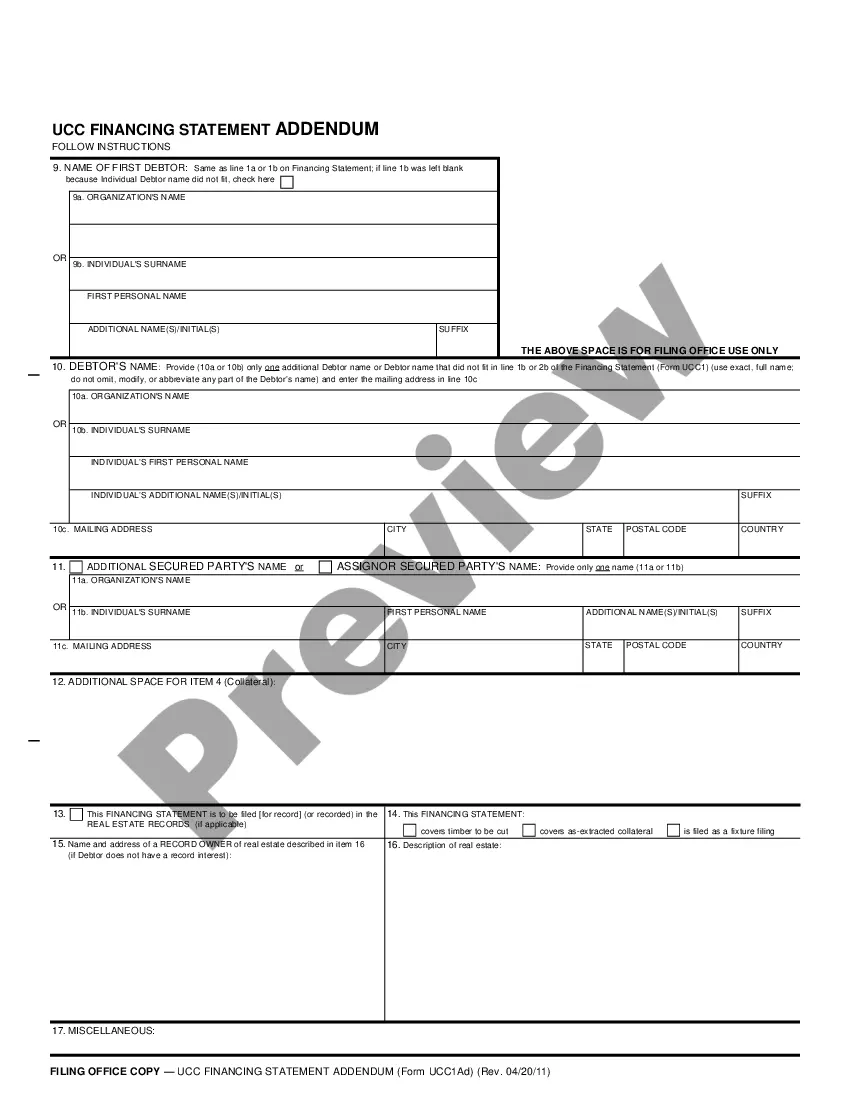
- Notice of Intent to Enforce Forfeiture Provisions of Contact for Deed
- Final Notice of Forfeiture and Request to Vacate Property under Contract for Deed
- General Notice of Default for Contract for Deed
- Seller's Disclosure of Forfeiture Rights for Contract for Deed
- Seller's Disclosure of Financing Terms for Residential Property in connection with Contract or Agreement for Deed a/k/a Land Contract
- Contract for Deed Seller's Annual Accounting Statement
- Notice of Default for Past Due Payments in connection with Contract for Deed
- Final Notice of Default for Past Due Payments in connection with Contract for Deed
- Assignment of Contract for Deed by Seller
- Notice of Assignment of Contract for Deed
When to use this form package
You should use the Maryland Contract for Deed Package in scenarios where:
- You are selling a property and wish to provide owner financing.
- A buyer is unable to secure traditional financing and you want to create a flexible agreement.
- You seek to establish clear terms and obligations related to the sale and financing of real estate.
- You need to communicate important details regarding payment schedules, interest rates, and potential defaults.
Who can use this document
- Real estate sellers who want to offer financing options to buyers.
- Buyers looking to purchase property through owner financing.
- Investors involved in owner-financed transactions.
- Individuals seeking legal agreements that comply with Maryland state laws.
How to prepare this document
- Review all included forms carefully to understand their purpose and requirements.
- Identify the parties involved in the transaction and enter their details.
- Complete the Contract for Deed with information about the property, payment terms, and other necessary details.
- Ensure that all forms requiring signatures are signed by the appropriate parties.
- Maintain copies of all completed forms for your records.
Do forms in this package need to be notarized?
Forms in this package typically do not require notarization unless required by local law. However, depending on the specific circumstances of your transaction, you may want to consider notarization to enhance the document's legal weight.
Get your form ready online
Our built-in tools help you complete, sign, share, and store your documents in one place.
Make edits, fill in missing information, and update formatting in US Legal Forms—just like you would in MS Word.
Download a copy, print it, send it by email, or mail it via USPS—whatever works best for your next step.
Sign and collect signatures with our SignNow integration. Send to multiple recipients, set reminders, and more. Go Premium to unlock E-Sign.
If this form requires notarization, complete it online through a secure video call—no need to meet a notary in person or wait for an appointment.
We protect your documents and personal data by following strict security and privacy standards.

Make edits, fill in missing information, and update formatting in US Legal Forms—just like you would in MS Word.

Download a copy, print it, send it by email, or mail it via USPS—whatever works best for your next step.

Sign and collect signatures with our SignNow integration. Send to multiple recipients, set reminders, and more. Go Premium to unlock E-Sign.

If this form requires notarization, complete it online through a secure video call—no need to meet a notary in person or wait for an appointment.

We protect your documents and personal data by following strict security and privacy standards.
Avoid these common issues
- Failing to clearly outline payment terms, leading to confusion later.
- Not notifying buyers of contract assignments properly.
- Neglecting to provide required disclosures about financing terms.
- Overlooking the need for signatures on all necessary documents.
Why use this package online
- Convenience of accessing and downloading forms at any time.
- Editability of forms to easily personalize agreements.
- Reliability of having attorney-drafted documents that meet legal standards.
- Cost-effective solution, saving up to 70% compared to purchasing forms individually.
Legal use & context
- Contracts for Deed are legally enforceable documents if all parties agree to the terms.
- Users should be aware of local laws that may impact the execution and enforceability of these forms.
- Understanding terms such as âforfeitureâ and âdefaultâ is essential to mitigate potential disputes.
Main things to remember
- The Maryland Contract for Deed Package facilitates owner-financed real estate transactions while ensuring compliance with state regulations.
- It includes multiple essential documents that protect both buyer and seller interests.
- Taking the time to review and accurately complete these forms is crucial for a smooth transaction.
Looking for another form?

Form popularity
FAQ
A deed is a written instrument which is executed with the necessary formality and by which an interest, right or property passes or is confirmed, or an obligation binding on some person is created or confirmed.
A deed is a document containing the terms of an agreement, especially an agreement concerning the ownership of land or a building. law He asked if I had the deeds to his father's property. Synonyms: document, title, contract, title deed More Synonyms of deed. Quick word challenge.
1 : something that is done : act a brave deed. 2 : a legal document by which a person transfers land or buildings to another. deed. verb.
The general warranty deed is the standard instrument for home sales. Your notarized warranty deed is proof of ownership, and that the grantor transferred complete and clear title to you. A quitclaim deed also proves full land ownershipif the person who conveyed the interest to you had full ownership.
A deed is an official written document declaring a person's legal ownership of a property, while a title refers to the concept of ownership rights.
The Difference Between A Title And A Deed A deed is an official written document declaring a person's legal ownership of a property, while a title refers to the concept of ownership rights.A deed, on the other hand, can (and must!) be in your physical possession after you purchase property.
Title deeds are documents which prove ownership of land or property.This means a record of your ownership is not held centrally at Land Registry. Your deeds may be held by a solicitor, a mortgage lender or by you, at home, or perhaps lodged at your bank.
When you own a home, you own both the deed and title for that property. In real estate, title means you have ownership and a right to use the property.The deed is the physical legal document that transfers ownership. It shows who you bought your house from, and when you sell it, it shows who you sold it to.
The purpose of a deed is to transfer a title, a legal document proving ownership of a property or asset, to another person. For the document to be binding in a court of law, it must be filed in the public record by a local government official tasked with maintaining documents.