Court Cases With The 3rd Amendment
Description
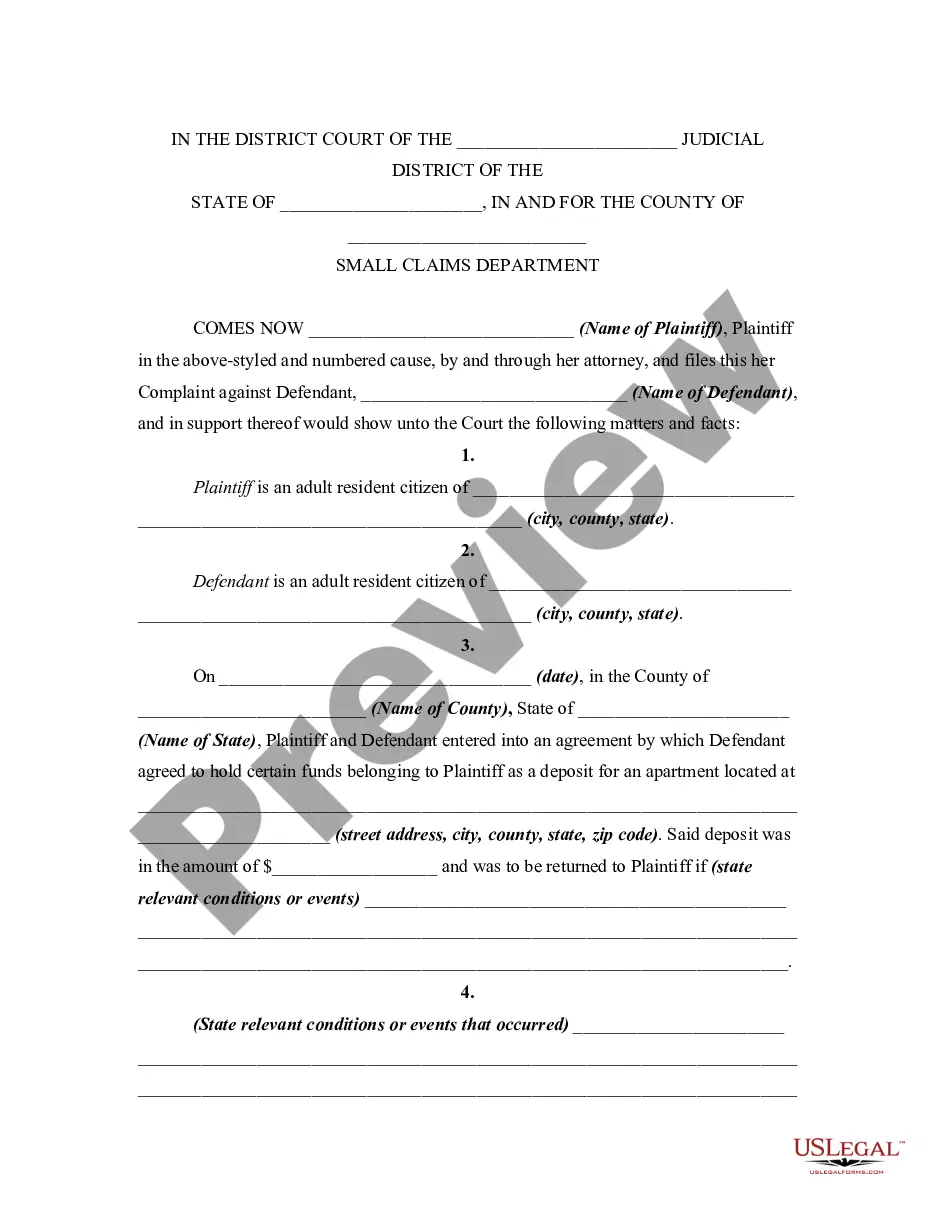

How to fill out Complaint In Small Claims Court For Failure Or Refusal To Return Money Deposited For Apartment?
It’s widely recognized that you cannot transform into a legal authority overnight, nor can you swiftly learn to draft Court Cases With The 3rd Amendment without possessing specific expertise.
Drafting legal documents is an arduous task that necessitates specialized knowledge and abilities. Therefore, why not entrust the crafting of the Court Cases With The 3rd Amendment to the professionals.
With US Legal Forms, which boasts one of the most comprehensive libraries of legal documents, you can find everything from court papers to templates for internal corporate communication. We understand the significance of compliance with federal and state regulations. That’s why our website ensures all forms are specific to your location and continuously updated.
You can regain access to your documents from the My documents section whenever necessary. If you’re a current client, you can simply Log In to find and download the template from the same section.
Regardless of the intention behind your forms—be it financial, legal, or personal—our website caters to all your needs. Experience US Legal Forms today!
- Begin by locating the document you require with the search function positioned at the top of the page.
- Preview the document (if this feature is available) and review the accompanying description to decide if Court Cases With The 3rd Amendment fits your needs.
- If you require a different template, restart your search.
- Create a free account and choose a subscription plan to purchase the template.
- Click Buy now. After completing the transaction, you can retrieve the Court Cases With The 3rd Amendment, fill it out, print it, and send it by mail to the appropriate individuals or organizations.
Form popularity
FAQ
Yes, the 3rd Amendment remains relevant as it symbolizes the right to privacy and personal space. While it may not often arise in court cases, its principles echo through ongoing legal discussions around state powers and individual rights. Understanding this amendment enhances our awareness of how history shapes current legal landscapes.
The 3rd Amendment prohibits the quartering of soldiers in private homes without the owner's consent, particularly during peacetime. This measure was designed to prevent governmental intrusion into personal lives and properties. It underscores the importance of personal autonomy, which remains relevant in discussions of citizens' rights today, including those related to court cases with the 3rd Amendment.
The 3rd Amendment serves as a crucial reminder of the right to personal privacy and the protection from unwanted military intrusion. In an era where privacy concerns are paramount, understanding this amendment becomes essential. Even if not frequently cited in court cases, it influences discussions on individual rights and government overreach.
The Third Amendment is seldom invoked directly in court cases, as its specific application is rare. However, it informs debates about the limits of government and military powers. Courts may reference it when evaluating related privacy and property rights cases, highlighting its waiting influence on broader constitutional interpretations.
The 3rd Amendment has rarely been at the center of court cases, but its principles became relevant during discussions about military actions in private homes. The last significant case was in the 1980s, still highlighting the amendment's protective role over personal space. While its direct courtroom relevance is low, its themes resonate with broader privacy rights seen in recent rulings.
The 3rd Amendment specifically prohibits the quartering of soldiers in private homes without consent during peacetime. This amendment arose from colonial experiences where British soldiers were forced upon citizens, leading to significant resentment. While there are few direct examples in modern law, cases like Engblom illustrate the amendment's continued significance. Understanding court cases with the 3rd amendment helps individuals appreciate their rights in today’s society.
One prominent court case that involved the 3rd Amendment is 'Engblom v. Carey'. In this case, correction officers challenged the housing of National Guard soldiers in their residence without consent. The court ruled in favor of the officers, affirming the importance of the 3rd Amendment in preventing unwanted quartering of troops. This decision highlights the ongoing relevance of court cases with the 3rd amendment in protecting individual rights.
The Third Amendment can be summarized as stating that no soldier can be placed in a person's home during peacetime without the homeowner's permission. This amendment ensures personal space and the sanctity of one's home from unwarranted government interference. When writing it in your own words, focus on the themes of consent and privacy, which are critical in court cases with the 3rd amendment. By understanding its essence, you can appreciate the importance of individual rights.
The Third Amendment is often invoked in court cases that address the right to privacy and property during peacetime. It prohibits the government from forcing citizens to house soldiers without their consent. While not frequently litigated, its principles appear in broader discussions of individual rights and government overreach in court cases with the 3rd amendment. Understanding its implications can help you navigate related legal scenarios.
While the 3rd Amendment has not been the focus of many high-profile court cases, its principles have surfaced in discussions surrounding privacy and government overreach. Some legal scholars argue that it can influence modern interpretations of personal freedom. Researching court cases with the 3rd amendment can provide you with insights into how this amendment retains its relevance today.